
芯片研发

Search documents
联想创投旗下基金等入股杭州一芯片研发公司
Xin Lang Cai Jing· 2025-09-17 09:42
Group 1 - The core point of the article is that West Lake Yanshan Technology (Hangzhou) Co., Ltd. has undergone a business change, with new shareholders including Lenovo Capital's Anhui Lenovo Strong Chain Supplement Chain Venture Capital Fund, Shenzhen Innovation Capital Investment Co., Ltd., and Ivy League (Zhejiang) Venture Capital Fund [1] - The registered capital of the company has increased from 5 million RMB to approximately 5.64 million RMB [1] - Several key personnel changes have also occurred within the company [1]
“80后牛散”与“85后芯片新贵”结盟,11连板“妖股”天普股份换老板
3 6 Ke· 2025-09-16 23:48
Core Viewpoint - Tianpu Co., Ltd. (605255.SH) has experienced significant stock price increases following the announcement of a control transfer to Yang Gongyi Fan, a rising star in the chip industry, leading to regulatory scrutiny and investor concerns about potential insider trading [1][3][4]. Group 1: Control Transfer and Company Background - The original controlling shareholder, You Jianyi, is stepping down due to age and lack of successors, prompting the need for new leadership to drive the company's transformation [4]. - Tianpu Co., Ltd. specializes in the research, production, and sales of polymer materials for automotive fluid systems and sealing systems, serving major clients like Nissan, Mazda, and Ford [3][4]. - The company reported a revenue of approximately 151 million yuan in the first half of the year, a decrease of 3.44% year-on-year, with a net profit of about 11.3 million yuan, down 16.08% [3]. Group 2: Regulatory Scrutiny and Market Reactions - Following the announcement of the control transfer, Tianpu received two regulatory letters from the Shanghai Stock Exchange regarding the source of funds and insider information management [3][8]. - The stock price surged by 37% in the month leading up to the suspension, raising suspicions of insider information leaks, which the company later denied [1][3]. Group 3: Transaction Structure and Financial Details - The control transfer involves a complex three-step process: share transfer, capital increase for controlling stake, and a mandatory tender offer at 23.98 yuan per share [8][9]. - The total funding required for the acquisition is 9.65 billion yuan, sourced entirely from the acquirer's own funds, with no debt or hidden arrangements involved [6][8]. - As of August 31, 2025, the acquirer, Zhonghao Xinying, reported total assets of 1.82 billion yuan and total liabilities of 445 million yuan [19]. Group 4: Future Prospects and Performance Commitments - Zhonghao Xinying has committed to achieving positive net profits from 2025 to 2027, despite facing significant pressure to turn around its financial performance after reporting a net loss of 144 million yuan in the first half of the year [21]. - The company has shown rapid revenue growth, with a compound annual growth rate of 170.55% from 2022 to 2024, indicating strong potential for future performance [21].



广东经营主体突破2000万,每6个人就有一个老板!
Sou Hu Cai Jing· 2025-09-12 11:46
Core Insights - The number of registered business entities in Guangdong Province has surpassed 20 million, marking a net increase of 953,100 entities, or 5%, compared to the end of 2024, maintaining its position as the highest in the country [1][5] - The entrepreneurial environment in Guangdong is thriving, with a significant increase in the number of companies compared to individual businesses, indicating a shift towards larger-scale operations [2][5] Business Composition - Among the 20 million registered entities, there are 9 million enterprises and 11 million individual businesses, with the proportion of enterprises increasing, reflecting a trend towards more organized business structures [2] - The private economy is a major driver of Guangdong's economy, with 19.25 million private economic organizations, representing 96.45% of total business entities, and a year-on-year growth of 6.47% [2][5] - Private enterprises have reached 8.35 million, showing a year-on-year increase of 10.6%, while individual businesses have grown by 3.52% to 10.91 million [2] New Economic Trends - Approximately 37.92% of newly established companies in Guangdong are engaged in "new quality productivity," with 414,600 new "four new economy" enterprises [3][4] - The digital economy sector has seen a significant year-on-year growth of 25.41%, with 167,600 new digital economy enterprises established [3][4] Investment Climate - Foreign investment confidence in Guangdong is increasing, with 230,000 registered foreign-invested enterprises, a net increase of 15,000, or 6.97%, since the end of 2024 [4] - The Guangdong-Hong Kong-Macao Greater Bay Area has become a preferred destination for foreign investment, with 18,500 new foreign-invested enterprises established in the nine cities of the Greater Bay Area, accounting for 97.73% of the total new foreign enterprises in the province [4] Economic Vitality - Guangdong's business entity growth from 19.04 million to 20 million in just nine months highlights the province's remarkable entrepreneurial density, with one business for every six residents [5] - The scale of registered enterprises in Guangdong is significantly higher than that of leading U.S. states, showcasing its robust market vitality [5][6] - The growth of 20 million business entities reflects Guangdong's strong economic foundation, successful transformation and upgrading, and favorable business environment [6]
中国芯力量|藏粮于技的“芯”应用
Xin Hua She· 2025-09-12 09:42
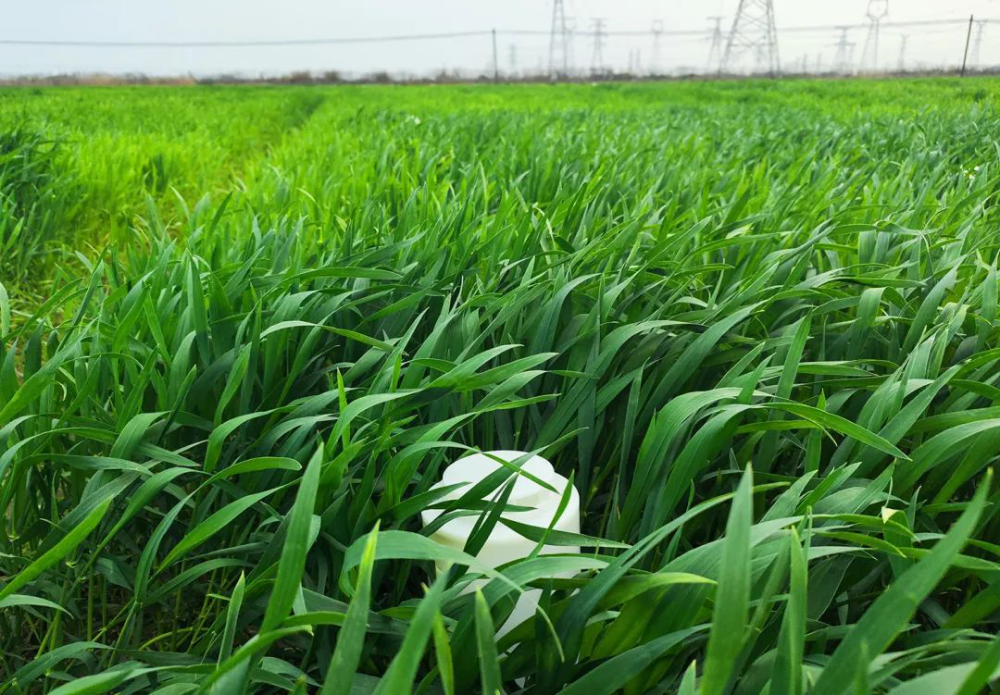
Core Insights - The article emphasizes the importance of food security and agricultural productivity, highlighting the transition from traditional farming to technology-driven precision agriculture [1] Group 1: Soil Management - Soil quality is crucial for crop growth, with 95% of global food coming from soil, which provides 15 out of 18 essential nutrients for plants [2] - The new microfluidic chip developed by the Chinese Academy of Sciences allows for rapid and accurate soil nutrient detection, significantly reducing the time and cost of traditional soil testing methods [2][3] - This technology enables farmers to make informed decisions on fertilization, improving crop yield and reducing waste [3] Group 2: Crop Protection - Smart agricultural management is becoming a trend, utilizing technology to monitor and manage crop health [4] - A new device developed by Jiangsu University can detect fungal spores that cause crop diseases, achieving an 85% identification rate and allowing for precise pesticide application [4] Group 3: Digital Agriculture - The Pingyuan Urban-Rural Integration Demonstration Zone in Xinxiang, Henan Province, employs spatial geographic information technology for comprehensive monitoring of various agricultural conditions [5] - The "Smart Combined Pole" integrates multiple sensors to provide real-time data on soil, weather, and pest conditions, enabling farmers to manage large areas efficiently through mobile applications [6] Group 4: Grain Storage - Grain storage is essential for food security, with new technologies reducing losses and ensuring safe storage [7] - The development of autonomous robots and AI-driven monitoring systems enhances the efficiency of grain storage operations, allowing for real-time adjustments to environmental conditions [7][8] - Integrated pest management systems are being developed to monitor and control grain pests, significantly reducing labor and improving storage safety [7]
中国芯力量丨藏粮于技的“芯”应用
Xin Hua She· 2025-09-11 08:18
Group 1: Agricultural Technology Advancements - The pursuit of food production and security has evolved from primitive farming to modern smart agriculture, emphasizing the transformation of traditional agriculture into precision and efficiency through technology [1] - The development of a new microfluidic chip by the Hefei Institute of Physical Science enables rapid and accurate soil nutrient detection, significantly improving agricultural production strategies [2][3] - The integration of smart information technology in agricultural management is becoming a trend, enhancing the precision of crop care and disease prevention [4] Group 2: Disease Prevention and Monitoring - A new device developed by Jiangsu University utilizes a chip to capture fungal spores, allowing for early detection of crop diseases and precise pesticide application, achieving an 85% identification rate for rice diseases [4][6] - The "Smart Pole" system in Henan Province collects various agricultural data, enabling farmers to manage large areas of farmland efficiently through a mobile app [6] Group 3: Grain Storage Innovations - The development of a flat storage robot by Zhongke Xinhai enhances grain storage efficiency by creating 3D maps of grain piles and ensuring proper storage conditions [7] - Intelligent grain storage technologies, including real-time monitoring and automated climate control, are crucial for maintaining grain quality and preventing spoilage [7][8] - The integration of AI and IoT in grain storage allows for targeted pest control and early warning systems, significantly reducing manual labor and improving storage safety [7][8]
11连板大牛股,突遭再次停牌核查
Zheng Quan Shi Bao· 2025-09-10 12:04
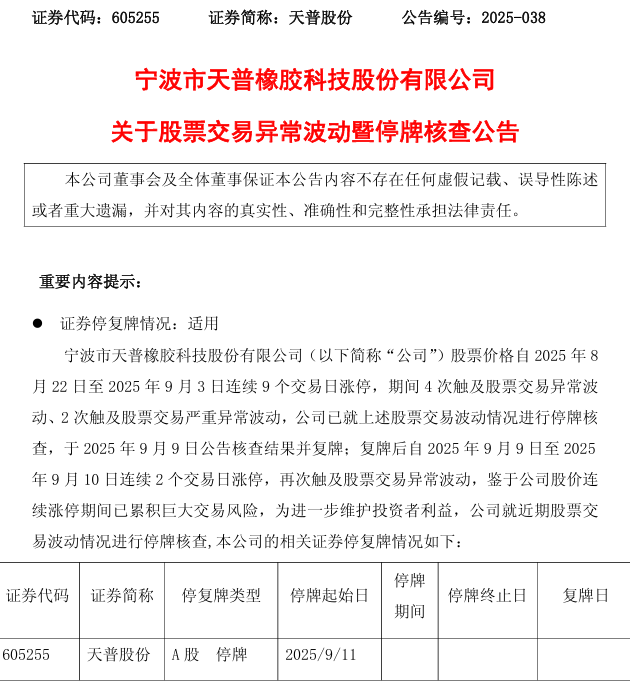
又停牌了。 天普股份(605255)9月10日晚间公告,公司股票价格自2025年8月22日至2025年9月3日连续9个交易日涨停,其间4次触及股票交 易异常波动、2次触及股票交易严重异常波动,公司已就上述股票交易波动情况进行停牌核查,于2025年9月9日公告核查结果并 复牌;复牌后自2025年9月9日至2025年9月10日连续2个交易日涨停,再次触及股票交易异常波动,鉴于公司股价连续涨停期间已 累积巨大交易风险,为进一步维护投资者利益,公司就近期股票交易波动情况进行停牌核查。 | | | 公告指出,公司股票价格自2025年8月22日至2025年9月10日连续11个交易日涨停,累计上涨185.29%,其间已累积巨大交易风 险,目前公司股价已严重偏离上市公司基本面,存在随时快速下跌的风险。 截至目前,天普股份总股本为13408万股,公司控股股东浙江天普控股有限公司、实际控制人尤建义及其一致行动人合计持有公 司股票10056万股,占公司总股本的75%;其余为外部流通股,流通盘较小,可能存在非理性炒作风险。 同时,公司市盈率和市净率显著高于行业平均水平。截至2025年9月10日,公司收盘价为76.00元/股,最新市盈 ...
芯片新贵借壳天普股份引关注,三家上市公司股价波动
Sou Hu Cai Jing· 2025-08-30 00:31
Core Viewpoint - The recent transaction involving Tianpu Co., Ltd. and Zhonghao Xinying has sparked significant market interest, with Tianpu's stock price soaring after the announcement of a control transfer to Zhonghao Xinying, leading to a total market value of 6.3 billion yuan [1] Group 1: Transaction Details - The total value of the transaction is approximately 2.12 billion yuan, structured in three main steps: Zhonghao Xinying acquiring 10.75% of Tianpu's shares, a natural person acquiring 8%, and subsequent capital increase by Zhonghao Xinying and its affiliates [1] - Zhonghao Xinying is required to make a mandatory tender offer at a price of 23.98 yuan per share to all public shareholders of Tianpu due to the capital increase triggering this obligation [1] Group 2: Stock Performance and Market Reactions - Prior to the announcement, Tianpu's stock had already increased by 37% in the month leading up to the suspension of trading, raising suspicions of potential insider information leaks [3] - Following the announcement, Tianpu's stock price reached 47.19 yuan per share, with a six-day consecutive limit-up [1] Group 3: Company Performance - Tianpu Co., Ltd. reported a revenue of approximately 151 million yuan in the first half of the year, a year-on-year decrease of 3.44%, and a net profit of about 11.3 million yuan, down 16.08% [3] - In contrast, Zhonghao Xinying reported a revenue of around 100 million yuan but incurred a net loss of 144 million yuan, with a debt-to-asset ratio of 19.08% [4] Group 4: Key Players - Yang Gongyifan, the founder of Zhonghao Xinying, has a notable background with previous roles at Oracle and Google, and aims to advance China's chip technology [3] - Fang Donghui, a prominent investor, has also acquired shares in Tianpu, adding further intrigue to the transaction [7] Group 5: Future Uncertainties - The transaction faces uncertainties regarding the approval of control change procedures, and Zhonghao Xinying has no immediate plans for asset injection within the next year [8] - Tianpu's stock price has significantly diverged from the Shanghai Composite Index and the automotive parts industry index, with a price-to-earnings ratio notably higher than the industry average [8]

中科蓝讯: 第二届董事会第二十次会议决议公告
Zheng Quan Zhi Xing· 2025-08-29 17:25
Group 1 - The board of directors of Shenzhen Zhongke Lanyun Technology Co., Ltd. held its 20th meeting on August 27, 2025, to discuss various agenda items, ensuring compliance with relevant laws and regulations [1][2][3] - The board approved the 2025 semi-annual report, which accurately reflects the company's financial status and operational results for the first half of 2025, confirming the report's authenticity and completeness [2][3] - The board also approved the special report on the use of raised funds, adhering to regulatory guidelines and internal management rules [3][4] Group 2 - The board agreed to conclude the IoT chip product R&D project and permanently supplement the remaining raised funds and interest income into working capital to improve fund utilization efficiency [4][5] - The timeline for the Wi-Fi and Bluetooth integrated chip R&D project and the Zhongke Lanyun R&D center construction project has been extended from August 2025 to August 2026 [5] - The board approved the temporary use of up to RMB 600 million of idle raised funds for working capital, with a validity period of 12 months, ensuring that these funds will not be used for stock trading or other non-compliant activities [6][7] Group 3 - The company is committed to enhancing quality and efficiency while providing returns to investors, as reflected in the semi-annual evaluation report of the "Quality Improvement and Efficiency Enhancement Return" action plan [7][8] - The board approved the reappointment of Tianjian Accounting Firm as the company's auditor for 2025, with the management authorized to negotiate audit fees based on actual business conditions [7][8]

数芯微&川红集团探索茶业“芯”未来 重磅推出「川红芯意」
Jiang Nan Shi Bao· 2025-08-28 07:08
Core Viewpoint - The collaboration between Shuxin Micro Technology and Chuanhong Tea Group has led to the launch of the first "chip-enabled experiential tea gift" in China, named Chuanhong Xinyi, which transforms traditional tea gifting by integrating smart chip technology for enhanced consumer experience and operational efficiency [1][2]. Group 1: Technology and Innovation - Shuxin Micro is a national high-tech enterprise focused on the research and application of smart chip technology, with products characterized by uniqueness, non-transferability, non-replicability, and non-tampering [2][3]. - The smart chip embedded in Chuanhong Xinyi provides a globally unique encrypted ID, significantly enhancing security compared to traditional methods like QR codes and passwords [2][3]. Group 2: Consumer Experience - Chuanhong Xinyi introduces a "taste before selection" model, allowing consumers to sample two classic teas before choosing one for their gift, thus reducing waste and enhancing user satisfaction [4][5]. - The ability to transfer the chip card's rights to others if the consumer is unsatisfied with the tea further promotes a two-way interaction in the gifting process [4]. Group 3: Operational Efficiency - The new model reduces costs and improves efficiency by eliminating the need for physical inventory in stores, as the chip card allows for streamlined management and logistics [5][6]. - The shift from traditional inventory methods to a chip and tasting combination significantly lowers material waste and distribution costs for Chuanhong Tea Group [5]. Group 4: Future Developments - The second phase of Chuanhong Xinyi will focus on enhancing anti-counterfeiting measures and providing full traceability of products through the integration of smart chips in all gift boxes [6][7]. - This initiative aims to create a transparent consumption loop, allowing consumers to access detailed information about the tea's origin and quality [6][7].
科思科技上半年营收增长超四成 芯片自主研发取得重大进展
Zheng Quan Shi Bao Wang· 2025-08-27 02:29
Core Insights - The company reported a significant increase in revenue for the first half of 2025, achieving 154.46 million yuan, a growth of 40.54% compared to the same period last year [1] - Despite the revenue growth, the company recorded a net loss attributable to shareholders of 108.72 million yuan, although this represents an improvement in loss compared to the previous year [1] Financial Performance - The company's revenue saw a substantial rise due to specific demands from end-users and their annual procurement plans [1] - The company maintained a high level of research and development (R&D) investment, with R&D expenses accounting for 84.88% of total revenue in the first half of 2025 [1] - Increased business activities led to a rise in related expenses, and the company also made appropriate provisions for asset impairment, contributing to the net loss [1] R&D and Product Development - The company achieved significant progress in chip research and development, with its first-generation smart wireless radio baseband processing chip entering the commercialization phase [1] - The second-generation smart wireless radio baseband processing chip has completed trial production and testing, and efforts are underway to advance its productization [1] - The radio frequency transceiver chip has completed trial production and is currently undergoing packaging and testing [1] - The company places a strong emphasis on R&D, continuing to invest in cutting-edge technologies in AI, cloud computing, virtual reality, and intelligent decision-making [1]
