
托育

Search documents
扩大服务消费!商务部等9部门发文
Sou Hu Cai Jing· 2025-09-17 02:16
Core Viewpoint - The Ministry of Commerce and nine other departments released policies on September 16 to expand service consumption through 19 measures across five areas [3] Group 1: Service Consumption Enhancement - Implementation of a quality improvement action for service consumption, continuing to deepen the "Buy in China" brand, and launching a series of promotional activities for "Service Consumption Season" [4] - Development of pilot cities for new business formats, models, and scenarios in consumption [4] - Promotion of the "first release economy" and support for innovative and diverse service consumption scenarios, including collaborations between quality consumption resources and well-known IPs [4] Group 2: Opening Up the Service Sector - Expansion of high-level openness in the service industry, with orderly opening in internet, culture, telecommunications, medical, and educational sectors [4] - Inclusion of more service consumption areas in the "Encouraged Foreign Investment Industry Catalog" to provide differentiated service supply [4] Group 3: Optimizing Consumer Experience - Extension of operating hours for popular cultural and tourist venues, optimization of reservation methods, and encouragement of no-reservation policies [4] - Support for the introduction of high-quality foreign sports events and local mass sports events, aiming to create well-known boutique events and professional leagues [4] Group 4: Educational Policy Adjustments - Optimization of student holiday arrangements while maintaining the total number of holiday days and teaching hours, encouraging local adaptations based on climate and production schedules [5] - Exploration of setting up spring and autumn breaks in primary and secondary schools, with a corresponding reduction in winter and summer vacation durations to increase service consumption time for tourism [5]

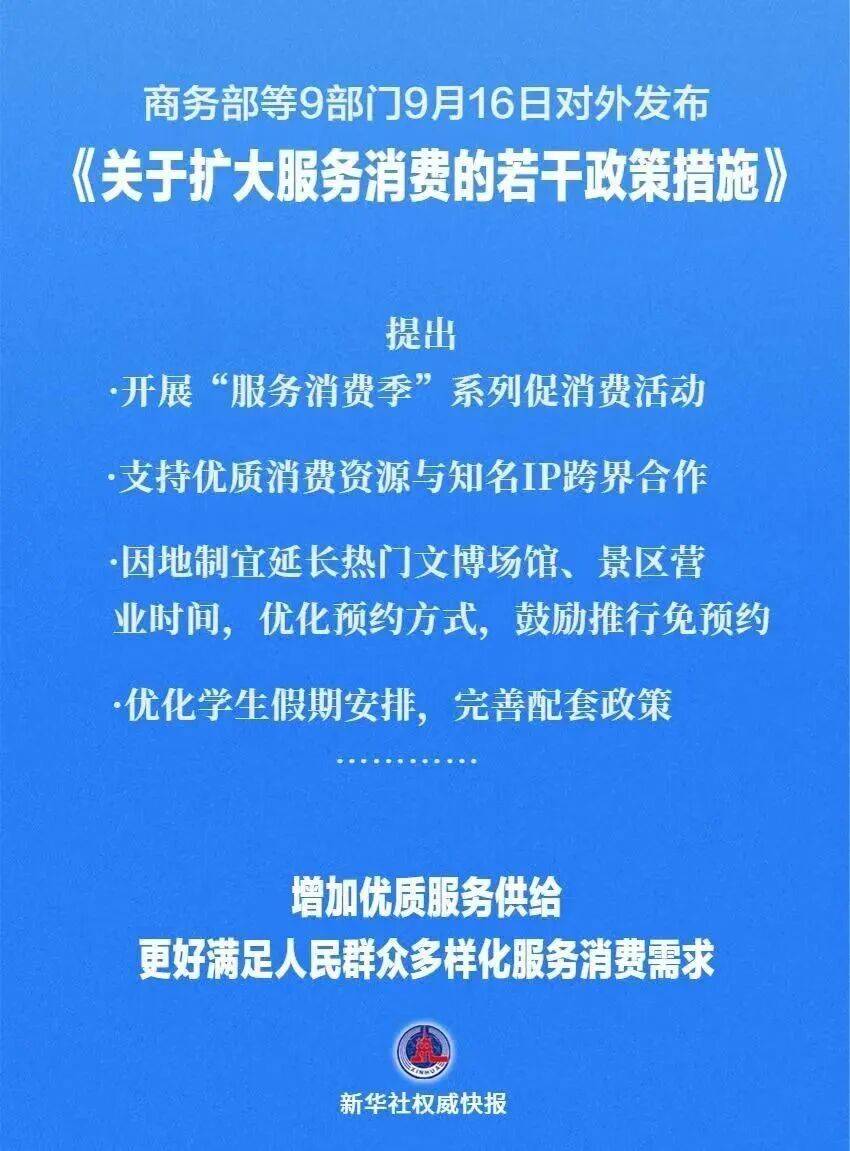
《关于扩大服务消费的若干政策措施》发布
Sou Hu Cai Jing· 2025-09-17 02:16
Group 1 - The core viewpoint of the article is the announcement of 19 measures by the Ministry of Commerce and nine other departments to expand service consumption in China [1] - The measures include the implementation of a service consumption quality improvement action and the continuous development of the "Buy in China" brand [1] - There is a focus on developing new consumption scenarios and supporting the integration of various sectors such as travel, culture, and sports to create innovative consumption experiences [1] Group 2 - The document emphasizes the need for high-level opening of the service industry, particularly in sectors like telecommunications, healthcare, and education [1] - It encourages the introduction of foreign sports events and supports local governments in hosting popular sports events to enhance service consumption [2] - The document also outlines the optimization of student holiday arrangements to increase service consumption opportunities during travel seasons [2]
9部门发文 19项措施扩大服务消费
Yang Shi Wang· 2025-09-17 00:16
Core Viewpoint - The article emphasizes the importance of service consumption in improving people's livelihoods and driving economic transformation, proposing various measures to boost consumption and expand domestic demand [1][2][3][4]. Group 1: Cultivating Service Consumption Platforms - Implementation of a service consumption quality improvement action plan, focusing on policy support, platform development, and enhancing the consumption environment [1]. - Development of pilot cities for new service consumption formats, promoting innovative service consumption scenarios and supporting the establishment of new leading consumption enterprises [1]. Group 2: Enriching High-Quality Service Supply - Expansion of high-level openness in the service industry, particularly in internet, culture, telecommunications, and healthcare sectors [1]. - Support for cultural and artistic sectors through funding for high-quality creations and optimizing cultural product supply [1]. - Encouragement of diverse education and training markets, including non-academic training and community education initiatives [1][2]. Group 3: Stimulating New Service Consumption Growth - Attraction of more foreign visitors for consumption by optimizing visa policies and promoting cultural resources [2]. - Expansion of digital service consumption through e-commerce platforms and support for the digital transformation of service enterprises [2]. - Adjustment of student holiday arrangements to increase service consumption opportunities [2]. Group 4: Strengthening Financial Support - Utilization of various funding channels to support the construction of service facilities in culture, tourism, and sports [3]. - Encouragement of financial institutions to increase credit support for service consumption sectors and develop tailored financial products [3]. - Implementation of fiscal interest subsidies to reduce financing costs for service industry operators [3]. Group 5: Optimizing Service Consumption Statistics - Advancement of regional service retail measurement to accurately reflect service consumption development [4]. - Encouragement of the use of big data for monitoring and analyzing service consumption [4].
九部门出台扩大服务消费政策措施 扩大电信、医疗、教育等领域开放试点 放宽中高端医疗、休闲度假等领域市场准入
Zhong Guo Zheng Quan Bao· 2025-09-16 22:25
商务部9月16日消息,商务部等九部门近日联合印发《关于扩大服务消费的若干政策措施》,在培育服 务消费促进平台、丰富高品质服务供给、激发服务消费新增量、加强财政金融支持、健全统计监测制度 5方面提出19条举措。 在培育服务消费促进平台方面,政策措施明确,持续深化"购在中国"品牌打造,开展"服务消费季"系列 促消费活动,围绕贴近群众生活、需求潜力大、带动作用强的重点领域开展服务消费促进活动,培育服 务消费品牌,打造服务消费热点。开展消费新业态新模式新场景试点城市建设。积极发展首发经济,推 动创新和丰富服务消费场景,支持优质消费资源与知名IP跨界合作,打造一批商旅文体健融合的消费新 场景,培育一批新型消费龙头企业。 在丰富高品质服务供给方面,政策措施提出,扩大服务业高水平对外开放。推动互联网、文化等领域有 序开放,扩大电信、医疗、教育等领域开放试点。加快推进服务业扩大开放综合试点示范。支持将更多 服务消费领域纳入《鼓励外商投资产业目录》,提供差异化服务供给。放宽中高端医疗、休闲度假等领 域市场准入,减少限制性措施,吸引更多外商投资、民营资本进入,增加优质服务供给。提升文化娱 乐、体育、家政、养老、托育等服务供给水平 ...
积极培育服务消费新的增长点
Qi Huo Ri Bao Wang· 2025-09-16 20:00
Group 1 - The core viewpoint of the news is the issuance of a set of policies aimed at expanding service consumption to boost economic growth and improve living standards [1][2] - The measures include 19 specific tasks across five main areas, focusing on enhancing service consumption platforms and promoting new consumption models [1] - The initiative aims to enrich high-quality service supply in sectors such as culture, entertainment, and elderly care, while also expanding the openness of the service industry [1][2] Group 2 - The policies encourage the attraction of foreign consumers and the expansion of digital service consumption [1] - Financial support is emphasized, with plans to utilize various funding channels to enhance service infrastructure and provide credit support for service consumption [1][2] - The measures also call for the development of innovative financial products tailored to the needs of service consumption businesses [2]
19条举措扩大服务消费 加强财政金融支持
Sou Hu Cai Jing· 2025-09-16 17:17
Core Viewpoint - The Chinese government is enhancing policy support for service consumption as a key measure to expand domestic demand, with 19 specific initiatives outlined in the recent policy measures [1][2]. Group 1: Policy Measures - The policy measures focus on five areas: cultivating service consumption promotion platforms, enriching high-quality service supply, and stimulating new service consumption growth [1][2]. - Specific initiatives include the implementation of a service consumption quality improvement action plan and the establishment of pilot cities for new consumption formats and models [2][3]. Group 2: Financial Support - The measures emphasize strengthening financial support through various funding channels, including central budget investments and local government bonds, to support the construction of cultural, tourism, and other service facilities [5]. - The People's Bank of China has set up a 500 billion yuan re-lending program to guide financial institutions in increasing support for high-quality service supply in sectors like accommodation, tourism, and education [4][5]. Group 3: Market Expansion - The policy encourages the opening up of sectors such as telecommunications, healthcare, and education to attract more foreign investment and enhance service supply [2][3]. - The government aims to optimize the supply of services by reducing restrictions in high-end medical and leisure sectors, thereby increasing the quality of service offerings [2][3].
商务部等9部门联合印发《关于扩大服务消费的若干政策措施》 加大对服务消费领域经营主体信贷投放力度
Zheng Quan Ri Bao· 2025-09-16 16:20
Core Viewpoint - The Ministry of Commerce and nine other departments have jointly issued policies to expand service consumption, aiming to boost domestic demand and improve people's livelihoods while promoting high-quality economic development [1] Group 1: Specific Measures - Five main areas with 19 specific tasks are outlined to enhance service consumption, including creating platforms for service consumption, improving service quality, stimulating new service consumption, increasing financial support, and optimizing statistical monitoring [1] - The initiative includes activities like "Service Consumption Season" and the development of new business models and scenarios to integrate commerce, tourism, culture, and sports [1] Group 2: High-Quality Service Supply - The policies aim to enrich high-quality service supply by promoting orderly opening in sectors like the internet, culture, telecommunications, healthcare, and education, while encouraging foreign investment in these areas [2] - There is a focus on attracting high-profile sports events and reducing market entry restrictions in mid-to-high-end healthcare and leisure sectors to increase quality service offerings [2] Group 3: Financial Support - The measures propose comprehensive use of monetary and credit policies to support financial institutions in increasing credit for service consumption, with an emphasis on sustainable loan rates [2] - Local governments are encouraged to establish risk compensation funds to mitigate consumer credit risks and promote collaboration between financial institutions and businesses to develop tailored products for service consumption [2]
刚刚!重大利好!商务部等9部门对外发布《关于扩大服务消费的若干政策措施》
Zhong Guo Ji Jin Bao· 2025-09-16 14:35
Group 1 - The article emphasizes the importance of service consumption as a key support for improving people's livelihoods and a direction for consumption transformation and upgrading, playing a significant role in promoting high-quality economic development [10] - A series of promotional activities for service consumption will be launched, focusing on areas closely related to people's lives, with high demand potential and strong driving effects [11][12] - The establishment of pilot cities for new business formats, models, and scenarios in consumption will be promoted, encouraging innovation and the development of new consumption scenarios [11][12] Group 2 - High-level opening up of the service industry will be expanded, with orderly opening in fields such as the internet, culture, telecommunications, healthcare, and education [11][12] - Existing funding channels will be utilized to support the creation of high-quality cultural products and services, optimizing the supply of cultural products [11][12] - The introduction of foreign sports events and support for local mass sports events will be encouraged to create well-known sports brands [4][11] Group 3 - The article outlines measures to attract more foreign visitors for consumption, including optimizing visa policies and enhancing international promotion of cultural resources [12] - Digital service consumption will be expanded, encouraging e-commerce platforms to innovate in online and offline integration [12][13] - Financial support for service consumption will be strengthened, including the use of various funding channels and credit policies to stimulate market activity [13][14]
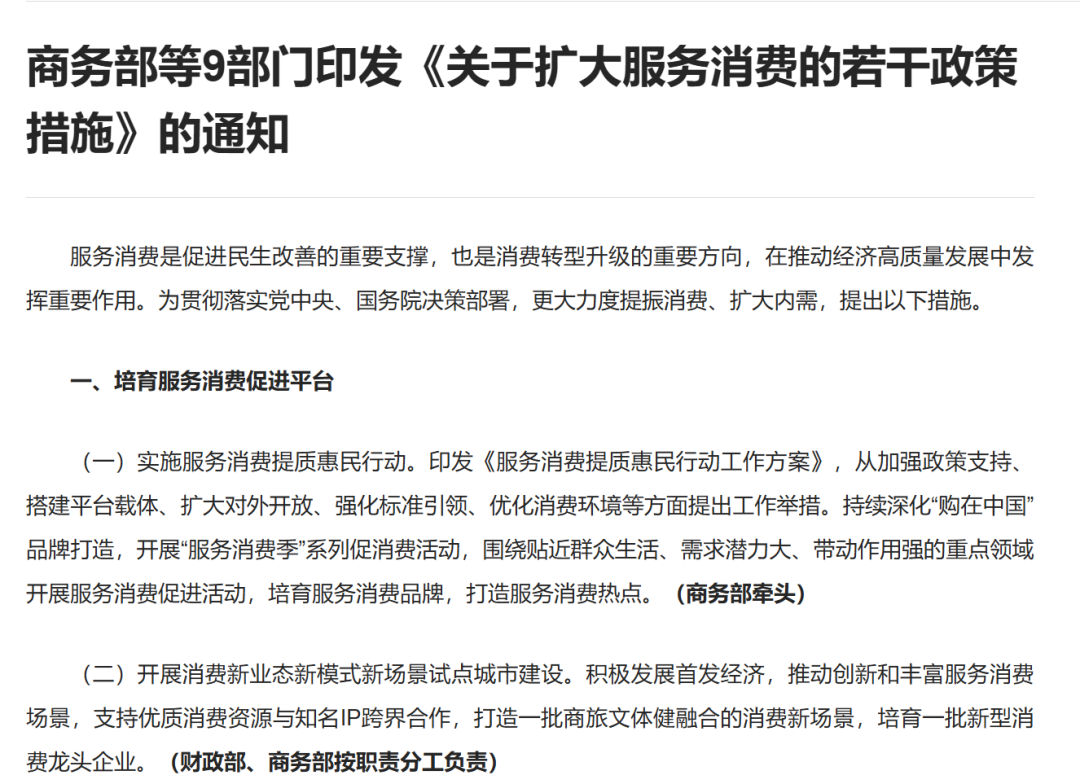
9部门发文扩大服务消费
Xin Hua She· 2025-09-16 13:50
新华社北京9月16日电 商务部等9部门16日对外发布《关于扩大服务消费的若干政策措施》,提出五方 面19条举措进一步扩大服务消费。 文件提出,实施服务消费提质惠民行动,持续深化"购在中国"品牌打造,开展"服务消费季"系列促消费 活动。开展消费新业态新模式新场景试点城市建设。积极发展首发经济,推动创新和丰富服务消费场 景,支持优质消费资源与知名IP跨界合作,打造一批商旅文体健融合的消费新场景,培育一批新型消费 龙头企业。 此外,扩大服务业高水平对外开放。推动互联网、文化等领域有序开放,扩大电信、医疗、教育等领域 开放试点。支持将更多服务消费领域纳入《鼓励外商投资产业目录》,提供差异化服务供给。 文件还明确,优化学生假期安排,完善配套政策。在放假总天数和教学时间总量保持不变的情况下,鼓 励有条件的地方结合气候条件、生产安排、职工带薪休假制度落实等因素,科学调整每学年的教学和放 假时间,探索设置中小学春秋假,相应缩短寒暑假时间,增加旅游出行等服务消费时间。(记者王雨萧 魏弘毅) 文件要求,结合实际、因地制宜延长热门文博场馆、景区营业时间,优化预约方式,鼓励推行免预约。 鼓励引进国外优秀体育赛事,支持地方举办大众体育 ...
19条举措扩大服务消费,加强财政金融支持
Di Yi Cai Jing· 2025-09-16 11:17
Core Viewpoint - The Chinese government is implementing strong policy support to expand service consumption as a key strategy for boosting domestic demand, with specific measures outlined in the recent policy document [2][3]. Group 1: Policy Measures - The policy document includes 19 specific measures across five areas to enhance service consumption, focusing on financial support, quality service supply, and stimulating new consumption growth [2][3]. - Financial institutions are encouraged to increase credit allocation for service consumption, utilizing various funding channels such as central budget investments and local government bonds [2][6]. Group 2: Service Consumption Growth - Service consumption has become a significant aspect of domestic demand expansion, with service retail sales growing by 5.1% year-on-year from January to August, outpacing the growth of goods retail sales [3]. - The government aims to cultivate new consumption formats and scenarios, promoting innovative service consumption experiences and supporting the development of new consumption leaders [3][4]. Group 3: Supply Optimization - The policy emphasizes the need to open up sectors like telecommunications, healthcare, and education to enhance service supply, attracting foreign investment and private capital [4][8]. - Since 2015, China has expanded its pilot programs for service industry openness, with new cities added to the list of trial areas [4]. Group 4: Financial Support - The People's Bank of China has established a 500 billion yuan fund to support service consumption and elderly care, aiming to enhance the quality of service supply in sectors like hospitality, tourism, and education [7]. - The policy encourages financial institutions to develop tailored financial products for service consumption businesses, addressing their unique financing needs [6][7].