
信托

Search documents
舜禹股份(301519.SZ):拟参与知识产权资产证券化融资事项
Ge Long Hui A P P· 2025-09-29 12:37
Group 1 - The company, Shunyu Co., Ltd. (301519.SZ), announced plans to participate in intellectual property asset securitization financing to reduce financing costs and expand financing channels [1] - The company intends to pledge certain intellectual property rights to Anhui Guoyuan Trust Co., Ltd. for a maximum credit limit of up to RMB 20 million, with a term of 345 days [1] - Zheshang Bank Co., Ltd. Hefei Branch will provide guarantee for the aforementioned credit [1]
陕国投A涨2.25%,成交额2.09亿元,主力资金净流入147.41万元
Xin Lang Cai Jing· 2025-09-29 06:12
Core Viewpoint - The stock of Shaanxi Guotou A has shown a mixed performance in recent trading sessions, with a slight increase on September 29, 2023, and a year-to-date price increase of 3.42% [1] Financial Performance - As of September 19, 2023, Shaanxi Guotou A reported a net profit of 726 million yuan for the first half of 2025, representing a year-on-year growth of 5.74% [2] - The company achieved zero operating revenue for the same period [2] Stock and Shareholder Information - The number of shareholders for Shaanxi Guotou A reached 108,500, an increase of 1.83% from the previous period [2] - The average number of circulating shares per shareholder decreased by 1.79% to 47,119 shares [2] Dividend Distribution - Since its listing, Shaanxi Guotou A has distributed a total of 1.928 billion yuan in dividends, with 972 million yuan distributed over the last three years [3] Major Shareholders - As of June 30, 2025, the top ten circulating shareholders include the Southern CSI 500 ETF, which holds 45.819 million shares, an increase of 6.4004 million shares from the previous period [3] - Hong Kong Central Clearing Limited is the eighth largest circulating shareholder, holding 44.688 million shares, a decrease of 1.8584 million shares from the previous period [3]

建元信托涨2.30%,成交额2.17亿元,主力资金净流入1516.60万元
Xin Lang Cai Jing· 2025-09-29 05:54
Core Viewpoint - Jianyuan Trust's stock price has shown fluctuations with a recent increase of 2.30%, while the company has experienced an overall decline of 11.14% this year [1] Group 1: Stock Performance - As of September 29, Jianyuan Trust's stock price is 3.11 CNY per share, with a trading volume of 2.17 billion CNY and a turnover rate of 1.29%, resulting in a total market capitalization of 30.616 billion CNY [1] - Year-to-date, Jianyuan Trust's stock has decreased by 11.14%, with a 5-day decline of 5.18%, a 20-day increase of 3.32%, and a 60-day increase of 7.61% [1] - The company has appeared on the "Dragon and Tiger List" twice this year, with the most recent instance on September 19, where it recorded a net buy of -38.1765 million CNY [1] Group 2: Financial Performance - For the first half of 2025, Jianyuan Trust reported zero operating revenue, while the net profit attributable to shareholders was 40.2897 million CNY, reflecting a year-on-year growth of 13.36% [2] - Cumulative cash dividends since the A-share listing amount to 4.622 billion CNY, with no dividends distributed in the past three years [3] Group 3: Shareholder Information - As of June 30, 2025, Jianyuan Trust had 86,300 shareholders, an increase of 16.23% from the previous period, with an average of 63,356 circulating shares per shareholder, a decrease of 13.96% [2] - The top ten circulating shareholders include Southern CSI 500 ETF, holding 58.8595 million shares, an increase of 8.3261 million shares from the previous period [3]

履职半年 金谷信托董事长林志忠转任信达证券董事长
2 1 Shi Ji Jing Ji Bao Dao· 2025-09-29 04:49
Group 1 - Lin Zhizhong has been appointed as the chairman of Xinda Securities after serving as the chairman of Jingu Trust for only six months [1] - The approval for Lin Zhizhong's position as chairman of Jingu Trust was granted on March 18, 2023, by the Beijing Regulatory Bureau of the National Financial Regulatory Administration [1] - Xinda Securities held its first extraordinary shareholders' meeting of 2025 on August 18, 2023, where Lin Zhizhong was elected as a non-independent director [1] Group 2 - Lin Zhizhong has a background in various leadership roles within China Cinda, including positions at the Shanghai branch and other regional offices [1] - Jingu Trust was established in April 1993 and underwent restructuring by China Cinda starting in April 2007, receiving a new financial license in September 2009 [5] - The registered capital of Jingu Trust is 2.2 billion RMB [5] Group 3 - In 2024, Jingu Trust achieved an operating income of 1.411 billion RMB, representing a year-on-year growth of 35.28%, and a net profit of 559 million RMB, with a year-on-year increase of 65.46% [7] - The shareholders of Jingu Trust are China Cinda and the China Women's Activity Center, holding 93.75% and 6.25% of the shares, respectively [6]

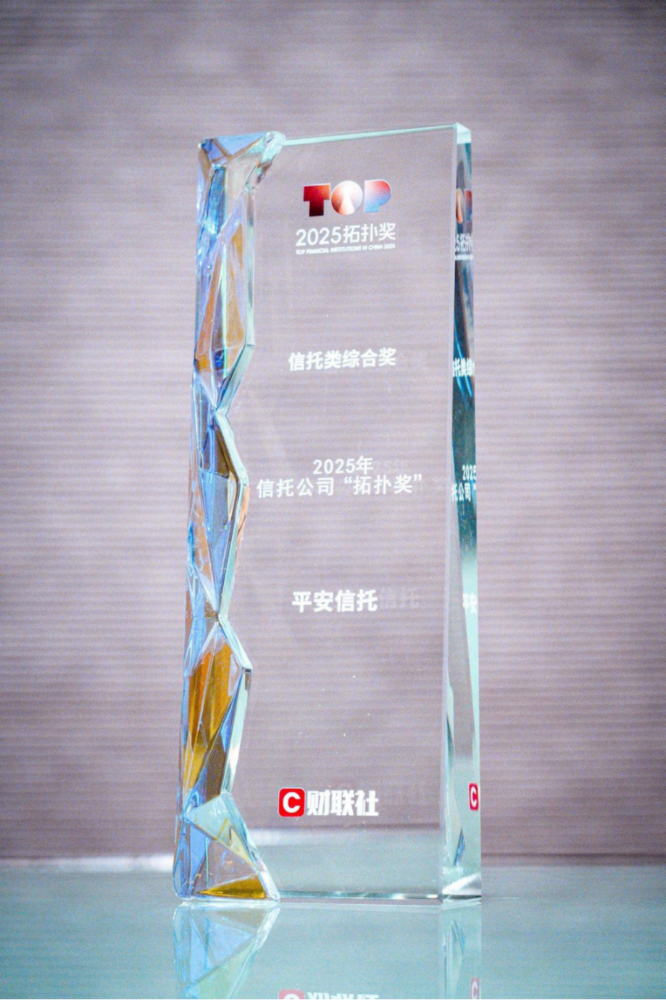
连续摘得两项权威殊荣 平安信托铸造行业领先品牌
Di Yi Cai Jing· 2025-09-29 04:47
Core Insights - Ping An Trust has recently won two significant industry awards, the "Topological Award" and the "Golden Bull Award for One-Year Mixed Products" for its "Ping An Trust Ansheng Stable TOF1 Collective Fund Trust Plan" [1][6] Group 1: Company Performance - In 2024, Ping An Trust achieved an operating income of 14.148 billion yuan and a net profit of 3.421 billion yuan, with asset management scale increasing by 49.88% year-on-year and investment scale growing by 62.06% [4] - As of June this year, the overall scale of Ping An Trust's wealth management service trust business exceeded 226 billion yuan, accounting for nearly 20% of the industry, serving over 46,000 clients [4] - The insurance trust business exceeded 173 billion yuan, holding over 30% market share, while the family trust business surpassed 53 billion yuan, serving over 3,000 clients [4] Group 2: Investment Strategy - Ping An Trust has established a comprehensive investment research system covering macro research, credit research, and asset allocation, supporting investment decisions effectively [5] - The award-winning "Ping An Trust Ansheng Stable TOF1 Collective Fund Trust Plan" is designed to meet client demand for low-volatility products, utilizing a diversified strategy across various asset classes to minimize risk and ensure steady asset appreciation [5][6] Group 3: Industry Recognition - The recent awards reflect the market's high recognition of Ping An Trust's professional capabilities, innovation, risk management, and product performance [6] - The company aims to continue enhancing its professional capabilities and service levels, contributing to the high-quality development of the trust industry [6]

2025保险业、信托业高质量发展大会举办
Huan Qiu Wang· 2025-09-29 03:07
Core Viewpoint - The insurance and trust industries are entering a new phase of high-quality development, emphasizing the importance of long-term investment and asset allocation to support the real economy and stabilize capital markets [3][4]. Group 1: Insurance Industry Insights - The insurance sector is expected to benefit from the growing demand for pension insurance due to an aging population, providing significant growth opportunities [3][4]. - Insurance funds possess unique "long money, long investment" attributes, making them well-suited for long-term capital market needs, which distinguishes them from other financial institutions [4]. - There is a need for insurance companies to innovate products and enhance market promotion to improve the competitiveness and coverage of the third pillar of pension insurance [3][5]. Group 2: Trust Industry Developments - The trust industry is showing renewed vitality through adjustments and explorations, with confidence in future development strengthened after years of industry adjustments [5]. - The trust system offers unique advantages in asset allocation, risk isolation, and wealth inheritance, which are increasingly in demand [5]. - The trust industry is entering a new stage of high-quality development, supported by a comprehensive "1+N" top-level design that enhances its operational model [5].
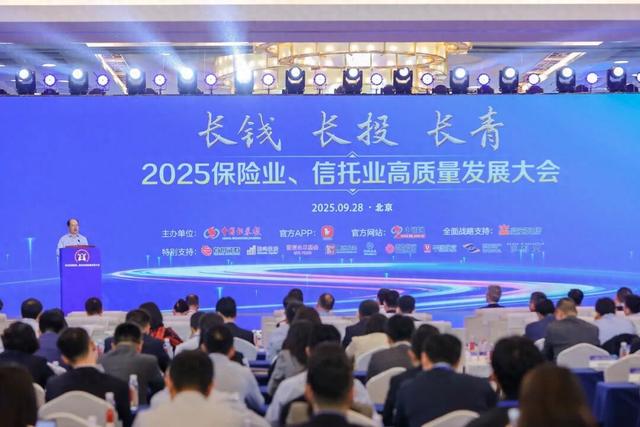
长钱 长投 长青 2025保险业信托业高质量发展大会举办
Zhong Guo Zheng Quan Bao· 2025-09-28 23:59
Core Insights - The conference "Long Money, Long Investment, Long Prosperity" highlighted the insurance and trust industries' transition towards high-quality development, emphasizing their roles in supporting the real economy and stabilizing capital markets [1][2] Group 1: Industry Transformation - Over 100 executives from insurance and trust companies gathered to discuss industry transformation, innovation, and alignment with national strategies [1] - The insurance sector is expected to leverage its "long money, long investment" characteristics to meet long-term capital market demands, distinguishing it from other financial institutions [2] Group 2: Economic Environment - The release of domestic demand is identified as a key driver for high-quality economic development, with calls for increased government support in service-oriented consumption, particularly in education, healthcare, and elderly care [1] - The demand for pension insurance is projected to grow, providing significant development opportunities for the insurance industry [1] Group 3: Asset Management and Innovation - The insurance industry is encouraged to enhance asset management capabilities and innovate products to improve the competitiveness and coverage of the third pillar of pension insurance [1] - The trust industry is undergoing adjustments and exploring new vitality, with a focus on its unique advantages in asset allocation and wealth transfer [2] Group 4: Mechanism and Capability Building - Mechanism and capability development are crucial for achieving high-quality growth in the insurance sector, with a recommendation for life insurance companies to strengthen their balance sheets [2] - The trust industry is entering a new phase of high-quality development, supported by improved top-level design [2]
第四届信托业金牛奖获奖名单
Zhong Guo Zheng Quan Bao· 2025-09-28 20:45
Core Insights - The article highlights the winners of the "Golden Bull Award" for various categories in the trust industry, including family trusts, charitable trusts, and fixed-income products [1] Group 1: Family Trusts - Shanghai International Trust Co., Ltd. and China Foreign Economic and Trade Trust Co., Ltd. received recognition in the family trust category [1] - Other notable winners include Jiangsu International Trust Co., Ltd. and Guotou Taikang Trust Co., Ltd. [1] Group 2: Charitable Trusts - The winners in the charitable trust category include Citic Trust Co., Ltd. and Shanghai International Trust Co., Ltd. [1] - Zhongguo Cuncheng Trust Co., Ltd. and Yingda International Trust Co., Ltd. were also recognized [1] Group 3: Fixed-Income Products - The three-year fixed-income product award was given to several plans, including Huaxin Trust's Xin Xin Feng Li No. 6 and Jiao Yin Guo Xin's Hui Yi No. 7 [1] - One-year fixed-income product winners include Huaxin Trust's Xin Xin Feng Li No. 8 and Yunnan Trust's Yu Xiang Gu Shi No. 6 [1] Group 4: Mixed Products - The three-year mixed product award was won by plans such as Wai Mao Trust's Jin Yuan TOT and Jiao Yin Guo Xin's Feng Yun No. 68 [1] - One-year mixed product winners include Yingda Trust's Wen Jian Zeng Zhang No. 2 and Shanghai Trust's "Xiang Yang" series [1]
发挥信托特色功能价值 打造财富和资管循环驱动新模式
Zhong Guo Zheng Quan Bao· 2025-09-28 20:45
Core Viewpoint - The trust industry is entering a new stage of high-quality development, with a focus on wealth management and asset management, driven by the unique advantages of the trust system in property independence, risk isolation, wealth inheritance, and asset allocation [1][2]. Group 1: Industry Development - The trust industry has gained confidence in its future development following recent adjustments, with a "1+N" top-level design gradually improving [1]. - The Shanghai Trust has successfully restructured its business model, emphasizing the advantages of trust functions and creating a wealth management and asset management cycle-driven business model [1]. Group 2: Wealth Management Services - As of mid-2023, the number of active trust accounts in Shanghai Trust's wealth management service has exceeded 13,000, with a total scale of 90 billion yuan [2]. - Shanghai Trust is enhancing its customer service system by integrating trust accounts into the wealth client service systems of commercial banks, insurance companies, and securities firms [2]. Group 3: Innovation and Strategic Focus - The company is focusing on creating a diversified asset management product system and a new long-cycle financing system, integrating trust loans, private equity investments, and asset securitization [2]. - There is a strong commitment to innovation and the functional value of the trust system in serving national strategies [2]. Group 4: Future Outlook - The trust industry is encouraged to adhere to its core principles, pursue high-quality development, strengthen corporate governance, and risk prevention while seizing policy opportunities [2]. - The industry is urged to maintain self-discipline, avoid internal competition, and collaborate with various institutions to build an ecosystem [2].
2025保险业信托业高质量发展大会举办
Zhong Guo Zheng Quan Bao· 2025-09-28 20:45
Group 1 - The conference "Long Money, Long Investment, Long Green" highlighted the importance of insurance and trust industries in supporting the real economy and stabilizing capital markets through innovative business models and optimized asset allocation [1] - The release of domestic demand is seen as a crucial driver for high-quality economic development, with a call for increased government support in service-oriented consumption, particularly in education, healthcare, and elderly care [1] - The insurance industry is presented with new growth opportunities, particularly in the pension insurance market, which is expected to continue growing, necessitating enhanced asset management and product innovation [1] Group 2 - Insurance funds possess a unique "long money, long investment" characteristic, positioning them as "patient capital" that aligns with the long-term investment needs of capital markets [2] - Mechanism and capability building are essential for achieving high-quality development in the industry, with a focus on restructuring balance sheets to integrate more effectively into national economic development [2] - The trust industry is undergoing adjustments and exploring new vitality, with its unique advantages in property independence, risk isolation, wealth inheritance, and asset allocation becoming increasingly relevant [2]