
无人机

Search documents
赛摩智能:控股子公司拟设立孙公司专注于无人机侦测反制解决方案
Xin Lang Cai Jing· 2025-11-28 10:56
Core Viewpoint - The company, Saimo Intelligent, announced the establishment of a wholly-owned subsidiary, ZhongSai Aviation Technology (Henan) Co., Ltd., focusing on drone detection and countermeasure solutions, with an investment of 50 million yuan [1] Group 1: Company Developments - The subsidiary will engage in the research, production, and sales of drone detection countermeasure solutions, disposal equipment, and low-altitude flight control platforms [1] - The technology for the new subsidiary is based on prior communications and will rely on a military research institute in Henan Province [1] - The establishment of ZhongSai Aviation will be included in the company's consolidated financial statements, which is expected to optimize and enhance the company's business structure [1] Group 2: Financial and Operational Aspects - The investment of 50 million yuan does not require shareholder approval as it falls within the board's review scope and does not constitute a related party transaction or a major asset reorganization [1] - There are uncertainties regarding the specific business operations of the new subsidiary, which may face risks related to market environment, regulatory policies, and operational management [1]

赛摩智能:控股子公司拟5000万元设立孙公司
Xin Lang Cai Jing· 2025-11-28 10:32
Core Viewpoint - The company announced the establishment of a wholly-owned subsidiary, ZhongSai Aviation Technology (Henan) Co., Ltd., with an investment of 50 million yuan to focus on the industrialization of drone monitoring and countermeasure technologies [1] Group 1: Investment and Subsidiary Establishment - The investment of 50 million yuan is made using the company's own funds and falls within the board's review scope, not constituting a related party transaction or a major asset restructuring [1] - The purpose of establishing ZhongSai Aviation is to specialize in drone monitoring and countermeasure technology, relying on a military research institute in Henan Province [1] Group 2: Financial Impact and Strategic Implementation - The newly established subsidiary will be included in the consolidated financial statements, but it is expected to have no significant short-term impact on financial and operational results [1] - Long-term, the establishment of the subsidiary is beneficial for the company's strategic implementation [1] Group 3: Risk Management - The company acknowledges uncertainties in business development and plans to improve governance structures to mitigate risks while ensuring timely disclosure of progress [1]
吉峰科技(300022.SZ):拟投资设立吉峰低空科技(盐城)有限公司
Ge Long Hui A P P· 2025-11-28 10:16
Core Viewpoint - The company aims to deepen its low-altitude operation business through regional development and strategic upgrades by leveraging the new management team's expertise in key technologies related to drone assembly and flight control systems [1] Group 1: Company Strategy - The company plans to establish a wholly-owned subsidiary, Jifeng Low-altitude Technology (Yancheng) Co., Ltd., with an investment of 50 million yuan to serve as an investment and operation platform for the low-altitude industry in Yancheng, Jiangsu [1] - The new subsidiary will integrate the company's extensive experience in channel networks, service systems, and terminal promotion within modern agricultural service projects [1] Group 2: Industry Focus - The establishment of the subsidiary is part of the company's strategy to promote regional deep cultivation and strategic upgrades in its low-altitude business [1]

大疆撕扯“小大疆”
3 6 Ke· 2025-11-28 08:15
Core Insights - The rivalry between DJI and its former employees who have founded new companies, particularly Tuo Zhu, has intensified, highlighting a battle for talent, technology, and market space [1][2][19] - DJI's investment in a 3D printing company, Smart Pie, has been perceived as a direct attack on Tuo Zhu, indicating a shift from value investment to competitive aggression [1][4][19] - The emergence of "DJI alumni" companies has created a competitive landscape where these startups are increasingly attracting talent away from DJI, posing a significant threat to its market dominance [13][14][16] Company Dynamics - DJI has historically been a breeding ground for talent, with many former employees establishing successful startups that often compete directly with DJI [8][9][13] - Tuo Zhu, founded by former DJI employee Tao Ye, has rapidly grown to capture a significant market share in the 3D printing sector, achieving approximately 60 billion RMB in revenue and a 29% market share by 2024 [11][19] - The competitive landscape has shifted, with candidates increasingly choosing Tuo Zhu over DJI, even when offered similar compensation, indicating a change in the perceived value of working for each company [4][13] Market Trends - The global drone market is experiencing stagnation, with growth rates around 5% in 2023 and a decline in consumer drone sales, which poses challenges for DJI's traditional business model [16][17] - DJI is diversifying its product offerings into new areas such as robotic vacuums, panoramic cameras, and outdoor power supplies, as it seeks to find new growth avenues amidst a saturated market [17][18] - The rise of "DJI alumni" companies is creating a closed loop of talent migration, where former employees leverage their DJI experience to attract investment and build competitive startups [14][15]

影石创新:计划推出两个无人机品牌 全景无人机将于12月4日正式发售
Zheng Quan Shi Bao Wang· 2025-11-28 07:51
Core Viewpoint - The company plans to launch two drone brands, including its own brand and a panoramic drone brand developed in collaboration with a third party, based on industry development trends and its long-term strategic planning [1] Group 1 - The company is progressing smoothly with the planned drone brand business [1] - The panoramic drone is scheduled to be officially released on December 4, 2025 [1]

重庆智造“氢鸟”展翅 低空经济添翼山城
Yang Guang Wang· 2025-11-28 02:33
Core Insights - The article highlights the development of hydrogen-powered drones in Chongqing, showcasing their potential for low-carbon and efficient flight solutions [1][2]. Group 1: Hydrogen-Powered Drone Technology - The "Qing Yao-10" drone utilizes a liquid hydrogen energy system with a high energy density fuel cell, achieving 2.5 hours of flight time, which is three times longer than traditional lithium battery drones [1]. - The drone's design allows for efficient hydrogen fuel conversion and stable output, making it suitable for extreme conditions, operating between -30°C to 45°C and at altitudes of 4000 meters [1]. Group 2: Applications and Efficiency - The "Qing Yao-10" has been successfully applied in various scenarios such as power line inspections and forest protection, significantly reducing labor costs and operational risks [2]. - The drone's continuous operation capability exceeds traditional models by over 50%, allowing for extensive coverage in a single flight, which enhances efficiency in tasks like power line inspections [2]. Group 3: Innovation and Future Prospects - The research team has filed 34 patents in the field of aviation hydrogen power, establishing a comprehensive technology system from core fuel cell development to complete system integration [3]. - The institute plans to accelerate the mass production of hydrogen-powered drones and explore diverse applications such as logistics and disaster relief, aligning with national strategic goals for hydrogen energy [3].
无人机龙头引资本追逐!中无人机询价转让落地 摩根大通等17家机构抢筹
Mei Ri Jing Ji Xin Wen· 2025-11-27 14:36
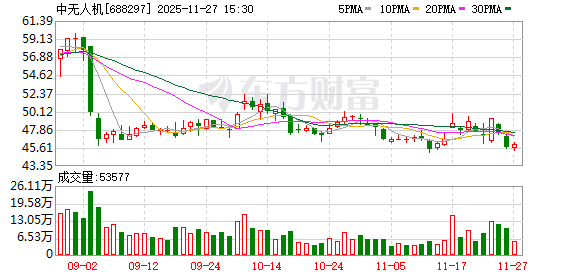
Core Viewpoint - Chengdu Industrial Investment Group successfully transferred shares of Zhong UAV at a price of 41.99 CNY per share, attracting significant interest from multiple institutional investors, indicating strong market confidence in the company [2][6]. Group 1: Share Transfer Details - The share transfer involved 10.125 million shares, representing 1.50% of Zhong UAV's total share capital, with 17 investors successfully allocated shares [6][8]. - Notable participants included major institutions such as Nord Fund, Huaxia Fund, and J.P. Morgan, highlighting the appeal of Zhong UAV to both domestic and foreign investors [6][9]. Group 2: Investment Performance - Chengdu Industrial Investment Group's investment in Zhong UAV has yielded over 30 times returns since its initial investment of 60 million CNY in 2014 [11]. - The company has experienced significant growth, with a revenue increase of 319% year-on-year in the first three quarters of this year, reaching 1.548 billion CNY [14]. Group 3: Company Growth and Product Offering - Zhong UAV has evolved into a leading player in the domestic drone industry, with its primary products being the Wing Loong series of large fixed-wing long-endurance drones [11]. - The company has seen a substantial increase in product deliveries compared to the previous year, contributing to its impressive revenue growth [14].

我们离实现“无人机灭火”还有多远?
凤凰网财经· 2025-11-27 14:26
Core Viewpoint - The article discusses the current limitations and challenges of using drones for firefighting, particularly in high-rise buildings, highlighting that the technology is still in its early stages and not yet ready for widespread practical application [2][11]. Group 1: Sales and Business Impact - The sales of firefighting drones are minimal, contributing very little to the overall revenue of companies involved in this sector. For instance, Helen Zhe has sold only three units of its first-generation firefighting drone [3]. - Other companies, such as Chen An Technology and Qing Niao Fire Protection, also report that their drone business has not yet generated significant revenue, with most of their focus still on traditional firefighting equipment [3]. Group 2: Technical Limitations - Current drone technology faces physical limitations in practical applications, particularly in high-rise firefighting scenarios. The existing drones struggle with the volume of water they can carry and the effects of high-pressure water flow [5][8]. - The predominant methods for firefighting using drones include "water delivery" and "fire extinguishing projectiles," but both have limitations in effectiveness against large fires [6][7]. Group 3: Environmental Challenges - High-rise fires present unique challenges due to turbulent airflow and strong winds, which require drones to have high power and stability to operate effectively [10]. - The article suggests that a coordinated approach using multiple drones may be necessary to tackle larger fires, as single units are insufficient [10]. Group 4: Future Directions - The industry needs to focus on developing a comprehensive framework for drone firefighting, including airspace management, collaborative command systems, and technical standards for high-capacity drones [11]. - There is a call for innovation and experimentation within the industry to fully realize the potential benefits of firefighting drones [11].

中央空管办等部门将在北京市行政区全域划设无人机电子围栏
Xin Hua She· 2025-11-27 11:14
Core Points - The central air traffic control office, in collaboration with the Ministry of Industry and Information Technology and the Ministry of Public Security, will establish a drone electronic fence across the entire administrative area of Beijing, effective from December 1, 2025 [1] - The initiative aims to standardize drone flight activities and effectively curb illegal behaviors such as "black flying" [1] - All drone companies are urged to pre-load data and users are encouraged to comply with regulations and update data in a timely manner [1] - Any deliberate actions to damage or circumvent the electronic fence will be severely punished by relevant authorities [1]
当万架无人机同时在深圳上空,怎么管?
Guan Cha Zhe Wang· 2025-11-27 10:31
Core Insights - The core issue facing Shenzhen's low-altitude economy is the challenge of scaling, which is becoming a test of urban governance capabilities [1][2] Group 1: Current State of Low-Altitude Economy - In 2024, Shenzhen's drone cargo flights reached 776,000, with an average of nearly 10,000 flying vehicles daily [1] - The city has opened 250 flight routes and recorded 28,000 manned helicopter flights [1] - By 2026, Shenzhen aims to achieve a production value exceeding 130 billion yuan and support over 10,000 flying vehicles simultaneously [1] Group 2: Challenges of Scale - The transition from a few flying vehicles to a fleet of 10,000 has significantly increased management complexity [2] - There have been several incidents of near-misses between manned and unmanned aircraft due to the crowded airspace [2] - The discrepancy in altitude standards between manned and unmanned aircraft poses compliance and safety challenges [2] Group 3: Technological Innovations - Hardware innovations include the "Height Box," which standardizes altitude measurements across different flying vehicles, addressing height conflict issues [3] - The OpenSILAS system has evolved from version 1.0 to 2.0, integrating AI to automate route generation and risk assessment [3][6] - The development approach follows a "local adaptation" principle, creating a product matrix that caters to varying levels of low-altitude economic development across regions [6]
