
啤酒

Search documents
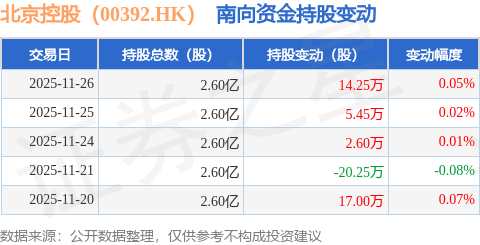
北京控股(00392.HK):11月26日南向资金增持14.25万股
Sou Hu Cai Jing· 2025-11-26 20:48
Group 1 - The core point of the article highlights that southbound funds have increased their holdings in Beijing Holdings (00392.HK) by 142,500 shares on November 26, 2025, marking a total net increase of 190,500 shares over the last five trading days and 1,125,000 shares over the last twenty trading days [1][2] - As of now, southbound funds hold 260 million shares of Beijing Holdings, accounting for 20.69% of the company's total issued ordinary shares [1][2] Group 2 - The trading data shows that on November 25, 2025, there was an increase of 54,500 shares (0.02%), and on November 24, 2025, an increase of 26,000 shares (0.01%) [2] - The company operates primarily in the gas business through five segments, including gas distribution and sales, water services, environmental services, beer production, and other consulting and investment services [2]


在数千家企业中,寻找穿越周期的商业力量
Jing Ji Guan Cha Wang· 2025-11-26 14:45
Core Insights - The conference highlighted the importance of respected enterprises in driving China's economic growth and social progress, emphasizing innovation and long-term value creation [1][2][8] Group 1: Respected Enterprises - The "2024-2025 Respected Enterprises" and "Respected Leading Enterprises" were recognized based on extensive research across thousands of companies and key industries, focusing on operational quality, innovation, public trust, social contribution, and annual impact [1] - Notable companies recognized include Anta, BYD, Huawei, JD.com, Meituan, Qingdao Beer, Ping An, and China Feihe, among others [1] - The event underscored that respected enterprises must address social pain points and create social value while maintaining economic contributions [2] Group 2: Innovation and Quality - High-quality products and services are fundamental to the reputation of respected enterprises, reflecting the innovation management capabilities and ethical standards of their leaders [3] - The need for a supportive environment that encourages innovation and tolerates failure was emphasized, alongside the importance of strategic investments and a stable macro policy [3] - The role of AI in transforming the financial industry was discussed, with a focus on integrating AI technologies to enhance customer service and operational efficiency [4] Group 3: Market Dynamics and Compliance - Antitrust compliance is seen as a catalyst for improving product quality and advancing industries towards higher standards, countering low-quality competition [5][6] - The implementation of antitrust laws has effectively curtailed monopolistic practices, promoting fair competition and encouraging companies to focus on quality [6] Group 4: Future Outlook - The development of new productive forces through technological self-reliance and innovation is crucial for enterprise growth, with China's computing infrastructure being a key asset [7] - The emergence of AI and related technologies is expected to disrupt various industries, leading to new growth opportunities [7]




华润啤酒20251125
2025-11-26 14:15
Summary of China Resources Beer Conference Call Company Overview - **Company**: China Resources Beer - **Industry**: Beverage (Beer and Liquor) Key Points Financial Performance - In 2025, overall operations remained stable with a slight decline in gross margin in the second half, but a more than 2% improvement in the first half due to the use of Australian barley and the implementation of the "Three Gold" plan [2][5] - The company expects capital expenditure to be around 2 billion in 2025, maintaining this level in the coming years while making necessary investments [2][10] Market Trends - There is an increasing consumer demand for differentiated products with high cost-performance ratios, driving the development of regional premium product portfolios [2][6] - The beer market remains stable in terms of consumption and competition, with a year-on-year sales growth of approximately 20% in Q3 2025 [3] Strategic Initiatives - The company is adopting an omnichannel strategy to penetrate the craft beer market and is collaborating with emerging channels like Hema and Sam's Club to produce and sell private label beers [4][12] - Material costs, particularly aluminum cans, constitute the largest expenditure, accounting for about 20%-25% of production costs [13] White Liquor Business - The white liquor industry is undergoing a transformation, with pressure on wholesale prices for leading companies. The company is cautiously optimistic about its white liquor business, which is expected to contribute limited profits in the short term [2][7] Future Outlook - For 2026, if the economic environment remains stable, volume, price, and premiumization trends are expected to be similar to 2025 [2][8] - The company plans to increase its dividend payout ratio from 52% in 2024 to around 60% in 2025, aiming for a gradual increase to over 70% in the following years [2][10] Competitive Landscape - The company is focused on strengthening its competitive advantages against rivals like Budweiser, which has lost market share, by optimizing product structure and enhancing service quality [18][19] - Heineken's brand positioning and consumer perception are seen as significant advantages, with ongoing efforts to enhance brand influence through sponsorships and marketing [17] Cost Management - The company is implementing digital strategies to optimize marketing and production processes, aiming for a slight annual reduction in overall expense ratios over the next 3-5 years [13][15] - The company anticipates manageable material cost pressures in 2026, with strategies in place to adjust procurement practices as needed [14] Product Development - The core product SPRIX has shown unit growth, with expectations for increased sales, although reaching the target of 1 million kiloliters remains challenging [20] - The company is diversifying its product offerings in the 8-10 yuan price range to enhance competitiveness and meet varying consumer preferences [20] Additional Insights - The company is cautious about the white liquor sector's future, maintaining a long-term perspective while adjusting strategies to adapt to industry changes [2][8] - The establishment of new factories, such as the one in Jinan, is part of a broader strategy to enhance operational efficiency and supply chain management [20]
百威亚太三季度在中国销量下滑? 营收被华润啤酒超过
Xin Lang Cai Jing· 2025-11-26 12:51
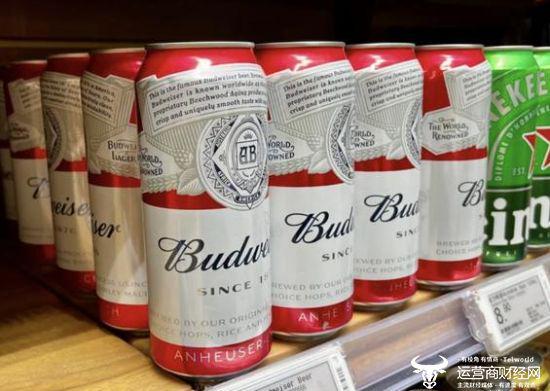
Core Viewpoint - Budweiser APAC reported a decline in both revenue and net profit for Q3 2025, with challenges particularly in the Chinese market [1][3]. Financial Performance - For Q3 2025, Budweiser APAC's revenue was $1.555 billion, down 8.80% year-on-year, and net profit was $185 million, a decrease of 7.96% [3]. - Total revenue for the first nine months of 2025 was $4.691 billion, a decline of 8.09% compared to the previous year, with net profit falling by 19.95% to $594 million [3][4]. - Sales volume for the first nine months was 6.614 million kiloliters, down 7.0% year-on-year [4]. Market Performance - In the Chinese market, sales volume decreased by 9.3% and revenue fell by 11.3% in the first three quarters of 2025 [4]. - In Q3 2025, sales volume in China dropped by 11.4%, and revenue decreased by 15.1%, indicating a worsening trend [4]. Competitive Landscape - Budweiser APAC's revenue for the first half of 2025 was $224.5 million, a year-on-year decline of 7.74%, resulting in the company being surpassed by China Resources Beer, which achieved a revenue growth of 0.83% [5][6]. - In terms of net profit for the first half of 2025, Budweiser APAC reported $29.28 million, down 24.20%, while China Resources Beer saw a net profit increase of 23.04% to $57.89 million [6].


国投证券:食品饮料行业迎来基本面与估值双重复苏机遇
智通财经网· 2025-11-26 09:13
Core Viewpoint - The report from Guotou Securities emphasizes the importance of consumption in economic growth, predicting a stabilization in the consumption fundamentals in 2026, which presents a significant opportunity for investment in the food and beverage industry [1] Group 1: Alcohol Industry - The liquor sector is at a cyclical bottom, with low expectations, low holdings, and low valuations, suggesting potential for left-side layout opportunities [2] - The rapid clearing of financial reports in the past two quarters indicates a resolution of supply-demand conflicts, with a gradual recovery in household consumption expected [2] - The white liquor business model remains strong, and with a potential economic recovery, valuations are likely to rebound quickly [2] Group 2: Beer Industry - The beer sector is expected to maintain a structural market in 2026, with investment opportunities in companies with strong single-product growth logic and those benefiting from competitor adjustments [3] - Overall profitability in the beer sector is on an upward trend, driven by the expansion of products priced between 8-10 yuan and improved efficiency from lean management [3] Group 3: Dairy Industry - The dairy sector is positioned for a turnaround in the raw milk cycle in 2026, with a focus on the profitability elasticity of the dairy supply chain [4] - Demand for dairy products has shown differentiation, with low-temperature fresh milk and cheese experiencing healthy growth, while room temperature liquid milk has been a drag [4] - The average milk price in major production areas is expected to recover above the average cost of production in 2026, making it an opportune time to invest in the dairy supply chain [4] Group 4: Soft Drink Industry - The soft drink sector has seen significant performance differentiation, with companies in strong growth categories leading the industry [5] - In 2026, there is a focus on functional beverages and the competitive landscape of packaged water, with an emphasis on companies introducing new products [5] - The demand for low-sugar functional beverages is anticipated to grow, particularly among white-collar workers seeking fatigue-relief options [5] Group 5: Snack Industry - The snack sector is benefiting from strong new channel drivers, with expectations of improved gross and net profit margins due to scale effects [6] - The konjac product category is maintaining high market interest, with significant growth potential in China [6] - Investment recommendations include focusing on companies with strong performance during the adjustment period and those with leading products in the snack sector [6]



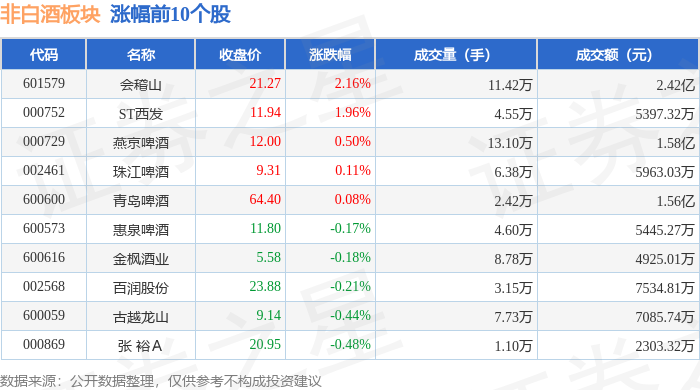
非白酒板块11月26日涨0%,会稽山领涨,主力资金净流入1435.5万元
Zheng Xing Xing Ye Ri Bao· 2025-11-26 09:05
Market Overview - The non-baijiu sector experienced a slight increase of 0.0% on the trading day, with Kuaijishan leading the gains [1] - The Shanghai Composite Index closed at 3864.18, down 0.15%, while the Shenzhen Component Index closed at 12907.83, up 1.02% [1] Stock Performance - Kuaijishan (601579) closed at 21.27, up 2.16% with a trading volume of 114,200 shares and a turnover of 242 million yuan [1] - ST Xifa (000752) closed at 11.94, up 1.96% with a trading volume of 45,500 shares and a turnover of 53.97 million yuan [1] - Cangliang Beer (000729) closed at 12.00, up 0.50% with a trading volume of 131,000 shares and a turnover of 158 million yuan [1] - Other notable stocks include Zhujiang Beer (002461) with a slight increase of 0.11% and Huichuan Beer (600573) with a minor decrease of 0.17% [1] Capital Flow - The non-baijiu sector saw a net inflow of 14.35 million yuan from institutional investors, while retail investors experienced a net outflow of 62.28 million yuan [2] - The overall capital flow indicates a mixed sentiment among different investor types, with institutional and speculative funds showing net inflows while retail investors withdrew funds [2][3] Individual Stock Capital Flow - Kuaijishan had a net inflow of 6.97 million yuan from institutional investors, while retail investors had a net outflow of 11.81 million yuan [3] - Chongqing Beer (600132) saw a net inflow of 5.78 million yuan from institutional investors but a significant outflow of 15.45 million yuan from retail investors [3] - ST Xifa (000752) had a net inflow of 4.64 million yuan from institutional investors, with retail investors also withdrawing funds [3]


食饮年度投资策略:稳基调黎明将至,抱主线向阳而生
Guotou Securities· 2025-11-26 08:09
Core Insights - The report emphasizes a cautious yet optimistic outlook for the food and beverage sector, suggesting that the economic cycle and drinking policies will stabilize, leading to potential recovery in valuations, particularly in the liquor segment [1][12] - The investment strategy focuses on identifying companies with strong performance resilience and growth potential across various sub-sectors, including liquor, beer, dairy, soft drinks, and snacks [12] Group 1: Liquor Industry - The liquor sector is currently experiencing a bottoming out phase, with low expectations, low holdings, and low valuations. The report suggests that the supply-demand imbalance is easing, and consumer spending is expected to gradually recover, making it a good time to invest in leading brands like Moutai and Wuliangye [1][27] - In Q3 2025, the liquor industry saw a revenue and profit decline of around 20%, with high-end and regional liquor experiencing significant drops in growth rates. The report indicates that the industry is in an adjustment phase, with companies becoming more pragmatic in their growth targets [27][39] - The report highlights a trend towards premiumization, with consumers increasingly favoring well-known brands and products, leading to a concentration of market share among top players [53][58] Group 2: Beer Industry - The beer sector is expected to maintain a structural growth trend, particularly for companies with strong single-product growth logic. The profitability of beer companies is on an upward trajectory, driven by the expansion of products priced between 8-10 yuan and improved operational efficiency [2] Group 3: Dairy Industry - The dairy sector is poised for a turnaround in the raw milk cycle in 2026, with expectations of recovering demand for raw milk as deep processing capacities come online. The report recommends investing in the dairy supply chain, as average milk prices are projected to rise above production costs [3][6] Group 4: Soft Drinks Industry - The soft drink sector is advised to focus on high-growth categories and capitalize on changes in competitive dynamics within the market. The report notes that functional beverages, particularly low-sugar options, are expected to gain traction, catering to the needs of health-conscious consumers [4] Group 5: Snack Industry - The snack segment is benefiting from new channel dynamics, with significant growth potential in bulk snack sales. The report highlights the strong performance of companies like Wancheng Group and suggests that products like konjac snacks have substantial market growth opportunities [5][20]
食品饮料周报(25年第43周):白酒板块红利属性凸显,关注大众品消费场景恢复-20251125
Guoxin Securities· 2025-11-25 13:55
Investment Rating - The report maintains an "Outperform the Market" rating for the food and beverage sector [4][5][15]. Core Views - The food and beverage sector is expected to benefit from a recovery in consumer spending, particularly in the context of the upcoming 2026 fiscal year, with a focus on health innovation and digital supply chains [3][10]. - The report highlights the differentiation in performance across categories, with beverages outperforming food and alcoholic beverages [2][10]. - Key investment opportunities are identified in premium liquor brands, dairy products, and innovative snack foods, with specific recommendations for companies like Guizhou Moutai, Yili, and Eastroc Beverage [2][3][15]. Summary by Relevant Sections Market Overview - The food and beverage sector saw a cumulative decline of 1.52% this week, with A-shares down 1.36% and H-shares down 3.69% [1]. - Notable performers included Nanchao Food (+11.91%) and Yili (+2.65%) [1]. Alcoholic Beverages - The liquor sector is entering a left-side layout phase, with premium brands expected to gain market share [2][10]. - Recommendations include Luzhou Laojiao, Shanxi Fenjiu, and Guizhou Moutai, with a focus on companies that can leverage pricing power and regional advantages [2][10]. Beer - The beer industry is experiencing healthy inventory levels, with expectations for demand recovery [2][11]. - Yanjing Beer is recommended for its strong growth potential and ongoing internal reforms [2][11]. Dairy Products - The dairy sector is seeing a steady recovery in demand, with Yili recommended for its valuation safety margin [2][13]. - The report anticipates improvements in supply-demand dynamics by 2026 [2][13]. Snacks - The report emphasizes the growth potential of konjac snacks, with leading companies like Weilong and Yanjinpuzi showing strong competitive advantages [2][12]. - The snack industry is shifting towards a category-driven growth model, necessitating strong product differentiation [2][12]. Investment Recommendations - The recommended investment portfolio includes Guizhou Moutai, Babi Food, Eastroc Beverage, Weilong, and Luzhou Laojiao, with an average decline of 4.94% this week [3][15]. - The report suggests that the current pricing environment for Moutai presents a favorable investment opportunity, with expectations for revenue growth in the coming years [15][16].




国家级啤酒评酒委员换届选拔首次落地重庆
Ren Min Wang· 2025-11-25 13:36
【中国国际啤酒网】11月23-25日,由中国酒业协会主办、重庆啤酒股份有限公司支持的第八届国 家级啤酒评酒委员换届选拔在重庆南坪会展中心会议中心举行,384名来自全国各地的啤酒品评高手齐 聚一堂。中国酒业协会秘书长何勇表示,这是该项选拔活动首次在渝举办,旨在借助重庆成熟的啤酒产 业基础和多样饮食文化,进一步丰富中国啤酒感官评价体系。 中国啤酒品评最高水平赛事 持续加大在品评领域投入 重啤派出76名品评员参考 在为期三天的选拔活动,参赛选手将经历严格的理论考试和感官品评测试。考核内容涵盖啤酒风味 特征识别、品质缺陷诊断、啤酒风格判断等多个方面,全面评估选手的专业素养和实践能力。 考完当即出结果 前20名获评首席评酒委员 对于专业选手,何勇说,最难的应该是复合风味识别。他介绍说,仪器能够检测出来的风味物质有 3000多种,人的味觉能够识别的有200多种,而考试会在基酒中加2-4种风味,要求品评员一一识别出 来,识别错误不得分,多识别倒扣分。"风味物质加的量可以说是微乎其乎,比如每一升啤酒只加1-2毫 克。" 与往届考试不同的是,此次考试将在25日考完当天出结果。"这也是开展这项选拔以来,首次在考 试结束后1小时出 ...
2025年10月中国啤酒进出口数量分别为0.27亿升和0.56亿升
Chan Ye Xin Xi Wang· 2025-11-25 03:27
数据来源:中国海关,智研咨询整理 近一年中国啤酒出口情况统计图 数据来源:中国海关,智研咨询整理 上市企业:燕京啤酒(000729),青岛啤酒(600600),珠江啤酒(002461),重庆啤酒(600132), 惠泉啤酒(600573) 相关报告:智研咨询发布的《2025-2031年中国无醇啤酒行业市场行情动态及竞争战略分析报告》 根据中国海关数据显示:2025年10月中国啤酒进口数量为0.27亿升,同比下降10.7%,进口金额为0.4亿 美元,同比下降0.4%,2025年10月中国啤酒出口数量为0.56亿升,同比增长4.6%,出口金额为0.39亿美 元,同比下降5.2%。 近一年中国啤酒进口情况统计图 知前沿,问智研。智研咨询是中国一流产业咨询机构,十数年持续深耕产业研究领域,提供深度产业研 究报告、商业计划书、可行性研究报告及定制服务等一站式产业咨询服务。专业的角度、品质化的服 务、敏锐的市场洞察力,专注于提供完善的产业解决方案,为您的投资决策赋能。 ...
