
公用事业

Search documents
PG&E Corporation (NYSE: PCG) Overview and Financial Outlook
Financial Modeling Prep· 2025-10-03 21:00
Company Overview - PG&E Corporation (NYSE: PCG) is a leading utility company in California, recognized for its extensive infrastructure and commitment to sustainable energy, competing with major players like Southern California Edison and San Diego Gas & Electric [1] Stock Performance - Jefferies updated its price target for PG&E to $20, indicating a potential upside of approximately 25.75% from its current trading price of $15.91, reflecting a more cautious stance compared to the previous target of $22 [2] - The stock is currently trading at $15.90, showing a slight increase of 1.70% or $0.27 [2] - PG&E's stock has experienced volatility, with a daily trading range between $15.62 and $15.97, and over the past year, it has seen highs of $21.72 and lows of $12.97, influenced by regulatory shifts and market dynamics [4] Market Capitalization and Trading Volume - PG&E has a market capitalization of approximately $34.93 billion, making it a significant player in the market [5] - The trading volume for the day reached 13.91 million shares, indicating strong investor interest [5] Upcoming Earnings Announcement - PG&E is scheduled to announce its third-quarter 2025 earnings on October 23, 2025, with a conference call at 11:00 a.m. Eastern Time, accessible via a webcast on PG&E's official website [3]


刚刚,港股突发!这个概念突然猛涨!
天天基金网· 2025-10-03 05:42
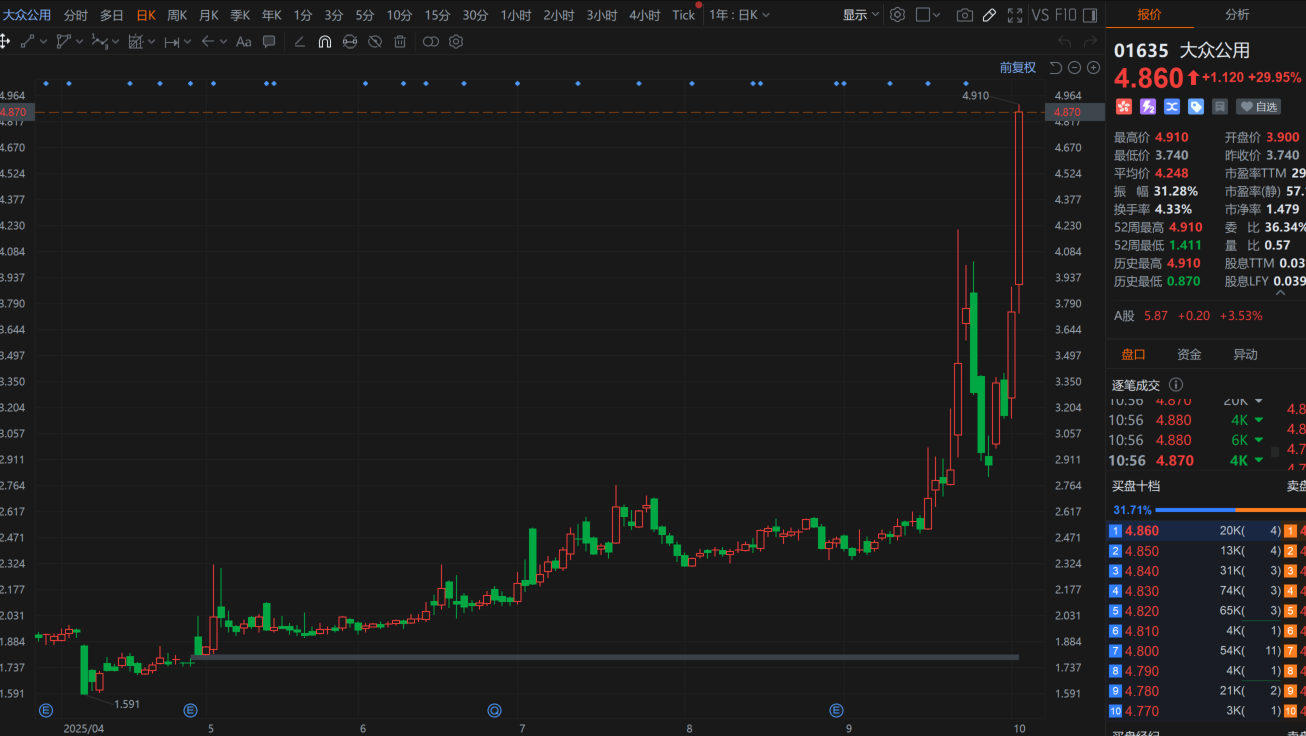
Core Viewpoint - The article discusses the significant rise in the stock price of Dazhong Public Utilities amid a generally declining Hong Kong stock market, highlighting its connections to investments in popular companies and the nuclear energy sector [3][4][5]. Group 1: Dazhong Public Utilities - Dazhong Public Utilities' stock price surged over 30%, reaching a historical high of 4.92 HKD per share, with a cumulative increase of nearly 70% over the last four trading days [3][4]. - The company holds a 10.7996% stake in Shenzhen Capital Group, which has investments in notable firms like Yushu Technology and GPU company Moore Threads, the latter having recently passed the IPO review [5][6]. - In the first half of the year, Dazhong Public Utilities reported a revenue of 3.476 billion CNY, a decrease of 5.80% year-on-year, while net profit increased by 172.62% to 333 million CNY [6]. Group 2: Nuclear Energy Sector - Nuclear energy stocks experienced a collective surge, with companies like China Nuclear International and Shanghai Electric seeing increases of over 20% and 16%, respectively, due to positive developments in the nuclear energy field [8][9]. - The BEST project in Hefei achieved a key breakthrough, marking a significant step towards demonstrating nuclear fusion power generation by 2025 [8]. - The Tianwan Nuclear Power Base has safely generated over 500 billion kilowatt-hours of electricity, significantly contributing to green energy supply in the Yangtze River Delta [9]. - A report from CMB International suggests that nuclear power demand may exceed expectations from 2026 to 2030, driven by the recovery of nuclear power plants in the U.S. and advancements in artificial intelligence [9][10].

港股突发,这一股猛涨
Zheng Quan Shi Bao· 2025-10-03 05:07
Group 1: Company Overview - Dazhong Public Utility (01635.HK) is an investment holding company driven by public utilities and financial venture capital [1][4] - The company holds a 10.7996% stake in Shenzhen Capital Group, making it the fourth-largest shareholder [2][4] - Dazhong Public Utility has invested in nearly 300 listed companies through its direct investment and venture capital platforms [4] Group 2: Recent Stock Performance - On October 3, Dazhong Public Utility's stock price surged, reaching a peak of 4.92 HKD per share, marking a historical high with an intraday increase of over 30% [1][2] - The stock has seen a cumulative increase of nearly 70% over the last four trading days [2] - As of the midday close, the market capitalization of Dazhong Public Utility was reported at 18.1 billion HKD [2] Group 3: Investment in Technology - Dazhong Public Utility's stock price increase is linked to its indirect investment in popular companies, including its stake in Shenzhen Capital Group, which has invested in Yushu Technology and the GPU company Moore Threads [2][3] - Moore Threads has successfully passed the listing review by the Shanghai Stock Exchange, with projected revenue of 702 million CNY for the first half of 2025, reflecting a year-on-year growth of 238.71% [3] Group 4: Nuclear Energy Sector - Nuclear energy stocks, including China National Nuclear Corporation and Shanghai Electric, experienced significant gains, with increases of over 20% and 16% respectively [6] - Recent advancements in nuclear fusion technology, such as the BEST project in Anhui, have contributed to positive sentiment in the nuclear sector [6][7] - The demand for nuclear power is expected to rise significantly from 2026 to 2030, driven by the recovery of nuclear power plants in the U.S. [7]

上线23天,用户突破4亿!阿里关键业务有重大进展,股价创下4年多新高
Mei Ri Jing Ji Xin Wen· 2025-10-03 05:05
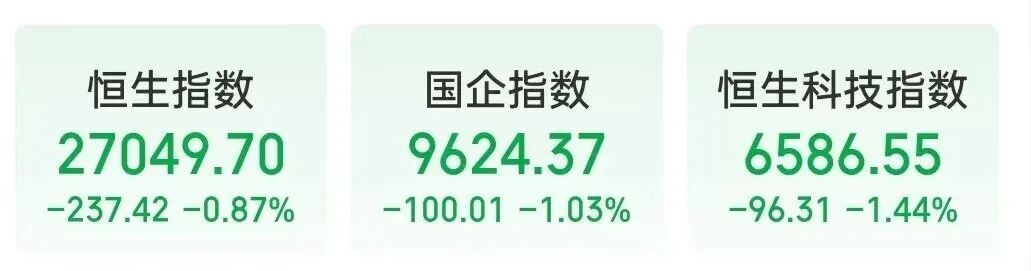
Core Viewpoint - The Hong Kong stock market experienced a decline, with the Hang Seng Index down by 0.87%, while certain sectors like utilities and coal showed gains, indicating mixed market sentiment [1]. Group 1: Stock Performance - The Hang Seng Index fell by 0.87%, the Hang Seng China Enterprises Index dropped by 1.03%, and the Hang Seng Tech Index decreased by 1.44% [1]. - Technology stocks in Hong Kong saw a mixed performance, with SMIC down by 0.5% and Tencent down by 0.44%, while Alibaba reached a four-year high, increasing by 0.33% [3]. - Alibaba's stock price hit a recent high of 183.7 HKD per share, with a market capitalization of approximately 3.5 trillion HKD [4]. Group 2: Analyst Insights - Morgan Stanley raised Alibaba's target price in Hong Kong by nearly 45% to 240 HKD per share by the end of 2026, based on improved cloud business prospects and synergies between AI and e-commerce [8]. - Alibaba's stock rose by 53% in September, making it the best performer among Hang Seng Index constituents, driven by increased investor sentiment following its AI investment announcements [8]. Group 3: Company Developments - Alibaba is actively involved in all aspects of generative AI, which is expected to enhance merchant operational efficiency [9]. - Alibaba's Gaode Map launched a new service to support offline consumption, with a significant increase in user engagement and order volume in the local dining sector [9]. Group 4: Market Trends - The Hong Kong stock market is expected to maintain its upward trend, supported by strong demand for quality targets like AI, and a favorable external environment [16]. - In September, foreign capital inflows into the Chinese stock market reached 4.6 billion USD, the highest monthly figure since November 2024, indicating renewed interest from international investors [16].
大众公用再涨超30%,股价创上市新高
Feng Huang Wang· 2025-10-03 03:23
Core Viewpoint - The stock price of China Resources Gas (01635.HK) has surged over 30%, reaching a historical high of 4.9 HKD, driven by news of its investment in Shenzhen Capital Group and the upcoming IPO of Yushu Technology [1] Group 1: Company Developments - China Resources Gas has a 10.80% stake in Shenzhen Capital Group, which is a significant source of profit for the company [1] - Shenzhen Capital Group and its funds hold shares in Yushu Technology, which is expected to submit its IPO application to the stock exchange in the fourth quarter of this year [1] Group 2: Market Reactions - The stock price increase reflects positive market sentiment following the announcement of the IPO and the company's investment activities [1] - The highest intraday price of 4.9 HKD marks a new historical peak for China Resources Gas [1] Group 3: Industry Context - The company operates in both public utilities and financial investment sectors, indicating a diversified business model [1] - The venture capital business is highlighted as an important segment for China Resources Gas, contributing significantly to its revenue [1]
港股异动 | 大众公用(01635)再涨超18% 股价创上市新高 近一个月股价累计飙升八成
Zhi Tong Cai Jing· 2025-10-03 03:03
Core Viewpoint - The stock of China Resources Gas (01635) has surged over 18%, reaching a new high of 4.45 HKD, with a cumulative increase of 80% over the past month [1] Company Summary - China Resources Gas has a significant stake in Shenzhen Capital Group, holding 10.80% of its shares, which is a crucial part of its investment and profit strategy [1] - The company is involved in both public utilities and financial investment, with venture capital being an important business segment [1] Market Activity - As of the latest report, the stock price increased by 18.18%, trading at 4.42 HKD with a transaction volume of 59.37 million HKD [1] - The company is expected to benefit from the upcoming IPO applications of its associated entities, including Yushu Technology and Moole Technology, which have received investments from Shenzhen Capital Group [1]
港股大众公用股价持续拉升,现涨超26%
Mei Ri Jing Ji Xin Wen· 2025-10-03 03:02
每经AI快讯,10月3日,港股大众公用股价持续拉升,现涨超26%,盘中最高见4.77港元,创历史新 高。 ...
大众公用再涨超30% 股价创上市新高
Xin Lang Cai Jing· 2025-10-03 03:02
Core Viewpoint - The stock price of Dazhong Public Utilities has surged over 30%, reaching a historical high of 4.9 HKD, driven by news of its investment in Shenchuang Investment and the upcoming IPO of Yushu Technology [1] Company Summary - Dazhong Public Utilities is an investment holding company engaged in both public utilities and financial venture capital, with venture capital being a significant business segment and profit source [1] - The company holds a 10.80% stake in Shenchuang Investment, which is involved in various investments including Yushu Technology [1] Industry Summary - Yushu Technology is expected to submit its listing application to the stock exchange in the fourth quarter of this year [1] - On September 26, the Shanghai Stock Exchange disclosed that the IPO application of Moer Thread has passed the review by the listing committee [1] - Moer Thread has received investments from multiple institutions, including Shenchuang Investment, indicating a robust interest in technology ventures [1]
港股集体回撤,公用、工商、科技、石油纷纷跳水
Ge Long Hui· 2025-10-02 12:44
Market Overview - The Hong Kong stock market continued its weak performance, with the Hang Seng Index closing down 1.67% after opening lower and maintaining a low-level consolidation throughout the day [1] - All sectors experienced declines of over 1%, with the Hang Seng Utilities Index showing the least decline, followed by the Hang Seng Industrial Index, Mainland Oil Index, and Hang Seng Technology Index [1] Sector Performance Utilities Sector - The Hang Seng Utilities Index opened lower and ended the day down 2.12%, with notable declines in stocks such as: - New Energy down 2.79% - Hong Kong and China Gas down 2.55% - CLP Holdings down 2.24% - Cheung Kong Infrastructure down 2.18% - Power Assets Holdings down 1.9% [1] Industrial Sector - The Hang Seng Industrial Index also opened lower and closed down 1.93%, with significant drops in: - Xinyi Solar down 5.41% - Sunny Optical Technology down 3.9% - Orient Overseas International down 3.85% - Geely Automobile down 3.47% - China Overseas Development down 3.35% - Zhongsheng Holdings down 3.19% [1] Mainland Oil Sector - The previously strong Mainland Oil sector saw a pullback, closing down 1.88%, with declines in: - CNOOC down 3.19% - Sinopec down 1.82% - PetroChina down 1.54% - China Oilfield Services down 0.65% [1] Technology Sector - The Hang Seng Technology Index opened lower and closed down 1.76%, with key stocks experiencing declines such as: - Meituan down 3.09% - Li Auto down 2.88% - SMIC down 2.72% - Dongfang Zhenxuan down 2.71% - NetEase down 2.64% - Other stocks like Tongcheng Travel, JD Group, and Ping An Good Doctor also saw declines exceeding 2% [2]
大众公用午后一度涨超22% 市场追捧宇树及摩尔线程概念
Zhi Tong Cai Jing· 2025-10-02 05:54
大众公用(600635)(01635)午后一度涨超22%,截至发稿,涨17.09%,报3.7港元,成交额6947.08万港 元。 公开资料显示,大众公用为公用事业与金融创投齐头并进的投资控股型企业,其中,创投业务是大众公 用较为重要的业务板块和利润来源,该公司持有深创投10.80%股权。 消息面上,9月26日,上交所官网披露信息显示,摩尔线程科创板IPO申请通过上交所上市委会议审 议。据悉,摩尔线程成立后曾获得包括深创投在内的多家机构投资。大众公用此前在互动平台表示,公 司参股深创投,深创投及其基金持有宇树科技股份。宇树科技预计于今年四季度向证券交易所提交上市 申请文件。 ...