电子设备制造业

Search documents
领益智造: 内部审计制度
Zheng Quan Zhi Xing· 2025-06-17 12:21
广东领益智造股份有限公司 内部审计制度 广东领益智造股份有限公司 (2025 年 6 月) 第一章 总则 第一条 为规范广东领益智造股份有限公司(以下简称"公司")内部审计工作,提高内 部审计工作质量,保护投资者合法权益,不断提高企业运营的效率及效果,依据《中华人民 共和国公司法》《中华人民共和国审计法》《审计署关于内部审计工作的规定》《深圳证券 交易所股票上市规则》《上市公司独立董事管理办法》《深圳证券交易所上市公司自律监管 指引第1号——主板上市公司规范运作》等法律、行政法规、部门规章及规范性文件以及《广 东领益智造股份有限公司公司章程》(以下简称"《公司章程》")的有关规定和要求,结合 公司实际,制定本制度。 第二条 本制度所称被审计对象,特指公司和公司各部门、全资或控股子公司及其直属 分支机构(含控股子公司),及上述机构相关责任人员。 第三条 本制度所称内部审计,是指由公司内部机构或人员,对内部控制和风险管理的 有效性、财务信息的真实性和完整性以及经营活动的效率和效果等开展的一种评价活动。 第四条 本制度所称内部控制,是指由公司董事会、审计委员会、高级管理人员及其他 有关人员为实现下列目标而提供合理保 ...

领益智造: 董事和高级管理人员所持公司股份及其变动管理制度
Zheng Quan Zhi Xing· 2025-06-17 12:21
General Principles - The management system for the shares held by the directors and senior management of Guangdong Lingyi Intelligent Manufacturing Co., Ltd. aims to strengthen the management of shareholding and changes, clarifying management procedures based on relevant laws and regulations [1][2] - This system applies to directors, senior management, and other specified individuals or organizations holding and trading the company's stocks and derivatives [1][2] Shareholding and Trading Regulations - Directors and senior management must strictly manage their personal stock accounts and are prohibited from transferring or lending their accounts to others for trading the company's stocks [2][3] - They are also prohibited from engaging in margin trading with the company's stocks as the underlying securities [2][3] Reporting and Disclosure Requirements - The company secretary is responsible for managing the identity and shareholding data of directors and senior management, ensuring timely and accurate reporting of share trading activities [3][4] - Directors and senior management must report any changes in their shareholding within two trading days and disclose this information through the company's announcements [10][11] Trading Limitations - Directors and senior management are restricted from trading the company's stocks during specific periods, such as before the announcement of annual and quarterly reports [8][9] - They are also prohibited from transferring shares within one year of the company's stock listing and for six months after leaving their positions [9][10] Share Transfer Conditions - The company may impose additional conditions on the transfer of shares held by directors and senior management, such as performance assessments and lock-up periods [10][11] - Any shares that are subject to lock-up will retain their rights, such as dividend rights and voting rights, during the lock-up period [10][11] Violations and Penalties - If directors and senior management engage in illegal trading activities, the company board is required to recover any profits made from such transactions and disclose the details of the violations [12][13] - The company must also disclose any instances of non-compliance with trading regulations in its periodic reports [12][13]
领益智造: 董事会秘书工作细则
Zheng Quan Zhi Xing· 2025-06-17 12:21
General Provisions - The document outlines the work guidelines for the Secretary of the Board of Guangdong Lingyi Intelligent Manufacturing Co., Ltd, ensuring the Secretary's responsibilities align with relevant laws and regulations [1][2] - The Secretary serves as the designated liaison between the company and the Shenzhen Stock Exchange, as well as regulatory bodies, and is accountable to the company and the Board [1][2] Qualifications for the Secretary - The Secretary must possess necessary financial, management, and legal knowledge, along with good professional ethics and personal integrity, and must hold a qualification certificate issued by the Shenzhen Stock Exchange [2] Responsibilities of the Secretary - The Secretary is responsible for coordinating the company's information disclosure, managing investor relations, organizing board and shareholder meetings, and ensuring compliance with disclosure regulations [3][4] - The Secretary must maintain confidentiality regarding undisclosed significant information and report any leaks to the Shenzhen Stock Exchange promptly [3][4] - The Secretary is tasked with training board members and senior management on securities laws and regulations, ensuring adherence to legal obligations [4] Appointment and Dismissal Procedures - The company must appoint a new Secretary within three months of the previous Secretary's departure and must also appoint a Securities Affairs Representative to assist [5][6] - The company is required to publicly announce the appointment of the Secretary and the Securities Affairs Representative, providing necessary documentation [5] - The Secretary can be dismissed for valid reasons, and the company must report the reasons for dismissal to the Shenzhen Stock Exchange [5][6] Additional Provisions - In the event of a vacancy, the Board must designate a director or senior manager to perform the Secretary's duties temporarily [6] - The Secretary must participate in ongoing training organized by the Shenzhen Stock Exchange during their tenure [6] - The guidelines will be effective upon approval by the Board and will be interpreted by the Board [7]
东山精密: 关于签订募集资金三方监管协议的公告
Zheng Quan Zhi Xing· 2025-06-17 09:20
证券代码:002384 证券简称:东山精密 公告编号:2025-042 本公司及董事会全体成员保证信息披露的内容真实、准确、完整,没有虚假 记载、误导性陈述或重大遗漏。 一、募集资金基本情况 经中国证券监督管理委员会《关于苏州东山精密制造股份有限公司向特定对 象发行股票注册的批复》(证监许可〔2025〕911 号)核准,苏州东山精密制造 股份有限公司(以下简称"公司"或"本公司")向特定对象发行人民币普通股 (A 股)股票 125,693,822 股,每股发行价格 11.17 元,募集资金总额为 券股份有限公司(以下简称"国泰海通")于 2025 年 6 月 11 日将人民币 发行费用 3,487,447.01 元(不含税),以及扣除公司以自有资金预付的保荐费 募集资金到位情况经天健会计师事务所(特殊普通合伙)审验,并由其出具了《验 资报告》(天健验〔2025〕5-2 号)。 二、募集资金三方监管协议的签订情况和募集资金专户的开立情况 为规范公司募集资金的存放、使用与管理,保护投资者合法权益,根据《深 圳证券交易所股票上市规则》《深圳证券交易所上市公司自律监管指引第 1 号— —主板上市公司规范运作(2025 ...

ST新亚: 公司章程 (2025年6月)
Zheng Quan Zhi Xing· 2025-06-13 14:04
Core Points - The company is named Sunyes Manufacturing (Zhejiang) Co., Ltd., established as a joint-stock limited company in accordance with Chinese laws [1][2] - The company was approved by the China Securities Regulatory Commission for its initial public offering of 28 million shares in March 2010, and it is listed on the Shenzhen Stock Exchange [1][2] - The registered capital of the company is RMB 506.53422 million [1][2] Company Structure - The company is a permanent joint-stock limited company, with all assets divided into equal shares, and shareholders are liable only to the extent of their subscribed shares [2][3] - The chairman serves as the legal representative of the company [2] Business Objectives and Scope - The company's business objective is to enhance and improve management, focusing on core talents, technologies, and products, with a market-oriented approach to maximize shareholder benefits [3][4] - The business scope includes research and promotion of new materials technology, sales of electronic products, instruments, and various other products, as well as domestic and international trade [3][4] Share Issuance - The company's shares are issued in the form of stocks, with each share having a par value of RMB 1 [4][5] - The total number of shares issued by the company is 506.53422 million, all of which are ordinary shares [4][5] Shareholder Rights and Obligations - Shareholders have rights to dividends, participate in shareholder meetings, supervise company operations, and transfer their shares [9][10] - Shareholders are obligated to comply with laws and regulations, pay for their subscribed shares, and not abuse their rights to harm the company or other shareholders [12][13] Shareholder Meetings - The company holds annual and temporary shareholder meetings, with specific procedures for calling and conducting these meetings [44][46] - Decisions at shareholder meetings require a majority or two-thirds majority vote, depending on the nature of the resolution [79][81] Board of Directors - The board of directors is responsible for the company's operations and decision-making, with specific qualifications and restrictions for board members [98] - The board must report to shareholders annually and is accountable for its actions [73][98]
利通电子: 603629:中信建投证券股份有限公司关于江苏利通电子股份有限公司差异化分红事项的核查意见
Zheng Quan Zhi Xing· 2025-06-13 10:06
Group 1 - The company plans to distribute a cash dividend of RMB 0.5 per 10 shares to all shareholders, excluding shares held in the repurchase account, resulting in a total cash dividend distribution of RMB 12.9315 million [2][3] - The total number of shares eligible for the dividend distribution is calculated as 25,863,000 shares, which is the total shares minus the 1,300,000 shares repurchased [2][3] - The company will not issue bonus shares or convert capital reserves into share capital for the 2024 fiscal year [3][4] Group 2 - The reference price for the ex-dividend date is calculated using the formula: (previous closing price - cash dividend) / (1 + change in circulating shares ratio), resulting in an ex-dividend reference price of approximately RMB 23.4603 per share [4][5] - The impact of the differential dividend on the ex-dividend reference price is minimal, calculated to be less than 1% [5] - The sponsor institution confirms that the differential dividend distribution complies with relevant laws, regulations, and the company's articles of association, ensuring no harm to the interests of the company and all shareholders [5]

凯旺科技投资3,000万设立全资子公司完成工商登记
Sou Hu Cai Jing· 2025-06-13 09:33
Group 1 - The company announced the establishment of a wholly-owned subsidiary, Jianshi Kaiwang Precision Industry Co., Ltd., with a registered capital of 30 million RMB [2] - The subsidiary's business scope includes the processing and sales of mechanical parts, mold manufacturing and sales, and electronic component manufacturing and sales [2] - The company was founded in November 2009, with a registered capital of 95.82 million RMB, and is primarily engaged in the R&D, production, and sales of electronic precision cable connection components [2] Group 2 - The company's revenue for 2022 to 2024 is projected to be 505 million RMB, 546 million RMB, and 596 million RMB, with year-on-year growth rates of -18.03%, 8.27%, and 9.12% respectively [3] - The net profit attributable to the parent company for the same period is expected to be 32.30 million RMB, -56.82 million RMB, and -93.45 million RMB, with year-on-year changes of -40.92%, -276.15%, and -64.47% respectively [3] - The company's asset-liability ratio is forecasted to be 15.65%, 30.84%, and 54.30% over the same period [3]

实益达上市18周年:利润由盈转亏,市值较峰值蒸发65%
Sou Hu Cai Jing· 2025-06-13 00:36
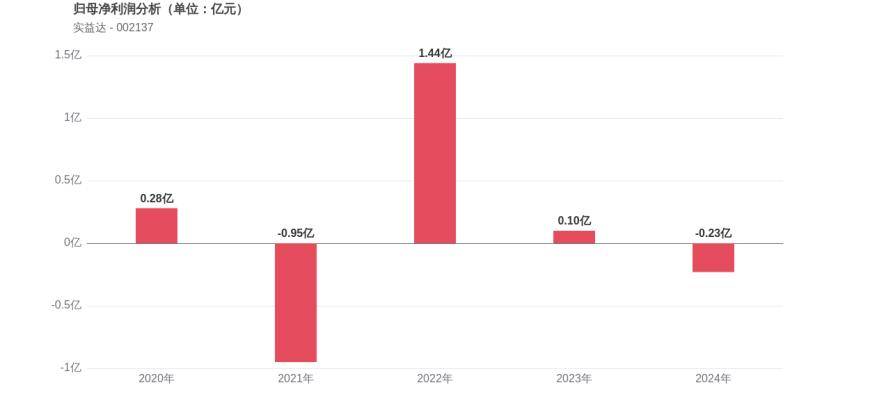
Core Insights - The company, Shiyida, has faced significant challenges since its IPO in June 2007, with its market value fluctuating from 4.289 billion yuan at the time of listing to 4.614 billion yuan currently, indicating a tumultuous growth journey [1] Business Overview - Shiyida specializes in PCBA control board assembly and produces a limited range of complete products such as DVDs, set-top boxes, and MP3 players. The main revenue sources are smart terminal products, accounting for 77.01%, and smart hardware manufacturing, which contributes 22.35% [3] Financial Performance - In 2007, the company reported a net profit attributable to shareholders of 62 million yuan, while the latest complete fiscal year for 2024 shows a net loss of 23 million yuan, resulting in a cumulative profit decline of 137.93% over 18 years [3] - The company has recorded losses in 4 out of the 18 years since its IPO, with profitable years accounting for 8 years, representing 44.44% of the total [3] - Revenue has decreased from 784 million yuan in 2020 to 595 million yuan in 2024, indicating a contraction in overall revenue scale [4] - The net profit attributable to shareholders has shifted from a profit of 28 million yuan in 2020 to a loss of 23 million yuan in 2024, reflecting a transition from marginal profitability to losses [5] Market Value Trends - The peak market value of Shiyida reached 13.261 billion yuan on December 31, 2015, with a stock price of 25.97 yuan. As of June 12, the stock price is 7.99 yuan, and the market value is 4.614 billion yuan, representing a decrease of 8.646 billion yuan and a market value evaporation of 65.20% [7]

宝明科技: 关于取得金融机构股票回购贷款承诺函的公告
Zheng Quan Zhi Xing· 2025-06-11 09:22
Group 1 - The company plans to repurchase a portion of its restricted shares using self-owned funds, with a total amount of 7.62231 million yuan allocated for this purpose [1][2] - The repurchase is part of a strategy to reduce registered capital and is not expected to significantly impact the company's annual operating performance [2] - The company has obtained a loan commitment letter from Shanghai Bank, confirming that the repurchase loan complies with relevant regulations and bank policies [1][2] Group 2 - The specific details regarding the number, price, and timing of the repurchased shares will be disclosed on April 29, 2025, on the company's information platform [2] - The repurchase does not constitute a related party transaction or a major asset restructuring [2]
信濠光电1年1期亏损 2021上市募19.8亿渤海证券保荐
Zhong Guo Jing Ji Wang· 2025-06-11 07:39
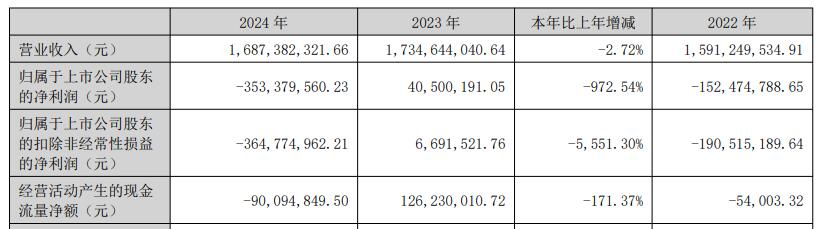
Core Viewpoint - Xinhau Optoelectronics reported a decline in revenue and significant losses in net profit for the fiscal year 2024 compared to the previous year, indicating financial challenges for the company [1][2]. Financial Performance Summary - The company achieved operating revenue of 1.688 billion yuan in 2024, a decrease of 2.72% from 1.735 billion yuan in 2023 [2]. - The net profit attributable to shareholders was -353.8 million yuan in 2024, a drastic decline from a profit of 40.5 million yuan in 2023, representing a decrease of 972.54% [2][3]. - The net profit after excluding non-recurring gains and losses was -364.8 million yuan in 2024, compared to a profit of 6.69 million yuan in the previous year, marking a decline of 5,551.30% [2][3]. - The net cash flow from operating activities was -90.1 million yuan in 2024, down from a positive cash flow of 126.2 million yuan in 2023, reflecting a decrease of 171.37% [2][3]. Q1 2025 Performance - In the first quarter of 2025, the company reported operating revenue of 421.1 million yuan, a decline of 3.57% from 436.7 million yuan in the same quarter of 2024 [3]. - The net profit attributable to shareholders for Q1 2025 was -105.3 million yuan, worsening from -28.4 million yuan in Q1 2024, indicating a decline of 270.31% [3]. - The net cash flow from operating activities in Q1 2025 was -197.4 thousand yuan, a significant drop from a positive cash flow of 1.27 million yuan in the same quarter of the previous year, representing a decrease of 255.46% [3]. Initial Public Offering (IPO) Details - Xinhau Optoelectronics was listed on the Shenzhen Stock Exchange on August 27, 2021, with an initial share price of 98.80 yuan and a total of 20 million shares issued [4]. - The company raised a total of 1.976 billion yuan from the IPO, with a net amount of 1.895 billion yuan after deducting issuance costs [4]. - The stock reached a peak price of 181 yuan on its first trading day but is currently trading below its IPO price [4]. Dividend Distribution - The company announced a dividend distribution plan for 2023, proposing a cash dividend of 2 yuan per 10 shares and a capital reserve conversion of 4 shares for every 10 shares held [5]. - For the 2024 profit distribution, the company plans to distribute a cash dividend of 0.5 yuan per 10 shares and convert 2 shares for every 10 shares held, with an estimated total cash dividend of 8.46 million yuan [5].