
信托

Search documents
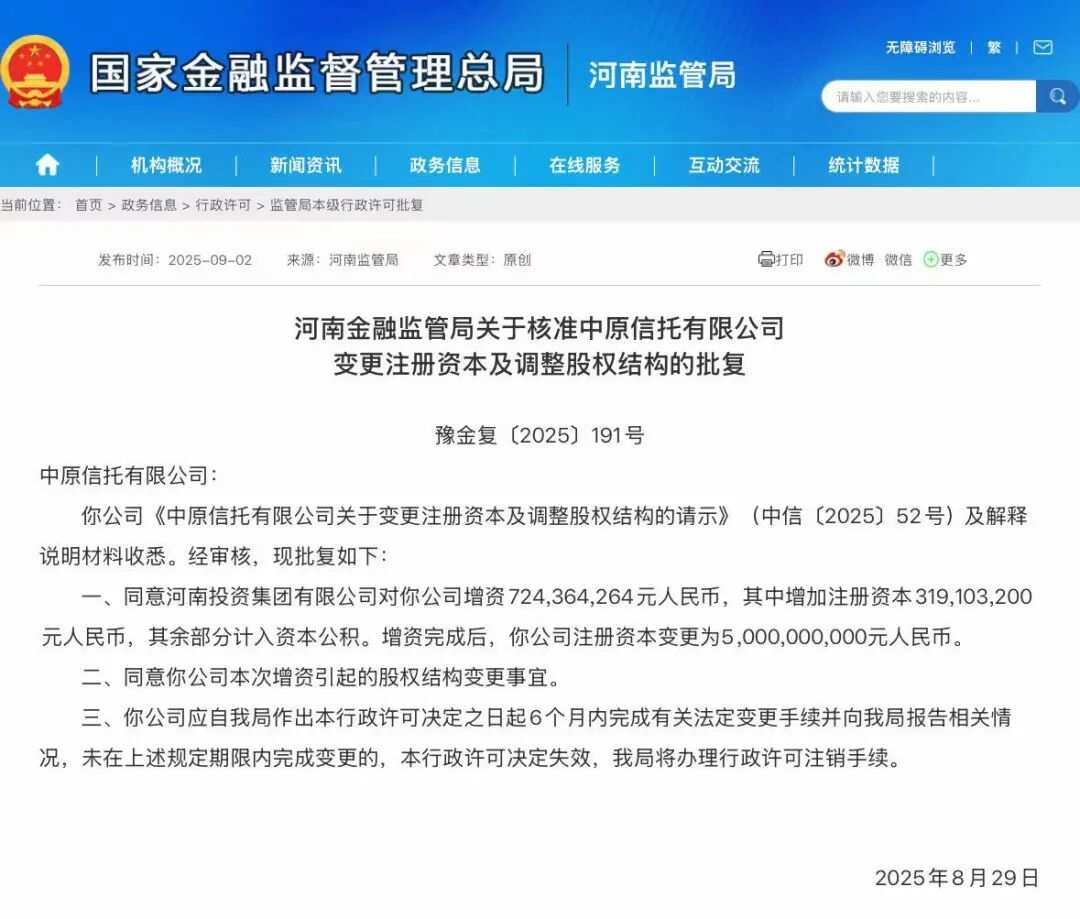
这家信托增资获批!资本金增至50亿元
Zheng Quan Shi Bao· 2025-09-22 14:14
Core Viewpoint - The Henan Financial Regulatory Bureau has approved the capital increase and equity structure adjustment of Zhongyuan Trust, allowing Henan Investment Group to inject approximately 724 million yuan into the company, raising its registered capital to 5 billion yuan [1][4]. Group 1: Capital Increase and Shareholding Structure - Henan Investment Group will increase its investment in Zhongyuan Trust by approximately 724 million yuan, with about 319 million yuan added to the registered capital and the remainder allocated to capital reserves [1]. - After the capital increase, Zhongyuan Trust's registered capital will change to 5 billion yuan [1]. - The capital increase does not change the number of shareholders in Zhongyuan Trust, but it will further increase Henan Investment Group's shareholding percentage [4]. Group 2: Shareholder Composition - As of the end of 2024, Zhongyuan Trust's registered capital was approximately 4.681 billion yuan, with three shareholders: Henan Investment Group (approximately 64.93%), Zhongyuan Expressway Co., Ltd. (approximately 27.27%), and Everbright Xinglong Trust Co., Ltd. (approximately 7.8%) [4]. - Following a court ruling, the third-largest shareholder will change from Everbright Xinglong Trust to Henan Provincial Grain Group [4]. Group 3: Financial Performance - Zhongyuan Trust has shown stable development in recent years, with operating revenues of 757 million yuan, 791 million yuan, and 881 million yuan from 2022 to 2024, and net profits of 126 million yuan, 140 million yuan, and 144 million yuan during the same period [5]. - In January 2025, the company achieved an operating revenue of 131 million yuan and a net profit of 36.71 million yuan [5]. Group 4: Strategic Direction - The company aims for a comprehensive transformation in 2024, focusing on innovation, strict risk control, and enhanced internal management to exceed annual targets [5]. - In 2025, Zhongyuan Trust plans to increase marketing to corporate clients, deepen cooperation with financial peers, and strengthen business collaboration to optimize its business structure and enhance core competitiveness [5].

中信信托新一届董事长、总经理班子调整到位
Jing Ji Guan Cha Bao· 2025-09-22 04:25
Group 1 - The new leadership team of CITIC Trust has been officially appointed, with Lv Tiangui becoming the Chairman and General Manager [1] - Lv Tiangui has over 30 years of experience in the financial industry, previously serving as Vice President of CITIC Bank before transitioning to CITIC Trust [1] - Tu Yikai has also been approved as the General Manager of CITIC Trust, having a long tenure within the CITIC system [1] Group 2 - CITIC Trust is a leading institution in the domestic trust industry, with a registered capital of 11.276 billion yuan [2] - In 2024, CITIC Trust achieved an operating revenue of 5.379 billion yuan and a net profit of 2.653 billion yuan, both ranking first in the industry [2] - As of the end of 2024, CITIC Trust's total trust assets amounted to 26,244 billion yuan, with 15,300 billion yuan in asset service trusts and 10,000 billion yuan in asset management trusts [2] - In the first half of 2025, CITIC Trust reported an operating revenue of 2.916 billion yuan and a net profit of 1.567 billion yuan, showing growth compared to the same period in 2024 [2]
中油资本(000617) - 000617中油资本投资者关系管理信息20250922
2025-09-22 01:29
Group 1: Strategic Framework - The company has established a "11445" strategic framework aimed at becoming an internationally recognized, domestically leading financial service provider, focusing on "innovation, market, service, and green" strategies [1] - The framework includes four major platforms: financial asset supervision, financial business integration, financial equity investment, and financial risk management, targeting high-quality development across five key businesses: banking, finance companies, trusts, financial leasing, and insurance [1] Group 2: Business Focus Areas - Kunlun Bank is advancing its industrial-financial strategy, expanding its customer base, and developing a unique product system that integrates online and offline services [2] - Zhongyou Finance serves as the internal bank and treasury platform for China National Petroleum Corporation, recognized for its efficient and professional services in treasury, industrial finance, and international business [2] - Kunlun Financial Leasing is implementing a differentiated and internationalized development strategy, maintaining stable asset growth and good asset quality [2] - Kunlun Trust is focusing on the energy and chemical industry chain, aiming to become a leading energy trust company while adhering to its core mission of serving the real economy [2] - The insurance segment is enhancing its support for core business capabilities, providing robust insurance coverage for assets, liabilities, and employee health [2] Group 3: Market Value Management - The company has developed a market value management approach that incorporates performance indicators into the annual contracts of management [3] - A "Quality Return Dual Improvement" action plan has been established, focusing on seven areas: party building, industrial-financial integration, business development, risk control, market value management, information disclosure, and shareholder returns [3] - Future efforts will include the implementation of regulatory requirements and the introduction of long-term patient capital to enhance investment value [3]

骗贷超12亿,世纪华通董事邵恒为何“免罚”?
阿尔法工场研究院· 2025-09-22 00:07
Core Viewpoint - The article discusses a significant loan fraud case involving Huaneng Trust, a state-owned trust company, and its partners, which has resulted in over 1.7 billion yuan in unrecoverable trust funds. The case highlights severe regulatory and compliance failures within the financial industry, particularly in risk management and internal controls [4][5][17]. Summary by Sections Background of the Case - The fraud case, known as the "Credit Insurance Loan" scheme, began in June 2019 when Huaneng Trust partnered with Huishang Bank and a local insurance company to create a loan product designed to share risks among multiple parties [7]. - The scheme was initially presented as a financial innovation aimed at mutual benefits, but it devolved into a fraudulent operation involving collusion among various parties [5][6]. Mechanism of the Fraud - The fraud was orchestrated by Chi Jinlong, the actual controller of Shenzhen Xingrui Information Technology Co., who manipulated the loan process by using fake identities to secure loans [11]. - Key players, including bank officials and insurance executives, neglected their due diligence responsibilities, allowing fraudulent loans to be approved without proper verification [9][10]. Scale of the Fraud - The fraud involved multiple layers, with Chi Jinlong's operations leading to the misappropriation of 2.5 million yuan in the first loan and a total of 12.7 billion yuan in loans being fraudulently obtained by the team of former Century Huatong director Shao Heng [12][11]. - By the time the fraud was uncovered, only 8.3 billion yuan of the principal had been repaid, resulting in a loss of 4.2 billion yuan to financial institutions [12]. Regulatory and Compliance Failures - The case underscores significant deficiencies in the risk management practices of Huishang Bank, which faced multiple regulatory penalties for various compliance failures between 2021 and 2025, totaling over 22.79 million yuan [17][18]. - The article also highlights systemic issues within the bank's governance, including corruption among senior executives, which has led to a series of legal actions against them [19]. Judicial Outcomes - As of July 2025, Chi Jinlong faced criminal charges for loan fraud and bribery, while Shao Heng received a non-prosecution decision, raising concerns about the fairness of the judicial process [14][12]. - The case remains ongoing, with implications for the broader financial industry regarding the need for improved regulatory oversight and internal controls [5][17].
信托业深化改革防控风险
Jing Ji Ri Bao· 2025-09-21 21:51
Core Viewpoint - The recent revision of the "Trust Company Management Measures" aims to promote the trust industry to focus on its core responsibilities, deepen reform and transformation, and effectively prevent risks [1] Summary by Relevant Sections Focus on Core Responsibilities - The revised measures emphasize the importance of the trust company's core business, adjusting the scope of operations to align with the role of a trustee, and regulating asset service trusts, asset management trusts, and charitable trusts [2] - The principle of "seller responsibility, buyer self-bear; seller liability, compensation according to responsibility" is established, breaking the rigid repayment model [2] Governance and Management - The measures require trust companies to integrate party building with corporate governance, enhancing the checks and balances within governance mechanisms [2] - There is a focus on strengthening shareholder behavior and managing related party transactions, along with establishing a scientific internal assessment and incentive mechanism [2] Risk Prevention and Control - Trust companies are mandated to establish a comprehensive risk management system, including the appointment of a chief compliance officer and the management of reputation and information technology risks [3] - The new regulations prohibit practices such as fund pooling, channel business, and rigid repayment, which have been major causes of past risks [3] - Trust companies must ensure the separation of proprietary assets from trust assets to prevent interest transfer and mitigate risk transmission [3] Regulatory Requirements - The measures increase the minimum registered capital for trust companies and enhance capital and provision management [2] - There is a clear requirement for risk disposal mechanisms and the implementation of tiered and classified regulatory requirements [2] - The financial regulatory authority will monitor the progress of rectification plans as a basis for classified supervision [4]
今年以来18家信托公司核心高管发生变动
Zheng Quan Ri Bao· 2025-09-21 15:49
Core Insights - Recent changes in the leadership of three trust companies, including CITIC Trust, Ping An Trust, and Guotai Junan Trust, have been approved by the National Financial Regulatory Administration, indicating a significant shift in management [1][2] - The new executives possess extensive experience in the banking and trust sectors, which is crucial for navigating the evolving regulatory landscape and competitive environment [1][2] Group 1 - The frequent changes in trust company leadership may be driven by regulatory adjustments, competitive pressures, and strategic realignments within the industry [2][3] - As of September 21, 18 trust companies have experienced changes in their core leadership positions, highlighting a trend of management turnover in the sector [2] Group 2 - The transformation of the trust industry necessitates a shift from scale-oriented to service-oriented business models, prompting companies to adapt their leadership to meet new demands [2][3] - New executives are expected to enhance corporate governance, drive business innovation, and improve market competitiveness, which are essential for success in the evolving trust landscape [3]
投资策略周报:临近“9.24”一周年,A股发生了哪些变化?-20250921
HUAXI Securities· 2025-09-21 09:22
Group 1 - The core viewpoint of the report indicates that the Chinese capital market has become the best-performing equity asset globally, with the Shanghai Composite Index rising from 2700 points to around 3900 points, an increase of nearly 40% over the past year [1] - The market outlook suggests that only a "slow bull" can lead to a "long bull," with the A-share market experiencing accelerated growth since August, despite weak economic data [1][3] - The report highlights that the valuation uplift is the main contributor to the index's rise, with the CSI 300 index increasing by 40% over the past year, where the contribution from valuation was 88% and EPS contribution was 12% [3] Group 2 - The report notes a significant recovery in risk appetite for A-shares, with daily trading volume increasing from below 800 billion yuan to a peak of 3.48 trillion yuan after the "924" policy package [3] - The technology growth sector has led the market style, with the STAR 50 index rising by 112% and the ChiNext index by 102% since the "924" event [3] - The report indicates that private equity funds and margin financing have become more active, with private equity stock positions reaching 63.82% in August, the highest level in two years [3] Group 3 - The report emphasizes that passive investment products are driving the trend towards indexation, with the scale of index funds reaching 4.2 trillion yuan, a 63% increase year-on-year [3] - It highlights that long-term funds entering the market are forming the basis for a slow bull market, with significant purchases of ETFs by state-owned funds since 2024 [3] - The report also mentions that the overall PE ratio of A-shares has reached above the 87th percentile since 2010, indicating a high valuation level [3]
稳健!某上市公司全年认购27笔信托,没有一例违约!(附详细清单)
Sou Hu Cai Jing· 2025-09-21 07:51
Core Viewpoint - Baida Group has actively utilized its idle funds for entrusted wealth management, amounting to 258.95 million yuan, reflecting a strategic approach to enhance fund utilization efficiency and returns [2][10]. Summary by Category Investment Strategy - The company has subscribed to 27 trust products in the past 12 months, all of which have been repaid normally without any defaults, indicating a robust risk management strategy [2][10]. - The main investment categories include trust wealth management, securities firm wealth management, and bank wealth management [2]. Financial Performance - In the last 12 months, Baida Group has invested a total of 2.603 billion yuan in entrusted wealth management, with 31 transactions, of which 27 were trust products [5][10]. - The contribution of entrusted wealth management earnings to the company's net profit reached 33.49%, significantly enhancing overall profitability [10]. Trust Products Overview - Recent investments include: - "Huaneng Trust·Bai Cheng Zeng Li Wealth Management Trust No. 13" with an investment of 37.7 million yuan and an expected annual yield of 4.7% [2][4]. - "Zhong Cheng Trust Zhong Hui No. 12 Collective Fund Trust Plan" with an investment of 30 million yuan and a similar yield of 4.7% [3][4]. - Other notable investments include "Huaneng Trust·Feng Yuan Ze Cheng No. 1" and "Huaneng Trust·Wan Cheng No. 3," both with an investment of 30 million yuan and an expected yield of 4.5% [3][4]. Risk Management - The trust products are favored for their higher yield compared to traditional bank deposits, with expected annual yields ranging from 4.5% to 5% [5][10]. - The company has maintained a strong focus on risk control, ensuring that all selected trust institutions have a solid background and stable historical performance [10]. Redemption and Current Status - As of September 18, 2025, the company has recovered 238.559 million yuan in principal from entrusted wealth management products, with a remaining balance of 1.0134497 billion yuan [8][10].


金融老将接棒,吕天贵出任中信信托董事长获批
Zhong Guo Zheng Quan Bao - Zhong Zheng Wang· 2025-09-20 10:18
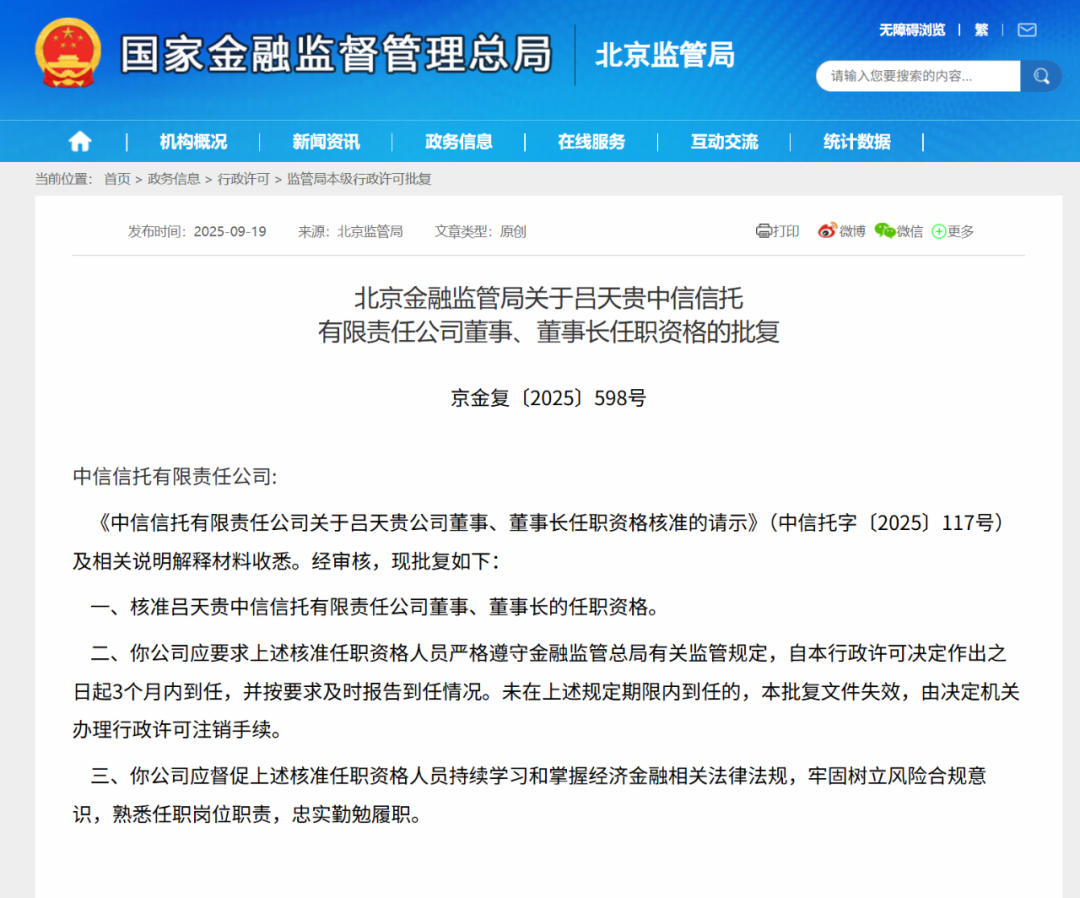
国家金融监督管理总局9月19日发布批复,核准吕天贵中信信托有限责任公司董事、董事长的任职资格。此次批复意味着中信信托自原董事长芦苇离任 后,正式迎来新任掌舵人。 金融老将接棒 图片来源:金融监管总局网站 今年3月,中信银行公告称,吕天贵因工作调整辞去副行长职务。 吕天贵拥有高级会计师职称、国际注册内部审计师、中国注册会计师资格,毕业于四川大学工商管理专业,获工商管理硕士学位,拥有数十年中国银行业 从业经验。 吕天贵长期任职于银行系统,在担任中信信托董事长前,担任中信银行副行长。他自2018年8月起任中信银行业务总监,2020年10月起担任党委委员, 2021年4月起,任中信银行副行长。今年3月,中信银行发布公告称,吕天贵因工作调整辞去副行长职务。 在中信银行2024年半年度业绩发布会上,时任副行长的吕天贵在回答有关财富管理的问题时表示,各类资产收益率持续走低,给个人财富的保值增值带来 较大挑战,确实需要专业机构,用专业的方法帮助客户解决这些问题。策略就是在客户洞察、财务规划、投资研究、资产配置、投顾服务上着力。 除了董事长一职出现变动外,此前中信信托总经理也发生人事变动。中信信托原副总经理涂一锴已升任总经理。 ...
华能信托17亿“信保贷”骗局曝光,世纪华通前高管退4亿赃款不被起诉
Guan Cha Zhe Wang· 2025-09-20 02:56
Group 1 - The core issue revolves around a fraudulent scheme involving 1.7 billion yuan in trust funds, which was exposed after six years, implicating state-owned trust companies, listed banks, and leading insurance firms as tools of the fraudsters [1][2] - The "credit insurance loan" model initiated by Huaneng Trust and Huishang Bank in June 2019 was intended to create a risk-sharing mechanism but quickly deviated from its intended purpose due to internal control failures and lack of compliance [2][6] - The fraudulent activities included fabricating loan entities, forging insurance documents, and manipulating bank account flows, resulting in a total of 12.7 billion yuan in fraudulent loans and an actual loss of 4.2 billion yuan [2][4] Group 2 - The case highlights systemic weaknesses in internal controls and compliance within financial institutions, particularly Huaneng Trust, which failed to verify the true identities of borrowers and did not conduct secondary underwriting on loan materials [6][7] - Huishang Bank has faced significant regulatory scrutiny, receiving 28 penalties totaling 22.79 million yuan from 2021 to 2024 for issues related to financing false projects and inadequate post-loan management [6][7] - The industry has seen a pattern of similar fraudulent events, indicating a trend where trust companies prioritize business innovation over thorough asset verification and risk management, which could lead to further risks if not addressed [7]
