互联网与电商

Search documents
拆解上万份财报后,大摩发现:遭抛售的“服务+周期”反而AI采用率最高、议价能力最强
Hua Er Jie Jian Wen· 2026-02-26 01:35
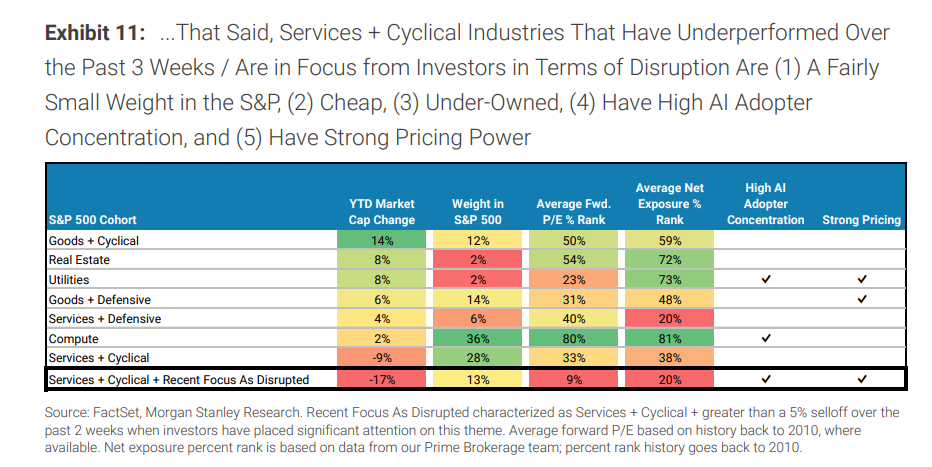
Core Viewpoint - The recent market panic regarding the potential disruption caused by generative AI (GenAI) and agentic AI is seen as an overreaction, particularly affecting traditional "services + cyclical" companies, especially in software, information services, and financial intermediaries [1][2]. Group 1: Market Reaction and Valuation - The group of companies perceived as "disrupted" currently represents only 13% of the total market capitalization of the S&P 500, explaining the limited overall market decline despite significant internal volatility [1]. - The relative valuation of the "services + cyclical" sector is at the 9th percentile since 2010, indicating it is near historical lows, while institutional net exposure has dropped to the 20th percentile, suggesting extreme underweighting [1]. - Morgan Stanley argues that the bearish outlook on GenAI underestimates the ability of established software providers to participate in the current innovation cycle [1]. Group 2: AI Adoption and Financial Impact - Data from Morgan Stanley shows that 30% of companies identified as "AI adopters" reported at least one quantifiable financial impact from AI in their Q4 2025 earnings calls, up from 24% in Q3 2025 and 16% in Q4 2024 [4]. - The anticipated profit margin growth for the S&P 500 due to AI adoption is projected to contribute 40 basis points by 2026 [4]. - AI adopters experienced a 310 basis point expansion in EBIT margins from 2024 to 2025, which is twice the rate of the MSCI global index during the same period [7]. Group 3: Industry-Specific Insights - In the software industry, concerns about AI startups taking market share and the collapse of traditional business models are misplaced; generative AI enhances existing software capabilities rather than replacing them [14]. - In consumer finance and payments, the trust and compliance aspects are critical, and AI is unlikely to disrupt traditional credit card networks significantly [15]. - The transportation sector shows a split; heavy asset operators will benefit from AI, while light asset freight brokers face disruption due to commoditization of freight matching capabilities [18]. Group 4: Historical Context and Future Employment - Historical parallels are drawn to the smartphone era, where initial fears of disruption led to significant market differentiation based on companies' ability to adapt and leverage new technologies [10][11]. - Technological advancements historically create new job opportunities rather than eliminate existing ones, with new roles expected to emerge alongside AI integration [22][23].

全球AI失业大逃杀:25年已裁94000人!微软高管:被裁可用AI管理情绪
具身智能之心· 2025-07-06 11:54
Core Viewpoint - The article highlights the alarming trend of mass layoffs in the tech industry, driven primarily by the integration of AI technologies, which is leading to significant job losses and a restructuring of workforce dynamics [3][50]. Group 1: Layoffs and AI Impact - Microsoft recently announced a new round of layoffs, cutting 9,000 jobs, contributing to a total of 94,000 tech workers laid off in the U.S. in 2025 alone [5][6]. - The layoffs are not merely cost-cutting measures; they reflect a strategic shift towards AI, with companies reallocating resources to AI projects and infrastructure [6][50]. - The layoffs are occurring despite strong financial performance, as evidenced by Microsoft's Q1 2025 revenue of $70.1 billion, a 13% year-over-year increase [58]. Group 2: Specific Job Losses - Certain job roles are at higher risk of being eliminated due to AI advancements, including software engineers, HR positions, customer service roles, content creation, data analysis, and middle management [52][54][56][57]. - In recent layoffs, 40% of the affected employees at Microsoft were developers, indicating a significant impact on software engineering roles [53]. Group 3: Corporate Responses and Reactions - A controversial suggestion from a Microsoft Xbox executive advised laid-off employees to use AI tools for emotional support and career planning, which sparked backlash from the public [10][11][18]. - The article also shares the story of a former Microsoft employee who experienced multiple layoffs, illustrating the uncertainty and instability faced by workers in the tech industry [30][36].