低空制造业

Search documents
重庆低空经济 从“起飞”迈向“高飞”
Xin Lang Cai Jing· 2026-02-08 17:26
Core Insights - The event on February 6 showcased significant achievements in Chongqing's low-altitude economy, including the launch of a 2 billion yuan low-altitude industry fund, the establishment of a municipal low-altitude economic operation company, and the first public flight of an eVTOL aircraft [4][5][6] Group 1: Investment and Infrastructure - A 2 billion yuan aerospace fund was established to focus on key segments of the commercial aerospace and low-altitude economy, aiming to inject long-term capital into the industry [6] - The Chongqing Low-altitude Economic Development Company was officially established with an initial registered capital of 200 million yuan, aiming to enhance low-altitude infrastructure and safety [6] - The signing of two major project agreements indicates a push towards upgrading high-end aircraft manufacturing and accelerating local supply chain upgrades [7] Group 2: Application and Impact - Several practical applications were highlighted, including a drone performance that generated over 350 million yuan in tourism revenue and a landslide monitoring project that improved inspection frequency by over 10 times [8] - The use of drones for transporting agricultural products demonstrated a 15-fold increase in efficiency and a 50% reduction in costs, benefiting local farmers [8][13] Group 3: Industry Growth and Development - The low-altitude manufacturing sector in Chongqing is projected to reach 10.2 billion yuan by 2025, marking a 20.4% year-on-year growth [9] - The city has 106 low-altitude manufacturing enterprises, with 15 generating over 100 million yuan in revenue, and 7 recognized as national "little giant" enterprises [9][10] - A comprehensive product catalog was released, showcasing 93 products across five categories, reflecting the expanding scale of the low-altitude equipment industry [9] Group 4: Strategic Approach - Chongqing's approach to developing the low-altitude economy emphasizes building a comprehensive management system before focusing on aircraft manufacturing, which is seen as a unique strategy compared to other regions [11][12] - The integration of low-altitude technology into urban governance and rural revitalization demonstrates a commitment to embedding these innovations into real-world applications [12][14] - The establishment of a collaborative ecosystem involving government, state-owned enterprises, and private capital aims to create a sustainable industrial framework [15][16]

十部门联手 低空经济迎重磅指南
Xin Lang Cai Jing· 2026-02-02 20:06
Core Viewpoint - The release of the "Guidelines for the Construction of Low-altitude Economic Standard System (2025 Edition)" aims to establish a comprehensive standard system for the low-altitude economy, addressing key areas such as low-altitude aircraft, infrastructure, air traffic management, safety supervision, and application scenarios [1][2]. Group 1: Standard System Development - By 2027, the low-altitude economic standard system is expected to be fundamentally established to meet safety and health development needs [1]. - By 2030, over 300 standards in the low-altitude economic field are anticipated, forming an optimized, advanced, reasonable, and internationally compatible standard system [1]. Group 2: Industry Structure and Market Potential - The domestic low-altitude economy has developed a complete industrial chain, including low-altitude manufacturing, operation, infrastructure, and supporting services [1]. - The market size of low-altitude aircraft manufacturing and operation services accounts for nearly 55% of the total, indicating significant economic value and development potential [1]. Group 3: Challenges and Solutions - Current challenges in the low-altitude economy include an incomplete safety supervision system, insufficient industry chain collaboration, and difficulties in balancing international integration with independent innovation [2]. - The standardization approach outlined in the guidelines aims to address these challenges by unifying standards for aircraft airworthiness, air traffic management, and safety supervision, thereby establishing a comprehensive risk prevention system [2]. Group 4: Impact on Enterprises and Regional Development - Compliance with standards will become a prerequisite for enterprises, driving them to increase R&D investment and improve product and service quality [3]. - Standard unification is expected to promote the formation of low-altitude economic industry clusters, attracting upstream and downstream enterprises and becoming a new growth pole for regional economies [3].

中国股市取得2026年“开门红”;国家外汇管理局副局长、新闻发言人李斌:我国外债形势总体平稳|每周金融评论(2025.12.29-2026.1.4)
清华金融评论· 2026-01-05 10:36
Group 1: Stock Market Performance - The Chinese stock market achieved a "good start" for 2026, with all three major indices rising. The Shanghai Composite Index returned to the 4000-point mark, closing at 4023.42, up 1.38%. The Shenzhen Component rose by 2.24%, and the ChiNext Index increased by 2.85%, with over 4000 stocks rising and a trading volume of approximately 2.57 trillion yuan [7]. - Key factors driving the A-share market's performance include strengthened policy expectations, with a positive macro policy tone and the implementation of industry policies, particularly in commercial aerospace and semiconductor support, boosting market confidence [8]. - The influx of capital played a significant role, with foreign capital returning and the RMB appreciating, attracting over 10 billion yuan in northbound capital. Domestic long-term funds, including insurance and public funds, accelerated their entry, with margin trading balances exceeding 1.8 trillion yuan [8]. Group 2: Tourism Market - The New Year's tourism market also experienced a "good start," with 142 million domestic trips taken during the three-day holiday, generating a total expenditure of 84.789 billion yuan, averaging 597.11 yuan per person. Ticket bookings for domestic scenic spots increased by over four times year-on-year [8]. - The tourism sector is seen as a vital component of service consumption and a reflection of national consumer sentiment, with a strong start in tourism igniting confidence for economic development in 2026 [9]. Group 3: Foreign Debt Situation - The overall foreign debt situation in China is stable, with the total foreign debt balance as of September 30, 2025, being 16.8287 trillion yuan (approximately 2.3684 trillion USD), a decrease of 2.8% from June 2025 [9][10]. - The structure of foreign debt remains stable, with domestic currency debt accounting for 51.9% and medium to long-term foreign debt making up 42.5% of the total, indicating that key indicators are within internationally recognized safety lines [10]. Group 4: Regulatory Developments - The China Securities Regulatory Commission (CSRC) released the "Implementation Measures for Supervision and Management of Securities and Futures Markets" to further standardize the implementation procedures of market supervision, effective from June 30, 2026 [11]. - The China Banking and Insurance Asset Management Association published the "Data Classification and Grading Guidelines for the Insurance Asset Management Industry," effective January 1, 2026, aimed at enhancing data management standards in the industry [12][13]. - The CSRC announced the pilot program for Real Estate Investment Trusts (REITs) in commercial real estate, which is expected to provide new financing channels for real estate companies and enhance the stability of the REITs market [14]. Group 5: Low-altitude Economy in Shanghai - Shanghai aims to achieve a core industry scale of approximately 80 billion yuan in the low-altitude economy by 2028, establishing a complete industrial chain for new low-altitude aircraft and creating a national advanced manufacturing cluster [15][16].

上海:支持保险机构创新适用于低空航空器测试试飞等的低空特色险
Bei Jing Shang Bao· 2026-01-04 08:56
Core Viewpoint - The Shanghai Municipal Economic and Information Technology Commission has issued measures to accelerate the construction of an advanced manufacturing cluster for low-altitude economy in the Yangtze River Delta region, emphasizing support for innovative insurance products tailored for low-altitude aircraft testing, commercial applications, and consumer use [1] Group 1 - The measures aim to promote the aggregation of low-altitude insurance institutions [1] - The initiative is part of a broader strategy to enhance the low-altitude economy in the Yangtze River Delta [1]
上海:支持保险机构创新适用于低空航空器测试试飞、商业应用及消费的低空特色险
Zheng Quan Shi Bao Wang· 2026-01-04 08:10
Core Viewpoint - The Shanghai Municipal Economic and Information Technology Commission has issued measures to accelerate the construction of a low-altitude economy and advanced manufacturing cluster in the Yangtze River Delta, emphasizing increased financial support for the sector [1] Financial Support Measures - The measures include promoting innovative insurance products tailored for low-altitude aircraft testing, commercial applications, and consumer use, aimed at fostering the concentration of low-altitude insurance institutions [1] - Banks are encouraged to enhance support for loans and financing leases for low-altitude enterprise production line investment projects [1] - A subsidy of up to 20 million yuan will be provided for bank loans and financing lease projects [1]
《低空统计分类》正式印发 主要包含这些内容→
Yang Shi Xin Wen· 2025-12-26 17:01
Core Viewpoint - The issuance of the "Low Altitude Economy and Its Core Industry Statistical Classification (Trial)" aims to clarify the concepts and categories of the low altitude economy, supporting accurate understanding and implementation of national policies [2] Group 1: Background of the Low Altitude Statistical Classification - The development of the low altitude economy is a priority for the central government, as highlighted in the 20th Central Committee's Fourth Plenary Session, which emphasizes the acceleration of strategic emerging industries [2] - The low altitude economy in China is in its initial stage, with a rapidly improving policy framework, infrastructure, and business entities, showing a positive overall trend [2] Group 2: Principles of Compilation - The statistical classification is designed to be systematic, scientific, and practical, focusing on the comprehensive economic form driven by low altitude aviation activities [3] - It emphasizes innovation by including various production and service activities related to low altitude aviation, reflecting the technology-intensive nature of the sector [3] - The classification is based on existing national economic industry classifications, ensuring precision and operability while highlighting key areas of the low altitude economy [3] - It balances immediate and long-term needs, allowing for adaptability to current developments while considering future growth potential [4] Group 3: Content of the Low Altitude Statistical Classification - The low altitude economy encompasses a comprehensive economic form driven by low altitude aviation activities, classified into four major categories: low altitude manufacturing, low altitude operations, low altitude infrastructure and information services, and low altitude supporting industries [5] - Low altitude manufacturing includes the production of aircraft and related materials, while low altitude operations involve various flight services [5] - Low altitude infrastructure and information services pertain to the construction and engineering services supporting low altitude activities, and low altitude supporting industries provide technical research and support services [5] - The core industries of the low altitude economy consist of activities that provide products, infrastructure, and services for low altitude flight, categorized into ten subcategories and thirty-six smaller categories [5]
我省低空经济产业规模近300亿元 综合实力位居全国前列
Xin Hua Ri Bao· 2025-09-14 23:19
Core Viewpoint - Jiangsu Province's low-altitude economy is rapidly developing, with a market size nearing 30 billion yuan and approximately 1,300 enterprises in the sector, showcasing national leadership in various aspects such as industrial scale, innovation platforms, and financing activity [1][5]. Industry Development - Jiangsu has established a dual-driven model of manufacturing and services in the low-altitude economy, with nearly 800 upstream and downstream enterprises and a core industrial scale exceeding 20 billion yuan by 2024 [3]. - The low-altitude service sector is also expanding, with around 400 related enterprises generating nearly 10 billion yuan in revenue, enhancing the industry's support capabilities [3]. - Key cities like Nanjing and Suzhou are central to the development, with differentiated growth trends across regions, focusing on innovation and equipment manufacturing [3]. Technological Innovation - Innovation is a critical driver for Jiangsu's advancement in the low-altitude economy, with the province ranking third nationally in patent applications and authorizations in this field, accounting for 12.1% and 11.2% respectively [4]. - Notable technological achievements include the FP-98 large cargo drone and the ET9 eVTOL, which meet international standards and fill domestic gaps [4]. Policy and Financial Support - Jiangsu has implemented supportive policies, including the "Implementation Opinions on Accelerating the High-Quality Development of the Low-Altitude Economy," which outlines a roadmap for creating a globally influential low-altitude economic hub [4]. - Financial backing is robust, with over 2.65 billion yuan raised in seed and Series A financing, and provincial funds exceeding 100 million yuan allocated for airport construction and R&D [4]. Challenges and Limitations - Despite strong growth, the low-altitude economy is still in its infancy, with a lack of leading enterprises and insufficient market scale to foster a complete industrial cluster [7]. - The industry faces challenges in expanding application scenarios, with many projects still reliant on government support and lacking sustainable business models [8]. - Regulatory frameworks and safety oversight are underdeveloped, complicating the management of low-altitude airspace and hindering the growth of a cohesive commercial ecosystem [9][10]. Future Directions - To maintain its leading position, Jiangsu should focus on attracting and nurturing key enterprises in low-altitude manufacturing, enhancing application scenarios, and establishing a supportive regulatory environment [10][11]. - Infrastructure development, including public take-off and landing facilities, is essential for the growth of the low-altitude economy [11].
云南:鼓励低空产业集聚发展
Zheng Quan Shi Bao Wang· 2025-08-14 15:21
Core Viewpoint - The Yunnan Provincial Government has issued measures to support the healthy development of the low-altitude economy, emphasizing industrial cluster development and technological innovation [1] Group 1: Policy Measures - The government encourages the transformation and docking of technological achievements, providing a subsidy of 0.2% of the annual sales for third-party technology introductions, with a maximum subsidy of 10 million yuan, applicable for three consecutive years, excluding related transactions [1] - Key parks such as Kunming National High-tech Industrial Development Zone, Qujing Economic and Technological Development Zone, and Yunnan Mile Industrial Park are supported as key areas for low-altitude manufacturing, with an annual maximum allocation of 50 million yuan for each park [1] Group 2: Industry Development - The measures support the development of the entire supply chain for low-altitude industries, including aircraft manufacturing, materials, batteries, motors, internal combustion engines, payloads, and flight control systems [1] - The government promotes the interconnection of upstream and downstream industries within the parks to foster industrial clustering and innovative development in the low-altitude sector [1]
眉山彭山:空域+及时起飞 助力全场景探索提速
Huan Qiu Wang Zi Xun· 2025-04-29 10:04
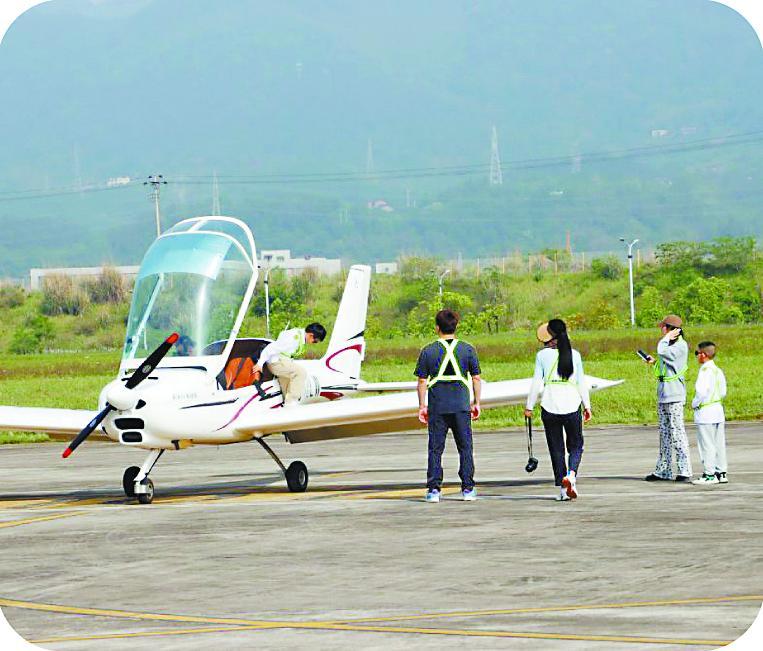
Core Viewpoint - The article highlights the rapid development of low-altitude economy in Pengshan District, Meishan City, Sichuan Province, driven by strategic planning and strong foundational advantages, aiming to establish a "low-altitude economy full-scenario application demonstration zone" for high-quality development [1] Group 1: Advantages of Pengshan - Airspace advantage is a significant asset for Pengshan, with the ability for immediate takeoff under a flight reporting system, allowing drones and light aircraft to quickly execute tasks [3] - The city is positioned as a key node in the Chengdu metropolitan economic circle, facilitating low-altitude logistics and air commuting, potentially becoming a core hub in Southwest China [3] - The diverse terrain in Pengshan provides rich low-altitude application scenarios, making it a natural laboratory for low-altitude economic technologies [3][4] Group 2: Industrial Integration - Pengshan's industrial synergy is a foundational pillar for the development of its low-altitude economy, with leading companies in the lithium battery sector and patents in aircraft component testing [4] - The integration of various industries, from battery supply to intelligent manufacturing, creates a complete industrial chain that supports the low-altitude economy [4] Group 3: Strategic Development Plan - Pengshan is advancing its low-altitude economy through a "1+2+3" strategy, which includes one industrial planning direction, two supporting infrastructure and safety regulations, and three focus areas: government, industry, and consumer scenarios [6] - The district is targeting three main sectors in low-altitude manufacturing: complete machine manufacturing, navigation and monitoring support, and flight batteries, with successful contracts signed for drone training projects [6] Group 4: Recent Developments - In March, a training program for civilian drone operators was launched, marking the beginning of the "low-altitude + education and training" sector in Pengshan [8] - The local police have effectively utilized drones for patrol tasks, demonstrating the practical value of "low-altitude + government" applications [8] - Upcoming events, such as helicopter flight experiences and drone photography in scenic areas, will further promote the "low-altitude + cultural tourism" sector [8]