
住宿和餐饮服务业

Search documents
加纳2026年1月生产者价格通胀率降至1.6%
Shang Wu Bu Wang Zhan· 2026-02-24 16:15
Core Insights - Ghana's producer price inflation rate decreased to 1.6% in January 2026, down from 1.9% in December 2025, representing a decline of 0.3% [1] - Month-on-month, producer prices increased by 3.3% in January compared to December 2025, which had a month-on-month increase of 0.8% [1] Industry Analysis - The mining and quarrying sector experienced the highest inflation rate at 43.7% [1] - The transportation and storage sector saw a continued decline in prices, with inflation dropping from -3.7% in December to -6.9% in January [1] - The accommodation and food services sector also faced significant deflation, with a rate of -5.4% in January, down from -3.2% in December [1] - The information and communication sector's price increase slightly slowed, rising by 1.4% in January compared to 1.7% in December 2025 [1]
波黑11月平均净工资环比下降,IT行业薪资最高
Shang Wu Bu Wang Zhan· 2026-01-22 12:25
Group 1 - The average net salary for employees in Bosnia and Herzegovina in November 2025 was 1600 marks, showing a nominal decrease of 0.3% month-on-month and a real decrease of 0.8% [1] - Year-on-year, the nominal salary increased by 13.8% and the real salary increased by 9% [1] - The highest average net salary was in the information and communication sector (IT), at 2156 marks, followed by the financial and insurance sector at 2073 marks, and public administration, defense, and mandatory social security at 2007 marks [1] Group 2 - The lowest average net salary was in the accommodation and food services sector at 1156 marks, followed by the construction sector at 1272 marks [1] - The average total salary for employees in Bosnia and Herzegovina in November 2025 was 2485 marks, with a nominal decrease of 0.3% month-on-month and a real decrease of 0.8% [1] - Year-on-year, the total salary showed a nominal increase of 14.3% and a real increase of 9.4% [1]
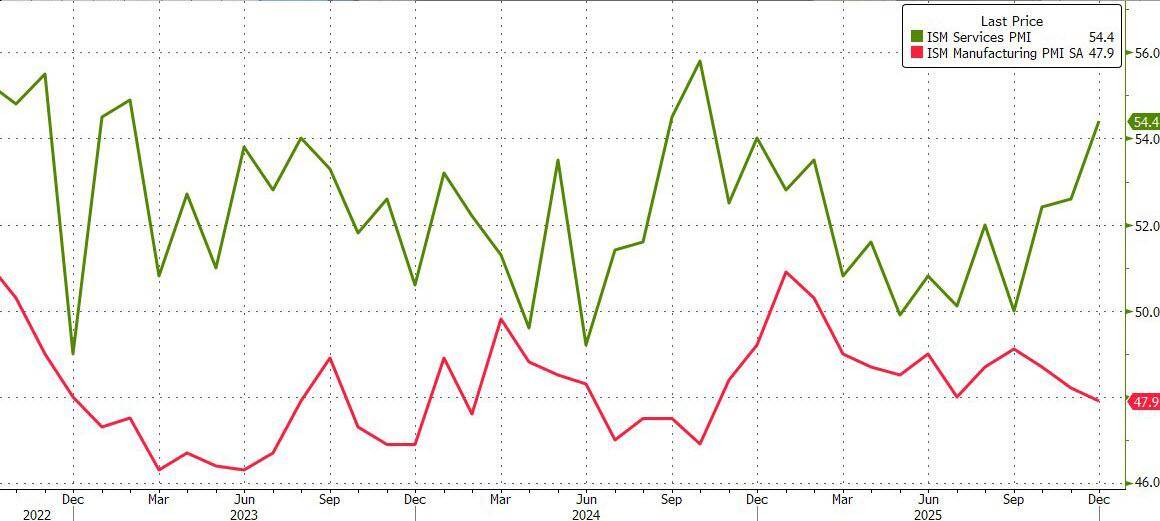
美国12月ISM服务业PMI 54.4创一年多最高,需求稳健,招聘回暖
Sou Hu Cai Jing· 2026-01-08 01:25
Core Insights - The US services sector expanded at its fastest pace in over a year in December, driven by robust demand growth and a rebound in hiring [1] - The ISM services index rose by 1.8 points to 54.4, marking the highest level since October 2024, and exceeded market expectations of 52.2 [1] - The December reading surpassed all forecasts in a survey of economists [1] Industry Performance - In December, 11 industries reported growth, led by retail, finance and insurance, and accommodation and food services; 5 industries contracted, including management and support services [5] - The strong performance of the services sector contrasts sharply with the weakness in manufacturing, which saw the most severe contraction since 2024 [5] Economic Indicators - New orders increased at the fastest rate since September 2024, and the index measuring business activity reached a one-year high [6] - Export orders grew at the fastest pace in over a year, indicating a recovery in demand [6] - Employment in the services sector saw the healthiest growth since February, with expectations of moderate growth in non-farm payrolls and a slight decrease in the unemployment rate [6] Price and Inventory Trends - The ISM services and materials prices index showed the slowest price increase in nine months [6] - Inventory expansion reached its fastest pace since October 2024, although the inventory sentiment index declined for the third consecutive month, indicating fewer firms believe their inventories are excessive [6] - The supplier delivery index fell 2.3 points from a one-year high [6] Sector-Specific Comments - Accommodation and food services reported high price pressures due to government trade and tariff policies, particularly affecting imports from Southeast Asia and South America [7] - The agriculture, forestry, fishing, and hunting sector noted flat overall business performance, with strong demand for value brands but challenges for high-end brands [7] - The finance and insurance sector reported stable business conditions with most contracts being renewed as the new year approaches [7] - The healthcare and social assistance sector experienced a surge in demand for respiratory devices and related supplies due to rising flu cases [7] - The information sector faced the highest annual price increases from major service and data providers in years, pushing costs higher [7] - Public administration expressed ongoing uncertainty and concerns regarding tariffs and their pricing impacts [7] - The transportation and warehousing sector benefited from heightened business activity during the holiday season [7]

美国非制造业PMI下滑 关税及政策不确定性影响显现
Zhong Guo Xin Wen Wang· 2025-08-06 02:29
Core Viewpoint - The ISM reported that the July non-manufacturing PMI in the U.S. was 50.1, indicating a slowdown in the service sector and falling below expectations [1] Economic Indicators - The July non-manufacturing PMI decreased from 50.8 in the previous month to 50.1, reflecting a near stagnation in the service economy [1] - Employment index fell to 46.4, marking the fourth contraction in five months and reaching one of the lowest levels since the pandemic [1] - Input cost index rose to the highest level since October 2022, indicating increasing inflationary pressures [1] Market Reaction - Following the release of the ISM data, all three major U.S. stock indices closed lower, with the Dow Jones down 0.14%, Nasdaq down 0.65%, and S&P 500 down 0.49% [1] Industry Insights - Comments from the ISM highlighted concerns over tariffs and uncertainty affecting procurement planning in the accommodation and food services sector, leading to delays in the next fiscal year's purchasing plans [1] - The construction industry noted that trade uncertainties are causing clients to reassess project feasibility, resulting in delays or cancellations [1] - Steve Miller, chairman of the ISM Services Business Survey Committee, indicated that tariffs are driving up payment prices, potentially fueling inflation [1]