前沿材料

Search documents
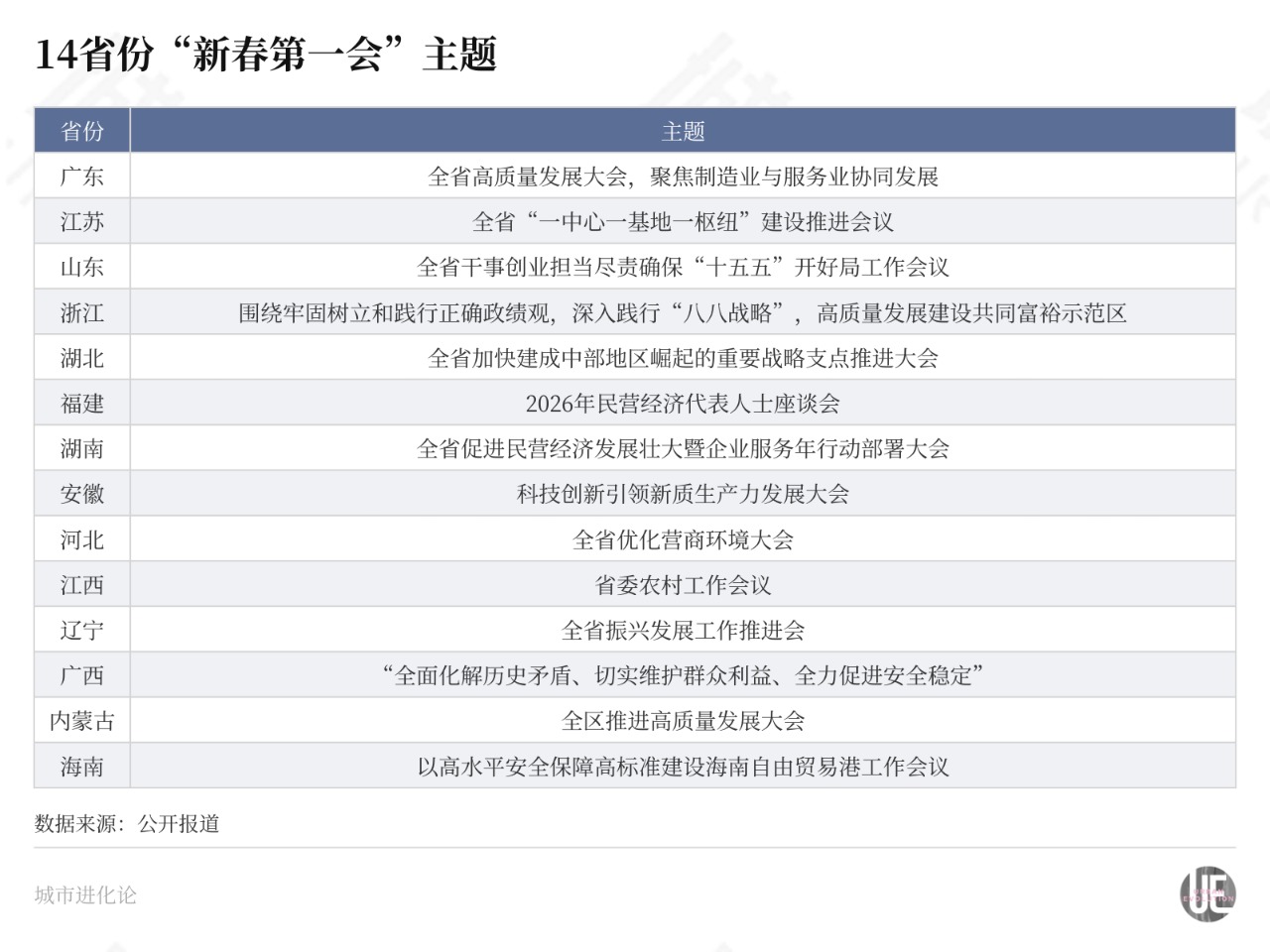
14省份“新春第一会” 传递出哪些信号?
Mei Ri Jing Ji Xin Wen· 2026-02-24 14:32
Core Insights - The "New Spring First Meeting" held across various provinces serves as a significant indicator for observing development trends and setting strategic directions for the year, particularly at the start of the "14th Five-Year Plan" [1] Group 1: Industry Upgrades - Guangdong's focus on the synergy between manufacturing and service industries highlights the importance of a modern industrial system as a foundation for China's modernization, with a GDP of 14.58 trillion yuan, maintaining the top economic position for 37 consecutive years [3][4] - The need for Guangdong to ascend the "smile curve" of industry, emphasizing advanced R&D and precise brand marketing, is crucial for overcoming current challenges in high-quality development [4][5] - Other provinces like Anhui and Hubei are also prioritizing technological innovation and new industries, with Anhui targeting quantum technology and biomanufacturing as future growth points [6][7] Group 2: Strategic Implementation - Hubei's strategic focus on becoming a key support point for central region development emphasizes specific goals such as increasing the number of large enterprises and enhancing infrastructure [7][8] - Liaoning's emphasis on project-driven growth aims to address investment declines and stimulate economic activity through effective project management and collaboration across industries [9] Group 3: Private Economy - The importance of a favorable business environment is underscored as a core competitive advantage for regional high-quality development, particularly in older industrial bases [10] - Provinces like Hebei and Hunan are actively working to improve their business environments, with Hebei aiming for a significant increase in private sector contributions to GDP by 2025 [12][13] - Fujian's initiatives to enhance the business environment have led to substantial growth in private enterprises, contributing significantly to innovation and economic activity [14]

贵阳高新区去年完成技术合同成交额25.7亿元
Xin Lang Cai Jing· 2026-02-09 20:19
Group 1 - The core message emphasizes the commitment of the Guizhou High-tech Zone to implement the "Three Grabs" and "Five Optimizations" strategy, aiming for a technology contract transaction value of 2.57 billion yuan in 2025 to support high-quality regional development [1] - The innovation momentum is driven by a thriving group of enterprises, with a focus on nurturing quality enterprises through a structured cultivation mechanism, resulting in a strong matrix of innovative companies, including a notable presence of specialized and innovative small and medium-sized enterprises [1] - The number of high-tech enterprises in the high-tech zone continues to lead the city, with collaborations established with top universities to enhance talent cultivation and implement numerous industry-university-research projects [1] Group 2 - A systematic mid-test service system has been established to address the "last mile" challenge in innovation value realization, effectively accelerating the conversion of technological achievements into productive forces, achieving a 100% completion rate for major technology tackling and achievement conversion projects [2] - The active innovation ecosystem is supported by a collaborative atmosphere, with regular events like the Guizhou Science City Technology Innovation Week facilitating technology achievement connections and project collaborations [2] - The Guizhou Science City is set to achieve a leap in capability by 2025, with breakthroughs in high-energy platforms, project implementations, and talent aggregation, particularly in key areas such as aviation engine components and solid-state battery materials [2]
湖南“十五五”规划建议:聚焦现代石化、绿色矿业、食品加工、轻工纺织等传统产业,加快技术改造和转型升级
Zheng Quan Shi Bao Wang· 2025-12-12 10:46
Core Viewpoint - The proposal by the Hunan Provincial Committee emphasizes the establishment of a "4×4" modern industrial system, focusing on both traditional and emerging industries to drive economic growth and transformation [1] Group 1: Traditional Industries - The plan highlights the importance of modern petrochemicals, green mining, food processing, and light textile industries, aiming to accelerate technological upgrades and transformation [1] - It also emphasizes enhancing the industrial capacity and cluster effects of advantageous industries such as engineering machinery, rail transit equipment, modern agriculture, and cultural tourism [1] Group 2: Emerging Industries - The proposal focuses on new industries such as digital industries, renewable energy, health, aerospace, and marine sectors, promoting large-scale application demonstration actions for new technologies, products, and scenarios [1] - It aims to implement industrial innovation projects to foster growth in these sectors [1] Group 3: Future Industries - The plan explores future industries including artificial intelligence, life engineering, quantum technology, and advanced materials, seeking to identify diverse technological routes, typical application scenarios, feasible business models, and market regulation rules [1] - The goal is to stimulate the formation of new economic growth points through these initiatives [1]
工信部重磅发布,重点发展5大行业100+新材料!
DT新材料· 2025-11-11 16:03
Core Viewpoint - The Ministry of Industry and Information Technology has issued a notice to accelerate the systematic layout and high-level construction of manufacturing pilot platforms, aiming to establish a modern pilot platform system by the end of 2027, with a focus on multi-entity participation and multi-field layout [2]. Group 1: Manufacturing Pilot Platforms - The notice outlines the construction guidelines for manufacturing pilot platforms, which include five major categories: raw materials industry, equipment manufacturing, consumer goods industry, information technology, and emerging and future industries [2]. - By 2027, the goal is to enhance the capabilities of high-level pilot platforms and establish a nationwide manufacturing pilot service network [2]. Group 2: Key Focus Areas - **Petrochemical and Chemical Industry**: Emphasis on low-carbon hydrogen-rich raw material utilization, high-end polymer synthesis, and green low-carbon technologies [4]. - **Non-ferrous Metals**: Focus on green and efficient extraction and smelting processes for metals like copper, aluminum, and rare metals, aiming for high-quality raw material preparation [5]. - **Inorganic Non-metallic Materials**: Development of high-performance ceramics, functional crystals, and green low-carbon materials [6]. - **Frontier Materials**: Concentration on micro-nano processing technologies and advanced materials like graphene and superconductors [7]. - **Light Industry**: Innovations in smart home appliances, battery materials, and green technologies for various consumer products [8]. - **Integrated Circuits**: Addressing reliability issues in complex applications and enhancing the verification capabilities of new technologies [9]. - **Energy Electronics**: Advancements in photovoltaic technologies and new battery systems, focusing on efficiency and reliability [10]. - **New Displays**: Development of next-generation display technologies and materials, enhancing performance and stability [11]. - **Brain-Computer Interfaces**: Focus on key technologies for brain-computer interface components and signal processing [12]. - **Metaverse**: Promotion of VR/AR technologies and related components, enhancing user interaction and content production [13]. - **Humanoid Robots and Embodied Intelligence**: Development of intelligent decision-making technologies and key components for humanoid robots [14]. - **Quantum Technology**: Focus on critical materials and technologies for quantum computing and communication [15]. - **Clean Low-Carbon Hydrogen**: Development of hydrogen production, storage, and application technologies across various industries [16].