助动车制造

Search documents
【行业深度】一文洞察2026年中国电助力自行车行业发展前景及投资趋势研究报告
Sou Hu Cai Jing· 2026-01-26 09:50
Core Viewpoint - The global electric assist bicycle market is rapidly growing due to government subsidies and policies aimed at reducing carbon emissions and promoting green transportation, with a projected market size of $32.95 billion in 2024, reflecting a 0.6% year-on-year growth [2]. Overview - Electric assist bicycles, also known as e-bikes, are a new type of transportation that primarily relies on human power, supplemented by electric motors and batteries [2]. - According to the National Bureau of Statistics, electric assist bicycles fall under the category of "C manufacturing" [2]. Market Policy - China has integrated electric assist bicycles into its "dual carbon" and green transportation frameworks, issuing various policies to support and regulate the industry, creating a favorable environment for development [13]. - Key policies include the "14th Five-Year Plan for National Economic and Social Development" and the "Guidance on the Development of the Electric Bicycle Industry during the 14th Five-Year Plan" [13][14]. Industry Entry Barriers - The electric assist bicycle industry has high entry barriers due to the need for comprehensive supply chain management capabilities, which require long-term operational experience to develop [8]. - Established manufacturers can efficiently integrate product design, material procurement, production, quality control, logistics, and after-sales service, making it difficult for new entrants to compete [8]. Industry Chain - The upstream of the electric assist bicycle industry includes suppliers of raw materials like steel, aluminum, and carbon fiber, as well as energy system suppliers such as lithium batteries and core components like motors and controllers [15]. - The midstream consists of electric assist bicycle manufacturers, while the downstream includes retail stores, distributors, e-commerce platforms, and end consumers [15].



研判2025!中国电助力自行车行业进入壁垒、发展历程、市场政策汇总、产业链图谱、市场规模、竞争格局及发展趋势分析:市场集中度较高[图]
Chan Ye Xin Xi Wang· 2026-01-15 01:59
Core Insights - The global electric assist bicycle market is rapidly growing, with a projected market size of $32.95 billion in 2024, reflecting a year-on-year growth of 0.6% [1][10]. Industry Overview - Electric assist bicycles, also known as e-bikes, are a new type of transportation that primarily relies on human power, supplemented by electric motors and batteries [2]. - The industry is characterized by various types of electric assist bicycles, including torque sensor assist, speed sensor assist, and manual assist types, as well as different motor and battery configurations [4]. Market Policies - The Chinese government has integrated electric assist bicycles into its "dual carbon" and green travel initiatives, issuing multiple policies to support and regulate the industry, creating a favorable environment for growth [7]. Industry Chain - The supply chain for electric assist bicycles includes upstream raw material suppliers, energy system providers, and core component manufacturers, with a growing demand driven by supportive policies and a shift towards green transportation [9]. Development Status - The electric assist bicycle market is experiencing significant growth globally, with both mature and emerging markets showing increased demand, particularly in response to climate change and urban transportation challenges [5][10]. Competitive Landscape - The market consists of brand operators and ODM/JDM/OEM manufacturers, with notable players including Accell Group, Pon, and domestic companies like Jiuqi Co., Ltd. and Tianjin Fujisawa [11][12]. - Jiuqi Co., Ltd. reported a revenue of 1.56 billion yuan from electric assist bicycles in the first half of 2025, accounting for 10.43% of its total revenue [11]. Development Trends - Future growth will be driven by policy support, technological innovations in battery and motor systems, and the expansion of application scenarios beyond commuting to include leisure and delivery services [13][14][16]. - The industry is expected to shift towards a dual focus on manufacturing and brand development, enhancing international competitiveness and establishing a more robust global supply chain [16].

前10月规上轻工企业实现营收19万亿元 家用电器和音像器材类商品零售额增长20.1%
Ren Min Ri Bao· 2025-12-05 21:59
Core Insights - The light industry in China has shown resilience with a revenue of 19 trillion yuan and a profit of 1.14 trillion yuan for the first ten months, reflecting a year-on-year growth of 1.9% and 1.6% respectively [1] Group 1: Economic Performance - The added value of large-scale light industry increased by 5.8% year-on-year from January to October [1] - The automotive, battery, and plastic furniture manufacturing sectors experienced double-digit growth due to the consumption upgrade policy [1] - The home appliance manufacturing sector's added value grew by 5.5%, with washing machine and air conditioner production increasing by 6.4% and 3% respectively [1] Group 2: Domestic Demand - Retail sales of 11 categories of light industry products reached 710.19 billion yuan, marking a year-on-year increase of 9.8% [1] - The consumption upgrade policy has been expanded, releasing potential in related product consumption [1] - Retail sales of home appliances and audio-visual equipment grew by 20.1%, maintaining double-digit growth since September of the previous year [1]
爱玛科技: 爱玛科技2025年半年度报告
Zheng Quan Zhi Xing· 2025-08-22 16:24
Core Viewpoint - Aima Technology Group Co., Ltd. reported significant growth in revenue and profit for the first half of 2025, driven by its focus on electric two-wheeled vehicles and a diversified product range [1][3]. Financial Performance - Revenue for the first half of 2025 reached approximately 13.03 billion RMB, a 23.04% increase compared to the same period in 2024 [3]. - Total profit amounted to approximately 1.43 billion RMB, reflecting a 27.37% increase year-on-year [3]. - Net profit attributable to shareholders was approximately 1.21 billion RMB, up 27.56% from the previous year [3]. - The company proposed a cash dividend of 0.628 RMB per share, totaling approximately 545.76 million RMB, which represents 45.01% of the net profit for the first half of 2025 [1]. Business Overview - Aima Technology has been focused on the research and manufacturing of electric two-wheeled vehicles since 2004, establishing itself as a leading player in the industry [3][4]. - The company's product offerings include electric bicycles, light motorcycles, and electric motorcycles, catering to various transportation needs [4][5]. - Aima operates multiple production bases across China and has expanded its international presence with factories in Indonesia and Vietnam [4][5]. Industry Context - The electric two-wheeled vehicle industry is experiencing rapid growth, driven by increasing demand for sustainable transportation solutions and regulatory support [7][8]. - The market is becoming more concentrated as smaller players exit, leading to higher market share for established companies like Aima [7][8]. - The industry is transitioning towards high-quality, intelligent, and diversified products, with a focus on user-centric service models [7][8]. Product Development and Innovation - Aima emphasizes technological innovation, focusing on core components such as motors, controllers, and batteries to enhance product performance [11][12]. - The company has developed a modular product architecture to streamline development processes and reduce costs [9][10]. - Aima is also investing in smart technology integration, enhancing user experience through features like smart control and interactive systems [12][13]. Sales and Marketing Strategy - Aima is enhancing its sales and service integration, focusing on channel capability upgrades and user value [14][15]. - The company employs a grid-based market management approach to improve service quality and responsiveness to consumer trends [14][15]. - Aima is actively expanding its brand presence through various marketing initiatives, targeting younger demographics and enhancing its international footprint [18][20].

税收数据显示天津制造业发展势头良好
Zhong Guo Chan Ye Jing Ji Xin Xi Wang· 2025-08-05 22:39
Group 1 - The manufacturing sector in Tianjin has shown a significant growth rate, with sales revenue from invoices increasing at a rate 2 percentage points higher than the overall city growth rate [1] - Traditional industries have demonstrated steady growth, with automotive manufacturing up by 6.3%, chemical raw materials and products by 5%, electrical machinery and equipment by 4%, general equipment by 5.1%, and specialized equipment by 11.6% [1] - High-tech industries are experiencing rapid growth, with computer, communication, and other electronic equipment manufacturing increasing by 16.5%, and railway, shipbuilding, aerospace, and other transportation equipment manufacturing rising by 18.6% [1] Group 2 - Certain manufacturing sectors with sales exceeding 10 billion yuan are witnessing remarkable growth, such as synthetic materials manufacturing up by 112.1%, computer manufacturing up by 55%, and motor manufacturing up by 34.8% [1] - The electric vehicle manufacturing sector has also shown strong performance, with an increase of 27.6%, while environmental protection, postal, social public services, and other specialized equipment manufacturing grew by 18.9% [1] Group 3 - The Tianjin Taxation Bureau is implementing a digital transformation in tax collection and management, focusing on creating data profiles for businesses to match applicable policies accurately [2] - The bureau aims to enhance policy management and provide comprehensive tax assessments for businesses, strengthening tax risk warnings [2] - Future efforts will include analyzing the effects of tax policies and optimizing the tax environment to encourage compliance and integrity in tax payments [2]
我国消费品工业加快向“新”向好发展
Zhong Guo Chan Ye Jing Ji Xin Xi Wang· 2025-05-25 22:17
Group 1: Industry Growth and Performance - In the first quarter, the value added of the consumer goods industry increased by 5.2% year-on-year, an improvement of 0.7 percentage points compared to the previous year [1] - 12 out of 14 major categories in the consumer goods industry reported year-on-year growth in value added [3] - The production capacity of consumer goods companies has been enhanced through new equipment and technological upgrades, leading to significant production increases [2] Group 2: Financial Performance - Many consumer goods companies achieved revenue and profit growth in the first quarter, indicating strong operational performance [4] - Specific sectors such as wearable smart devices, electric bicycles, and kitchen appliances saw profit increases of 78.8%, 65.8%, and 21.7% respectively [5] Group 3: Innovation and Market Expansion - Companies are accelerating innovation to meet diverse consumer demands, with examples including AI-integrated home appliances and specialized food products [7][6] - The foreign trade sector demonstrated resilience, with significant engagement at international trade fairs and a focus on expanding market share through quick response strategies [8][9] Group 4: Government Support and Policy Initiatives - Local governments are providing financial incentives to industrial enterprises, such as cash rewards for maintaining full production [3] - Various departments are implementing policies to support technological upgrades and alleviate financial pressures on expanding companies [2]
一季度规上工业企业利润实现增长
Ren Min Ri Bao· 2025-04-27 22:11
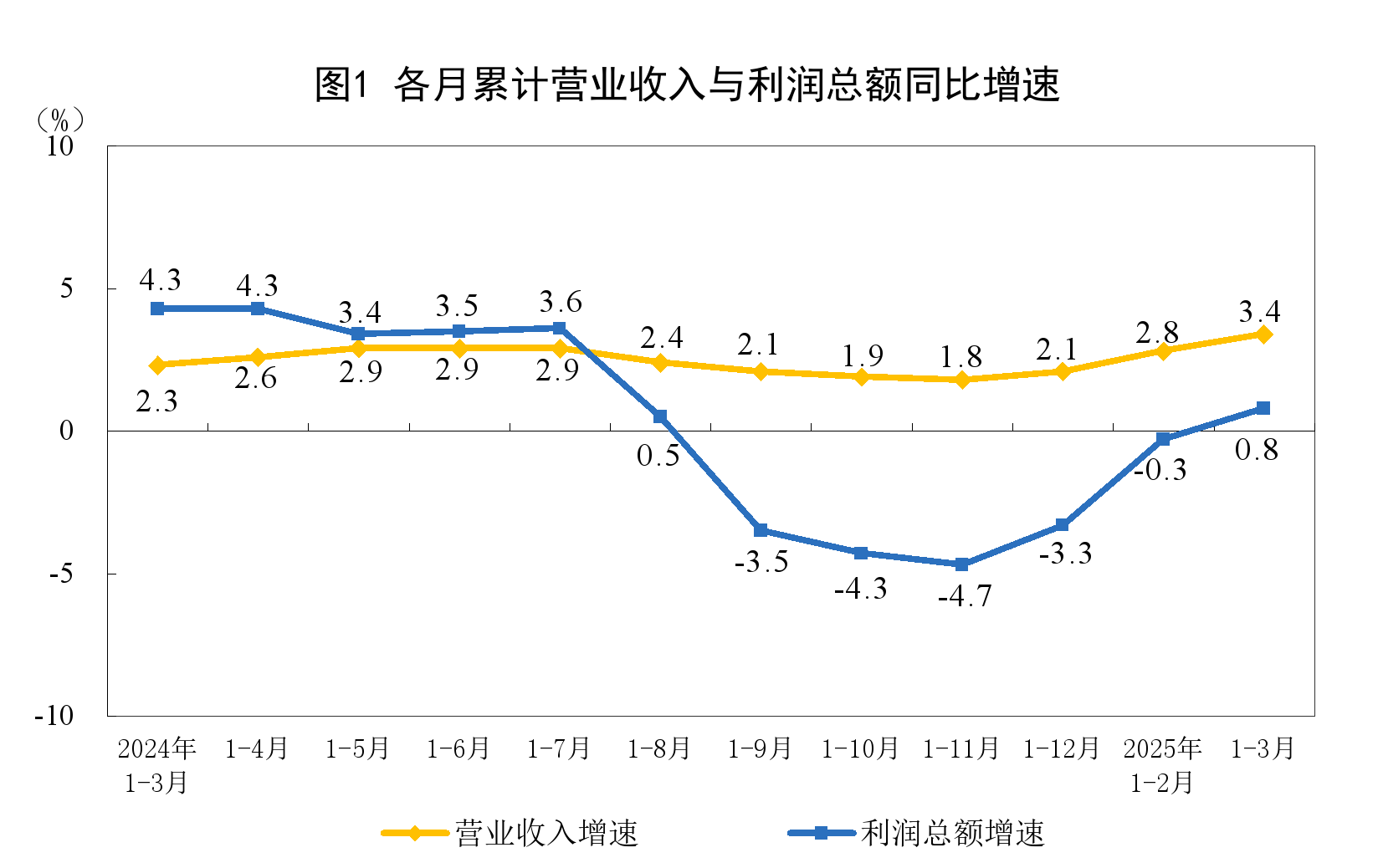
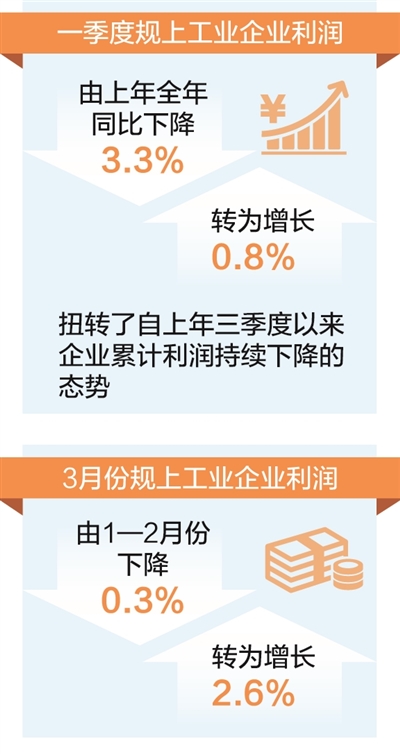
Group 1 - In the first quarter, profits of industrial enterprises above designated size turned from a year-on-year decline of 3.3% in the previous year to a growth of 0.8%, reversing the continuous decline since the third quarter of last year [3] - In March, profits of industrial enterprises increased by 2.6%, improving from a decline of 0.3% in January-February [3] - Revenue growth for industrial enterprises accelerated, with a year-on-year increase of 3.4% in the first quarter, which is 0.6 percentage points faster than January-February [3] Group 2 - Nearly 60% of industries saw profit growth, with manufacturing showing significant improvement, achieving a profit growth of 7.6% in the first quarter, an acceleration of 2.8 percentage points [4] - The equipment manufacturing sector became a crucial support for profit growth, with a year-on-year profit increase of 6.4%, accounting for 32.0% of total profits of industrial enterprises above designated size [4] - High-tech manufacturing led high-quality development, with profits turning from a year-on-year decline of 5.8% in January-February to a growth of 3.5% in the first quarter, exceeding the average growth rate of all industrial enterprises by 2.7 percentage points [4] Group 3 - The "Two New" policies showed significant effects, with profits in specialized and general equipment industries increasing by 14.2% and 9.5% respectively [4] - The policy of replacing old consumer goods with new ones had a notable impact, with profits in wearable smart device manufacturing, electric bicycle manufacturing, and kitchen appliance manufacturing increasing by 78.8%, 65.8%, and 21.7% respectively [4]
3月规模以上工企利润由降转增,高技术制造业利润实现两位数增长,一季度近六成行业利润增长
Mei Ri Jing Ji Xin Wen· 2025-04-27 07:05
Group 1 - In the first quarter, the profits of industrial enterprises above designated size turned from a year-on-year decline of 3.3% in the previous year to a growth of 0.8% [2][5] - In March, the profits of these enterprises increased by 2.6%, reversing a 0.3% decline in January and February [6][8] - The revenue of industrial enterprises in March grew by 4.2%, accelerating by 1.4 percentage points compared to January and February [6][8] Group 2 - High-tech manufacturing profits surged by 14.3% in March, contributing 2.8 percentage points to the overall profit growth of industrial enterprises [3][8] - The specialized and general equipment sectors saw profit increases of 14.2% and 9.5%, respectively, outperforming the average profit growth of all industrial enterprises [3][8] - In the first quarter, 24 out of 41 industrial categories reported profit growth, indicating nearly 60% of industries experienced improvements [8] Group 3 - The private and joint-stock enterprises showed significant profit growth in March, with private enterprises increasing by 16.0% and joint-stock enterprises by 3.5% [7] - The equipment manufacturing sector accounted for 32.0% of the total profits of industrial enterprises, with a year-on-year profit growth of 6.4% [8] - The aerospace industry experienced a profit increase of 23.9%, while sectors like smart consumer devices and medical equipment also reported substantial profit growth [8]