绿证交易

Search documents
国家能源局发布2026年1月全国可再生能源绿色电力证书核发及交易数据
国家能源局· 2026-02-14 02:10
Group 1: Green Certificate Issuance - In January 2026, the National Energy Administration issued 196 million green certificates, covering 832,000 renewable energy generation projects, with 151 million being tradable, accounting for 76.79% of the total [2] - The green certificates issued correspond to renewable energy generation for December 2025, totaling 152 million, which represents 77.49% of the issuance [2] - The breakdown of green certificate issuance by renewable energy type includes: Wind Power (85,450), Solar Power (54,900), Conventional Hydropower (41,580), Biomass Power (13,110), and Other Renewable Energy (980) [4] Group 2: Green Certificate Trading - In January 2026, a total of 102 million green certificates were traded nationwide, with 33.69 million being green electricity trading certificates [5] - The trading volume by renewable energy type includes: Wind Power (48,970), Solar Power (42,060), Biomass Power (7,970), and Other Renewable Energy (3,060) [7] - The separate trading of green certificates in January 2026 reached 68.37 million, with 6.5 million certificates for the production year 2024 traded at an average price of 1.25 yuan per certificate, reflecting a 11.64% increase in price; for the production year 2025, 61.88 million certificates were traded at an average price of 5.51 yuan per certificate, showing a 7.04% price increase [7][9]

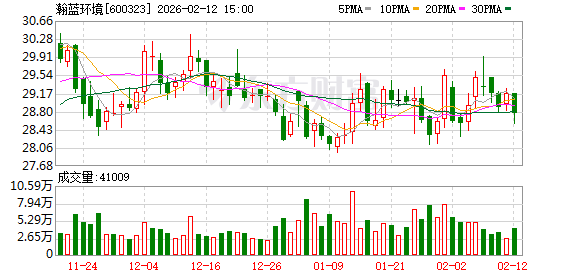
瀚蓝环境:公司具有丰富的固废处理应用场景和资源
Zheng Quan Ri Bao· 2026-02-12 13:12
Group 1 - The company has established a Carbon Management Center to create a systematic carbon management system and overall carbon reduction planning [2] - The company aims to develop an information platform for carbon management, providing a one-stop service model for green certificate application, trading, and carbon footprint tracing [2] - The company has rich experience in carbon trading and green certificate trading, with a substantial reserve of green certificates [2] Group 2 - The company possesses abundant solid waste treatment application scenarios and resources, actively focusing on related resource utilization businesses [2]

2025年可再生能源发电量达到约4万亿千瓦时 超过欧盟27国用电量之和
Zhong Guo Dian Li Bao· 2026-02-02 01:56
Core Viewpoint - The National Energy Administration (NEA) emphasizes that by 2025, China's energy supply security will be significantly enhanced, leading to a generally relaxed supply-demand situation and a healthy development of the industry, with a solid foundation for the construction of a new energy system to support the continuous recovery of the economy [1] Group 1: Energy Supply and Production - By 2025, the annual power generation from renewable energy will exceed the total electricity consumption of the 27 EU countries, reaching approximately 4 trillion kilowatt-hours [2] - The production of major industrial raw coal increased by 1.2% year-on-year, while crude oil and natural gas production reached historical highs, with year-on-year increases of 1.5% and 6.2%, respectively [2] - The price of 5500 kcal thermal coal at the Qinhuangdao port is expected to reach 690 yuan per ton by the end of 2025, reflecting a 75 yuan increase from the lowest point of the year [2] Group 2: System Resilience and Weather Impact - The maximum electricity load in China exceeded 1.4 billion kilowatts for three consecutive days due to extreme cold weather, setting a new winter record [3] - The NEA has implemented a "one province, one policy" approach to enhance supply security measures and optimize electricity grid arrangements [3] Group 3: Natural Gas Supply - During the heating season, the cumulative natural gas consumption reached 119.52 billion cubic meters, a year-on-year increase of 4.6%, with stable domestic and imported gas supply [4] Group 4: New Energy Grid Development - The construction of a new energy grid platform is accelerating, with the establishment of the world's largest and most complex AC/DC hybrid power grid, enhancing nationwide electricity resource allocation [5] - By 2030, a new energy grid platform will be established, focusing on a robust backbone grid and smart microgrids to support high proportions of renewable energy integration [6] Group 5: Future Energy Planning - By 2030, non-fossil energy consumption is expected to account for 25% of total energy consumption, with renewable energy generation capacity exceeding 50% [7] - The NEA plans to promote a diversified supply of energy sources, including wind, solar, and nuclear, while enhancing energy efficiency in key sectors [8] - A comprehensive energy planning framework is being developed, with the new energy system and renewable energy planning expected to be released in the first half of this year [9]
绿证交易活跃度提升 专家提醒别患上“依赖症”
Zhong Guo Zheng Quan Bao· 2026-02-01 21:02
Core Insights - The trading volume of renewable energy green power certificates (green certificates) in China is expected to double in 2025 compared to 2024, driven by improved mechanisms for green power consumption and market demand [1][2] - There is a price differentiation trend among green certificates issued in different years, reflecting varying market expectations [2][3] - The green certificate market is anticipated to remain robust in 2026, with an emphasis on avoiding reliance on certificates to offset carbon emissions [1][4] Trading Activity and Price Differentiation - In 2025, a total of 2.947 billion green certificates were issued, with 1.893 billion being tradable; the total trading volume reached 930 million, a significant increase from 446 million in 2024 [2] - The average trading price for 2025-issued green certificates fluctuated, starting at 4.12 yuan in April, peaking at 8.10 yuan in August, and dropping to 5.15 yuan by December; 2024-issued certificates maintained a price above 2 yuan until December, when it fell to 1.12 yuan [2] - The price differentiation indicates a market preference for newly issued certificates due to declining policy applicability of older certificates [2][3] Benefits to Companies - The active trading of green certificates has become a direct revenue source for renewable energy projects, helping to offset declining electricity prices and enhancing overall project profitability [3] - Inner Mongolia Energy Group reported over 800,000 tradable green certificates issued in 2025, a 330% increase from 2024, generating sales exceeding 16 million yuan [3] - Other companies, such as Huayin Power and Yunnan Energy Investment, have also reported significant revenues from green certificate trading, indicating a growing trend among firms to leverage these certificates for financial gains [3] Market Outlook and Strategic Considerations - The green certificate market is expected to see increased supply and demand in 2026, with a broader range of industries targeted for green power consumption [4] - High energy-consuming companies may face rising procurement costs for green certificates, which could pressure them to accelerate their green transformation efforts [4] - Companies are advised to prioritize optimizing their energy structure and improving energy efficiency rather than relying solely on green certificates for carbon neutrality [4]


绿证交易活跃度提升专家提醒别患上“依赖症”
Zhong Guo Zheng Quan Bao· 2026-02-01 20:53
Group 1 - The trading volume of renewable energy green power certificates (green certificates) in China is expected to double in 2025 compared to 2024, with a total of 9.30 billion certificates traded [1] - The average trading price of green certificates issued in 2025 showed significant fluctuations, starting at 4.12 yuan in April, peaking at 8.10 yuan in August, and then dropping to 5.15 yuan by December [1] - The price of green certificates issued in 2024 remained above 2 yuan after April 2025, eventually falling to 1.12 yuan by December [1] Group 2 - The increase in green certificate trading activity and the rise in prices are driven by policy support and market supply-demand dynamics, as highlighted by the recent government policies aimed at promoting green electricity consumption [2] - Some companies, such as Inner Mongolia Energy Group, reported significant growth in green certificate issuance and sales, with over 800,000 certificates issued in 2025, representing a growth of over 330% from 2024 [3] - The green certificate market is expected to see increased demand and supply in 2026, with a focus on expanding the coverage of industries required to meet green electricity consumption targets [3] Group 3 - High energy-consuming enterprises are expected to face increased procurement costs for green certificates due to rising prices, which may pressure them in the short term but encourage long-term green transformation [3] - The active green certificate market is anticipated to provide stable market demand and revenue assurance for the development of renewable energy in China, facilitating the transition of high-energy-consuming industries [4] - The synergy between the green electricity consumption mechanism and the national carbon market is expected to create a dual incentive system for carbon pricing and green certificate trading, supporting the achievement of carbon neutrality goals [4]
国家能源局:2025年12月国家能源局核发绿证2.11亿个
智通财经网· 2026-01-22 03:19
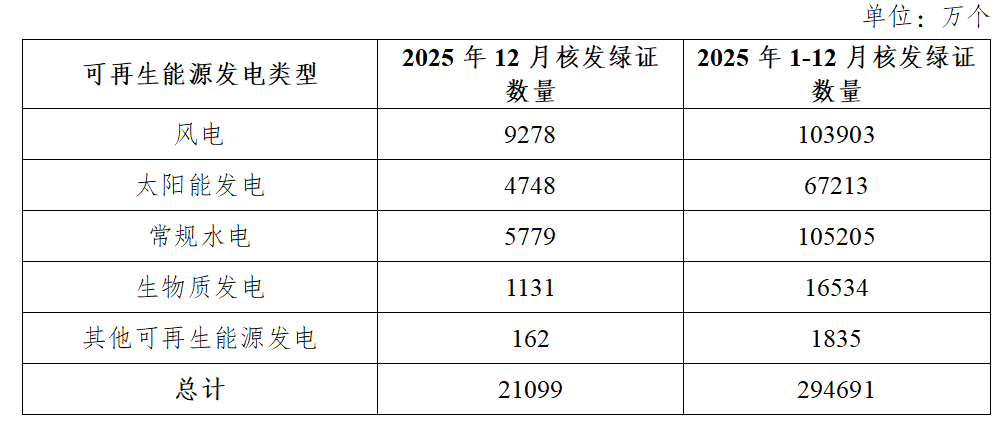
Core Insights - The National Energy Administration issued data on the issuance and trading of renewable energy green power certificates for December 2025, highlighting significant activity in the renewable energy sector [1] Group 1: Green Certificate Issuance - In December 2025, a total of 211 million green certificates were issued, covering 688,700 renewable energy generation projects, with 150 million being tradable, accounting for 71.32% of the total [1] - For the entire year of 2025, the total number of green certificates issued reached 2.947 billion, with 1.893 billion being tradable [1] Group 2: Breakdown of Issued Green Certificates - The issuance of green certificates in December 2025 by renewable energy type included: - Wind Power: 9.278 million - Solar Power: 4.748 million - Conventional Hydropower: 5.779 million - Biomass Power: 1.131 million - Other Renewable Energy: 162,000 - Total: 21.099 million [2] Group 3: Green Certificate Trading - In December 2025, a total of 202 million green certificates were traded, with 22.75 million being green power trading certificates [3] - For the full year of 2025, the total number of traded green certificates was 930 million, with 250 million being green power trading certificates [3] Group 4: Breakdown of Traded Green Certificates - The trading of green certificates in December 2025 by renewable energy type included: - Wind Power: 9.415 million - Solar Power: 8.931 million - Biomass Power: 1.421 million - Other Renewable Energy: 463,000 - Total: 20.230 million [5] Group 5: Trading Prices of Green Certificates - The average trading price for green certificates for the production year 2024 was 1.12 yuan per certificate, reflecting a decrease of 73.82% compared to the previous period [7] - The average trading price for green certificates for the production year 2025 was 5.15 yuan per certificate, showing a slight decrease of 0.22% [7]
顺控发展(003039) - 003039顺控发展投资者关系管理信息20260121
2026-01-21 00:32
Group 1: Financial Performance and Cost Management - The cost of electricity generation for the company's waste incineration power business is competitive within the industry, with specific cost components including franchise rights amortization, maintenance, and operational costs [2]. - The company’s heat and power project is positioned favorably in terms of cost control and profitability compared to industry peers [2]. Group 2: Strategic Acquisitions and Market Position - The acquisition of Huaxin Color Printing is a strategic move aimed at diversifying revenue streams and finding opportunities for market integration, as the environmental protection industry has shifted from incremental to stock competition [2]. - The company aims to establish a second growth curve by integrating market-oriented and cash flow-positive industries, with Huaxin Color Printing aligning with its strategic needs [2]. Group 3: Industry Trends and Future Opportunities - The company is actively monitoring industry trends and is open to exploring new business growth points in the environmental protection sector, including potential entry into niche markets or emerging industries [2]. - Current operations focus on solid waste treatment in the living sector, with ongoing attention to resource utilization in the renewable energy field, although no related business has been initiated yet [2]. Group 4: Challenges and Risk Management - Some regions face challenges with insufficient waste for incineration power projects, leading to the excavation of landfills to increase waste processing capacity [2]. - To mitigate industry risks, the company maintains good communication with government entities and enhances project operations and profitability through collaborative waste treatment strategies [2]. - The company is also engaged in green certificate trading to promote sustainable development in line with national carbon neutrality policies [2].

内蒙古能源集团2025年绿证销售实现跨越式增长
Xin Hua Cai Jing· 2026-01-14 08:29
Core Insights - In 2025, Inner Mongolia Energy Group's renewable energy sector achieved significant growth in green certificate sales, driven by abundant wind and solar resources and favorable regional policies, marking a benchmark for green certificate operations and enhancing the company's green transformation efforts [1][2] Sales and Revenue - The company issued over 800,000 tradable green certificates in 2025, representing a year-on-year increase of over 330% - Green certificate sales revenue exceeded 16 million yuan, becoming a new growth point for the company's revenue [1] Market Performance - The domestic green certificate market in 2025 exhibited a differentiation between "new certificates at high prices" and "existing certificates at low prices" - The company strategically focused on trading newly produced wind power green certificates to maximize revenue while avoiding risks associated with low prices of existing certificates [1] Trading Strategy and Market Positioning - Leveraging the Inner Mongolia power grid as a platform for green electricity trading, the company established a diversified trading system - The company actively engaged in the Mongolian West electricity multilateral trading market, employing a "bundled electricity and certificates" approach, with 80% of green certificate transactions being long-term agreements, ensuring stable sales [2] Policy and Capacity Support - The rapid growth of the company's green certificate business is supported by policy initiatives and increased capacity - In March 2025, new policies from the National Development and Reform Commission and the comprehensive market entry of Inner Mongolia's renewable energy created rigid market demand - The company accelerated the deployment of new renewable energy capacity, ensuring a solid foundation for green certificate supply [2] Future Outlook - The company plans to continue focusing on wind and solar energy, expanding green electricity capacity, and deepening cooperation with market participants - With the advancement of the "Shagehuang" base and external transmission channels, the green certificate business is expected to break regional boundaries and contribute to national energy structure transformation [3]
构建适应绿色低碳转型市场机制
Zhong Guo Dian Li Bao· 2026-01-14 01:57
Core Viewpoint - The construction of a national unified electricity market is essential for optimizing electricity resource allocation and supporting energy transition, with a three-step plan proposed for its development by 2025, 2029, and 2035 [1] Group 1: Challenges in Electricity Market - The rapid increase in the share of renewable energy generation has led to significant challenges, including intensified pressure on renewable energy consumption, with projected growth rates of 16% for wind and 44% for solar power in 2024 [2] - The electricity trading mechanism needs improvement, as issues such as weak price correlation between medium- and long-term trading and spot markets, insufficient liquidity, and a lack of unified rules hinder market efficiency [2] - The environmental value of renewable energy is not adequately reflected, with the average trading price of green certificates falling below 0.6 cents per kilowatt-hour in 2024, indicating a lack of robust demand support [2] Group 2: Solutions for Market Improvement - To address the challenges, it is crucial to accelerate the construction of a national unified electricity market and develop a market mechanism that aligns with green and low-carbon transitions [3] - Enhancements to the renewable energy consumption responsibility mechanism are necessary, including stricter accountability for electricity consumers and clearer penalties for non-compliance [4] - The electricity trading mechanism should be adapted to better reflect the temporal and spatial value of renewable energy, allowing for more flexible trading arrangements and a broader range of auxiliary services [5] Group 3: Future Prospects - The establishment of a national unified electricity market is vital for breaking down inter-provincial barriers and optimizing resource allocation, which will enhance the electricity system's adaptability to high proportions of renewable energy [7] - This market will serve as a foundational infrastructure for fostering new productive forces in the energy sector and addressing international green trade barriers, thereby strengthening China's position in global climate governance [8] - The successful implementation of this market requires collaboration among government departments, grid companies, power generation groups, and electricity consumers, paving the way for a new energy system focused on non-fossil energy sources [9]
绿证交易量增价稳,行业长期价值稳固
Changjiang Securities· 2026-01-04 23:30
Investment Rating - The report maintains a "Positive" investment rating for the utility sector [10] Core Insights - In November, the national trading volume of green certificates reached 132.12 million, a year-on-year increase of 143%, marking a historical high for monthly trading scale. From January to November, the trading of green certificates accounted for 41.81% of the issued tradable scale, an increase of 27.65 percentage points compared to the entire year of 2024, indicating a continuous alleviation of the oversupply issue in green certificates [2][12] - The average trading price of green certificates in November was 4.96 yuan per certificate, showing a month-on-month increase of 10.80%. The improvement in both supply and demand sides is expected to provide long-term support for green certificate prices, further catalyzing the recovery of the utility sector's attributes and growth narrative [2][12] - The report highlights a significant increase in new installed capacity for thermal power, with a historical high of 77.52 million kilowatts added from January to November, representing a year-on-year growth of 63.41%. This expansion is expected to enhance the power system's regulation capacity and alleviate the pressure on renewable energy consumption and electricity prices [2][12] Summary by Sections Green Certificate Trading - The trading volume of green certificates in November reached 132.12 million, a 143% increase year-on-year, with the trading scale hitting a historical high. The trading of green certificates from January to November totaled 728 million, a 119% increase year-on-year. The proportion of traded green certificates to the issued tradable scale reached 41.81%, up 27.65 percentage points from 2024 [2][12] - The average trading price for green certificates in November was 4.96 yuan per certificate, reflecting a month-on-month increase of 10.80%. The price stability is supported by the synchronized improvement in supply and demand, with expectations of rational expansion in supply due to policy changes [2][12] Installed Capacity - From January to November, the total new installed capacity was 44.557 million kilowatts, with November alone contributing 4.773 million kilowatts, a year-on-year increase of 27.86%. Wind and solar power installations saw significant growth, with wind power increasing by 59.42% and solar power by 33.25% year-on-year [2][12] - The report emphasizes that the substantial expansion of thermal power capacity will significantly enhance the power system's ability to accommodate fluctuating renewable energy outputs, thereby stabilizing electricity prices [2][12] Investment Recommendations - The report recommends focusing on quality thermal power operators such as Huaneng International, Datang Power, Guodian Power, and Huadian International, as well as hydropower companies like Yangtze Power and State Power Investment Corporation. It also highlights opportunities in the renewable energy sector, suggesting companies like Longyuan Power and New天绿色能源 [2][12]