
可可种植与加工

Search documents
新年最惨商品,暴跌近40%,主产国出手救市
Di Yi Cai Jing· 2026-02-12 00:10
Core Viewpoint - Cocoa futures prices have fallen below $3,800, marking the lowest level since October 2023, driven by weak global demand and increased supply [1] Group 1: Price Trends - Cocoa prices have dropped nearly 40% this year, making it the worst-performing commodity [1] - The price decline follows a record annual drop of 48.1% in 2025, with a 70% decrease compared to the peak in May 2024 [1] Group 2: Supply and Demand Dynamics - The imbalance in supply and demand is the primary reason for the current cocoa price crash [3] - European cocoa grinding volume fell to 304,470 tons in Q4 last year, down 8.3% year-on-year, marking the sixth consecutive quarter of decline [3] - Major companies like Mondelez, Hershey, and Kraft Heinz cite cocoa costs as a key factor affecting profits, with Hershey reporting a 60.3% drop in net profit due to cocoa costs [3] Group 3: Inventory and Production Issues - Low purchasing willingness has led to inventory buildup in major cocoa-producing countries, with Côte d'Ivoire's cocoa arrivals reaching 1.263 million tons, a 4.5% increase year-on-year [4] - Ghana's cocoa prices are higher than other producing countries, causing international buyers to abandon purchases, resulting in approximately 50,000 tons of unsold cocoa at Ghana's ports [4] - Forecasts indicate a global cocoa surplus of 287,000 tons in the 2025/26 season and 267,000 tons in 2026/27 [4] Group 4: Industry Responses - Côte d'Ivoire has initiated a strategic operation to buy back thousands of tons of unsold cocoa from warehouses and ports to alleviate pressure on producers [4] - Ghana is accelerating payments to farmers for cocoa beans and exploring new financing models to reduce reliance on raw cocoa bean exports, aiming to enhance local processing and sustainability [5]

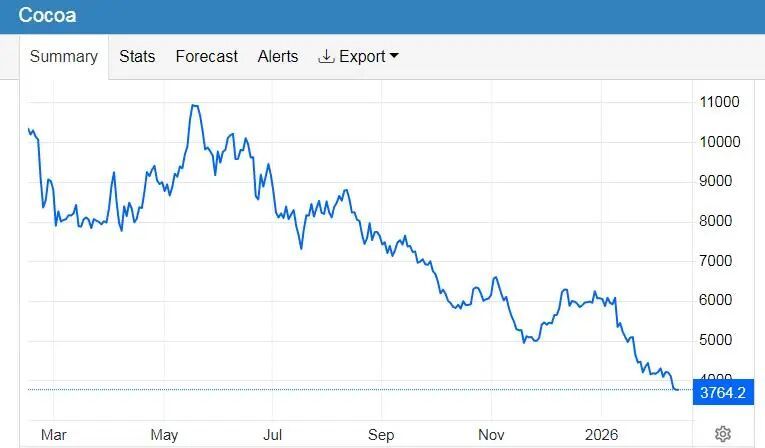
全球可可价格跌破加纳国内收购价
Shang Wu Bu Wang Zhan· 2026-01-24 14:46
Group 1 - The global cocoa prices have fallen below the purchase price set by the Ghanaian government for its farmers, leading to significant financial burdens for the Ghana Cocoa Board [1] - Current international cocoa prices are approximately $5,100 per ton, equivalent to about 54,570 Ghanaian cedis, which is below the producer price of 58,000 cedis set for the 2025/2026 season [1] - The Ghana Cocoa Board is currently paying farmers 3,100 cedis per bag (64 kg) and is absorbing the gap caused by exchange rate fluctuations through internal subsidies [1] Group 2 - The decline in prices is attributed to changes in supply and demand dynamics, with cocoa prices expected to see a surplus in the 2025/2026 and 2026/2027 seasons due to improved weather conditions in major West African producing regions [2] - The Ghana Cocoa Board aims to support farmers by maintaining purchase prices, providing free fertilizers, and implementing a cocoa traceability system to comply with the EU's upcoming deforestation regulations [2] - The Ghana Cocoa Board faces a difficult decision on whether to maintain current purchase prices under unfavorable international market conditions or adjust them according to falling global prices, impacting farmer welfare and the sustainability of the cocoa industry [2]
喀麦隆凭借可可豆在与荷兰、马来西亚和印度尼西亚的贸易中呈现顺差
Shang Wu Bu Wang Zhan· 2025-12-02 17:14
Core Insights - Cameroon is experiencing a trade surplus with the Netherlands, Malaysia, and Indonesia, primarily driven by cocoa bean exports [1] Group 1: Trade Partners - The Netherlands, Malaysia, and Indonesia are highlighted as the main importers of cocoa beans from Cameroon [1] - Cocoa and its products account for 84% of Indonesia's total imports from Cameroon, 72% for the Netherlands, and 68% for Malaysia [1]
可可价格跳水近60%
Shang Wu Bu Wang Zhan· 2025-10-11 16:23
Core Viewpoint - The cocoa market has experienced a dramatic collapse after two years of strong growth, with prices dropping to $5,997.59 per ton, a staggering 58% decline from the historical high in April 2024 [1] Group 1: Market Dynamics - The decline in cocoa prices is attributed to weakened demand and improved supply conditions [1] - Global cocoa grinding volumes are expected to decrease year-on-year in Q2 2025, with Europe down 7.2%, Asia down 16%, and North America down 2.8%, indicating significant demand loss in major consuming regions [1] - The International Cocoa Organization (ICCO) unexpectedly forecasts a global cocoa surplus of 142,000 tons for the 2024-2025 season, contrasting sharply with three consecutive years of supply shortages [1] Group 2: Supply Factors - Weather conditions in West Africa, which accounts for over 70% of global cocoa supply, have improved, and strategic price adjustments have stabilized production [1] - Côte d'Ivoire and Ghana have raised farm delivery prices for producers, potentially stimulating an increase in cocoa supply in Q4 [1] Group 3: Future Outlook - Analysts predict that cocoa prices will fluctuate between $5,500 and $6,500 per ton in the near term [1] - Factors such as weather impacts, political instability in producing regions, pest outbreaks, or the El Niño phenomenon could quickly reverse the current trend [1] - Industry observers are also monitoring Ecuador's rise as a major exporter, which may challenge Ghana's position as the world's second-largest producer [1]
加纳可可局清偿20亿塞地到期票息
Shang Wu Bu Wang Zhan· 2025-09-05 17:28
Group 1 - The Ghana Cocoa Board has paid 20 billion cedis in interest to investors participating in the cocoa bond restructuring plan [1] - The restructuring involves converting existing notes into bonds, primarily affecting commercial banks, aimed at debt repayment and financial strengthening [1] - Market analysis suggests that this move will enhance the Cocoa Board's financing capacity and credit rating, facilitating cocoa procurement for the new production season [1] Group 2 - The Central Bank Governor indicated that the Cocoa Board is expected to secure a cash inflow of 4 billion USD through new pre-sale agreements for cocoa procurement and currency stabilization [1]
科特迪瓦2025上半年出口160万吨可可豆,直接影响全球市场价格波动
Shang Wu Bu Wang Zhan· 2025-08-14 04:27
Core Insights - Côte d'Ivoire exported 1.613 million tons of cocoa beans by the end of June 2025, representing a year-on-year increase of 1.1% [1] - The International Cocoa Organization (ICCO) raised concerns about the accuracy of the export data, suggesting potential issues with weight measurement or double counting [1] - Cocoa production in Côte d'Ivoire significantly influences global market price fluctuations, with prices experiencing an 8% increase in early June before a subsequent decline due to adverse weather conditions [1] Market Dynamics - Cocoa market prices surged to $9,245 per ton in London and $10,175 per ton in New York in early June [1] - Following strong rainfall, market sentiment shifted, leading to a price drop of 16% in London and 18% in New York by mid-June [1] - By the end of June, market concerns regarding potential cocoa bean production declines eased, resulting in a recovery in prices [1] Industry Position - Côte d'Ivoire is the world's largest cocoa producer, accounting for approximately 40% of global cocoa production [2]
喀麦隆可可,藏着“财富密码”(国际视点)
Ren Min Ri Bao· 2025-07-30 22:12
Core Viewpoint - Cameroon is the world's fourth-largest cocoa exporter, with cocoa and its derivatives expected to account for over 20% of the country's export revenue in 2024, exceeding 1 trillion Central African Francs [1][3]. Group 1: Cocoa Production and Economic Impact - Cameroon exported over 180,000 tons of raw cocoa beans last year, representing approximately 7.6% of the global market [1]. - The cocoa cultivation area in Cameroon is about 425,000 hectares, primarily located in seven tropical rainforest regions [2]. - Approximately 40% of the agricultural population in Cameroon relies on cocoa farming, with around 600,000 farmers involved in the cocoa industry, benefiting nearly 6 million people directly or indirectly [3]. Group 2: Industry Development and Government Initiatives - The Cameroonian government aims to increase cocoa production to 284,600 tons in the 2024-2025 season and is implementing various measures to expand cocoa cultivation and develop processing industries [1][6]. - The local processing rate of cocoa is currently below 15%, but the proportion of first-grade beans has increased from 0.13% in 2009 to 5.8% [5]. - The government has raised the purchase price of cocoa by 30% to encourage farmers and has been distributing disease-resistant seedlings and pesticides for over 20 years [6]. Group 3: International Trade and Market Expansion - Cameroon cocoa is expected to benefit from China's zero-tariff policy for cocoa beans and related agricultural products, enhancing export opportunities [7]. - The completion of the Kribi deep-water port, built with Chinese aid, has improved the export capacity for cocoa and other products [7]. - Chinese companies are planning to invest in Cameroon’s cocoa industry, including establishing a chocolate factory and implementing solar drying technology to reduce spoilage [8].
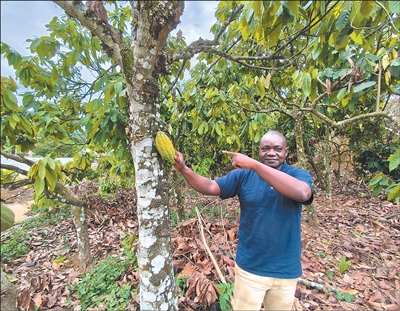
2024年可可及其衍生产品占全国出口收入的20%以上 喀麦隆可可 藏着“财富密码”(国际视点)
Ren Min Ri Bao· 2025-07-30 22:12
Core Insights - Cameroon is the world's fourth-largest cocoa exporter, with over 180,000 tons exported last year, accounting for approximately 7.6% of the global market [1] - Cocoa and its derivatives are projected to contribute over 20% of Cameroon’s export revenue in 2024, exceeding 1 trillion Central African Francs [1] - The country aims to increase cocoa production to 284,600 tons in the 2024-2025 season through various initiatives [1] Group 1: Cocoa Industry Overview - Cocoa cultivation in Cameroon spans approximately 425,000 hectares, primarily in seven tropical rainforest regions [2] - The main cocoa variety is "Forastero," which constitutes over 80% of production, while the rare "Criollo" variety accounts for only 5% but is highly sought after in the European market [2][3] - About 40% of the agricultural population in Cameroon relies on cocoa farming, with around 600,000 farmers involved in the industry [3] Group 2: Economic and Strategic Importance - Cocoa is recognized as a strategic economic pillar in Cameroon, with the government establishing the National Cocoa and Coffee Office for better coordination [4] - The local processing rate of cocoa is currently below 15%, but efforts are being made to improve this through enhanced agricultural practices [4] - The proportion of first-grade cocoa beans has increased from 0.13% in 2009 to 5.8% recently, indicating improvements in quality [4] Group 3: Government Support and Initiatives - The government has raised the purchase price of cocoa by 30% to encourage farmers and has implemented a 20% export tax reduction for qualifying cocoa products [5] - Initiatives like the "Cocoa Coffee Planting Protection Support Program" have been in place for over 20 years to ensure stable cocoa production [5] - The "Sodecao Strategic Plan" aims to produce 500,000 high-quality cocoa seedlings by 2027 and establish 100 kilometers of planting pathways [5] Group 4: Export Opportunities and International Collaboration - Cameroon is set to benefit from China's zero-tariff policy on cocoa beans and related agricultural products, enhancing export potential [7] - The completion of the Kribi Deep Sea Port has improved export logistics, facilitating quicker access to international markets [7] - Chinese companies are showing interest in investing in Cameroon’s cocoa industry, with plans for a chocolate factory and innovations in drying technology to reduce spoilage [7][8]