
干细胞治疗

Search documents
金达莱回应对外投资问询 详解济慈医疗与中科鸿泰投资逻辑
Xin Lang Cai Jing· 2026-01-07 11:38
Core Viewpoint - Jiangxi Jindalai Environmental Protection Co., Ltd. is expanding its business into the biomedicine and medical robotics sectors due to the slowdown in the environmental protection industry and increasing external competition, aiming to cultivate new profit growth points [1][2]. Group 1: Investment Strategy - The company is making strategic investments in unlisted companies in the biomanufacturing and health sectors, specifically targeting Yunnan Jici Medical Technology Co., Ltd. and Beijing Zhongke Hongtai Medical Technology Co., Ltd., which focus on stem cell technology and vascular interventional surgical robots, respectively [2][3]. - The investments are aligned with national priorities for strategic emerging industries, reflecting the company's proactive response to market conditions [2]. Group 2: Jici Medical Overview - Jici Medical specializes in autologous stem cell therapy, particularly focusing on rFib cell research and clinical transformation, addressing the growing demand for elderly healthcare solutions [3][4]. - The global stem cell industry was valued at $21.06 billion in 2022, with China's market at approximately 104.2 billion RMB, showing a compound annual growth rate of 56.79% [3]. Group 3: Jici Medical's Technology and Financials - Jici Medical's core technology involves reprogramming skin fibroblasts into induced mesenchymal stem cells, with over 30 clinical indications under investigation [4]. - The company has a projected revenue of 8.69 million RMB in 2024, with an asset valuation of 543.6 million RMB for the investment, reflecting a high appraisal value due to the inclusion of unrecorded patent technologies [5]. Group 4: Zhongke Hongtai Overview - Zhongke Hongtai focuses on the development of vascular interventional surgical robots, with a significant market potential as China is expected to conduct approximately 7 million vascular interventional surgeries in 2024 [6][7]. - The global market for vascular robots is projected to reach $4.48 billion by 2030, with the Chinese market estimated at 5.82 billion RMB [6]. Group 5: Investment Logic and Risk Control - The investment in Zhongke Hongtai is seen as a strategic move, with the company contributing 30 million RMB for a 10% stake, reflecting the advancements made in team building and product development [7]. - To ensure investment safety, the agreement includes conditions for staged payments and a buyback option if regulatory approvals are not obtained by the end of 2027 [7]. Group 6: Financial Health - The company maintains a strong financial position with sufficient working capital, reporting current assets of 3.17 billion RMB and a debt ratio of 10.20% as of September 30, 2025 [8]. - The investment will not adversely affect the company's main business operations or debt servicing capabilities [8].

金达莱拟2.8亿元增资入股济慈医疗
Zhi Tong Cai Jing· 2025-12-19 08:21
Core Viewpoint - The company, Jindalai (688057.SH), is optimistic about the development prospects of stem cell technology and plans to optimize its industrial structure to enhance risk resistance and cultivate new profit growth points through a capital increase in Yunnan Jici Medical Technology Co., Ltd. [1] Group 1 - The company intends to invest 280 million yuan of its own funds to acquire a 34% stake in Yunnan Jici Medical Technology Co., Ltd. [1] - Yunnan Jici Medical has unique advantages in the field of cell dedifferentiation and rejuvenation research, having established a technology system that induces skin fibroblasts into specific functional cells without going through the induced pluripotent stem cell (iPSC) stage [1] - The company has developed a series of autologous cell preparations or their derivatives, including first-generation induced mesenchymal stem cells (rFib), second-generation induced mesenchymal stem cells (cFib), induced osteoblasts (iOB), induced chondrocytes (iCH), induced neurons (iNC), induced endothelial cells (iEC), and induced vascular smooth muscle cells (iVSMC) [1] Group 2 - Yunnan Jici Medical has pioneered a new field of autologous cell therapy and tissue engineering for refractory diseases, particularly refractory geriatric diseases, based on its original series of stem cell patent technologies [2] - The company has obtained 20 invention patents in countries including China, the United States, Japan, Canada, Australia, and Malaysia [2]
干细胞治疗产业链加速实现技术与成本突围
Zheng Quan Ri Bao· 2025-11-24 16:29
Core Insights - Stem cell therapy has become a global research hotspot due to its potential for self-renewal and multi-directional differentiation, with China's first stem cell therapy drug, Aimi Maitosai injection, marking the commercialization phase of stem cell drugs in January this year [1] - 2025 is anticipated to be a pivotal year for stem cell applications in China, with the first stem cell new drug expected to be launched, alongside various policies promoting cell and gene therapy [1][8] - The clinical trial scale for stem cell therapy is expected to expand, with an increasing number of new drugs and a broader range of indications [1][2] Industry Development - Stem cell therapy aims to repair, replace, or regenerate damaged cells, tissues, and organs, addressing various medical challenges such as Alzheimer's disease and tissue damage from aging [2] - Over the past 30 years, significant breakthroughs in stem cell technology have been achieved, including nuclear transfer and gene editing, which have advanced the field [2] - As of January 2025, over 120 stem cell drugs have been approved for clinical trials in China, covering various systems including hematological, respiratory, cardiovascular, and autoimmune diseases [2] Clinical Applications - In orthopedics, stem cell therapy shows promise, particularly for osteoarthritis and cartilage issues, with a dual-track system for clinical research in place [3] - The emergence of stem cell treatment centers and anti-aging clinics indicates a growing market, especially in regions like Hainan Boao and the Guangdong-Hong Kong-Macao Greater Bay Area [3] Challenges and Innovations - The stem cell therapy industry faces challenges such as regulatory scrutiny and the need for cost-effective, quality-controlled production methods [4][5] - Current approved mesenchymal cell drugs focus on immune modulation rather than direct differentiation, while pluripotent stem cells are seen as the future but face safety concerns [4] - Innovations in production processes, such as the 3D biodegradable microcarrier technology developed by Huakan Biotechnology, have significantly reduced production costs and improved scalability [6][7] Policy and Market Environment - A comprehensive policy support system covering research, approval, and payment is being established to facilitate the development of the stem cell industry in China [8][9] - Recent regulations and pilot programs aim to create a standardized and efficient environment for stem cell therapy, promoting both domestic and foreign investment [9][10] - The market for stem cell therapy in China is projected to exceed 200 billion yuan by 2029, with a growing share in the global market [10]
2024年度北京市科技奖公布,38位科学家、193项成果获奖
Bei Jing Ri Bao Ke Hu Duan· 2025-11-07 02:58
Core Insights - The 2024 Beijing Science and Technology Awards recognized 38 scientists and 193 achievements, with over half of the awarded projects involving enterprises for six consecutive years [1][3] - Basic research achievements accounted for 29.5% of the total awards, indicating a growing emphasis on foundational research [1][2] Group 1: Basic Research Achievements - Basic research is highlighted as the source of innovation, with significant achievements in cutting-edge fields such as new generation information technology, new materials, and health [2] - Notable awardees include Professor Deng Hongkui for developing new strategies for treating major diseases using stem cell technology, and researcher Dong Jin for leading the development of the "Chang'an Chain," a domestically controlled blockchain technology [2] Group 2: Enterprise Innovation - The project "Research and Industrialization of Advanced Oxide Semiconductor Technology for Intelligent Display" won the first prize for scientific and technological progress, showcasing the critical role of enterprises in innovation [3] - Companies like BOE Technology Group have been pivotal in advancing key components and materials in the display field, demonstrating a commitment to sustained R&D investment [3] Group 3: Youth Talent - Over 50% of the awardees are young talents aged 45 and below, reflecting the city's efforts to invigorate innovation among younger scientists [4] - Young researchers like Professor Liu Ying have made significant breakthroughs in life sciences, contributing to a better understanding of cellular mechanisms and potential treatments for metabolic disorders [4] Group 4: Award Overview - The awards included 57 natural science achievements, 24 technological invention awards, and 112 scientific and technological progress awards, with a total of 15 first prizes and 42 second prizes in natural sciences [5]
近五年,176个国家和地区投资,8089家外资企业落户
Hai Nan Ri Bao· 2025-11-04 01:15
Core Insights - The Hainan Free Trade Port is rapidly attracting global investment due to its unique advantages and upcoming operational closure [2][3] - In the past five years, Hainan has established 8,089 foreign-invested enterprises, with an average annual growth rate of 43.7% [3] Investment Trends - In the first three quarters of this year, actual foreign investment in Hainan increased by over 40% year-on-year [3] - A total of 176 countries and regions have invested in Hainan, making it a new hotspot for global investment [3] Policy Advantages - The Hainan Free Trade Port offers significant policy advantages, including zero tariffs on raw materials, production equipment, and yachts, which boosts foreign trade [3] - The port's policies are designed to enhance the integration of domestic and international markets, providing a platform for cross-border trade and innovation [2][3] Notable Developments - The first foreign-funded stem cell project has been established in Hainan, indicating the port's openness to advanced medical technologies [2] - Hainan is set to welcome its first wholly foreign-owned hospital, showcasing the growing interest from international healthcare providers [2]
干细胞IND困局下的突围:如何跨越“从实验室到临床”的鸿沟?
Sou Hu Wang· 2025-09-26 09:44
Core Insights - The Chinese stem cell therapy industry is accelerating towards a "clinical verification" era, but many leading research teams face significant challenges in the IND (Investigational New Drug) application process, often leading to delays and missed opportunities [1][2][3] Group 1: Challenges in IND Application - The unique characteristics of stem cell drugs, such as live cell properties and production process complexity, impose higher regulatory requirements for safety and quality control compared to traditional drugs [2][3] - Over 60% of stem cell IND applications submitted in the past three years have required supplementary information, with some projects being halted due to ineffective responses to review comments [1][2] - Key challenges include difficulties in converting experimental data into compliant documentation, frequent process optimizations leading to quality consistency concerns, and insufficient identification of critical quality attributes (CQA) [3][4] Group 2: Importance of Registration Strategy - There is a disconnect between research and registration functions, with many teams only starting registration preparations late in the development process, which should be integrated throughout [4][8] - Successful projects often involve early engagement of regulatory experienced teams to establish quality systems and registration narratives, significantly reducing compliance risks [4][8] Group 3: Emergence of CQDMO Model - A new service model, Contract Quality & Development and Manufacturing Organization (CQDMO), is emerging, emphasizing registration-driven strategies and regulatory understanding alongside traditional production services [5][6] - Companies like Jiuzhitang Meike have successfully implemented the CQDMO model, supporting multiple stem cell projects through efficient IND application processes [6][7] Group 4: Market Potential and Future Outlook - The global stem cell market is projected to exceed $100 billion by 2030, with China's market expected to surpass 200 billion RMB, indicating a shift from technology followers to independent innovators [10][11] - The ability to navigate the IND application process effectively will become a critical competitive advantage for companies in the stem cell sector, as they seek to translate research breakthroughs into clinical applications [11][12]
赴日打干细胞致死事件之后:不必把日本医疗吹上天
创业邦· 2025-09-25 04:27
Core Viewpoint - The article discusses the recent incident involving a Chinese woman who died after receiving stem cell treatment in Japan, highlighting the complexities and risks associated with stem cell therapies in the country [5][17][22]. Group 1: Stem Cell Treatment in Japan - Japan is seen as a leader in stem cell research, particularly due to the work of Nobel laureate Shinya Yamanaka, who developed induced pluripotent stem (iPS) cells [9][10]. - The Japanese government has actively promoted stem cell therapy as a key industry, with significant funding and regulatory frameworks established to support its development [9][19]. - The majority of stem cell treatments in Japan are not based on iPS cells but rather on other types of stem cells, which may not have the same level of scientific backing [10][19]. Group 2: Treatment Costs and Market Dynamics - The costs for various stem cell treatments in Japan range significantly, with joint repair costing between 23,000 to 46,000 RMB and diabetes treatment ranging from 55,000 to 115,000 RMB [11][12]. - There is a high demand for stem cell treatments in Japan, particularly from foreign patients, which has led to a proliferation of private clinics offering these services [13][28]. - The regulatory environment in Japan allows for earlier commercialization of stem cell therapies compared to other countries, which may require more extensive clinical trials before approval [15][29]. Group 3: Risks and Safety Concerns - The article outlines potential risks associated with stem cell treatments, including allergic reactions, blood clots, infections, and the possibility of tumor formation [22][23]. - The recent death of a patient has raised concerns about the safety protocols in place at clinics offering stem cell therapies, prompting regulatory scrutiny [17][25]. - Patients are advised to thoroughly research and understand the treatment processes and potential risks before undergoing such procedures [7][24]. Group 4: Regulatory Environment and Global Context - Japan's regulatory framework for stem cell therapies is considered moderate, allowing for treatments to be offered after phase II clinical trials, unlike stricter regulations in the US and EU [15][29]. - The article suggests that Japan's approach to stem cell therapy may attract foreign investment and patients seeking advanced medical treatments [28][36]. - The global landscape for stem cell research is evolving, with countries like China also showing significant interest and investment in this field [19][30].


最近几个月投资活跃度最高的基金,我打赌你没注意过它
Sou Hu Cai Jing· 2025-08-19 08:49
Core Viewpoint - The article highlights the emergence of Lushan Ke Investment, which has become a leading player in the investment landscape by actively funding startups through the Hunan University Student Entrepreneurship Investment Fund, launched by the Hunan provincial government to support student entrepreneurship [1][3][4]. Investment Strategy and Performance - Lushan Ke Investment's Hunan University Student Entrepreneurship Investment Fund has shown a strong inclination towards early-stage investments, with angel round investments accounting for 71.74%, A round at 15.22%, and seed round at 8.70% [5]. - The fund's investment activities have fluctuated quarterly, with 24 projects in Q3 2025 and 22 in Q2, influenced by project application cycles and market conditions [5]. - A significant 84.78% of the invested companies are located in Changsha, indicating a focus on local projects while also supporting innovation across other regions in Hunan [5]. Sector Focus - The fund's investments span various sectors, with advanced manufacturing representing 39.13%, artificial intelligence at 15.22%, and healthcare at 10.87%, among others [5]. - Notable investments in advanced manufacturing include companies like Dingcai Technology, which provides digital R&D solutions, and Chumo Technology, specializing in intelligent servo systems [7]. - In the AI sector, investments include Xizhi Technology, which offers smart solutions for various industries, and Yizhi Intelligent, focusing on AI applications in healthcare [8]. Support for Student Entrepreneurship - The establishment of the fund reflects a commitment to supporting university students in entrepreneurship, leveraging Hunan's rich educational resources to identify quality local projects [13]. - The fund aims to balance the risks associated with student-led startups, which often face challenges due to inexperience and market misjudgments [13].
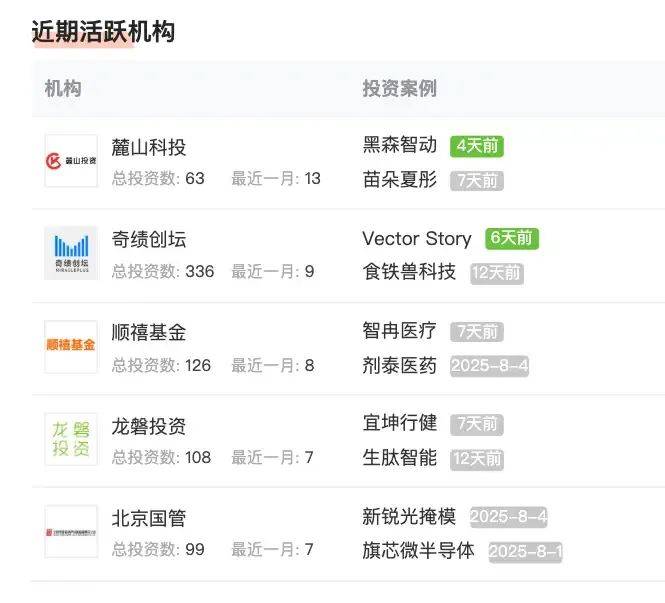
【RimeData周报07.26-08.01】人工智能再迎重大利好,年内融资已超550起,生育补贴政策落地,母婴赛道有望回暖!
Wind万得· 2025-08-02 22:28
Core Insights - The article highlights a significant decrease in financing events and amounts in the primary market, with a total of 119 financing events this week, down by 32 from the previous week, and a total financing amount of approximately 6.878 billion RMB, down by 36.973 billion RMB from last week [4][5]. Financing Overview - This week, 74 financing events disclosed amounts, a decrease of 4 from last week, with notable changes in the financing amount distribution [5]. - The financing events included 7 under 5 million RMB, 28 between 5 million and 10 million RMB, 9 between 10 million and 50 million RMB, 17 between 50 million and 100 million RMB, and 12 between 100 million and 500 million RMB, with 1 event over 1 billion RMB [5]. Notable Investment Events - Semiconductor front-end materials company Anhui Jingmei completed a strategic financing of 1.195 billion RMB [7]. - Darwin Bio, focused on stem cell therapy, raised over 200 million RMB in Series C financing [7]. - Medical beauty device company Puliyan announced a Series C financing of 50 million USD [8]. - Humanoid robot company Zero Point Robotics completed 100 million RMB in angel financing [8]. Industry Distribution - Financing events spanned 13 industries, with the top five being Information Technology, Equipment Manufacturing, Electronics, Consumer Goods and Services, and Medical Health, accounting for 73.95% of total events [11]. - The Information Technology sector led with 29 events, followed by Equipment Manufacturing with 20 events, and Electronics with a focus on chip design and semiconductor materials [11]. Financing Amount by Industry - The Electronics sector topped the financing amount with 5.246 billion RMB, influenced by significant investments in semiconductor companies [13]. - Information Technology followed, driven by strategic financing in AI applications [13]. Key Focus Areas - The maternal and infant sector is gaining attention due to new government subsidies and insurance coverage for reproductive technologies, with 16 financing cases totaling nearly 900 million RMB since the beginning of 2025 [14]. - The artificial intelligence sector is also seeing favorable policies, with over 550 financing events and a total amount exceeding 33.5 billion RMB since 2025 [14]. Regional Distribution - The top five regions for financing events were Jiangsu, Shanghai, Beijing, Guangdong, and Zhejiang, accounting for 68.07% of total events [17]. - In terms of financing amounts, Shanghai, Anhui, and Beijing led, with a combined total of 5.873 billion RMB, representing 85.38% of the total [17]. Financing Rounds - Angel and A rounds were the most active, totaling 79 events, with early-stage financing (A round and earlier) accounting for 69.75% of the total [23]. - Strategic financing and angel rounds were the top two in terms of financing amount, each exceeding 23% [23]. Investment Institutions - A total of 139 investment institutions participated this week, with notable activity from several groups including Jiantou Group and Guotou Group [25]. Exit Situation - There were 20 public exit cases this week, a decrease of 5 from last week, with the electronics sector leading in exit cases [29].

新的细胞治疗范式,延缓多器官衰老效果得到验证
Xuan Gu Bao· 2025-06-23 14:36
Industry Insights - Recent research published in the journal "Cell" by Chinese scientists presents a new paradigm for human aging intervention through engineered human anti-aging mesenchymal stem cells (SRC), demonstrating effects in delaying multi-organ aging in primate models [1] - The global stem cell therapy market is projected to reach $100 billion by 2030, with China's stem cell industry expected to grow from 45 billion yuan in 2025 to 300 billion yuan by 2030, reflecting a compound annual growth rate of over 25% [1] - The rapid growth in the stem cell sector is driven by policy relaxation, urgent medical needs from an aging population, and disruptive technological breakthroughs, expanding applications from blood disease treatment to tissue repair and anti-aging [1] Company Highlights - Zhongyuan Union is recognized as a major player in China's stem cell industry, possessing the largest umbilical cord blood hematopoietic stem cell bank in Asia, with six CAR-T drugs approved in the field of immune cell therapy [2] - Guanhao Biological has established a GMP-compliant cell preparation technology system, engaging in stem cell drug research and clinical trial collaborations, with significant market influence in cartilage cell transplantation and immune cell storage technologies [2]

