必需消费品制造

Search documents
美股轮动风暴背后,竟是2001年与2022年的崩盘魅影!
Jin Shi Shu Ju· 2026-02-04 12:48
Core Viewpoint - The recent decline in U.S. tech stocks has led to a relative strength in value stocks, indicating a potential shift in market dynamics that may just be beginning [1][2]. Group 1: Market Trends - The Russell 1000 Value Index has risen by 8.6% since early November last year, outperforming its growth counterpart by 14 percentage points, which historically suggests further gains for value stocks [1]. - The recent outperformance of value stocks has raised concerns, as similar patterns preceded significant market downturns in 2022 and 2001 [1]. - A consensus is forming on Wall Street that the era dominated by large tech stocks may be nearing its end, as evidenced by a recent sell-off in tech stocks following declines in software manufacturers [1]. Group 2: Analyst Insights - Andrew Greenebaum from Jefferies believes the rotation towards value stocks is just beginning, with significant room for value stocks to outperform growth stocks over a longer time frame [2]. - Historical analysis indicates that periods of value stock outperformance often coincide with economic recovery phases or GDP growth acceleration [2]. - Doug Beath from Wells Fargo notes that since late October, investors have increasingly favored cyclical stocks, often at the expense of large-cap growth stocks [3]. Group 3: Valuation Dynamics - The current market environment has created a significant valuation gap between growth and value stocks, making value stocks particularly attractive [4]. - The past 15 years have seen growth stocks outperform value stocks by an average of 7% annually, but this trend may be reversing as high valuations and strong profit growth are already priced in for growth stocks [4]. - Greenebaum highlights that low market expectations for value stocks provide room for price increases, even with average performance [5]. Group 4: Future Projections - Despite the positive outlook for value stocks, there are concerns regarding profit growth, with projected earnings growth for value stocks at 6.4% compared to 27.1% for growth stocks by 2026 [5]. - Noah Weisberger from BCA Research suggests that as the bull market matures, overall stock market returns will likely be more closely tied to earnings growth rather than valuation increases [5][6]. - Weisberger also notes that while relative valuations may signal a rotation, the leading sectors may not change entirely, indicating a potential convergence between lagging and leading sectors [6].
华尔街寻找牛市新引擎 高盛看好中产阶级消费股
Ge Long Hui A P P· 2026-01-08 14:09
Group 1 - The core viewpoint of the article is that Wall Street strategists are seeking new engines to drive the U.S. stock market bull run amid concerns over a slowdown in AI trading [1] - Goldman Sachs is focusing on companies that will benefit from increased spending by middle-class consumers, particularly in sectors such as healthcare services, materials production, and essential consumer goods [1] - The firm is particularly bullish on companies selling "nice-to-have" products rather than "necessity" items, anticipating that the U.S. economy will accelerate, boosting profits for stable growth companies with lower margins [1]

美国中产崛起 高盛押注美股2026“消费牛”接棒AI
Zhi Tong Cai Jing· 2026-01-08 12:19
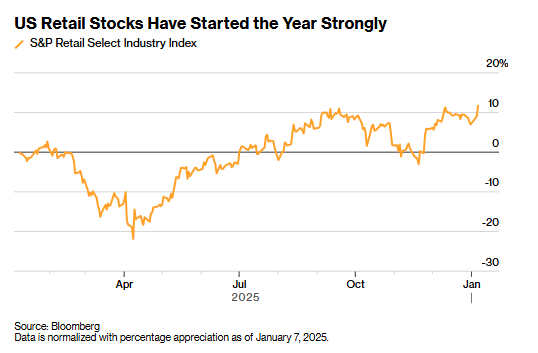
Group 1 - The core focus of Wall Street strategists is shifting towards companies benefiting from increased middle-class consumer spending as concerns over the AI trading frenzy diminish [1] - Goldman Sachs analysts, led by Ben Snider, are optimistic about healthcare providers, materials producers, and essential consumer goods manufacturers, particularly those selling discretionary non-essential items [1][2] - The S&P Retail Select Industry Index, which includes companies like CarMax (KMX.US), Etsy (ETSY.US), and Academy Sports & Outdoors (ASO.US), has risen 3.5% since the beginning of the year and 8.8% since the busy holiday shopping season began last November [1] Group 2 - Multiple favorable factors are expected to inject momentum into the consumer market, including the gradual easing of negative impacts from tariffs imposed during the Trump administration, a stabilizing labor market, and tax rebates from significant legislation enacted by the U.S. government last year [2] - Economists predict that U.S. economic growth will reach 2.1% this year, driven by consumer spending, prompting investors to shift funds towards underperforming sectors [5] - The market is experiencing a broader rally, moving away from reliance on a few tech stocks, with investors turning to sectors with higher beta coefficients that are closely tied to the economic conditions of the average American consumer [5] Group 3 - Dick's Sporting Goods (DKS.US) has emerged as an early beneficiary of this potential sector rotation, with its stock rising 6.1% in just four trading days at the start of 2026 [6] - Goldman Sachs has identified additional retail chains that stand to benefit from the growth of middle-class wealth, including Burlington Stores (BURL.US), Best Buy (BBY.US), Five Below (FIVE.US), Levi's (LEVI.US), and Gap (GAP.US) [6] - Despite facing fierce competition from e-commerce giants like Amazon (AMZN.US), investors are increasingly focusing on alternative investment opportunities amid high valuations in large tech and AI-driven companies [6] Group 4 - Value stocks are perceived as a "value pit" in the market, with growth stock valuations considered excessively high [7]