数据要素

Search documents
“智慧大脑”与“天空之眼”齐聚 探访西北首个数据要素产业园
Zhong Guo Xin Wen Wang· 2026-02-13 08:04
Core Insights - The article highlights the transformation of a traditional wholesale market in Gansu, China, into a digital economy hub, showcasing advancements in artificial intelligence and drone technology [1][2] - The Yongxin Guoxin Data Element Industrial Park is positioned as a key player in Gansu's digital transformation, focusing on data elements as a core component of its strategy [2] Group 1: Industrial Development - The Yongxin Guoxin Data Element Industrial Park has been operational since July 2024 and is rapidly evolving as a platform for nurturing new productive forces in Gansu's digital economy [2] - The park aims to create a data element and cybersecurity industry cluster in Northwest China, supported by the Gansu Technology Investment Group and other partners [2] Group 2: Operational Philosophy - The park's management emphasizes a partnership approach, aiming to ensure that resident companies benefit from their presence rather than merely acting as landlords [2] - This philosophy has attracted businesses seeking long-term growth and collaboration opportunities [2] Group 3: Business Growth and Collaboration - Companies like Zhongce Zhixing and Tiaowei (Lanzhou) Smart Technology have reported rapid business expansion and effective government engagement facilitated by the park [5][6] - The park has successfully activated dormant data assets, with evaluations reaching several million yuan, marking a significant breakthrough in data asset management [5][6] Group 4: Future Development Plans - The park is planning to leverage Gansu's cultural tourism resources by creating a "digital cultural tourism matrix" to enhance promotion and sales platforms [7] - Future initiatives include addressing local computing power challenges and developing a computing power scheduling platform to support local research and innovation [7] Group 5: Challenges and Opportunities - Despite rapid development, the park faces challenges such as talent shortages and the need for more focused policies to attract businesses [8] - The park's efforts to revitalize old properties and activate new data elements are seen as essential for fostering a conducive environment for new productive forces [8]


国泰海通:制度闭环叠加AI催化 迎接数据要素“价值释放年”
智通财经网· 2026-01-29 23:47
Core Insights - The National Data Work Conference will be held in Beijing from December 29 to 30, 2025, focusing on clarifying the functional positioning of data circulation service institutions, enhancing the efficiency of data circulation transaction services, and promoting a prosperous data market ecosystem. It has been declared that 2026 will be the "Year of Data Factor Value Release" [1][2] Group 1: Policy and Institutional Framework - Since 2024, the pace of policy implementation has accelerated to establish a closed-loop system for data factors. In 2020, the Central Committee and the State Council officially recognized data as the "fifth production factor," alongside labor, capital, land, and technology. This has led to a transition from top-level design documents to actual policies, creating a solid institutional foundation for the industrialization of data factors [2] Group 2: Market Demand and Supply - The demand for AI applications is creating a significant supply gap in the data market. According to the National Data Bureau, the daily Token consumption for AI applications in China surged from 100 billion at the beginning of 2024 to over 30 trillion by the end of June 2025, reflecting a growth of over 300 times in just a year and a half. This rapid growth indicates a burgeoning demand for data supply in the market [2] Group 3: Investment Recommendations - The combination of a closed-loop system and AI catalysis is expected to accelerate the release of data factor value and the blossoming of the industry in 2026. It is recommended to focus on various segments of the industry chain, including data supply, data transaction circulation, data application development, data services, data security, computing power, and network infrastructure [1][2]

数智湃丨数据资产将正式入法 制度建设正迈出关键步伐
Xin Lang Cai Jing· 2026-01-26 07:02
Core Viewpoint - The draft of the "State-Owned Assets Law" marks a significant milestone by officially recognizing data as an asset within the legal framework, addressing the long-standing issue of data ownership and valuation in China's digital economy [3][4][5][10]. Group 1: Legal Recognition of Data Assets - The "State-Owned Assets Law (Draft)" concludes public consultation on January 25, 2026, and will be reviewed by the National People's Congress, marking the first formal legal recognition of data assets [3][4]. - This law aims to establish a multi-layered regulatory framework for data asset management, addressing challenges in ownership, valuation, circulation, and security management [4][5][10]. - The draft law introduces a broad definition of "other state-owned assets," which includes data and other emerging asset types, reflecting a forward-looking legislative approach [4][5]. Group 2: Implications for Digital Economy - The recognition of data as a legal asset signifies a shift from viewing assets as tangible entities to recognizing intangible elements in the digital age, enhancing China's position in the global digital economy [6][10]. - The law provides a legal basis for the valuation, accounting, trading, and collateralization of data assets, which is essential for developing a unified and regulated data market [5][10][20]. - The draft law's provisions will facilitate the transition of public data from mere administrative records to valuable assets requiring strict management and security [7][18]. Group 3: Governance and Management Framework - The draft law outlines three key provisions that create a comprehensive governance framework for state-owned data assets, focusing on management responsibilities, capacity building, and legal status establishment [7][19]. - It mandates that government agencies actively manage data generated during their operations, thus clarifying ownership and regulatory boundaries for public data assets [7][18]. - The law emphasizes the need for a digital regulatory system that allows for real-time monitoring and analysis of data assets, moving towards a dynamic governance model [19]. Group 4: International Significance - The "State-Owned Assets Law (Draft)" is a pioneering effort globally, as no other country has yet established a legal framework that explicitly recognizes data as an asset [11][20]. - This legislative innovation is expected to play a crucial role in the development of data asset systems, marking a significant step in the evolution of digital governance [20].
数据要素价值有望加速兑现,制度与技术双轮驱动长效发展
Sou Hu Cai Jing· 2026-01-19 00:54
Core Insights - The data factor market is experiencing a dual trend of "policy system improvement" and "local practical implementation" at the beginning of the new year [1] - Multiple policy documents focusing on the value extraction of data factors have been released, indicating a strong national directive towards data utilization [1] - By 2026, it is designated as the "Year of Data Factor Value Release," highlighting the government's commitment to enhancing data's role in the economy [1] Policy Developments - Several policy documents have been issued this year that emphasize the importance of data factor value extraction [1] - Local governments are actively advancing practical explorations, such as Shanxi's implementation plan for comprehensive digital economy development [1] - The first national transaction of "embodied intelligent data sets" was completed in Jiangsu, showcasing local initiatives [1] Market Trends - Experts predict that public data products, such as meteorological and statistical analysis, will mature quickly due to their compliance advantages [1] - The supply of data products in the financial and healthcare sectors is expected to rapidly develop under market-driven conditions [1] - These developments are set to empower the real economy through data factors, marking a new chapter in economic growth [1]
四大证券报头版头条内容精华摘要_2026年1月19日_财经新闻
Xin Lang Cai Jing· 2026-01-19 00:37
Group 1 - The China Securities Regulatory Commission (CSRC) emphasizes the importance of maintaining a stable market as a primary task for capital market reform and development in 2026, with targeted policies expected to be introduced to support this goal [1] - The State Administration of Customs highlights the need to balance export expansion with appropriate import growth during the 14th Five-Year Plan period, aiming to enhance domestic and international circulation [2] - The State Council's recent meeting calls for accelerating the cultivation of new growth points in service consumption, with increased policy support across various sectors including the silver economy and green consumption [3] Group 2 - The People's Bank of China and financial regulators have announced a reduction in the minimum down payment ratio for commercial real estate to 30%, aimed at addressing inventory issues in the commercial property market [5] - Insurance companies are optimistic about the equity market in 2026, planning to enhance asset allocation strategies focused on "hard technology" investment opportunities [6] - Recent disclosures from high-performing funds indicate a shift in holdings towards sectors with favorable industry conditions, particularly in AI-related industries and innovative pharmaceuticals [7][8] Group 3 - The data factor market is experiencing significant changes, with numerous policy documents focused on data value extraction being released, indicating a growing emphasis on digital economy development [9] - The Ministry of Industry and Information Technology has expanded the scope of its nurturing program to include technology-based small and medium-sized enterprises, enhancing support for innovative businesses [11] - The China Securities Regulatory Commission has initiated an investigation into Rongbai Technology for potentially misleading statements regarding significant contracts, aiming to uphold market integrity [12] Group 4 - Several small and medium-sized banks have recently raised deposit rates, with specific increases noted in products such as the "Fuman Deposit" [13] - The bank wealth management market is seeing a rise in demand for fixed-income products and gold-linked structured deposits, with expectations of a market growth of 3.83 trillion yuan in 2026 [16] - Three securities investment consulting firms have been penalized and barred from taking on new clients due to regulatory violations, reflecting ongoing scrutiny in the sector [17]
数据要素价值有望加速兑现 制度与技术双轮驱动长效发展
Zheng Quan Shi Bao Wang· 2026-01-18 23:29
Core Viewpoint - The data factor market is characterized by both "policy and institutional improvement" and "local practical implementation" at the beginning of the new year, with a clear national directive aiming for 2026 to be the "year of data factor value release" [1] Group 1: Policy Developments - Multiple policy documents focusing on the value extraction of data factors have been issued since the beginning of the year, indicating a strong governmental push [1] - Local initiatives, such as Shanxi's implementation plan for the comprehensive development of the digital economy, demonstrate practical efforts to advance this agenda [1] Group 2: Market Trends - The first national transaction of "embodied intelligent data sets" was completed in Jiangsu, showcasing the market's evolving landscape [1] - Experts predict that public data products, particularly in meteorology and statistical analysis, will mature rapidly due to their compliance advantages [1] Group 3: Industry Implications - The financial and healthcare sectors are expected to see a rapid formation of data product supply driven by market forces, contributing to the empowerment of the real economy through data factors [1]
数据要素价值加速释放 千亿蓝海迎来质变
Zheng Quan Shi Bao· 2026-01-18 18:15
Group 1 - The core viewpoint of the articles highlights the dual characteristics of "policy system improvement" and "local practice implementation" in the data factor market at the beginning of the year, with a clear national directive aiming for the "release of data factor value" by 2026 [1] - Multiple policy documents focusing on the value extraction of data factors have been issued, and local practices are advancing, such as the implementation plan for the comprehensive development of the digital economy in Shanxi and the first national transaction of "embodied intelligent data sets" in Jiangsu [1] - Experts predict that public data products, particularly in meteorology and statistical analysis, will mature rapidly due to compliance advantages, while data products in finance and healthcare will also form quickly under market-driven forces [1][2] Group 2 - The value of data factors is expected to accelerate, with public and enterprise data serving as the two main carriers, entering a phase of rapid value release, which is crucial for market transformation by 2026 [2] - By 2025, China's data infrastructure construction will enter a practical phase, achieving breakthroughs in resource registration, operational authorization, and pricing mechanisms [2] - Public data applications have already demonstrated effectiveness in various sectors, including smart agriculture and healthcare, with applications like precise medical insurance services and seamless entry to scenic spots [2] Group 3 - The analysis indicates that public data products not involving personal privacy are likely to achieve large-scale supply first, while commercially valuable data products in financial risk assessment and clinical diagnosis will accelerate their market entry [3] - Industrial internet data products are being developed through trusted data spaces established by leading enterprises, facilitating value sharing and circulation within the industry chain [3] Group 4 - The current market faces multiple collaborative obstacles that hinder the full release of data factor value, stemming from a lack of coordinated governance and resulting in fragmented rules and unclear responsibilities [4] - The existing management structure, with multiple departments overseeing data resources, complicates unified resource allocation and rule formulation [4] - Issues such as "products without demand" highlight the need for a vibrant data factor market, where demand is essential for realizing data value [4] Group 5 - To facilitate the smooth release of data factor value, addressing collaborative obstacles is crucial, focusing on resolving issues of coordination, fragmented rules, and unclear responsibilities [5] Group 6 - The national data work conference emphasizes accelerating the cultivation of a unified national data market, enhancing top-level design to promote cross-regional and cross-industry rule interoperability [6] - The focus of policies will shift from "establishing rules" to "implementing and promoting collaboration" as 2026 approaches, with a unified transaction rule and registration system expected to transform data holders' perspectives from "cost centers" to "profit centers" [6] Group 7 - Establishing standards for measuring data value is essential for the long-term development of the market, with a focus on quantifying data circulation and transaction scale [7] - The future assessment system should measure the actual benefits of data in digital transformation and its contribution to the core industries of the digital economy [7] - The data factor market in China is projected to exceed 200 billion yuan by 2025 and is expected to surpass 300 billion yuan by 2028, driven by institutional and technological advancements [7]
山东抢抓政策机遇,国家数据要素综合试验区全面起势
Qi Lu Wan Bao· 2025-12-24 06:18
Core Viewpoint - Shandong Province is making significant progress in its digital economy development, particularly through the establishment of a national data factor comprehensive pilot zone, which has led to various innovations and applications in data utilization and management [1][2][3] Group 1: Institutional Innovation - The province is accelerating the legislative process for the "Shandong Data Regulations" to create a comprehensive data development and utilization system, including public data registration, openness, authorized operation, and pricing [1] - Shandong has introduced the first national guidelines for data circulation and trading, along with a management list for data export in free trade pilot zones [1] - A specialized dispute resolution mechanism in the data sector has been established, and a three-year action plan for building a digital standard system has been formulated [1] Group 2: Application-Driven Development - The "Data Factor ×" initiative has led to the organization of competitions and the establishment of 328 data open innovation application laboratories, with 141 typical operational scenarios and 194 exemplary cases created [2] - Focus on artificial intelligence has resulted in the development of 90 high-quality datasets in industrial manufacturing, with two recognized as national typical cases [2] Group 3: Platform Development - A data supply and demand matching platform has been created, facilitating data transactions worth 33.18 million yuan [2] - By the third quarter, two data trading institutions in the province reported a cumulative transaction volume of 350 million yuan, with a year-on-year growth of 169% for Shandong Data Trading Company [2] - The establishment of data circulation infrastructure supports the efficient and compliant flow of data, including the promotion of "privacy computing" as a national pilot [2] Group 4: Ecosystem Building - Shandong is cultivating several industrial clusters, including six provincial digital economy innovation development pilot zones and 22 digital economy characteristic clusters, with 139 high-quality development projects nurtured [3] - The province has selected 114 third-party professional service institutions to provide comprehensive services for data circulation and trading [3] - A talent cultivation initiative has been launched, resulting in nearly 10,000 technical professionals receiving junior-level or higher qualifications in big data engineering [3]

上海浦东启动数字出海行动计划
Xin Hua She· 2025-12-22 15:28
Core Viewpoint - The launch of the Digital Outbound Action Plan in Shanghai's Pudong New Area aims to promote the market-oriented allocation of data elements and facilitate the secure and orderly cross-border flow of data, serving as a model for deepening digital economic cooperation and exploring new paths for global data element allocation in Shanghai and nationwide [1] Group 1 - The Digital Outbound Action Plan was officially launched on December 22 [1] - Pudong New Area will focus on reforms related to the market-oriented allocation of data elements [1] - The initiative aims to enhance data security and promote orderly cross-border data flow [1] Group 2 - The plan is expected to play a leading role in deepening digital economic openness and cooperation [1] - It seeks to explore new global allocation paths for data elements [1]
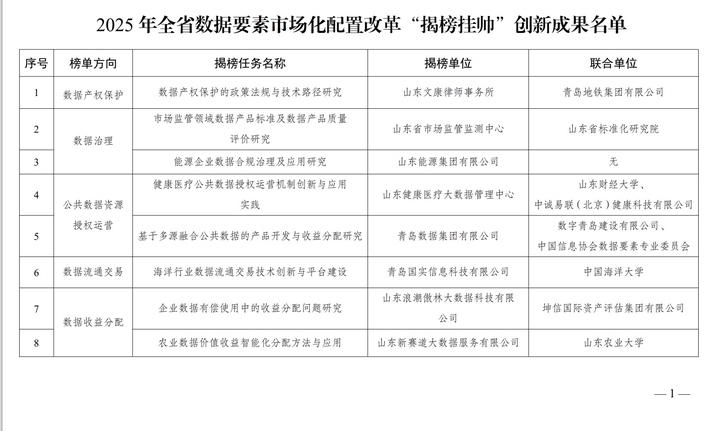
山东公布2025数据要素市场化配置改革“揭榜挂帅”创新成果
Feng Huang Wang Cai Jing· 2025-12-19 07:36
Group 1 - The Shandong Provincial Big Data Bureau has officially announced the list of innovative achievements for the 2025 provincial data element market-oriented allocation reform, marking a key initiative in advancing the construction of the national data element comprehensive pilot zone and accelerating data element market-oriented allocation reform [1][2] - Data is recognized as a new production factor and the core engine for the development of the digital economy, making the promotion of data element market-oriented allocation reform significant for activating data potential, driving industrial transformation, and enhancing governance efficiency [1] - The Shandong Provincial Big Data Bureau has focused on key bottlenecks and challenges in data element market-oriented allocation, leading to a series of innovative achievements in areas such as data rights confirmation, data circulation and trading, data security governance, and data value transformation [1][2] Group 2 - The announcement of the innovative achievements aims to build a platform for exchanging and promoting results, encouraging the replication and dissemination of quality innovative experiences across the province [2] - The next steps include deepening data element market-oriented allocation reform, enhancing tracking and application promotion of innovative achievements, and improving the data element market system to address challenges related to data usage [2] - A list of innovative projects has been compiled, covering various aspects such as data property protection, data governance, public data resource practices, and data circulation and trading technology innovations [3][4]