新闻

Search documents
吴晓波:“狗娘养的”张和平
Xin Lang Cai Jing· 2026-02-23 01:28
Core Viewpoint - Zhang Heping, a prominent journalist from Wenzhou, passed away unexpectedly, leaving a legacy of integrity and impactful reporting that resonated with both friends and adversaries [1][21]. Group 1: Zhang Heping's Career and Impact - Zhang Heping was born in 1955 and began his career at the Zhejiang Daily before joining Xinhua News Agency, where he became a significant figure in Wenzhou's journalism [3][23]. - He was known for his motto of "getting one's feet muddy and hands bloody," emphasizing the importance of grassroots reporting and fearlessness in confronting authority [3][23]. - Throughout his career, he reported on critical events and issues, including the first private bank and the first farmer city in Wenzhou, showcasing his role as both a witness and participant in the region's economic history [6][27]. Group 2: Reporting Style and Philosophy - Zhang's reporting style was characterized by directness and a lack of embellishment, which he believed was essential for conveying the truth [39]. - He was known for his critical reports, which often led to significant political repercussions, including the dismissal of corrupt officials [12][33]. - His unique phrase "狗娘养的" (literally "dog mother raised") was used both as a term of endearment and as a critique, reflecting his complex relationship with the subjects of his stories [4][25]. Group 3: Legacy and Recognition - In 2008, Zhang was recognized as one of the "Top Ten Influential Figures" in the 30 years of reform and opening up in Wenzhou, highlighting his contributions to journalism [11][32]. - His sudden passing prompted an outpouring of tributes from colleagues and friends, emphasizing the profound impact he had on those around him [20][41]. - Zhang's life and work continue to inspire a sense of integrity and dedication in journalism, as reflected in the memories shared by his peers [20][41].


韩国研究:AI助记者写稿更快但原创性不足
Xin Hua She· 2026-02-17 06:10
Core Insights - The introduction of AI in the news industry has shown potential for improving efficiency in producing structured articles, but it lacks originality and unique perspectives, highlighting the continued importance of journalists' insights [1][2] Group 1: AI's Role in Journalism - A recent study by the Korea Press Foundation involved 98 journalists who used AI chatbots to write reports based on limited background information, focusing on the impact of climate change on maternal and child health [1] - The average score for AI-assisted articles was 62.5 out of 100, with structural and logical quality averaging around 67 [1] - However, the originality and uniqueness of the content scored only around 50, indicating that while AI can help organize information and optimize language, it does not significantly enhance novelty [1] Group 2: Journalists' Interaction with AI - The study found that journalists' interaction with AI was limited, with an average of fewer than five questions asked per task, and follow-up questions making up just over one-third of total inquiries [1] - There were relatively few fact-checking questions, suggesting that most journalists view AI primarily as a tool for quick information gathering rather than as an interactive reporting partner [1][2] Group 3: Importance of Journalistic Judgment - The findings emphasize the ongoing significance of journalists' judgment in the news industry, particularly in terms of original analysis and opinion formation [2] - The effective use of AI in journalism depends on how journalists integrate it into their reporting practices, including fact-checking, narrative, and analysis [2] - As news organizations globally adopt AI technology, the study highlights both the potential for automation and the irreplaceable role of journalists' insights in news reporting [2]
【微特稿】韩国研究:AI助记者写稿更快但原创性不足
Xin Hua She· 2026-02-17 05:09
Core Insights - The integration of artificial intelligence (AI) in the news industry has shown potential for enhancing efficiency in producing structured articles, but it lacks originality and unique perspectives, highlighting the irreplaceable role of journalists' insights [1][2] Group 1: AI Performance in News Writing - A recent survey by the Korea Press Foundation involving 98 journalists revealed that AI-assisted articles scored an average of 62.5 out of 100, with structural and logical aspects averaging around 67 [1] - The originality and uniqueness of AI-generated content scored only about 50, indicating that while AI can help organize information and optimize language, it does not significantly enhance novelty in reporting [1] Group 2: Journalists' Interaction with AI - The study found that journalists' interaction with AI was limited, with an average of fewer than 5 questions posed per task, and follow-up inquiries making up just over one-third of total questions [1] - Most journalists view AI primarily as a tool for quick information gathering rather than as an interactive reporting partner [1] Group 3: Importance of Journalistic Judgment - The research underscores the ongoing importance of journalists' judgment in the news industry, particularly in original analysis and opinion formation [2] - Effective use of AI in journalism depends on how journalists incorporate it into their reporting practices, including fact-checking, narrative, and analysis [2]
湖南省2025“新时代新雷锋”发布
Xin Lang Cai Jing· 2026-01-13 14:35
Core Viewpoint - The article highlights the recognition of seven individuals and groups with the "New Era New Lei Feng" title, showcasing their contributions to various fields and embodying the spirit of dedication and service in contemporary society [1][2]. Group 1: Recognized Individuals and Their Contributions - The Digital Innovation Team of Hunan Museum has made significant breakthroughs in the application of digital technology for cultural heritage, enhancing the transformation of the cultural sector and promoting the sharing of cultural resources [2]. - Zuo Guofeng, a senior engineer at Hunan Steel Group, has led over ten major technological innovations in seamless pipe research, achieving key technology localization and breaking foreign monopolies [2]. - Wen Xiaoyan, an athlete from the Hunan Disabled Athletics Team, has won nine gold medals across three Paralympic Games, exemplifying resilience and determination in sports [3]. - Zhang Di, the director of the Children's Medical Center at Hunan University of Traditional Chinese Medicine, has dedicated over 30 years to pediatric care using traditional Chinese medicine, emphasizing effective treatment and community service [3]. - Mo Bocheng, a postdoctoral researcher and founder of Hunan Orange Friend Biotechnology Co., has focused on agricultural innovation, winning multiple national awards and contributing to rural revitalization [4]. - Ma Shiguang, a courier at YTO Express, has maintained a service record of over one million packages with zero complaints, actively engaging in community service and social responsibility [4]. - Huang Hua, a former editor and chief reporter at Chenzhou Daily, dedicated 33 years to journalism, producing impactful stories and demonstrating professional integrity until her passing [5].
职场多元化矫枉过正现象
Xin Lang Cai Jing· 2025-12-22 10:12
Core Viewpoint - Discrimination against young white males in hiring practices has become an open secret, with many institutions prioritizing the hiring of all groups except for this demographic [3][11]. Group 1: Hiring Trends - The hiring rate of young white males has drastically declined in elite institutions, with the percentage of white males in entry-level positions such as junior screenwriters dropping from 48% to 12% and in Harvard humanities tenure-track positions from 39% to 18% over the past decade [3][11]. - This trend is not attributed to demographic changes in the job-seeking population, as the proportion of white individuals in the workforce has not shifted as rapidly as the hiring statistics suggest [4][12]. Group 2: Diversity, Equity, and Inclusion (DEI) Policies - The push for diversity, equity, and inclusion (DEI) has led to targeted discrimination against young white males, as employers seek to make their organizations appear more representative of the U.S. population [4][12]. - The DEI policies are seen as fundamentally unfair to well-educated millennial males, creating a perception of injustice within this demographic [4][12]. Group 3: Historical Context and Perceptions - There is a historical context of discrimination against minorities, but the current hiring practices are viewed as an overcorrection that disproportionately affects young white males [6][14]. - The narrative surrounding DEI often overlooks the generational effects of demographic changes, leading to misconceptions about the representation of white individuals in various sectors [5][13]. Group 4: Societal Reactions - Some argue that the current situation is a form of justice for past inequities, suggesting that young white males are simply experiencing a reversal of historical advantages [15]. - However, it is acknowledged that young white males are not competing on a level playing field, facing a more challenging job market with fewer rewards [16].
美国10月挑战者企业裁员报告全文:同比激增175%!
Jin Shi Shu Ju· 2025-11-06 09:37
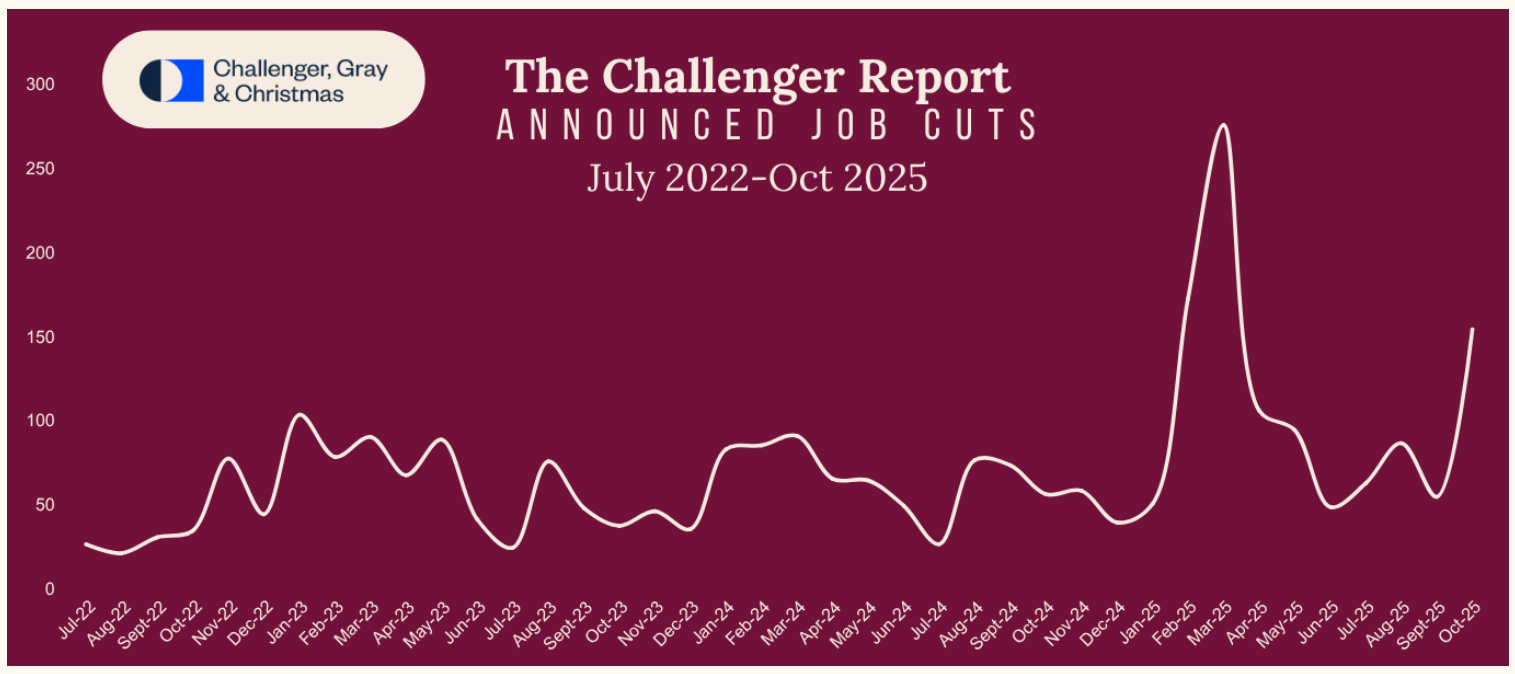
Core Insights - In October, U.S. employers announced layoffs of 153,074, a 175% increase from the same month in 2024 and an 183% increase from the previous month [1][3] - Cumulatively, layoffs for the year reached 1,099,500, a 65% increase compared to the same period in 2024, marking the highest level since 2020 [1][3] Layoff Trends - Nearly 450 independent layoff plans were tracked in October, up from just below 400 in September [3] - October's layoffs were the highest for the month since 2003, with a record of 171,874 layoffs at that time [3] - The trend of announcing layoffs in the fourth quarter has changed, with companies now more willing to disclose layoffs in October, contrary to past practices [3] Industry-Specific Layoffs - The technology sector led private sector layoffs with 33,281 announced in October, a significant increase from 5,639 in September [4] - The retail sector announced 2,431 layoffs in October, a slight decrease from 2,577 in September, but still facing significant challenges [4] - The warehousing industry saw the highest number of layoffs in October, with 47,878, reflecting ongoing restructuring due to overcapacity and automation [4] Reasons for Layoffs - Cost-cutting was the primary reason for layoffs in October, affecting 50,437 individuals, followed by layoffs due to artificial intelligence integration, impacting 31,039 individuals [9] - Market and economic conditions led to 21,104 layoffs in October, with cumulative layoffs for the year reaching 229,331 [9] Recruitment Plans - Employers announced plans to hire 488,077 individuals by October, a 35% decrease from the same period in 2024, marking the lowest level since 2011 [10] - The average monthly recruitment announcement was 48,808, also the lowest since 2011 [10]
用AI裁掉初级岗位,是在断送企业的未来
3 6 Ke· 2025-09-29 01:35
Core Argument - The article argues against the short-sighted and dangerous approach of significantly cutting entry-level jobs solely for cost reduction, emphasizing that these positions are essential for future leadership, innovation, culture, and society itself [1][16]. Group 1: Importance of Entry-Level Jobs - Entry-level jobs are crucial for developing future mid-level professionals and leaders, as they provide foundational skills and perspectives necessary for effective decision-making [4][5]. - Eliminating entry-level positions would sever the talent development pipeline, leading to management that lacks practical experience and understanding of core business operations [4][5]. - Entry-level roles serve two primary functions: task completion and the cultivation of capable individuals within the organization and society [5]. Group 2: Innovation and Organizational Culture - Innovation often originates from those closest to the work, as entry-level employees can identify inefficiencies and propose creative solutions without being constrained by traditional thinking [6]. - A diverse workforce, including younger employees, enriches organizational culture and fosters creativity, while the absence of entry-level workers can lead to a stagnant and homogeneous environment [7]. Group 3: Societal Impact - Work provides individuals with purpose, structure, and a sense of belonging; the absence of entry-level jobs could lead to social issues such as alienation and unrest among millions of young people [8]. Group 4: Redesigning Entry-Level Work - To protect entry-level jobs, organizations must rethink their design to ensure they remain valuable in an AI-driven workplace, focusing on understanding the rationale behind tasks rather than merely performing repetitive ones [10][11]. - Emphasizing skill enhancement is vital, as critical thinking combined with AI can lead to better outcomes; training should include exercises that encourage questioning AI outputs [12]. - The redesign of work should prioritize human involvement in defining problems and building relationships, rather than allowing AI to replace all human tasks [13]. - Entry-level jobs should not only focus on task completion but also on talent development, allowing individuals to experience pressure and uncertainty, which are essential for building resilience and judgment [14][15]. Group 5: Future Considerations - The article suggests that organizations should redefine value beyond mere output, considering contributions to culture and innovation, and that entry-level jobs are foundational to this transformation [16]. - The future of work should be shaped proactively, ensuring that entry-level positions remain a vital part of a more intelligent, equitable, and satisfying work environment in the age of AI [17].