智能辅具

Search documents
苏州市首届科技助残创新产品推介会举行
Su Zhou Ri Bao· 2025-12-06 00:22
Core Viewpoint - The first Technology Assistance for the Disabled Innovation Product Promotion Conference and R&D Innovation Competition was held in Suzhou, showcasing the potential of technology in improving the lives of disabled individuals through innovative products and collaboration between universities and enterprises [1][2]. Group 1: Event Overview - The event featured a collaboration agreement between Suzhou University and the Suzhou Disabled Persons' Federation to provide more internship opportunities for students in the field of assistive technology [1]. - Six technology companies presented cutting-edge assistive products, highlighting advancements in areas such as smart assistive devices and biomedical technology [1]. Group 2: Innovative Products - Notable products included the first artificial cornea made from new synthetic materials, which offers high transparency, stability, low cost, and large-scale production capabilities [1]. - An AI-based tinnitus detection and personalized treatment system was introduced, transforming tinnitus treatment from subjective to objective measures [1]. - An open-type hearing aid was showcased, addressing common issues with traditional hearing aids such as fit, sound quality, and high costs [1]. Group 3: Innovation Competition - Seven innovative projects from institutions like Suzhou University and the Suzhou Institute of Biomedical Engineering and Technology were presented, covering five categories of disabilities [2]. - The competition evaluated projects based on innovation, practicality, and market potential, resulting in the awarding of two first prizes, two second prizes, and three third prizes [2]. - Winning projects included a smart hand rehabilitation robot and a digital rehabilitation solution for autism based on humanoid robots [2].
四川10部门体系化推进科技助残 构建“需求—科研—产品”一体化链条
Si Chuan Ri Bao· 2025-12-03 00:42
Core Viewpoint - The event held on December 2 in Chengdu, themed "Technology with Love, Co-creating the Future," marks a new phase in the systematic promotion of technology-assisted support for people with disabilities in the province, as highlighted by the release of the "Implementation Opinions on Promoting Technology Assistance for the Disabled" by ten departments [1] Group 1: Implementation Opinions - The "Implementation Opinions" emphasize a "demand-driven, closed-loop linkage" mechanism, integrating resources from ten departments to form a collaborative effort in building a "demand-research-product" integrated chain [1] - The province will establish a list of "bottleneck" issues in assistive technology and a reserve of special projects for technology assistance, leveraging resources from top universities such as Sichuan University and University of Electronic Science and Technology of China to create high-level research platforms [1] Group 2: Research and Development Focus - The focus will be on tackling cutting-edge assistive technologies, particularly in areas where foreign monopolies exist and in basic research that has not yet been translated into applications, with an emphasis on major disabling diseases like autism and Alzheimer's [1] - The aim is to clarify the mechanisms of onset and control for these significant disabling conditions through foundational research [1] Group 3: Industry Development - The "Implementation Opinions" outline a strategic focus on developing five key frontier industries: smart assistive devices, exoskeleton rehabilitation robots, brain-computer interfaces and human-computer interaction, humanoid robots, and integrated smart home applications [1] - The goal is to accelerate the establishment of a nationally influential technology-assisted support industry cluster [1]
中国国际大学生创新大赛(2025)总决赛举行 在创新中成长 在奋斗中出彩
Ren Min Ri Bao· 2025-10-16 22:07
Core Points - The China International College Students Innovation Competition (2025) concluded with Tsinghua University winning the championship for their AI project based on a "layered-circulation" brain mechanism, showcasing significant advancements in reasoning depth and data pattern recognition [1] - The competition attracted participation from 5673 schools across 161 countries and regions, with a total of 619 million projects and 24.43 million participants [1] - The event served as a platform for innovation and collaboration, connecting students with investors and entrepreneurial institutions, enhancing their skills and capabilities [2] Group 1 - The competition emphasized the integration of industry and education, with 3104 companies submitting 6976 challenges, leading to participation from 2355 universities and 248,000 projects [3] - A total of 17 online and 3 offline resource matching activities were conducted during the competition, resulting in investment intentions amounting to approximately 9 billion [3] - The event also facilitated international exchanges, with regional competitions held in Europe and Africa, enhancing its global influence [4] Group 2 - The competition featured innovative projects addressing real-world problems, such as a modular satellite system aimed at reducing operational costs for low-orbit satellite constellations [2] - Projects like the "Cultural Heritage Protection" initiative and the development of assistive technology for visually impaired individuals demonstrated the social value of student innovations [2] - The competition culminated in the World University Student Innovation Conference, where reports on global student innovation indices and educational innovation were released [4]
高盛:通往2075(全球老龄化的机会)未来30年养老市场大爆发
Xin Lang Cai Jing· 2025-06-09 01:29
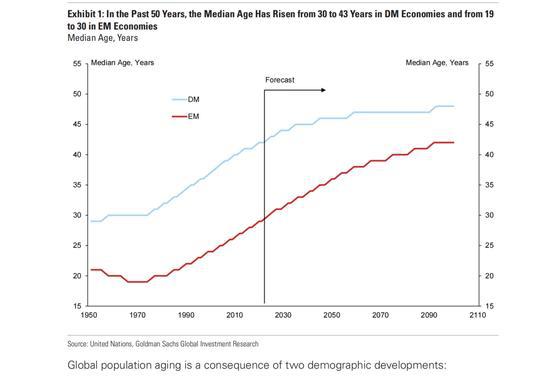
Global Population Trends - The median age of the global population has increased significantly over the past 50 years, with developed economies rising from 30 to 43 years and emerging economies from 19 to 30 years, projected to reach 47 and 40 years respectively by 2075 [2] - The average life expectancy has steadily increased, with developed economies rising from 72 to 82 years and emerging economies from 58 to 73 years, indicating a healthier aging population [4] - The global fertility rate has declined from 5.4 in 1963 to approximately 2.1 today, which is at the replacement level, but the actual threshold to maintain population stability is lower due to increased life expectancy [6] Labor Market Dynamics - Despite a decrease in the proportion of the working-age population in developed economies, the actual employment rate has increased, indicating a rise in labor force participation [10] - The trend of delayed retirement is largely driven by individuals' choices rather than policy changes, with many older adults opting to work longer due to improved health and longevity [11] - Women's participation in the labor force has also increased, contributing positively to overall employment rates and helping to mitigate the effects of an aging population [13] Longevity Economy - The aging population presents opportunities for economic growth through technological advancements and productivity improvements, particularly in sectors catering to elderly care [16] - The rise of "silver technology" is creating new markets, including smart healthcare solutions and elder care services, which are essential as the demand for elderly care increases [16] - The perception of older adults is shifting from being seen as a burden to being recognized as valuable consumers and contributors to the economy [16] China's Aging Population - China has officially entered a moderate aging phase, with over 310 million people aged 60 and above, representing 22% of the total population, indicating significant potential for the "silver economy" [18] - The market for silver economy in China is currently valued at approximately 8 trillion yuan and is rapidly expanding, driven by policy support and changing consumer demands [18] - The Chinese government is prioritizing the development of the silver economy as a national strategy, with various initiatives aimed at enhancing the quality of life for the elderly [19] Consumer Behavior Changes - The consumption patterns of older adults in China are evolving, with a shift from basic needs to quality consumption, including healthcare, cultural activities, and travel [20] - The demand for non-medical services among the elderly is expected to exceed 60% by 2030, indicating a significant market opportunity in sectors like entertainment and education [21] - The segmentation of the elderly population into different age groups allows for more targeted products and services, enhancing the potential for growth in the silver economy [21] Policy and Industry Development - China is actively developing its silver industry as a new driver of high-quality economic growth, focusing on urban-rural integration and technological innovation [22] - The silver economy encompasses a wide range of sectors, including smart devices, healthcare services, and financial products tailored for the elderly [22] - The integration of technology in elder care services is expected to enhance service quality and efficiency, leading to the emergence of a "smart elder care" ecosystem in China [22]