服装供应链

Search documents
除夕重磅!五家公司齐发公告,并购投资潮来袭
Sou Hu Cai Jing· 2026-02-16 12:52
Group 1 - On Lunar New Year's Eve, five listed companies announced significant mergers, acquisitions, and strategic investments, igniting market expectations for the upcoming year [1][7] - Pacific Shipping announced a strategic investment agreement with Tuo Wei Group, aiming to enhance its financial strength and expand its business in the recovering global shipping market [3] - Daren International sold 40% of its stake in Lordan Group Ltd for HKD 31.41 million, optimizing its asset structure and focusing on core business development [4] Group 2 - Li Hua Holdings Group provided a supplementary announcement regarding its asset acquisition, detailing pricing and transaction terms, which signifies a substantial step in its restructuring efforts [5] - Northern Long Dragon disclosed an acquisition aimed at enhancing its business ecosystem in both civilian and military sectors, indicating a focus on high-quality development through industry consolidation [6] - Baodi Mining's restructuring registration became effective, indicating a comprehensive integration of its gold industry chain, reflecting the ongoing trend of mergers and acquisitions in the capital market [7][8]



上市半年股价跌去97%,平安生物医药(PASW.US)“更名”博眼球却难博股价上涨?
智通财经网· 2026-01-15 13:58
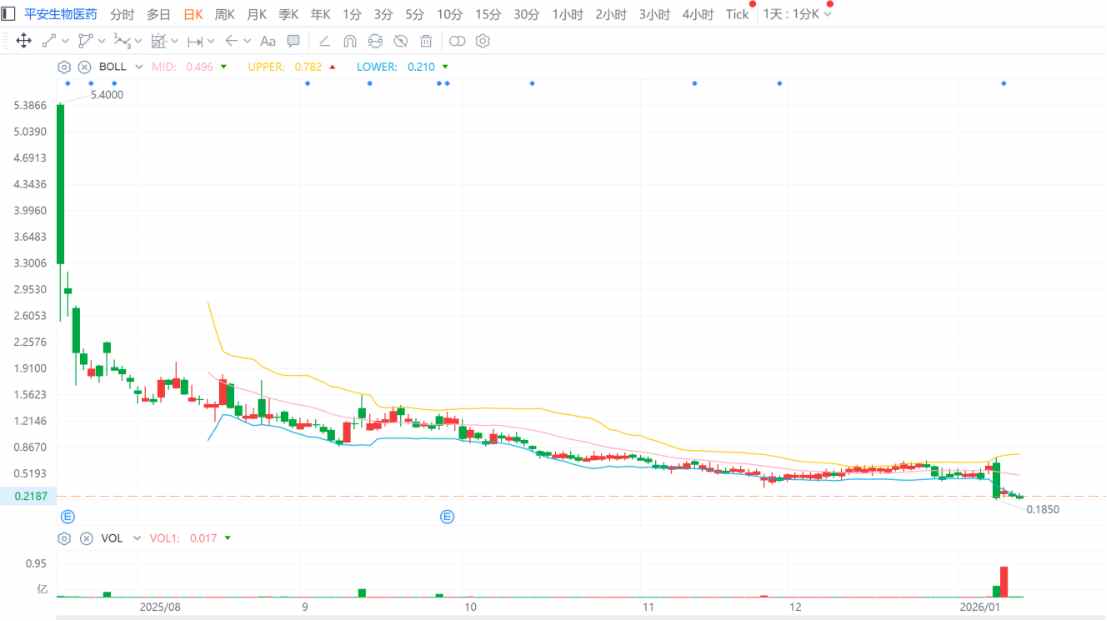
Group 1: Market Overview - In 2025, 93 Chinese companies successfully listed on the US stock market through IPOs, SPAC mergers, and OTC transfers, representing a 7.8% increase from 64 companies in the previous year [1] - Among the 93 companies, 84 completed their listings via traditional IPOs, accounting for 90.3% of the total [1] - Additionally, 149 companies have publicly submitted applications for US listings, indicating strong enthusiasm among Chinese firms [1] Group 2: Company Case Study - Weimi Holdings - Weimi Holdings (MJID.US), which recently transitioned to "Ping An Biopharmaceutical" (PASW.US), is the first company to receive a filing notice from the China Securities Regulatory Commission since the new filing regulations [2] - The company faced challenges during its IPO journey, submitting its F-1 document in April 2023 and only obtaining its Nasdaq listing in July 2025 [2] - Following its listing, Weimi Holdings' stock price fell significantly, opening at $5.39, down 10.17% from its IPO price of $6, and reaching a low of $2.55, a 57.5% drop [4] Group 3: Stock Performance Analysis - Weimi Holdings experienced a significant decline in stock price, with a closing price of $3.30 on its first day, reflecting a 45% drop [4] - The stock continued to decline, entering a "four consecutive down days" pattern, dropping below $2 within the first ten trading days [4] - Over a five-month period, the stock showed a downward trend, with low trading volumes and minimal upward movements, indicating a lack of market interest [5] Group 4: Business Model and Financials - Prior to its name change, Weimi Holdings was a clothing supply chain management service provider, primarily offering yarn and finished garment solutions [7] - The company reported revenues of 82.56 million RMB and 87.62 million RMB for the respective periods, with a year-on-year growth of 6.2% [11] - Yarn sales accounted for over 90% of the company's revenue, highlighting its role as an "OEM" in the supply chain [11] Group 5: Recent Developments - Despite the name change to "Ping An Biopharmaceutical," Weimi Holdings continued its operations in clothing supply chain management, with yarn sales still representing 92% of its revenue [12] - On January 9, the company announced a non-binding cash investment plan of $30 million and a $60 million acquisition of Future Biotech, which temporarily boosted its stock price by 41.85% [12] - However, the stock price quickly fell again, dropping to around $0.20, a 96.67% decrease from the initial offering price, raising concerns about compliance with Nasdaq listing requirements [12]
中概股赴美潮再升级:上市企业数激增,指数强势破局领跑
Sou Hu Cai Jing· 2025-08-18 01:43
Group 1 - The core viewpoint is that geopolitical tensions have not hindered Chinese companies from listing in the U.S., with a record number of listings expected in 2024 and 2025 [2] - In 2024, 64 Chinese companies have already listed in the U.S., and 36 more are expected in the first half of 2025, primarily small and medium-sized enterprises, many utilizing SPACs to expedite the process [2] - Over 40 Chinese companies are currently waiting to list on NASDAQ, driven by stricter domestic listing regulations and the attractive valuations in the U.S. market [2] Group 2 - In July 2025, 13 Chinese companies successfully listed in the U.S., all on NASDAQ [3] - The financing landscape for Chinese companies listing in July showed significant stratification, reflecting the flexibility of U.S. capital tools and differing financing strategies among companies [5][11] Group 3 - The SPAC model has emerged as a leading capital tool in the U.S., with A Paradise Acquisition raising $200 million, accounting for over 69% of the total IPO scale for Chinese companies during the same period [6][11] - Companies like Youlan International and Meihua Chuangfu are focusing on core sectors, raising $27 million and $15 million respectively, indicating a trend towards securing funds for technology development and market expansion [8] Group 4 - Smaller companies are adopting a "lightweight listing" strategy, with firms like Weimei Holdings and Anba Finance raising $2.5 million and $5 million respectively, prioritizing brand exposure and flexible post-listing financing [9] - The differentiation in fundraising among Chinese companies is influenced by industry attributes and listing models, with emerging industries attracting more capital due to clear growth potential [11] Group 5 - Foreign institutions are becoming more optimistic about Chinese stocks, as evidenced by the 16.76% increase in the NASDAQ Golden Dragon China Index since the beginning of the year, outperforming major U.S. indices [12] - Approximately 72% of Chinese companies choose to list on NASDAQ, favoring technology and growth-oriented firms, while 25% opt for the NYSE, primarily for established industry leaders [12][13]