
未明确细分

Search documents
Solventum Corporation (SOLV) Presents at 2026 KeyBanc Capital Markets Healthcare Forum Transcript
Seeking Alpha· 2026-03-18 17:22
Core Insights - The company has undergone significant changes since its separation from 3M, focusing on defining a new mission and enhancing organizational talent [1][2] - Key priorities for the year include continued portfolio management and potential acquisitions to strengthen the company's market position [1][2] Group 1 - The CEO expressed satisfaction with the progress made over the past two years, highlighting the successful establishment of the company post-separation [2] - The company has made strides in upgrading talent across the organization, which is seen as a critical component of its growth strategy [2] - The focus on portfolio management indicates a strategic approach to optimizing business operations and identifying growth opportunities [1][2]



中企赴美上市局势突变,OTC市场成破局关键
Sou Hu Cai Jing· 2026-01-20 05:18
Core Viewpoint - The new financial thresholds and stricter substantive reviews imposed by Nasdaq and NYSE are expected to make 2026 a pivotal year for Chinese companies seeking to list in the U.S. The OTC market is emerging as a more flexible alternative for these companies to navigate the challenges of going public abroad [1]. Nasdaq Regulations - Nasdaq has implemented discretionary powers allowing it to reject listings even if companies meet all written requirements if there are risks of securities manipulation [2]. - The minimum public float market capitalization requirement under the net income standard has been raised from $5 million to $15 million [2]. - A new delisting rule states that stocks priced below $0.10 for ten consecutive days will be immediately suspended and initiated for delisting without a grace period [2]. - Special requirements for Chinese companies may include a minimum fundraising of $25 million through IPO or reverse mergers, potentially prohibiting direct listings [2]. NYSE Regulations - NYSE maintains its existing standards while the NYSE American market awaits approval for its new standards [3]. Financial Standards - The fundraising and market capitalization thresholds have been raised to $15 million [4]. Stock Price Standards - The minimum stock price standard has been unified to $4 per share, and the calculation of public shares has been revised to exclude restricted stocks [5]. Market Dynamics - In 2025, only 1 out of 93 Chinese companies listed on U.S. main boards met the new regulations through direct IPO, with nearly 70% of small enterprises raising less than $1 million, contrasting sharply with the $25 million threshold for main boards [5]. - The OTC market, with over 12,000 listed companies and annual trading volumes in the hundreds of billions, is being recognized as a viable capital market ecosystem rather than a secondary option [5]. Advantages of OTC Market - The OTC market offers excellent cost-effectiveness with a listing cycle of only 3-6 months and no mandatory underwriters, significantly reducing compliance uncertainty [5]. - It accommodates various stages of enterprise development, with market makers providing broad coverage and supporting ADR listings to meet diverse financing needs [6]. - The transition to main boards is facilitated, with an average of 52 companies per year moving from OTC to main boards between 2018 and 2022, and a recent case of a Chinese company transitioning in just 6-8 weeks [8]. - The flexible equity structure allows founders to maintain a high level of control [9]. Strategic Considerations for Chinese Companies - Startups should initially consider the OTC ID/Pink Sheets market, while growth-stage tech companies should target OTCQB, and mature companies should aim for OTCQX [10]. - Companies are advised to standardize financial statements according to U.S. GAAP/IFRS and enhance information disclosure to meet dual regulatory requirements [10]. - OTC can serve as a "compliance training ground" to prepare for transitioning to main boards by meeting net asset, shareholder, and market capitalization requirements [10]. - The evolving U.S. market landscape is complemented by improved regulatory processes from the China Securities Regulatory Commission and optimized foreign exchange policies, facilitating the repatriation of funds raised abroad [10].
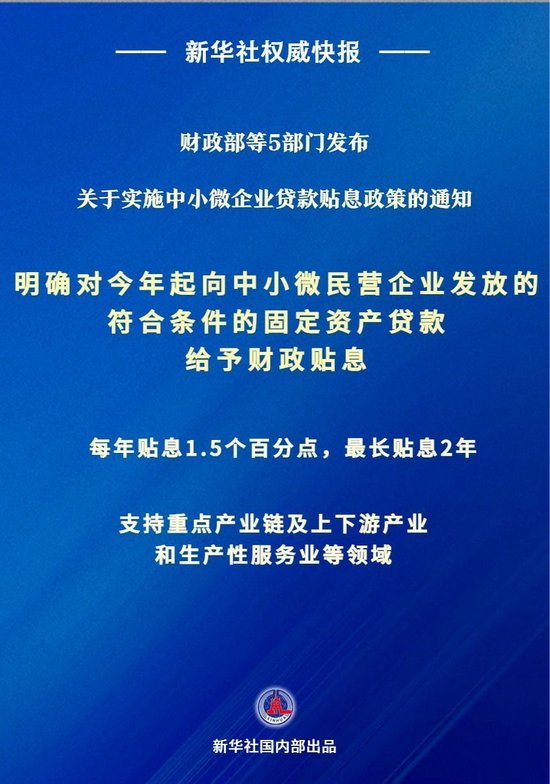
新华社权威快报|财政“真金白银”支持!中小微企业相关贷款可享贴息
Xin Lang Cai Jing· 2026-01-20 04:04
Core Viewpoint - The Ministry of Finance and four other departments announced a loan interest subsidy policy for small and micro enterprises, effective from January 1, 2026, aimed at supporting fixed asset loans and new policy financial tools for eligible private enterprises [2][5]. Group 1 - The policy supports small and micro private enterprises in key industrial chains, upstream and downstream industries, and productive service industries [2][5]. - The interest subsidy is set at 1.5 percentage points per year, with a maximum subsidy period of two years [2][5]. - The maximum loan amount eligible for the subsidy is 50 million yuan per enterprise, with a maximum subsidy of 1.5 million yuan per enterprise [2][5]. - The initial implementation period of the policy is one year, with the possibility of extension based on future evaluations [2][5].
《江苏省上市公司发展报告》出炉 全景展现A股“江苏板块” 实力
Zheng Quan Ri Bao Wang· 2025-12-30 08:34
Core Insights - The "Jiangsu Province Listed Companies Development Report (2025)" was officially released, highlighting the role of technology innovation in driving industrial innovation and promoting high-quality economic development in Jiangsu [1] Group 1: Overview of the Report - The report is based on a sample of 696 listed companies in Jiangsu for 2024, utilizing a four-dimensional structural analysis framework to showcase the comprehensive strength and new development of the "Jiangsu sector" [1] - The report aligns with the strategic deployments of the 20th National Congress regarding high-quality development, technological innovation, and regional coordination [1] Group 2: Achievements of Jiangsu Listed Companies - In 2024, Jiangsu listed companies maintained their scale advantages, covering the "1650" industrial system, with solid operational performance reinforcing their role as a pillar of the real economy [2] - The number of companies listed on the Sci-Tech Innovation Board and the Beijing Stock Exchange, as well as the number of national-level specialized and innovative "little giant" enterprises, ranked first in the country [2] - Governance capabilities improved, with a significant increase in the number of listed companies receiving an A-level rating for information disclosure, up over 20% year-on-year [2] Group 3: Financial Performance and Market Activity - The total financing scale from equity and bond issuance exceeded 200 billion yuan, with nearly 200 mergers and acquisitions amounting to over 60 billion yuan, highlighting efficient resource allocation [2] - The industrial system is accelerating its upgrade, with innovations in high-end manufacturing and biomedicine, and orderly layouts in emerging sectors like artificial intelligence and low-altitude economy [2] Group 4: Regional Development and Future Outlook - The regional layout is becoming more coordinated, with a deepening pattern of "Southern Jiangsu leading, Northern Jiangsu advancing," fostering a positive collaborative development environment [2] - The Jiangsu Securities Regulatory Bureau emphasized the supportive policy environment for listed companies, with 28 companies having gone public in A-shares by the end of 2025, 26 of which belong to strategic emerging industries [3] - Looking ahead, the bureau aims to leverage the capital market's hub function to support direct financing and encourage listed companies to enhance their strengths, contributing to the modernization of Jiangsu [3]
冠农股份:12月29日召开董事会会议
Mei Ri Jing Ji Xin Wen· 2025-12-29 09:59
Group 1 - The company, Guannong Co., Ltd. (SH 600251), announced its eighth board meeting on December 29, 2025, to discuss the performance evaluation and compensation matters for senior management for the year 2024 [1] - For the first half of 2025, Guannong's revenue composition was as follows: industrial sector accounted for 68.69%, commercial sector for 27.37%, and services and others for 3.94% [1] - As of the report date, Guannong's market capitalization was 7.2 billion yuan [1] Group 2 - The article highlights the emergence of a new type of chip in China that bypasses the limitations of lithography machines, supporting AI training and embodied intelligence, and can be mass-produced using mature processes of 28 nanometers and above [1]

HPE Q4 Earnings Surpass Expectations, Revenues Rise Y/Y
ZACKS· 2025-12-05 16:30
Core Insights - Hewlett Packard Enterprise (HPE) stock fell over 8% in pre-market trading despite reporting better-than-expected results for Q4 fiscal 2025, with non-GAAP earnings of 62 cents per share, surpassing the Zacks Consensus Estimate by 5.1% and increasing 6.3% year over year [1] - HPE's revenues grew 14.4% year over year to $9.68 billion but missed the Zacks Consensus Estimate by 2.63%, driven primarily by the networking business [1] Segment Performance - The Server segment generated $4.5 billion in revenues, down 5% year over year due to delays in AI server shipments and reduced U.S. federal spending, with an operating profit margin of 9.8%, down 180 basis points from the previous year [3] - Networking revenues reached $2.8 billion, up 150% year over year, largely due to the addition of Juniper Networks, although the operating profit margin decreased to 23%, down 140 basis points [4] - The Hybrid Cloud division reported $1.4 billion in revenues, down 12% year over year, as HPE focused on higher-margin solutions, resulting in an operating profit margin of 5%, down from 7.8% [5] - The Financial Services segment recorded $889 million in revenues, flat year over year, with an operating margin of 11.5%, up 230 basis points [6] Operating Results - HPE's non-GAAP gross profit for Q4 fiscal 2025 was $3.52 billion, with a non-GAAP gross margin of 36.4%, up 550 basis points year over year [7] - The non-GAAP operating profit was $1.18 billion, with an operating margin of 12.2%, up 110 basis points from the previous year [7] Balance Sheet and Cash Flow - HPE ended Q4 with $5.77 billion in cash and cash equivalents, up from $4.57 billion in the previous quarter [8] - The company generated $2.5 billion in cash from operating activities and produced $1.9 billion in free cash flow, both significantly higher than the prior year [8] Shareholder Returns - HPE returned $271 million to shareholders in Q4 through dividends and share repurchases, totaling $886 million for the full fiscal 2025 [9] Guidance for FY26 and Q1 - For Q1 fiscal 2026, HPE expects revenues between $9 billion and $9.4 billion, with a Zacks Consensus Estimate of 54 cents per share, indicating 10.2% year-over-year growth [12] - For full-year fiscal 2026, HPE forecasts revenue growth of 17-22% and projects non-GAAP diluted EPS of $2.25-$2.45, with a Zacks Consensus Estimate of $2.31 per share, indicating 21.5% year-over-year growth [14]


“A+H”双平台助力上市公司高质量发展
Zheng Quan Ri Bao· 2025-11-25 16:21
Core Viewpoint - The recent surge of A-share companies applying for or planning to list in Hong Kong reflects both strategic choices for corporate development and significant progress in the reform of China's capital markets [1] Group 1: A-share Companies' Listing Trends - Over 140 A-share companies have proposed plans for listing in Hong Kong or splitting subsidiaries for a Hong Kong listing this year [1] - The current wave of listings is characterized by leading enterprises and prominent players in niche sectors actively participating [1] Group 2: Strategic Recommendations for Companies - Companies should maintain strategic clarity and prepare adequately to convert opportunities into high-quality development [2] - It is essential to optimize financing structures using the "A+H" dual platform, particularly for companies in emerging industries like new energy, high-end manufacturing, biomedicine, and new consumption [2] - Companies must establish clear capital strategies based on their development stages and needs, avoiding blind following of trends [2] Group 3: Governance and Brand Development - Companies should enhance internal controls and transparency to meet the governance standards of the Hong Kong market, which align with international practices [2] - The listing in Hong Kong should be viewed as an opportunity to build international brands and improve brand reputation and recognition [2] Group 4: Global Operations and Resource Integration - Listing in Hong Kong is seen as a new starting point for integrating global resources rather than an endpoint [3] - Companies are encouraged to attract international strategic investors and engage in cross-border technology and talent cooperation [3] - The "A+H" dual platform model is increasingly favored by quality enterprises, contributing to their high-quality development and the deepening reform of China's capital markets [3]


关于并购,上交所最新发声!
Zhong Guo Zheng Quan Bao· 2025-11-12 08:26
Core Insights - The resilience and vitality of China's economy and capital markets have significantly increased due to systematic and institutional reforms, making investment in China a common consensus among global investors [1][2] - Mergers and acquisitions (M&A) are seen as a crucial engine for enhancing the quality and investment value of listed companies, providing new investment opportunities for international investors [1][2] Group 1: M&A Activity and Trends - Since the introduction of the "Six M&A Guidelines," over 1,000 M&A transactions have been disclosed by companies listed on the Shanghai Stock Exchange, with significant asset restructurings increasing by 138% year-on-year [1] - Half of the major asset restructurings since the guidelines were introduced have been in the technology sector, which has seen a year-on-year growth of 287%, focusing on emerging and future industries [1][2] Group 2: Investment Opportunities - International investors are encouraged to strategically invest in A-share technology companies, particularly those on the Sci-Tech Innovation Board, to capitalize on China's technological innovation dividends [2] - Traditional industry companies are actively transforming through M&A, presenting opportunities for international investors to benefit from undervalued assets and value re-evaluation [2] Group 3: Market Environment and Support - The Shanghai Stock Exchange is committed to enhancing the quality of listed companies and attracting more high-quality enterprises to go public, thereby improving the overall quality of Chinese assets [3] - Continuous improvement of the M&A regulatory framework and responsiveness to investor needs is emphasized, aiming to create a conducive environment for M&A activities [3] - The exchange aims to provide better services for international investors, including educational resources on M&A and improved communication channels [3]
Astera Labs Q3 Earnings Beat Estimates, Revenues Rise Y/Y
ZACKS· 2025-11-05 18:36
Core Insights - Astera Labs (ALAB) reported third-quarter 2025 non-GAAP earnings of 49 cents per share, exceeding the Zacks Consensus Estimate by 25.64% and doubling from 23 cents per share in the same quarter last year [1][8] - Net revenues increased by 103.9% year over year to $230.58 million, surpassing the Zacks Consensus Estimate by 11.53%, driven by new AI platform ramps and multiple product families [1][8] - ALAB shares fell by 4.14% in pre-market trading following the earnings report [1] Revenue and Product Details - Astera Labs is increasing production of its PCIe 6 product portfolio for customized rack-scale AI systems, with Scorpio P-Series fabric switches achieving multiple design wins across various AI platforms, including those using NVIDIA's GB300 and B300 GPUs [2] - Strong demand was noted for the signal conditioning portfolio, driven by PCIe scale-up and Ethernet scale-out connectivity applications in custom ASIC platforms [3] Operating Performance - The non-GAAP gross margin was reported at 76.4%, a decrease of 140 basis points year over year [4] - Research and development expenses rose by 55.8% year over year to $78.9 million, while sales and marketing expenses decreased by 16.7% to $19.4 million, and general and administrative expenses decreased by 3.3% to $22.1 million [4] - The non-GAAP operating margin improved to 41.7% compared to 32.4% in the previous year [4] Balance Sheet Overview - As of September 30, 2025, cash and cash equivalents along with marketable securities totaled $1.13 billion, up from $1.07 billion as of June 30, 2025 [5] Q4 Guidance - For the fourth quarter of 2025, Astera Labs expects revenues to be between $245 million and $253 million, with a non-GAAP gross margin of approximately 75% and operating expenses projected between $85 million and $90 million [6] - Earnings are anticipated to be around 51 cents per share for the fourth quarter [6] Market Position - Astera Labs currently holds a Zacks Rank 2 (Buy) [7]

今日视点:从10.6万亿元“红包”看A股新生态
Zheng Quan Ri Bao· 2025-09-23 23:14
Core Viewpoint - The awareness of listed companies in China regarding returning value to investors has significantly increased during the "14th Five-Year Plan" period, with a total of 10.6 trillion yuan distributed through dividends and buybacks, representing an over 80% increase compared to the "13th Five-Year Plan" period, and equivalent to 2.07 times the amount raised through IPOs and refinancing during the same period [1] Policy Ecosystem - The explosive growth in dividends and buybacks is attributed to systematic upgrades in the capital market's foundational systems during the "14th Five-Year Plan" period. The regulatory framework has shifted from sporadic encouragement to a comprehensive institutional framework [2] - New policies, such as the "National Nine Articles," impose restrictions on major shareholders of companies that have not paid dividends or have low dividend ratios, while also encouraging long-term dividend planning [2] - The evolution of policies has transitioned from "requiring returns" to "facilitating returns" and "cultivating a return culture," establishing a solid institutional foundation for a normalized dividend mechanism [2] Listed Company Ecosystem - The concept of sharing profits has evolved, with dividends shifting from "passive compliance" to "active return." In 2024, nine companies are expected to distribute over 50 billion yuan in dividends, and 33 companies over 10 billion yuan [3] - The number of companies consistently paying cash dividends over the past five years has increased by 6% in 2024 compared to 2023 [3] - The behavior of listed companies has also changed, with a notable increase in share buybacks aimed at reducing share circulation and enhancing earnings per share, allowing all shareholders to share in value appreciation [3] Investor Ecosystem - The surge in dividends and buybacks corresponds with a shift in investor structure and investment philosophy, with a growing preference for high-dividend assets as value investment concepts gain traction [4] - Investors are increasingly focused on returns, prompting companies to actively publish shareholder return plans and set minimum dividend rates above historical averages [4] - The transformation from "speculative price differences" to "sharing value" has diminished speculative market behavior, highlighting a more rational market ecosystem [4]