
机器人材料

Search documents
大国基座2025:新材料三重战线的突破与2026年体系化决战
材料汇· 2025-12-31 11:27
Core Viewpoint - The article discusses the strategic transformation of China's new materials industry by 2025, emphasizing a "three-dimensional war" approach that includes "fortress materials" for national security, "sovereign materials" for technological independence, and "fusion materials" for future industry definition [3]. Group 1: Fortress Materials - The development of safety dimension materials is closely tied to national core interests, focusing on absolute reliability and performance under extreme conditions rather than cost-effectiveness [5]. - A significant breakthrough in 2025 is the mass production of the fourth-generation single crystal high-temperature alloy turbine blades, which can withstand temperatures above 1200°C and have a lifespan increased by nearly 50% compared to previous generations [8][10]. - Continuous silicon carbide fibers have transitioned from laboratory preparation to stable engineering mass production, with a production capacity of hundreds of tons, marking a strategic leap in the aerospace sector [14][15]. Group 2: Sovereign Materials - Sovereign materials focus on achieving "self-control" and enhancing industrial competitiveness, particularly in strategic sectors like semiconductors and high-end manufacturing [40]. - In the semiconductor sector, the production of 12-inch silicon wafers has reached a milestone with over 500,000 monthly shipments, and significant advancements in low-oxygen high-resistivity silicon wafer technology have been made [44]. - The domestic supply ratio of 300mm semiconductor silicon wafers is expected to increase from 15% to 40% by the end of 2025, significantly reducing reliance on imports [45]. Group 3: Fusion Materials - The fusion materials dimension represents a shift towards creating new demands and defining new products, characterized by the integration of materials science with cutting-edge fields like artificial intelligence and synthetic biology [72]. - AI-driven platforms for materials research have emerged, enabling rapid property prediction and screening, significantly reducing development cycles for critical materials [74]. - The integration of intelligent materials in robotics is evolving, allowing materials to interact with their environment and make autonomous decisions, marking a shift from passive components to intelligent structures [77].







首程控股:附属公司拟设立机器人先进材料产业公司
Xin Lang Cai Jing· 2025-08-31 13:06
Core Viewpoint - The establishment of Shoucheng Robot Advanced Materials Industry Co., Ltd. by Shoucheng Holdings' wholly-owned subsidiary Shouwu Investment Holdings Ltd. aims to invest and incubate key upstream materials required for the robotics industry [1] Group 1 - The new company will focus on the industrialization of core advanced materials such as electronic skin materials, tendon materials, and lightweight PEEK materials [1] - The investment strategy will systematically target advanced materials for robotics and other new industry sectors with high synergy potential [1]

化工行业新材料周报(20250811-20250817):英伟达推出新Cosmos模型,2025Q2中东手机出货量大增-20250818
Huachuang Securities· 2025-08-18 01:17
Investment Rating - The report maintains a recommendation for the chemical industry, specifically for new materials, indicating a positive outlook for investment opportunities in this sector [1]. Core Insights - The new materials sector outperformed the broader market and the basic chemical sector, with a weekly change of 5.69% for the new materials index compared to 1.09% for the basic chemical index [10]. - The report highlights significant growth in the Middle East smartphone market, with a 15% year-on-year increase in shipments in Q2 2025, reaching 13.2 million units, driven by consumer demand and economic momentum [13]. - The global robot market is projected to exceed $400 billion by 2029, with China expected to capture nearly half of this market share, indicating strong growth potential in robotics materials [14][15]. Industry Updates - The report notes that the new materials sector is characterized by high demand growth and strong technological barriers, with various subcategories including high-end engineering plastics and renewable energy materials [18]. - The Ministry of Industry and Information Technology (MIIT) is actively addressing low-price competition in the photovoltaic industry, aiming to promote sustainable development and the exit of outdated production capacity [11]. - Recent policies from the Ministry of Finance and the State Taxation Administration allow for tax deductions on hydrogen and methanol usage, which could stimulate growth in the hydrogen energy sector [15]. Trading Data - The Huachuang Chemical Industry Index stands at 71.97, reflecting a 1.21% decrease week-on-week and a 23.14% decrease year-on-year [19]. - The industry inventory percentile is at 81.38%, indicating a relatively high level of inventory compared to the past five years [19]. Price Movements - Notable price increases this week include 6F (+9.45%), lithium iron phosphate (+5.05%), and oxygen (+2.81%), while significant declines were observed in valine (-3.24%), threonine (-2.28%), and lysine (-1.93%) [10][23].

供给增速转负,化工拐点渐近
GOLDEN SUN SECURITIES· 2025-07-08 06:41
Group 1: Chemical Industry Overview - The construction project growth rate in the basic chemical sector has turned negative, indicating a potential turning point for the industry [1] - The fixed asset growth rate is a leading indicator for supply growth, and the current negative trend in construction projects suggests that the chemical sector is approaching a new upward cycle [1][10] - The overall chemical sector requires multiple factors to resonate for the next upward cycle to begin, with oil prices being a key pricing anchor for most chemical products [1] Group 2: AI for Science (AI4S) in Chemical R&D - AI for Science represents a new paradigm in materials science research, with the potential to grow into a trillion-dollar market, significantly enhancing research efficiency through literature learning, AI model calculations, and automated laboratories [2] - The application of AI4S in the pharmaceutical sector is accelerating, with successful models for drug discovery and solid-state research being established [2] - China is positioned to lead in the AI4S market due to its comprehensive chemical manufacturing industry and supply chain, with key companies like 泰控股 and 志特新材 emerging as leaders [2][46] Group 3: Investment Opportunities in New Industries - The AI hardware sector, particularly in light connections, power supplies, and liquid cooling, presents significant investment opportunities, with companies like 东阳光 recommended for attention [3] - The solid-state battery market is expected to undergo transformation driven by demand from emerging sectors, with large-scale commercialization anticipated from 2026 onwards [3] - The robotics sector, particularly with tendon-driven systems, is gaining traction, with significant market potential as the technology matures [3][50] Group 4: Supply and Demand Dynamics - The supply side of the chemical industry is currently in a downward trend, with construction project growth rates at historically low levels [9][10] - Demand for chemical products has been affected by various external factors, including trade tensions and geopolitical events, but the overall demand is stabilizing as tariff disturbances recede [13] - The global chemical product sales accounted for 45% of the total market, indicating a strong position in the global supply chain [13] Group 5: Oil Market Impact - The oil market is facing increasing supply pressures, with predictions of excess supply in 2025, leading to a potential decline in oil prices [17][20] - Geopolitical tensions, particularly in the Middle East, continue to create uncertainty in oil prices, which directly impacts the profitability of the chemical sector [28][32] - The OPEC+ group is expected to increase production, further exacerbating the supply-demand imbalance in the oil market [25]


研判2025!中国人形机器人腱绳材料行业产业链、市场规模及重点企业分析:技术突破与成本优势并进,中国人形机器人腱绳材料企业崛起[图]
Chan Ye Xin Xi Wang· 2025-05-28 01:31
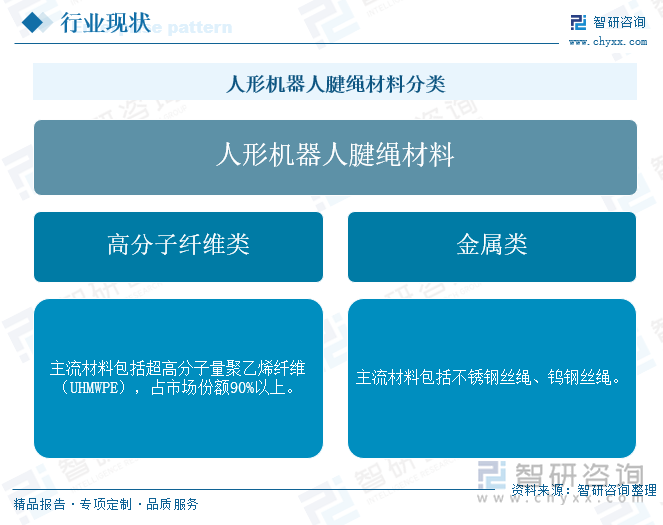
Core Viewpoint - The development of humanoid robot tendon materials is driven by advancements in ultra-high molecular weight polyethylene (UHMWPE) fibers, which have achieved performance levels comparable to international leaders while reducing costs by 30% [1][17]. The mass production plans of benchmark products like Tesla's Optimus are significantly increasing the demand for high-end tendon materials [1][17]. Industry Overview - Humanoid robot tendon materials are used to connect and fix robot joints, simulating human tendons to drive joint movement. These materials are crucial for enhancing the dexterity and lightweight characteristics of robotic hands [2][9]. Industry Development History - The industry has undergone three phases: 1. **Technical Enlightenment (2019-2022)**: The introduction of UHMWPE as a key strategic material by the Ministry of Industry and Information Technology (MIIT) and the initiation of domestic production [9]. 2. **Industrial Exploration (2023-2024)**: The MIIT's guidance on humanoid robot innovation and the successful mass production of high-strength fibers by companies like Nanshan Zhishang [10]. 3. **Ecosystem Construction (2025-Present)**: The establishment of standards and funding support for tendon material companies, with advancements in fiber strength and the introduction of smart tendon materials [10][24]. Industry Chain - The upstream of the tendon materials industry includes raw materials like UHMWPE resin and production equipment. The midstream involves the manufacturing of tendon materials, while the downstream applications include humanoid robots, industrial robots, and medical robots [12]. Market Size - The market for humanoid robot tendon materials in China is projected to grow from 1.325 million RMB in 2025 to 47.368 million RMB by 2029, with a compound annual growth rate (CAGR) of 144.52% [1][17]. Key Companies' Performance - Key players in the UHMWPE fiber sector include Jiuzhou Xingji, Qianxi Longxian, Tongyi Zhong, Henghui Anfang, and Nanshan Zhishang, with significant production capacities and product performance [19][22]. For instance, Jiuzhou Xingji has an annual production capacity of 30,000 tons, leading globally [19]. Industry Development Trends 1. **Material Performance and Smart Integration**: The industry will focus on enhancing UHMWPE fibers' strength and reducing creep rates, while also developing smart tendon materials with real-time monitoring capabilities [24]. 2. **Application Scenario Diversification**: The demand for tendon materials will split into high-end applications for medical and rehabilitation robots and low-cost solutions for educational and entertainment markets [25][26]. 3. **Domestic Substitution and Global Supply Chain Restructuring**: Chinese companies are accelerating domestic substitution and entering global supply chains, with a projected increase in domestic market share from 20% in 2023 to 35% in 2024 [27].

化工行业新材料周报(20250512-20250518):4月动力及其他电池同比+49%、环比-0.03%,本周电子级氮气、氧气涨价
Huachuang Securities· 2025-05-19 00:50
Investment Rating - The report maintains a "Recommend" rating for the chemical industry, particularly focusing on new materials [1]. Core Insights - The chemical industry is experiencing a recovery in prices due to easing trade tensions between China and the U.S., leading to a replenishment window for trade [9]. - The report highlights a significant year-on-year increase of 49% in the production of power and other batteries in April, despite a slight month-on-month decline of 0.03% [1][13]. - The report emphasizes the importance of new materials, particularly those that are domestically produced and can replace imports, as a key investment opportunity [10]. Industry Overview - The chemical industry has a total market capitalization of approximately 426.56 billion yuan, with 486 listed companies [1]. - The Huachuang Chemical Industry Index stands at 79.16, reflecting a week-on-week increase of 0.95% but a year-on-year decrease of 21.44% [20][22]. - The report notes that the industry price percentile is at 21.88% over the past decade, with a slight increase of 0.37% week-on-week [9][20]. New Materials Sector - The new materials sector has shown a week-on-week increase of 0.26%, underperforming compared to the basic chemical sector, which increased by 1.21% [11][29]. - The report identifies specific companies in the new materials sector that are recommended for investment, including Ruifeng New Materials, Tongyi Zhong, and Lianlong [9]. - The report also mentions the impact of regulatory changes on the safety standards for power batteries, which will be enforced starting July 1, 2026, pushing companies to enhance their battery management systems [13][14]. Price Movements - The report indicates that nitrogen prices increased by 2.97%, while electronic-grade sulfuric acid saw a significant drop of 11.90% [11][26]. - The report provides a detailed overview of price changes in various materials, highlighting both increases and decreases across different sectors [27]. Market Performance - The report notes that the new materials sector is expected to benefit from the ongoing trends in domestic production and import substitution, particularly in high-demand areas such as robotics and renewable energy materials [10][15]. - The report also highlights the performance of specific stocks within the new materials sector, noting both the top gainers and losers for the week [29].

