
民营火箭

Search documents
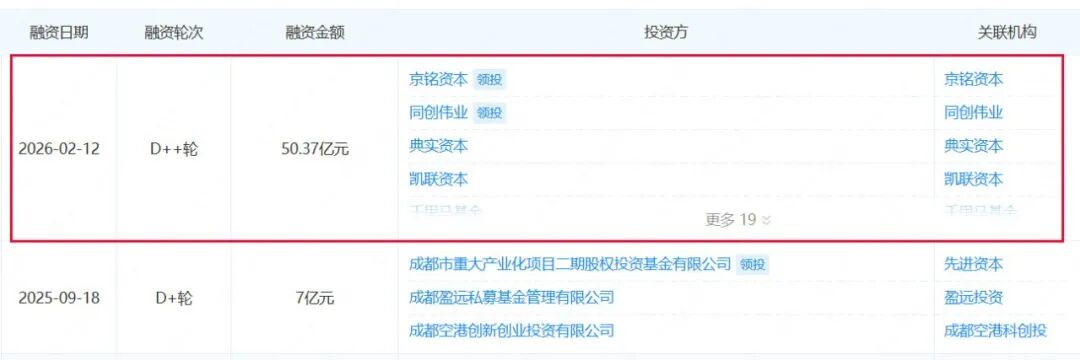
汉中火箭创业者,一举拿下50亿融资
2 1 Shi Ji Jing Ji Bao Dao· 2026-02-14 08:06
Core Insights - The private aerospace company, Galactic Glory, has completed a record-breaking D++ round financing of 5.037 billion yuan, marking the largest single financing in China's private rocket sector [1][2]. Financing Details - The financing round was led by Tongchuang Weiye and Jingming Capital, with follow-up investments from Ganquan Capital, Chengdu Industrial Investment, and over ten new institutions including Dian Shi Capital and Longxin Venture Capital [2][3]. - The previous financing round (D+ round) occurred on September 18, 2025, raising 700 million yuan, led by Chengdu's major industrialization project equity investment fund [3]. Company Development - The funds raised will primarily accelerate the development and commercialization of the "Hyperbola-3" rocket, enhancing capabilities in assembly, testing, sea recovery, and experimental launches [4]. - The "Hyperbola-3" is a medium to large reusable rocket using liquid oxygen and methane, crucial for achieving land launch and sea recovery [5]. Leadership Background - Founder Peng Xiaobo, a veteran in the aerospace industry, has a history of working on the Long March series rockets and founded Galactic Glory in 2015 after leaving a state institution [6][7][8]. - The company achieved a significant milestone in 2019 by successfully launching its first major product, the "Hyperbola-1" rocket, becoming the first private company in China to reach orbit [9]. Challenges and Strategic Shift - Following initial successes, the company faced setbacks with three launch failures of the "Hyperbola-1" between 2021 and 2022, prompting a strategic shift towards reusable technology [12]. - The current focus is entirely on the "Hyperbola-3," which is designed to meet high-frequency, low-cost launch demands for satellite constellations and cargo transport to space stations [13][14]. Future Plans - The "Hyperbola-3" is scheduled for its first flight with orbit and sea recovery by the end of 2026, with significant testing already completed [15]. - Other companies, such as Deep Blue Aerospace and Tianbing Technology, are also expected to enter the reusable rocket market in 2026, intensifying competition [16]. - The first company to achieve orbit is likely to compete for the title of "the first commercial aerospace stock on the Sci-Tech Innovation Board" [17].


蓝箭航天IPO获受理,金风科技持有其4.14%股权被重估,风电龙头因一笔七年前投资市值逼近千亿
Xin Lang Cai Jing· 2026-01-07 05:08
Core Viewpoint - The heat of commercial aerospace has been reignited at the beginning of 2026, particularly with the acceptance of Blue Arrow Aerospace's IPO application, marking a significant moment for the industry [3][16]. Group 1: Company Developments - Blue Arrow Aerospace has officially launched its IPO application on the Sci-Tech Innovation Board, aiming to become the "first stock in commercial aerospace" [3][16]. - Goldwind Technology, through its subsidiary Jianghan Asset, holds a 4.14% stake in Blue Arrow Aerospace, which has recently gained attention as its stock price surged, pushing its market capitalization above 100 billion yuan [5][18]. - On January 6, 2026, Goldwind Technology's stock hit a historical high of 24 yuan, with a total market value reaching 937.86 billion yuan, reflecting strong investor interest [6][19]. Group 2: Investment Insights - Goldwind Technology's investment in Blue Arrow Aerospace dates back to 2018 during the latter's B+ round financing, a time when commercial aerospace was not a frequent topic in capital markets [9][21]. - The estimated value of Goldwind's stake in Blue Arrow Aerospace has exceeded 800 million yuan based on the latter's valuation of 20 billion yuan [21]. - Goldwind's broader investment strategy spans multiple sectors, including new energy and manufacturing, with its equity investment value reaching 3.337 billion yuan as of mid-2025 [10][24]. Group 3: Market Reactions - The acceptance of Blue Arrow Aerospace's IPO has triggered a rally in the secondary market, with stocks related to commercial aerospace, including Goldwind Technology, experiencing significant price increases [9][27]. - The stock price of Goldwind Technology has been positively influenced by the overall market sentiment surrounding commercial aerospace, showcasing a butterfly effect from past investments [27].

【研选行业+公司】民营火箭迎来首飞潮,技术突破与政策支持双驱动下,这类标的值得布局
第一财经· 2025-12-13 11:29
Group 1 - The private rocket industry is experiencing a wave of inaugural flights, driven by technological breakthroughs and policy support, making these types of stocks worth considering for investment [1] - The demand for core materials in AI computing power is surging, with a specific company successfully entering the global GPU supply chain, leading to rapid business growth and a projected 38% CAGR [1]

星河动力谷神星一号发射失败,上月公司刚启动IPO上市辅导
Nan Fang Du Shi Bao· 2025-11-17 11:57
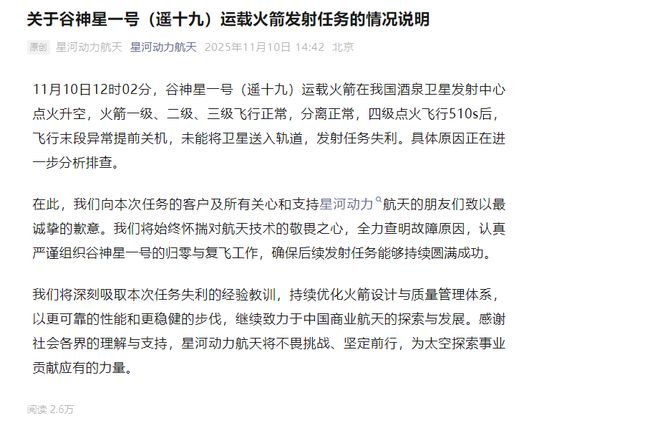
Core Viewpoint - Beijing Xinghe Power Aerospace Technology Co., Ltd. (Xinghe Power) faced a launch failure of its Vesta-1 (Remote 19) rocket on November 10, 2023, which did not successfully place its satellite into orbit, marking a setback during a critical period for its A-share IPO preparation [1][2]. Group 1: Launch Failure Details - The Vesta-1 rocket experienced normal flight for its first three stages, but the fourth stage encountered an anomaly and shut down prematurely after 510 seconds, resulting in mission failure [1]. - This incident is not the first for Xinghe Power; a previous launch on September 21, 2023, also failed due to instability caused by an engine component defect [4]. Group 2: Company Performance and Market Position - Despite the recent setbacks, Xinghe Power is one of the leading private rocket companies in China, having completed 22 launch missions with a success rate of approximately 90.9%, successfully placing 85 satellites into orbit [4]. - The company accounts for about 51.3% of the total successful launches in the domestic private rocket sector [4]. Group 3: IPO and Financing Activities - The launch failure occurred shortly after Xinghe Power initiated its IPO counseling process in late October 2023 [5]. - In September 2023, the company completed a record-breaking D-round financing of 2.4 billion yuan, marking the highest single financing amount for a private rocket company in China to date [6]. - Since its establishment in 2018, Xinghe Power has raised over 5.3 billion yuan and was valued at 15 billion yuan by the end of last year [6]. Group 4: Industry Trends - The recent launch failure highlights the challenges faced by the commercial space sector, which is currently experiencing a wave of IPO activities among several leading private rocket companies [5][7]. - The regulatory environment has become more favorable for commercial space enterprises, with new rules allowing unprofitable tech companies to list on the STAR Market, prompting a surge in IPO preparations [7].
星河动力冲刺上市 “火箭”股集体蹿升
2 1 Shi Ji Jing Ji Bao Dao· 2025-10-24 05:00
Core Viewpoint - The commercial aerospace sector in China is experiencing a surge in interest and investment, with multiple private rocket companies preparing for IPOs, driven by supportive government policies and significant capital inflows [1][5]. Group 1: Market Dynamics - On October 24, stocks of commercial aerospace companies such as Aerospace Changfeng and Aerospace Science and Technology reached their daily limit, indicating strong market enthusiasm [1]. - The China Securities Regulatory Commission announced that Beijing Xinghe Power Aerospace Technology Co., Ltd. has submitted its IPO guidance, marking a significant step in the commercialization of private rockets [1][5]. - A total of five private rocket companies, with a combined valuation exceeding 855 billion yuan, are now in the IPO preparation phase, intensifying competition for the title of "first private rocket stock" [1][6]. Group 2: Company Profiles - Beijing Xinghe Power, established in 2018, has developed solid and reusable liquid rockets, with its "Gushenxing" series being the first to transition from experimental to commercial production in China [4]. - The company achieved a record-breaking 2.4 billion yuan in Series D financing in September, raising its post-money valuation to between 15 billion and 15.8 billion yuan [4]. - Other companies in the IPO pipeline include Tianbing Technology, Blue Arrow Aerospace, and Star Glory, with valuations of 225 billion, 220 billion, and 150 billion yuan respectively [2][6]. Group 3: Competitive Landscape - Xinghe Power leads the private rocket sector with a 51.3% success rate in domestic launches, having successfully launched 85 commercial satellites for 27 clients [8]. - The competitive landscape is evolving, with other companies like Blue Arrow Aerospace and Tianbing Technology also making significant strides in securing commercial contracts [8]. - The upcoming launches of reusable rockets by several companies, including Xinghe Power and Tianbing Technology, are expected to further stimulate investment interest in the commercial aerospace sector [8].

24亿元!星河动力完成国内民营火箭企业最高单笔融资
Xin Lang Cai Jing· 2025-09-29 01:40
Group 1 - Beijing Xinghe Power Aerospace Technology Co., Ltd. completed a D-round financing totaling 2.4 billion yuan, marking the second-highest single financing amount in China's commercial aerospace sector [1] - This financing is the highest single amount for a private rocket company in China to date, following a 6.7 billion yuan financing by a state-owned company [1] - The funds will primarily be used to accelerate the development and production of the "Zhishen" series of reusable liquid launch vehicles and the "Gushen II" medium-sized solid launch vehicle [1] Group 2 - Xinghe Power was founded in 2018 and provides aerospace launch services, equipment manufacturing, and systematic solutions in engineering, technology, safety, and system integration [2] - The company has completed 20 rocket launches, successfully launching 85 satellites for 27 commercial satellite clients, making it the private company with the most launches in China [2] - As of last year, the company's valuation increased from 9.2 billion yuan to 15 billion yuan, reflecting significant growth in the commercial aerospace sector [2] Group 3 - The commercial aerospace industry in China is characterized by a competitive landscape dominated by state-owned enterprises and a tiered structure of seven licensed private companies [3] - Future industry development will focus on low-cost, high-frequency, and large-capacity launches, leveraging reusable rocket technology and expanding infrastructure [3] - The industry aims to diversify into space tourism and in-orbit services, building a competitive commercial aerospace ecosystem [3]
Firefly Aerospace(FLY.US)登陆美股市场 开盘涨超54%
Zhi Tong Cai Jing· 2025-08-07 17:02
Group 1 - Firefly Aerospace (FLY.US) went public on the US stock market, with shares opening up over 54% at $69.63, compared to the IPO price of $45 [1] - The company was founded in 2014 and faced near bankruptcy due to funding issues, but successfully landed its "Blue Ghost" lunar lander, becoming the only private lunar probe to achieve stable landing [1] - In this IPO, Firefly increased the number of shares issued to 19.3 million, raising approximately $868 million, which exceeded previous fundraising plans [1] Group 2 - There was strong market demand for Firefly's stock, with subscription orders being ten times the originally planned issuance [1]
民营企业家代表与中外记者见面交流 企业家大显身手正当其时
Jing Ji Ri Bao· 2025-07-15 23:50
Group 1 - The meeting highlighted the importance of promoting entrepreneurial spirit among private enterprises in China, emphasizing their role in building a strong socialist economy [1] - Wang Xingxing, CEO of Hangzhou Yushu Technology Co., expressed confidence in the growth of the private economy, citing favorable policies and a strong focus on R&D and production [1] - Zhang Bo, Chairman of Shandong Weiqiao Chuangye Group, discussed the need for traditional manufacturing to transition towards high-quality development through green low-carbon practices, digital transformation, and innovation [1] Group 2 - Inner Mongolia Ordos Investment Holding Group's President Wang Zhen emphasized the connection between corporate growth and national development, advocating for the use of technological innovation to empower local communities [1] - Beijing Xinghe Power Aerospace Technology Co., known for its high success rate in private rocket launches, noted that supportive policies have created opportunities for private enterprises in the aerospace sector [2] - Liu Changyun, Chairman of Jiuzhoutong Pharmaceutical Group, identified three favorable conditions for enterprise development: government support for the private economy, a large consumer market in China, and the impact of digitalization and AI on the pharmaceutical industry [2]