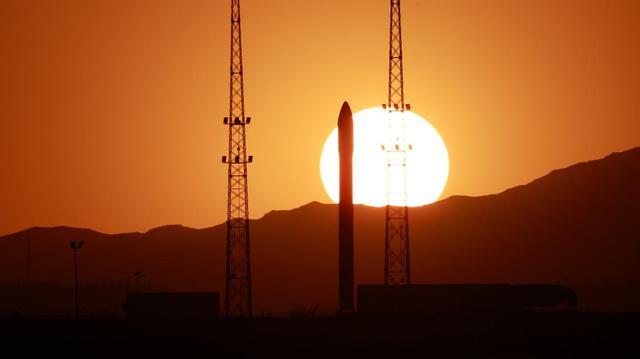
谷神星一号运载火箭

Search documents
商业航天“五小龙”,谁是中国版SpaceX?
凤凰网财经· 2026-03-23 11:58
Core Viewpoint - The commercial space industry is experiencing a significant surge, particularly with the upcoming IPO of SpaceX, which has reached a valuation of $1.75 trillion, surpassing Meta and nearing Amazon. This has led to increased investment and interest in China's private space companies and related industries, with notable growth in stock prices and funding rounds [4][6]. Group 1: Market Dynamics - The commercial space sector in China has seen a dramatic increase in investment, with 67 financing rounds recorded in 2025, nearly double that of 2024 [4]. - The private rocket company, Galactic Glory, recently completed a financing round of 5.037 billion yuan, setting a record for private rocket financing in China [4]. - The valuation of the five leading private rocket companies in China exceeds 100 billion yuan, with Blue Arrow Aerospace leading the way in the IPO process [5]. Group 2: Technological and Business Model Insights - The success of SpaceX is attributed to its reusable rocket technology and the Starlink satellite internet service, which generates continuous cash flow and reduces launch costs [7][9]. - The Chinese commercial space sector currently lacks advancements in reusable technology and the rapid deployment of its satellite internet systems, which are crucial for future growth [11][12]. - The planned satellite constellations, GW and Qianfan, aim to deploy 12,992 and 15,000 low-orbit satellites by 2027 and 2030, respectively, but as of December 2025, only 244 satellites have been launched [11][12]. Group 3: Investment Valuations and Market Potential - The total valuation of the five leading private rocket companies has increased significantly, with a combined valuation of approximately 1 billion yuan as of early 2026, reflecting a growth of over 325 million yuan in just over a year [16]. - Investors believe that the combined valuation of these companies should not exceed SpaceX's valuation of $1.5 trillion, indicating a speculative market environment [16]. - The market for satellite manufacturing and launch services in China is projected to reach approximately 26.8 billion yuan by 2026, with a growth rate of 49% [39]. Group 4: Challenges and Future Outlook - Despite the optimistic market sentiment, the financial performance of companies like Blue Arrow Aerospace shows significant losses, with cumulative losses exceeding 3.5 billion yuan from 2022 to mid-2025 [6][36]. - The industry consensus suggests that achieving cost-effective rocket recovery is essential for sustainable operations, yet no Chinese private rocket company has successfully implemented this technology to date [38]. - The future of the commercial space industry in China may see consolidation, with expectations that only a few private rocket companies will survive in the long term [42].


商业航天“五小龙”,谁是中国版SpaceX?
创业邦· 2026-03-23 10:20
Core Viewpoint - The commercial space industry is experiencing significant growth, with a focus on private rocket companies in China, which are seen as potential counterparts to SpaceX. The valuation of SpaceX has reached $1.75 trillion, prompting increased investment and interest in China's private space sector [6][8]. Group 1: Market Dynamics - The commercial space sector has seen a surge in investment, with 67 financing rounds in 2025, nearly double that of 2024. The private rocket company, Space Honor, raised 5.037 billion yuan, setting a record for private rocket financing in China [6][8]. - The commercial space industry in China has experienced a stock price increase of over 40% in a short period, although it has faced volatility since then, with a year-to-date increase of nearly 10% [6][8]. Group 2: Key Players - Five private rocket companies in China are on track for IPOs, with a combined valuation exceeding 100 billion yuan. These companies include Blue Arrow Aerospace, Tianbing Technology, Zhongke Aerospace, Space Honor, and Xinghe Power [7][8]. - Blue Arrow Aerospace is currently in the review process for listing on the Sci-Tech Innovation Board, while the other four companies are in the counseling stage [8]. Group 3: Technological Challenges - The commercial space industry is heavily reliant on launch vehicles, which are essential for satellite deployment and network formation. However, the Chinese private sector has yet to achieve successful rocket recovery, which is crucial for reducing launch costs [9][22]. - The lack of a successful recovery technology in the Chinese commercial space sector is a significant hurdle, as it requires substantial investment and technological advancement [22][23]. Group 4: Financial Performance - Blue Arrow Aerospace reported cumulative losses exceeding 3.5 billion yuan from 2022 to mid-2025, highlighting the financial challenges faced by private rocket companies [23]. - The company generated revenue of 36.43 million yuan in the first half of 2025, with 97.96% coming from single rocket launch services, indicating a heavy reliance on this revenue stream [23]. Group 5: Future Outlook - The market for satellite manufacturing and launch services in China is projected to reach approximately 26.8 billion yuan by 2026, with a growth rate of 49% [25]. - The valuation of private rocket companies is influenced by their ability to secure launch orders within the framework of China's satellite network, with expectations that only a few companies will survive in the long term [28][30].

粤开证券以“慢投资”之道陪伴企业成长
Zhong Guo Zheng Quan Bao· 2026-01-28 20:59
Core Viewpoint - Yuekai Securities, a state-owned comprehensive securities company, emphasizes a culture of compliance, integrity, professionalism, and stability, aiming to become a boutique broker in the Guangdong-Hong Kong-Macao Greater Bay Area, focusing on long-term investments in sectors like new energy, biomedicine, commercial aerospace, and low-altitude economy [1][2] Strategic Advantages - The company leverages its "professional judgment" and "state-owned attributes" to support patient capital, focusing on long-term value rather than short-term returns [2][3] - By enhancing its research capabilities, Yuekai Securities aligns its investment decisions with industry trends and project potential, identifying quality targets for long-term partnerships [2][3] Industry Focus - The company is strategically investing in new energy, biomedicine, commercial aerospace, and low-altitude economy, avoiding short-term speculation and focusing on technology-driven enterprises with core technologies and long-term growth potential [5][6] - The global market for AI data center energy storage batteries is projected to grow nearly 20 times from approximately 15 GWh in 2025 to over 300 GWh by 2030, indicating significant opportunities in the new energy sector [4] Investment Practices - Yuekai Securities adopts a "slow investment" approach, which involves patient capital and deep empowerment, allowing companies to navigate challenges and focus on core technology development [5][6] - The company has established a comprehensive empowerment system that integrates investment, investment banking, and wealth management, supporting companies throughout their growth cycles [6][7] Case Studies - In the low-altitude economy, Yuekai Capital led a strategic investment in XPeng Huitian, facilitating the construction of the world's first mass production flying car factory, with over 5,000 orders expected for delivery by 2026 [6][7] - In the biomedicine sector, Yuekai Capital has supported innovative companies like Anjisheng Biotech, accelerating the global clinical development of breakthrough treatments for severe diseases [7] Economic Impact - The company's investments are driving the formation of industrial clusters in commercial aerospace and low-altitude economy, contributing to regional industrial structure optimization and high-quality economic development [7]
星河动力回应发射失利
Xin Lang Cai Jing· 2026-01-17 09:52
Core Viewpoint - The recent launch of the Xinghe Power's Gushenxing No. 2 rocket was unsuccessful due to flight anomalies, and the company is currently investigating the cause of the failure [1][7]. Group 1: Gushenxing No. 2 Rocket - Gushenxing No. 2 is an upgraded model based on Gushenxing No. 1, featuring a three-stage solid rocket combined with a liquid upper stage, with a launch mass of 100 tons [8]. - The rocket has a payload capacity of 1.6 tons to a 500 km Low Earth Orbit (LEO) and 1.3 tons to a 500 km Sun-Synchronous Orbit (SSO), achieving an efficiency of 1.3% [8]. - The company aims to reduce launch costs significantly while maintaining flexibility and rapid deployment capabilities, with launch prices comparable to medium-sized liquid rockets of 200 tons [8]. Group 2: Gushenxing No. 1 Rocket - Gushenxing No. 1 is the main rocket model for Xinghe Power, having successfully conducted 21 commercial launches, delivering a total of 89 satellites into their designated orbits [10]. - The successful launch of the Gushenxing No. 1 sea-launch variant on January 16 marked a positive start for private commercial launches in 2026, successfully placing four satellites into near-Earth orbit [10]. Group 3: Zhishenxing Series Development - The Zhishenxing series is being developed for large constellation deployment, with the first flight of Zhishenxing No. 1 imminent [10]. - The main engine of Zhishenxing No. 1, CQ-50, has completed over 10,000 seconds of cumulative testing, achieving a significant breakthrough in thrust variability [10]. - Zhishenxing No. 2, a large reusable liquid rocket, is set to enter production, with its main engine CQ-90 having completed assembly and ready for system testing [12]. Group 4: IPO Plans - In October 2025, Xinghe Power filed for IPO guidance with the Beijing Securities Regulatory Bureau, joining the queue of commercial rocket companies for public offering [12].
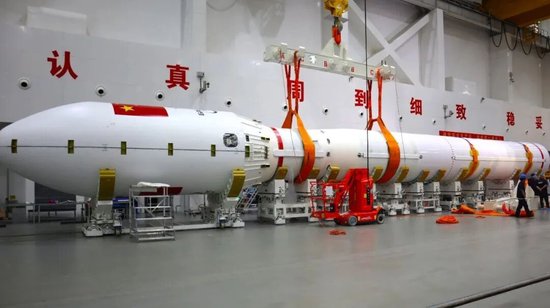
星河动力谷神星一号发射失败,上月公司刚启动IPO上市辅导
Nan Fang Du Shi Bao· 2025-11-17 11:57
Core Viewpoint - Beijing Xinghe Power Aerospace Technology Co., Ltd. (Xinghe Power) faced a launch failure of its Vesta-1 (Remote 19) rocket on November 10, 2023, which did not successfully place its satellite into orbit, marking a setback during a critical period for its A-share IPO preparation [1][2]. Group 1: Launch Failure Details - The Vesta-1 rocket experienced normal flight for its first three stages, but the fourth stage encountered an anomaly and shut down prematurely after 510 seconds, resulting in mission failure [1]. - This incident is not the first for Xinghe Power; a previous launch on September 21, 2023, also failed due to instability caused by an engine component defect [4]. Group 2: Company Performance and Market Position - Despite the recent setbacks, Xinghe Power is one of the leading private rocket companies in China, having completed 22 launch missions with a success rate of approximately 90.9%, successfully placing 85 satellites into orbit [4]. - The company accounts for about 51.3% of the total successful launches in the domestic private rocket sector [4]. Group 3: IPO and Financing Activities - The launch failure occurred shortly after Xinghe Power initiated its IPO counseling process in late October 2023 [5]. - In September 2023, the company completed a record-breaking D-round financing of 2.4 billion yuan, marking the highest single financing amount for a private rocket company in China to date [6]. - Since its establishment in 2018, Xinghe Power has raised over 5.3 billion yuan and was valued at 15 billion yuan by the end of last year [6]. Group 4: Industry Trends - The recent launch failure highlights the challenges faced by the commercial space sector, which is currently experiencing a wave of IPO activities among several leading private rocket companies [5][7]. - The regulatory environment has become more favorable for commercial space enterprises, with new rules allowing unprofitable tech companies to list on the STAR Market, prompting a surge in IPO preparations [7].
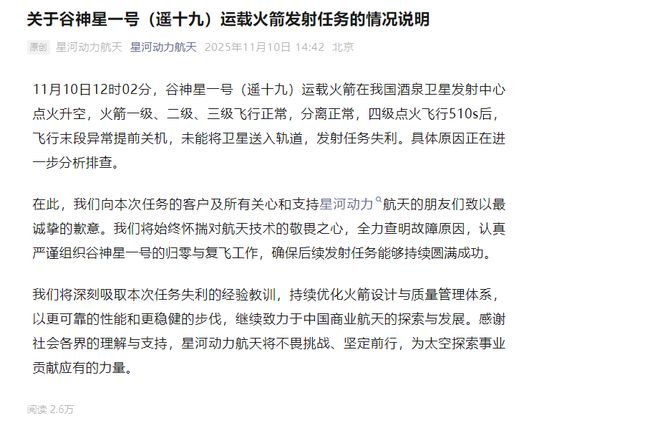
星河动力:谷神星一号运载火箭发射失利,具体原因正在分析排查
Bei Ke Cai Jing· 2025-11-11 11:09
Core Viewpoint - On November 10, 2023, the launch of the Vesta-1 (Yao 19) rocket by Star River Dynamics Aerospace was unsuccessful, failing to place the satellite into orbit due to an abnormal shutdown during the final flight stage after 510 seconds of flight [1]. Company Overview - Star River Dynamics Aerospace was established in 2018 and primarily provides launch services for domestic and international aerospace clients. Its core products include the "Zhishenxing" series of medium to large reusable liquid rockets and the "Gushenxing" series of small solid rockets [2]. - In late September 2023, Star River Dynamics Aerospace completed a Series D financing round, raising a total of 2.4 billion yuan. The funds will be used to accelerate the development and related production, testing, and launch capabilities of the "Zhishenxing" series of reusable liquid rockets and the "Gushenxing II" medium solid rocket [2].
卫星未能入轨 “谷神星一号”发射任务失利 火箭公司致歉
Mei Ri Jing Ji Xin Wen· 2025-11-10 10:42
Core Viewpoint - The launch of the Ceres-1 rocket by Star River Dynamics Aerospace was unsuccessful due to an abnormal shutdown during the final stage of flight, with the specific cause under investigation [1]. Company Overview - Star River Dynamics Aerospace is the first private rocket company in China to achieve continuous and stable successful launches, holding the record for the most launches, the highest number of clients served, and the highest success rate among private rocket companies [5]. - The company provides efficient and reliable launch services for domestic and international aerospace clients, with core products including the "Zhishenxing" series of medium to large reusable liquid rockets and the "Gushenxing" series of small solid rockets [6]. Industry Context - The commercial aerospace sector in China is experiencing rapid growth, with a significant increase in launch activities noted in October 2023, including successful launches of multiple satellites [7]. - As of July 2025, the commercial aerospace sector has seen 31 financing events totaling 2.143 billion yuan, with an average single financing amount of 6.9 million yuan, nearing the total for the entire year of 2024 [7]. - On September 25, 2023, Star River Dynamics Aerospace completed a Series D financing round of 2.4 billion yuan to accelerate the development and production of its "Zhishenxing" and "Gushenxing II" rockets [7].
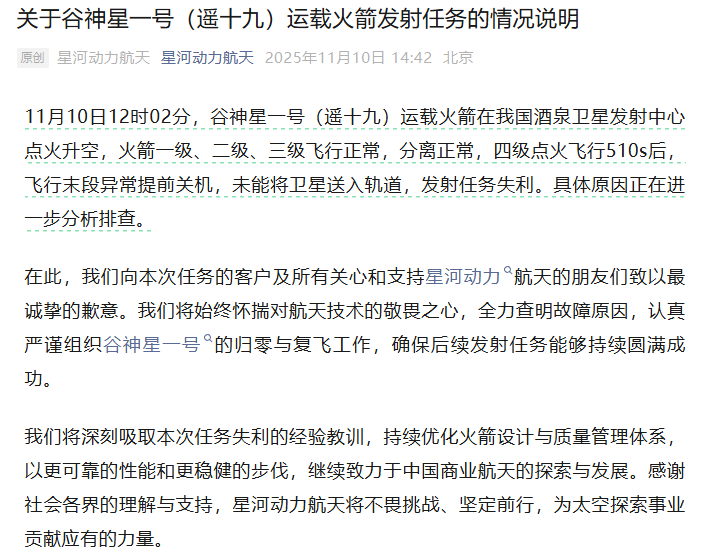
谷神星一号运载火箭,发射任务失利
Xin Hua Ri Bao· 2025-11-10 09:49
Core Viewpoint - The launch of the Ceres-1 (Yao-19) rocket by Galaxy Dynamics Aerospace on November 10 was unsuccessful due to an anomaly during the final flight phase, which prevented the satellite from reaching its intended orbit [1] Group 1: Launch Details - The Ceres-1 (Yao-19) rocket was launched from the Jiuquan Satellite Launch Center at 12:02 PM on November 10 [1] - The rocket's first, second, and third stages performed normally, and the separation of stages was successful [1] - The fourth stage ignited and flew for 510 seconds before an early shutdown occurred, leading to mission failure [1] Group 2: Company Response - Galaxy Dynamics Aerospace expressed sincere apologies to the mission's clients and supporters for the failure [1] - The company is committed to thoroughly investigating the cause of the anomaly and will rigorously organize the recovery and re-launch of the Ceres-1 [1] - The company aims to ensure that future launch missions are successful [1]
天地之间的“快递员”——记北京星河动力航天科技股份有限公司总裁刘建设
Jing Ji Ri Bao· 2025-10-18 22:57
Core Viewpoint - The successful launch of the Vesta-1 rocket by Beijing Xinghe Power Aerospace Technology Co., Ltd. marks a significant achievement in China's commercial space sector, highlighting the potential for collaboration between state-owned and private enterprises in the aerospace industry [1][2]. Company Overview - Liu Jianshe, the president and technical leader of Xinghe Power, has been a driving force in the company's development since its founding, believing in the vast prospects of the commercial space market [2]. - The company has achieved 20 successful launches in just eight years, serving 27 satellite clients and successfully placing 85 different types of commercial satellites into orbit [2][3]. Technological Advancements - Xinghe Power is preparing for significant milestones in the fourth quarter, with the Vesta-2 and Zhi-1 rockets entering critical stages of development, aiming to enhance their launch capabilities [3]. - The Vesta-2 rocket is an upgraded model with parameters reaching international leading levels, designed to support various launch platforms and significantly reduce launch costs [3]. Market Position - Xinghe Power is recognized for its high success rate and cost control in the commercial space sector, achieving a 95% launch success rate and creating multiple milestones for private rocket companies in China [4][5]. - The company has implemented strict quality control and failure mitigation mechanisms, which have been crucial for maintaining its operational success [5]. Future Prospects - The company has recently completed a D-round financing of 2.4 billion yuan, aimed at accelerating the development of reusable liquid rockets and enhancing production and launch capabilities [7]. - Liu Jianshe anticipates a significant demand for low-orbit satellite launches in the next decade, emphasizing the importance of cost and reliability in the sustainable development of the industry [7].

四川“资阳造”第三枚运载火箭精确送入预定太阳同步轨道
Huan Qiu Wang Zi Xun· 2025-09-06 10:25
Core Insights - Xinghe Power successfully launched the Vesta-1 rocket, delivering a total of 27 satellites and the Aishen Star experimental platform into a predetermined sun-synchronous orbit [1][3]. Group 1: Launch Details - The launch, named "Qiao Qiao Xian," symbolizes the integration of space exploration and poetic ideals, reflecting a cultural significance [3]. - The mission included four satellites with distinct functions: Kaiyun-1 for Earth observation, Zhixing-1 for material verification and imaging, and YunYao-1 for GNSS occultation detection [3][5]. - The Aishen Star platform is China's first commercial rocket upper stage designed for long-term orbital operation, enhancing the utility of the rocket's upper stage [5]. Group 2: Technological Advancements - The Aishen Star platform was adapted from the Vesta-1 rocket's upper stage, enabling it to provide low-cost and efficient in-orbit testing services for new technologies and products [5]. - This innovation marks a significant step in resource reuse within the commercial space sector, potentially opening new pathways for future developments [5]. Group 3: Industry Positioning - Ziyang is establishing itself as a comprehensive commercial rocket hub in Western China, aiming to become a core growth area for the commercial space industry and a benchmark for low-cost manufacturing [7]. - The city is transitioning from merely being a "space delivery service" to a provider of critical core technologies, expanding its role in the space industry [8].