海洋开发

Search documents
山东威海编制无居民海岛控规
Zhong Guo Zi Ran Zi Yuan Bao· 2026-01-08 06:17
Group 1 - The core viewpoint of the article is the establishment of the first regulatory detailed plan for an uninhabited island in Shandong Province, specifically for Chudao, which provides a legal basis for island licensing and project construction [1] - Chudao has a total area of 0.18 square kilometers and a coastline of 2.9 kilometers, with good water quality conditions and rich biological resources in the surrounding marine area [1] - The island is designated as a core experimental area of the National Marine Comprehensive Experimental Zone (Weihai) and is among the first batch of uninhabited islands approved for development by the National Oceanic Administration [1] Group 2 - The planning positioning of Chudao prioritizes natural ecological protection, focuses on technological public services, and moderately incorporates functions related to technology, culture, and tourism [1] - The goal is to develop Chudao into a "Marine Technology Island" that integrates smart ocean technology, ecological civilization, marine science popularization, and marine culture and tourism, serving as a model for the construction of technology-based public service islands nationwide [1]


深度融合 场景生态怎样建
Jing Ji Ri Bao· 2025-11-14 01:58
Core Insights - The Guangdong-Hong Kong-Macao Greater Bay Area is embracing "All Sports Time" with the opening ceremony of the 15th National Games, showcasing technological innovations like the electric water mist system for the torch lighting [1] - Scene innovation is becoming a new engine for economic growth in China, emphasizing the importance of open collaboration and ecosystem building [1][2] Group 1: Scene Innovation and Economic Growth - Scene innovation is characterized by its integrative nature, combining new technologies, products, and business models to unlock deeper value and experiences [3] - The city of Hefei has launched 431 scene matching activities, resulting in over 1,200 cooperative projects, highlighting the effectiveness of demand-supply matching [2] - The establishment of various alliances, including state-owned enterprises and international collaborations, aims to promote resource sharing and innovation [2] Group 2: Technological Advancements and Applications - The "Flying Sea" model in Nansha, Guangzhou, integrates advanced technologies and resources to enhance deep-sea economic development [4] - The International Advanced Technology Application Promotion Center is facilitating the integration of major scientific infrastructure to support innovation in deep-sea applications [4][5] - The Guangdong region is leading in innovation, with initiatives like allowing L4 autonomous vehicles to operate without safety personnel, paving the way for commercial applications [5] Group 3: Regulatory and Institutional Framework - Effective scene cultivation requires not only infrastructure development but also regulatory and policy innovations to create a supportive environment for innovation [6] - The need for collaboration between effective markets and proactive government is emphasized to address uncertainties in scene development [5][6] Group 4: Urban Scene Innovation Practices - As of mid-2024, 65 cities in China have engaged in scene innovation practices, reflecting a significant increase and evolution in this area [7] - The transition from isolated actions to a more systematic approach in scene cultivation is noted, with a focus on integrating local resources and strengths [7][8] - Different cities have unique scene resource potentials based on their industrial foundations and consumer dynamics, necessitating tailored approaches to scene development [8]
国办最新部署22类重点领域,大量涉及科学仪器
仪器信息网· 2025-11-08 03:58
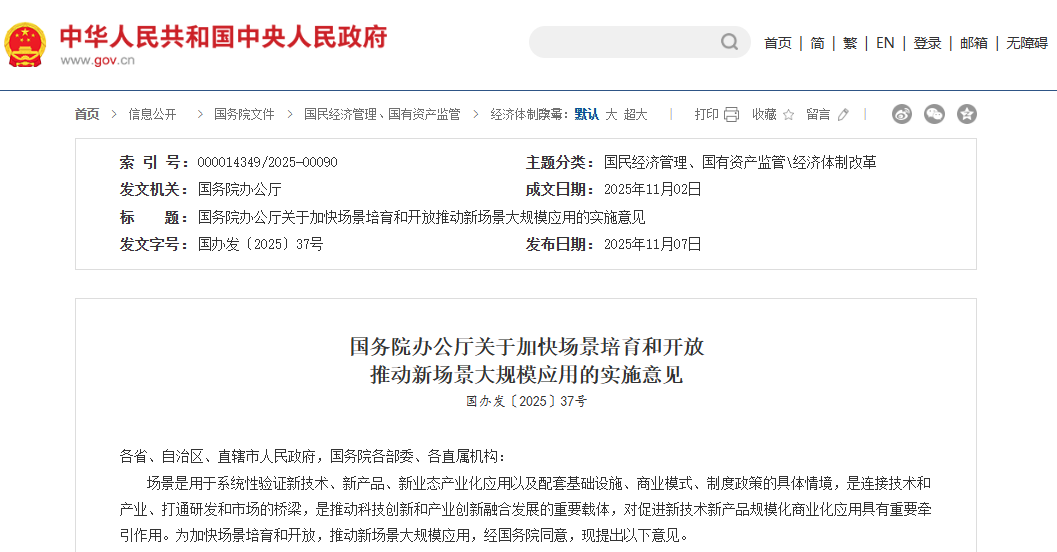
Core Viewpoint - The article discusses the implementation opinions issued by the State Council on accelerating the cultivation of scenarios and promoting large-scale applications of new scenarios, which is seen as a positive development for the scientific instrument industry [2]. Group 1: New Field and New Track Application Scenarios - The digital economy sector aims to explore application scenarios for technologies such as the metaverse, virtual reality, and intelligent computing, promoting deep integration of the real economy and digital economy [3]. - In the artificial intelligence sector, there is a focus on strengthening core technology breakthroughs and promoting high-value application scenarios to meet various development needs [4]. - The all-space unmanned system will encourage the development of application scenarios across land, sea, and air, including logistics and public services [5]. Group 2: Industry Transformation and Upgrading Application Scenarios - The manufacturing sector will focus on intelligent, green, and service-oriented manufacturing, supporting the development of smart factories and zero-carbon parks [10]. - The transportation sector will innovate application scenarios for intelligent traffic management and optimize urban traffic structures [12]. - The smart logistics sector will accelerate the development of smart highways and logistics hubs, exploring new logistics models [13]. Group 3: Emergency Management and Safety - The emergency management sector will enhance digital scenarios for emergency rescue systems, improving capabilities in disaster monitoring and emergency response [16]. - The mining safety sector will integrate technologies to enhance automation and risk management in mining operations [17]. - The smart water conservancy sector will promote integrated monitoring and management of water resources [18]. Group 4: Social Governance and Public Services - The government service sector will advance intelligent services such as smart identity verification and approval processes [21]. - The smart city sector will focus on urban infrastructure and digital transformation scenarios [22]. - The rural construction sector will enhance information application levels and improve governance standards [23]. Group 5: Enriching Livelihood Application Scenarios - The healthcare sector will promote the integration of new information technologies and medical robots in various medical applications [24]. - The elderly care and childcare sector will innovate service robots and remote service systems to enhance care services [25]. - The cultural and tourism sector will accelerate the application of digital technologies to create immersive experiences [26].

利好来了!刚刚 国办发布实施意见!信息量很大
Zhong Guo Ji Jin Bao· 2025-11-07 16:20
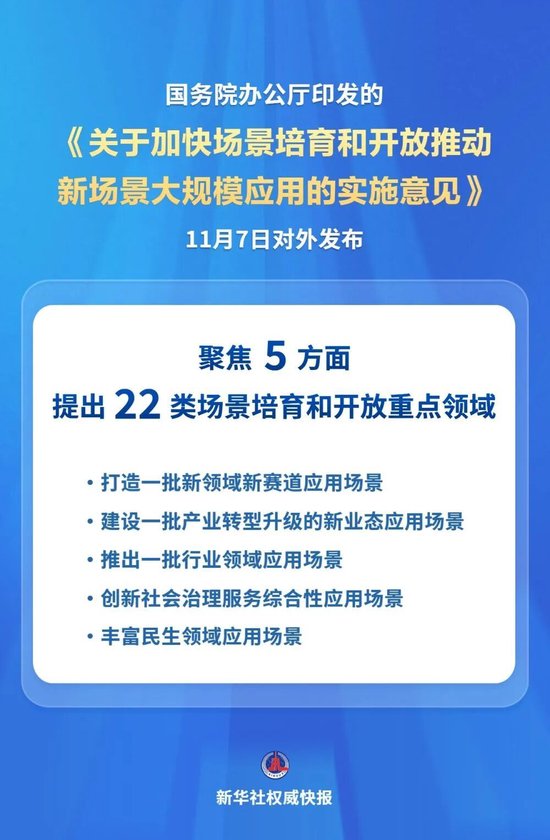
Core Viewpoint - The State Council's implementation opinion aims to accelerate the cultivation and large-scale application of new scenarios, emphasizing the integration of technology and industry to promote economic and social high-quality development [1][3]. Summary by Relevant Sections Overall Requirements - The opinion emphasizes innovation-driven, reform-promotion, and systematic advancement, leveraging China's vast market and diverse application scenarios to support the construction of major comprehensive scenarios and high-value niche scenarios [8]. Economic and Social Application Scenarios - Focus on creating new application scenarios in digital economy, artificial intelligence, unmanned systems, and biotechnology, with specific emphasis on integrating these technologies into various industries [9][10]. New Industry Application Scenarios - In manufacturing, the focus is on smart and green manufacturing, while in transportation, the emphasis is on intelligent traffic management and logistics [11][12]. Industry-Specific Application Scenarios - Emergency management, mining safety, and smart water management are highlighted as key areas for developing innovative application scenarios [13][14]. Social Governance and Public Services - The opinion promotes the development of smart governance services, including intelligent appointment systems and digital social security, to enhance public service efficiency [15][16]. Enhancing Application Scenario Support - The document outlines the need for policy support and management systems to ensure the effective implementation of new application scenarios, emphasizing collaboration among various sectors [20][21].
聚焦22类重点领域,国办最新部署
Guan Cha Zhe Wang· 2025-11-07 13:31
Core Insights - The State Council issued an implementation opinion to accelerate the cultivation and large-scale application of new scenarios, focusing on creating new application scenarios in various fields and promoting industrial transformation and upgrading [1][27]. Group 1: New Fields and New Tracks - The digital economy sector aims to explore applications of technologies like the metaverse, virtual reality, and robotics, enhancing the integration of the digital and real economies [2][30]. - In the artificial intelligence sector, there is a push for the cultivation and opening of high-value application scenarios to meet diverse development needs across technology, industry, and governance [3][30]. - The development of a comprehensive unmanned system across land, sea, and air is encouraged, with applications in tourism, logistics, and public services [4][30]. - The biotechnology sector is set to expand applications in new materials, energy, and environmental protection, focusing on bio-based materials and low-carbon transformations [5][30]. - Clean energy applications are to be promoted in various transportation sectors, aiming for a collaborative development of the clean energy industry chain [6][31]. - The marine development sector will focus on deep-sea exploration and biotechnology applications [7][31]. Group 2: Industrial Transformation and Upgrading - The manufacturing sector will innovate in smart and green manufacturing, supporting the development of intelligent factories and zero-carbon parks [8][32]. - The transportation sector will implement new technologies for smart traffic management and optimize urban transport structures [11][32]. - The logistics sector will accelerate the development of smart logistics hubs and explore new models integrating technology and logistics [12][32]. - Modern agriculture will enhance digital applications in breeding and farming, promoting digital transformation in livestock and aquaculture [13][33]. Group 3: Industry-Specific Application Scenarios - The emergency management sector will focus on digital scenarios for disaster response, enhancing capabilities in monitoring and rescue operations [15][34]. - The mining safety sector will integrate technologies for intelligent decision-making and automation to improve safety standards [16][34]. - The water conservancy sector will promote integrated monitoring and management applications to enhance flood prevention and water resource management [17][34]. - The construction safety sector will implement intelligent risk monitoring and autonomous inspections to improve safety management [18][35]. - The forestry sector will utilize remote sensing technologies for ecological monitoring and disaster prevention [19][35]. Group 4: Social Governance and Public Services - The government services sector will enhance smart services through intelligent appointment and identity verification systems [20][36]. - The smart city sector will focus on urban infrastructure and digital transformation to improve community services [21][36]. - The rural construction sector will promote digital village initiatives to enhance governance and service standards [22][36]. Group 5: Enriching Livelihood Application Scenarios - The healthcare sector will integrate new technologies for innovative medical applications, including remote healthcare services [23][37]. - The elderly care and childcare sectors will innovate service delivery through smart devices and remote systems [24][37]. - The cultural and tourism sector will accelerate the application of digital technologies to enhance visitor experiences [25][37]. - The cross-industry consumption sector will promote the integration of various sectors to create new consumer experiences [26][37].
重大利好!国办印发,聚焦五方面,提出22类场景培育和开放重点领域
Shang Hai Zheng Quan Bao· 2025-11-07 09:31
Core Viewpoint - The State Council's implementation opinion emphasizes the importance of cultivating and opening new application scenarios to promote the large-scale application of new technologies and products, serving as a bridge between technology and industry, and facilitating the integration of technological and industrial innovation [3][4][6]. Group 1: Overall Requirements - The opinion is guided by Xi Jinping's thought and aims to fully implement the new development concept, focusing on innovation, reform, and the effective allocation of resources to support the construction of various application scenarios [4][7]. Group 2: Expanding Economic and Social Application Scenarios - The opinion outlines five key areas for developing new application scenarios, including digital economy, artificial intelligence, unmanned systems, biotechnology, and clean energy, with specific focus on fostering innovation and integration across these fields [8][9][10][11]. Group 3: Industry-Specific Application Scenarios - Emphasis is placed on creating application scenarios for various industries, such as smart manufacturing, transportation, logistics, and modern agriculture, to enhance productivity and efficiency through technological advancements [10][11][12]. Group 4: Social Governance and Public Services - The opinion highlights the need for innovative application scenarios in social governance, including smart government services, urban management, and rural development, to improve public service delivery and governance efficiency [13][14]. Group 5: Resource Allocation and Open Access - The document stresses the importance of fair and efficient allocation of scenario resources, encouraging collaboration across regions and sectors, and promoting the participation of private enterprises in the development of application scenarios [15][16]. Group 6: Policy Support and Management - It calls for strengthening policy support and management systems to ensure the safe and orderly development of application scenarios, while also promoting innovation in management practices [18][19].