消费品和零售

Search documents
洛阳钼业(03993)拟出资5亿元参投私募股权投资基金 聚焦科技、医疗健康、消费品和零售三大朝阳产业
智通财经网· 2025-12-02 14:45
Core Viewpoint - The company, Luoyang Molybdenum (03993), announced an investment of 500 million RMB by its wholly-owned subsidiary, Tibet Shimo Ke, into a fund focused on technology, healthcare, consumer goods, and retail sectors, with a target size of 8-10 billion RMB [1] Investment Details - The fund is established in partnership with Boyu Tian Shu as the general partner and other limited partners [1] - The investment from Tibet Shimo Ke is part of a larger commitment to raise a total of 8-10 billion RMB for the fund [1] Strategic Intent - The investment aims to leverage the advantages of professional investment institutions to enhance investment efficiency and create reasonable returns for the company and its shareholders [1] - The funding for this investment comes from the company's own resources and will not significantly impact its financial status or operational results [1]

39位U40企业家个人财富超50亿,泡泡玛特、寒武纪企业估值涨超五倍
Sou Hu Cai Jing· 2025-11-07 08:16
Core Insights - The 2025 Hurun China U40 Entrepreneurs List features 39 individuals with personal wealth exceeding 5 billion yuan, highlighting the wealth accumulation among the U40 demographic [2][3] Industry Overview - The primary sectors represented by these U40 entrepreneurs are entertainment and new consumption, particularly in online gaming, new tea beverages, and consumer goods [3] - Notable companies in the gaming sector include MiHoYo and Lilith Games, while the new tea beverage sector features brands like Heytea and Manner Coffee [3] Geographic Distribution - Major cities are increasingly attractive for wealthy U40 entrepreneurs, with a significant concentration in Shanghai and Beijing, housing 11 and 9 individuals respectively, followed by Shenzhen with 7 and Guangzhou and Chengdu with 3 each [3] Notable Entrepreneurs - Key figures include: - Wang Ning from Pop Mart with a wealth of 18.2 billion yuan, marking a 562% increase [4] - Chen Tian Shi from Cambricon with 18 billion yuan, a 463% increase [4] - Cai Haoyu from MiHoYo with 8.1 billion yuan, an 11% increase [4] - The list also includes new entrants such as Liu Jingkang from Yingshi with 3.82 billion yuan and Yang Zhilin from Kimi with 7.3 billion yuan [4]



摩根士丹利:关税风险又来了,对普通投资者意味着什么?
Sou Hu Cai Jing· 2025-07-30 02:23
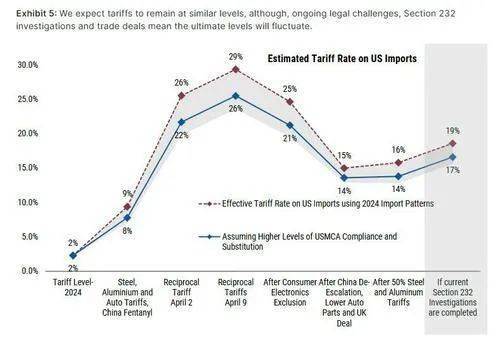
Group 1 - The upcoming tariff deadline on August 1 could lead to increased tariffs on major trading partners, including Europe, Canada, and Mexico, which together account for nearly half of U.S. goods imports [1][2] - The potential impact of a 5% tariff increase on these partners could result in a negative shock to U.S. GDP that is twice as severe as previous measures against smaller economies [2] - The effects of tariffs are not limited to the macroeconomic level; different sectors in the U.S. stock market will experience varying impacts, necessitating continued attention to U.S. trade policy in investment strategies [2][5] Group 2 - The most likely economic scenario is "slowing growth with persistent inflation," with a probability of 40%, driven by the negative impacts of trade and immigration restrictions [4] - A second scenario of optimistic acceleration exists, with a 20% probability, contingent on easing trade and immigration policies or fiscal measures stimulating economic activity [4] - The third scenario, "economic slowdown triggered by trade," also holds a 40% probability, where further tariff increases could lead to a mild recession [4] Group 3 - In the fixed income market, an economic slowdown due to tariffs may lead to rising U.S. Treasury prices as the market anticipates a more dovish Federal Reserve [5] - The U.S. stock market faces a complex situation; while slowing growth may not disrupt the upward trend of the S&P index, different sectors will react differently to trade policies [5] - Industrial and capital goods companies may benefit from domestic investment despite rising costs, while consumer goods and retail sectors face greater pressure due to increased import costs and limited pricing power [5]