消费白马

Search documents
杨德龙:2026年牛市行情愈演愈烈 赚钱效应明显提高
Xin Lang Cai Jing· 2026-01-12 07:31
Group 1 - The A-share market has started 2026 with a strong bullish trend, marked by a historic 17 consecutive days of gains in the Shanghai Composite Index [1][7] - The trading volume has significantly increased, surpassing 30 trillion yuan for two consecutive days, indicating a phase of rising prices and volumes, officially launching the spring offensive [1][7] - The current bull market is seen as a once-in-a-decade investment opportunity, with a substantial shift of household savings towards the capital market due to low bank deposit rates [1][7] Group 2 - The real estate market is still in an adjustment phase, with a fundamental change in expectations for housing price increases, particularly in second and third-tier cities [2][8] - The market has broken through the 4150-point mark, moving away from key integer levels and forming an upward trend, with a slow bull market expected to last 3 to 5 years or longer [2][8] - Investment opportunities are anticipated to expand beyond technology and banking sectors to include consumer staples, new energy leaders, non-ferrous metals, and military industries, enhancing the market's profitability [2][8] Group 3 - The current bull market is tasked with three historical missions: enhancing household wealth, stabilizing the real estate market through stock market wealth effects, and supporting the development of new productive forces, particularly in technology innovation [3][9] - Emerging industries such as commercial aerospace and brain-computer interfaces are showing active performance, with expectations for continued strength in technology sectors like robotics and semiconductors in 2026 [3][9] Group 4 - Investment in technology stocks, especially leading companies, should be viewed within the context of the AI revolution, representing a long-term trend opportunity [4][10] - The Hong Kong stock market has also seen a significant rebound, indicating a similar slow bull market trend as in the A-share market, with expanding investment opportunities [4][11]
超半数投资者盈利 权益配置意愿持续升温——上海证券报·个人投资者2025年第四季度调查报告
Shang Hai Zheng Quan Bao· 2025-11-04 19:09
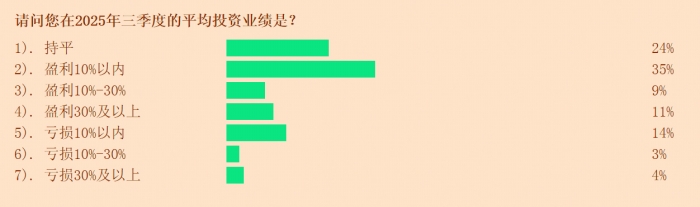
Core Viewpoint - The A-share market experienced a strong rebound in the third quarter, leading to improved investor sentiment and profitability, with over 55% of surveyed investors reporting gains [6][7][24] Market Performance - The Shanghai Composite Index rose from below 3500 points to close at 3882.78 points by September 30, marking a cumulative increase of 12.73% for the quarter [7] - The Shenzhen Component Index and the ChiNext Index saw even larger gains, increasing by 29.25% and 50.4% respectively [7] Investor Sentiment - 55% of investors reported profitability in Q3, an increase of 7 percentage points from Q2 and 13 percentage points from Q1 [7][8] - Over 70% of surveyed investors are optimistic about the A-share market in Q4, with many expecting the Shanghai Composite Index to reach around 3900 points [19][20] Asset Allocation Trends - The proportion of personal financial assets allocated to securities increased to 42.2%, up from 40.87% in Q1 [10] - 38% of investors increased their stock market investments in Q3, while 41% reduced their holdings [9] Sector Focus - The technology sector remains a focal point for investors, with nearly half expecting a style shift in Q4, while 30% believe technology stocks will continue to perform strongly [14][16][18] - The average holding in technology growth stocks rose to 26.64%, significantly higher than other sectors [15] Gold Investment - 67% of investors anticipate further increases in gold prices, with many viewing it as a hedge against geopolitical risks and inflation [12] - The average gold price rose from $3300 to $3800 per ounce during the quarter [12] Hong Kong Market Interest - 24% of investors increased their Hong Kong stock investments in Q3, with a profitability rate of 40% [22] - Investors are optimistic about the long-term potential of the Hong Kong market, with many viewing it as a value opportunity [22][24]