居民存款转移

Search documents
一月居民存款向资管产品加速转移,对银行业经营提出挑战
Hua Xia Shi Bao· 2026-02-26 10:15
Core Viewpoint - The data from January indicates a significant shift of bank deposits towards asset management products, with a notable increase in non-bank financial institution deposits while household deposits have decreased compared to the previous year [2][3]. Group 1: Deposit Trends - In January, RMB deposits increased by 8.09 trillion yuan, with household deposits rising by 2.13 trillion yuan and non-financial enterprise deposits increasing by 2.61 trillion yuan [2]. - Compared to January of the previous year, household deposits increased by 5.52 trillion yuan, while non-financial enterprise deposits decreased by 206 billion yuan [2]. - The shift indicates that the decrease in household deposits largely converted into deposits at non-bank financial institutions, which increased by 2.56 trillion yuan year-on-year [2]. Group 2: Asset Management Products - The primary channel for the conversion of household deposits into non-bank institution deposits is through financial institutions' asset management products, particularly bank wealth management products [3]. - In January, the scale of bank wealth management products decreased by approximately 114.2 billion yuan, remaining stable compared to the end of 2025, which is significantly lower than the seasonal growth trends of previous years [3]. - Public fund issuance saw a significant increase, with a total issuance scale of approximately 120.21 billion yuan in January, representing a year-on-year increase of 39.28% [3]. Group 3: Impact on Banking Structure - The transformation of deposits into asset management products does not lead to an outflow from the banking system; however, it alters the structure of bank liabilities, potentially increasing the cost of liabilities and decreasing deposit stability [4][5]. - Regular term deposits are more stable and less risky compared to interbank deposits, which are subject to higher credit risk and liquidity demands [5][6]. - The volatility of interbank deposit rates is higher, and they tend to be more sensitive to market conditions compared to regular term deposits, which are influenced by central bank rates and market competition [6]. Group 4: Implications for Banks - The decline in deposit rates since 2024 aims to reduce banks' liability costs and stabilize net interest margins, but this has inadvertently increased the cost of liabilities and reduced deposit stability [6]. - Banks need to enhance their liability management to ensure reliable funding sources, diverse structures, and alignment with assets to mitigate the risks associated with the changing deposit landscape [6].


港股通金融ETF(513190) 冲击3连涨!居民存款转移或是诱因?
Mei Ri Jing Ji Xin Wen· 2026-01-28 06:37
Core Viewpoint - The China Securities Hong Kong Stock Connect Financial Index (H11146) has shown a strong upward trend, with significant increases in constituent stocks, indicating a positive outlook for the financial sector in Hong Kong [1] Group 1: Market Performance - As of January 28, 2026, the index rose by 1.98%, with notable increases in stocks such as Shenwan Hongyuan (up 3.57%), Bank of China (up 3.33%), and China Pacific Insurance (up 3.24%) [1] - The Hong Kong Stock Connect Financial ETF (513190) also increased by 1.94%, marking a third consecutive rise [1] Group 2: Future Projections - According to CICC forecasts, 32 trillion yuan in household deposits will mature by 2026, while some banks have seen large time deposit rates drop below 1%, leading to a shift towards dividend insurance products [1] - Analysts suggest that the new insurance premiums will create demand for high-dividend, undervalued quality H-share banks [1] Group 3: Investment Opportunities - The insurance institutions that have benefited from the deposit shift include several companies listed in Hong Kong, which may see improved earnings expectations in Q1 2026 [1] - The Hong Kong Stock Connect Financial Index has a one-year dividend yield of 4.84% and a price-to-book ratio (PB-MRQ) of 0.58, which is below the median of the past ten years, indicating it is a typical low-valuation, high-yield index [1] Group 4: ETF Composition - The Hong Kong Stock Connect Financial ETF (513190) tracks the China Securities Hong Kong Stock Connect Financial Index, with 59% of its constituent stocks being mainland banks listed in Hong Kong, making it the only ETF tracking this index [1]
超半数投资者盈利 权益配置意愿持续升温——上海证券报·个人投资者2025年第四季度调查报告
Shang Hai Zheng Quan Bao· 2025-11-04 19:09
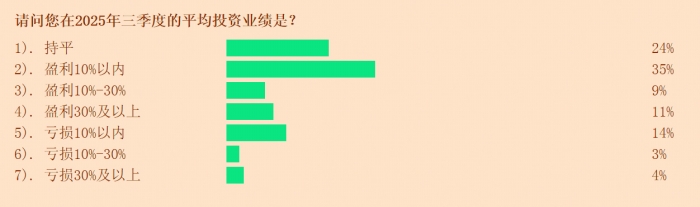
Core Viewpoint - The A-share market experienced a strong rebound in the third quarter, leading to improved investor sentiment and profitability, with over 55% of surveyed investors reporting gains [6][7][24] Market Performance - The Shanghai Composite Index rose from below 3500 points to close at 3882.78 points by September 30, marking a cumulative increase of 12.73% for the quarter [7] - The Shenzhen Component Index and the ChiNext Index saw even larger gains, increasing by 29.25% and 50.4% respectively [7] Investor Sentiment - 55% of investors reported profitability in Q3, an increase of 7 percentage points from Q2 and 13 percentage points from Q1 [7][8] - Over 70% of surveyed investors are optimistic about the A-share market in Q4, with many expecting the Shanghai Composite Index to reach around 3900 points [19][20] Asset Allocation Trends - The proportion of personal financial assets allocated to securities increased to 42.2%, up from 40.87% in Q1 [10] - 38% of investors increased their stock market investments in Q3, while 41% reduced their holdings [9] Sector Focus - The technology sector remains a focal point for investors, with nearly half expecting a style shift in Q4, while 30% believe technology stocks will continue to perform strongly [14][16][18] - The average holding in technology growth stocks rose to 26.64%, significantly higher than other sectors [15] Gold Investment - 67% of investors anticipate further increases in gold prices, with many viewing it as a hedge against geopolitical risks and inflation [12] - The average gold price rose from $3300 to $3800 per ounce during the quarter [12] Hong Kong Market Interest - 24% of investors increased their Hong Kong stock investments in Q3, with a profitability rate of 40% [22] - Investors are optimistic about the long-term potential of the Hong Kong market, with many viewing it as a value opportunity [22][24]