清洁能源制造

Search documents
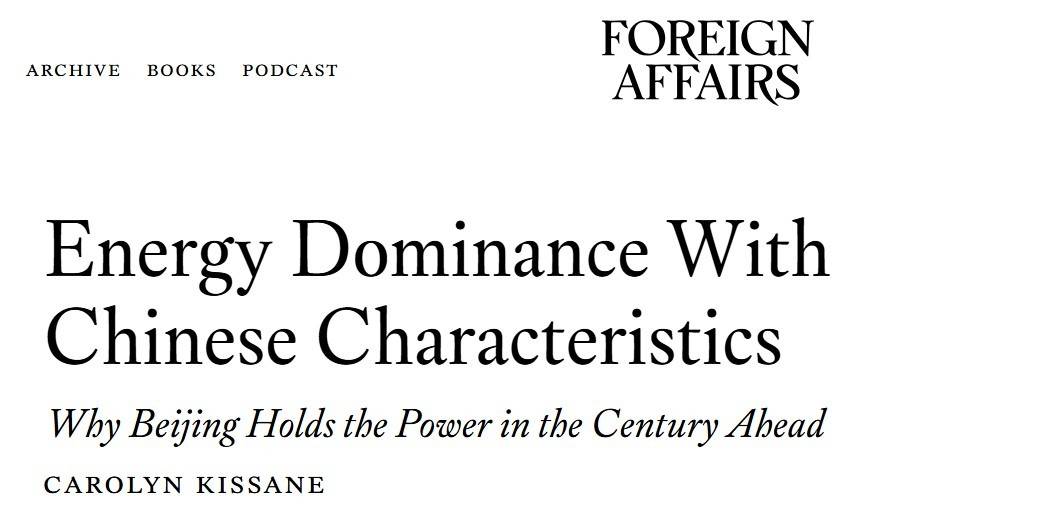
全球媒体聚焦 | 美媒:中国正朝着实现能源主导权的方向迈进
Sou Hu Cai Jing· 2026-02-24 14:48
Core Insights - The article emphasizes that China is advancing towards energy dominance, transitioning from a reliance on oil and gas imports to becoming a global leader in clean energy [1][2]. Group 1: China's Energy Transition - Over the past two decades, China has transformed from an energy-dependent nation to a leader in clean energy, integrating energy and electrification as core components of national strength [2][3]. - China's strategic approach combines manufacturing, technological innovation, and national security, reducing external dependencies while enhancing domestic capabilities [2][3]. Group 2: Supply Chain and Innovation - China's energy sector has developed a tightly coordinated ecosystem capable of setting global standards, with manufacturing of raw materials, intermediate components, and finished products located in close proximity [3][4]. - The supply chain clustering effect has led to reduced costs and accelerated production, giving Chinese companies a competitive edge in speed and pricing [3][4]. Group 3: Global Market Influence - China's large-scale domestic construction has lowered local costs, while its export capabilities ensure that its technologies reach markets with high demand and limited capital [4]. - The country has shifted from supplying single components to offering complete energy systems, including generation, transmission, storage, and grid modernization, often accompanied by financing and long-term maintenance services [4]. Group 4: Strategic Framework - China's energy strategy is encapsulated in the Energy Law, which integrates energy security, industrial development, technological innovation, and market structure into a unified legal and policy framework [4]. - The organizational principle of this new system is "expansion" rather than "replacement," allowing China to build a resilient energy system that supports industrial growth and leverages influence over other nations [4]. Group 5: Future Directions - In the next five years, China plans to extend its national industrial strategy for clean energy manufacturing into emerging fields such as autonomous driving, artificial intelligence, and robotics [4]. - The goal is not merely participation but to root next-generation technologies in domestic supply chains and achieve scale before global competitors catch up, thereby securing a leading position [4].

全国统一电力市场体系建设 为相关产业带来发展机遇
Xin Lang Cai Jing· 2026-02-12 22:59
Core Viewpoint - The State Council has issued the "Implementation Opinions on Improving the National Unified Electricity Market System," aiming to establish a basic national unified electricity market system by 2030 and fully complete it by 2035 [1][5]. Group 1: Key Progress and Goals - Significant progress has been made in building the national unified electricity market system, with a goal to achieve a preliminary establishment by 2025 [1][5]. - The construction of the national unified electricity market system has been ongoing for several years, focusing on addressing key bottlenecks such as barriers between regional power grids and inter-provincial obstacles [2][6]. Group 2: Barriers and Solutions - Major barriers to the establishment of the unified electricity market include institutional obstacles, technical bottlenecks, and differences in market rules [2][6]. - Reforms are needed to shift from local protectionism to a unified national approach, accelerate the development of key technologies like smart grids and ultra-high voltage transmission, and unify market rules to ensure fair competition [2][6]. Group 3: Market Dynamics and Renewable Energy - The reform emphasizes the participation of renewable energy in market transactions, with a focus on integrating wind and solar power into the electricity market by 2025 [3][7]. - The introduction of green electricity and green certificate mechanisms will provide pathways for renewable energy to compete fairly in the market, enhancing the efficiency of energy consumption and system operation [3][7]. Group 4: Industry Impact - The establishment of a national unified electricity market will benefit various sectors, including power generation companies, grid companies, and the energy storage industry [4][8]. - Power generation companies will gain broader market access and improved operational efficiency, while grid companies will find new opportunities in network construction and maintenance [4][8]. - The energy storage industry will become increasingly important in addressing the intermittency of renewable energy, entering a phase of rapid development [4][8].
生产总值突破600亿元
Xin Lang Cai Jing· 2026-01-20 19:55
Group 1 - The core viewpoint of the articles highlights the significant achievements of Haidong City in the past five years, focusing on high-quality development, industrial upgrades, and ecological improvements, with a historic GDP surpassing 60 billion yuan [1] - Haidong City's industrial structure has been optimized to 13.6:40.3:46.1, with the service sector exceeding 48%, marking a significant transformation [1] - The city has actively integrated into the "Four Places" construction, with clean energy manufacturing, particularly in photovoltaic and hydrogen energy sectors, gaining momentum [1] Group 2 - Over the past five years, Haidong City has planted over 2.76 million acres of greenery and over 35 million trees, establishing a robust ecological environment [2] - Water quality in major rivers has consistently maintained Class I standards for five consecutive years, with air quality remaining above 92% [2] - The transformation path of "green mountains and clear waters are invaluable assets" has become clearer, exemplified by the establishment of the province's first "zero-carbon village" [2]
青海海东:河湟谷地崛起“算力绿洲”
Zhong Guo Xin Wen Wang· 2025-12-18 23:40
Core Insights - Qinghai Haidong is emerging as a "computing power oasis" driven by clean energy manufacturing, particularly in photovoltaic and hydrogen energy sectors [1][3] - The city has made significant advancements in digital economy, with data center rack scale occupying a substantial share of the province and ranking in the top 30 cities nationwide for computing power index [1][3] Group 1: Clean Energy Development - Haidong is actively integrating into the "Four Places" industrial construction, with clean energy manufacturing chains forming around photovoltaic and hydrogen energy [3] - The Red Lion silicon-based new materials project has been completed, producing 140,000 tons of polysilicon annually, marking a significant development in key materials [3] Group 2: Emerging Industries - The city is focusing on nurturing emerging industries such as new energy, new materials, equipment manufacturing, electronic information, and specialty light industry [3] - Key projects include the production of 100,000 tons of high-end aluminum-based materials by Qinghai Asia-Pacific and advanced equipment manufacturing by Zhongtai Qingzhuan [3] Group 3: Strategic Initiatives - Haidong is seizing the "East Data West Computing" strategic opportunity to promote the coordinated development of green computing and electricity [3] - Plans are in place to establish a trillion-level industrial cluster, enhancing the clean energy industry landscape [3] Group 4: Infrastructure and Ecosystem - The zero-carbon industrial park and core platform functionalities are continuously upgraded, with supporting facilities like standard factories and logistics warehouses being enhanced [3] - The integration of "park + industrial chain + innovation chain" is providing core support for the agglomeration of emerging industries, fostering a competitive modern industrial ecosystem [3]