
炼化一体化

Search documents
华锦阿美项目上马将对北方化工格局带来什么影响?
Xin Lang Cai Jing· 2026-02-04 11:53
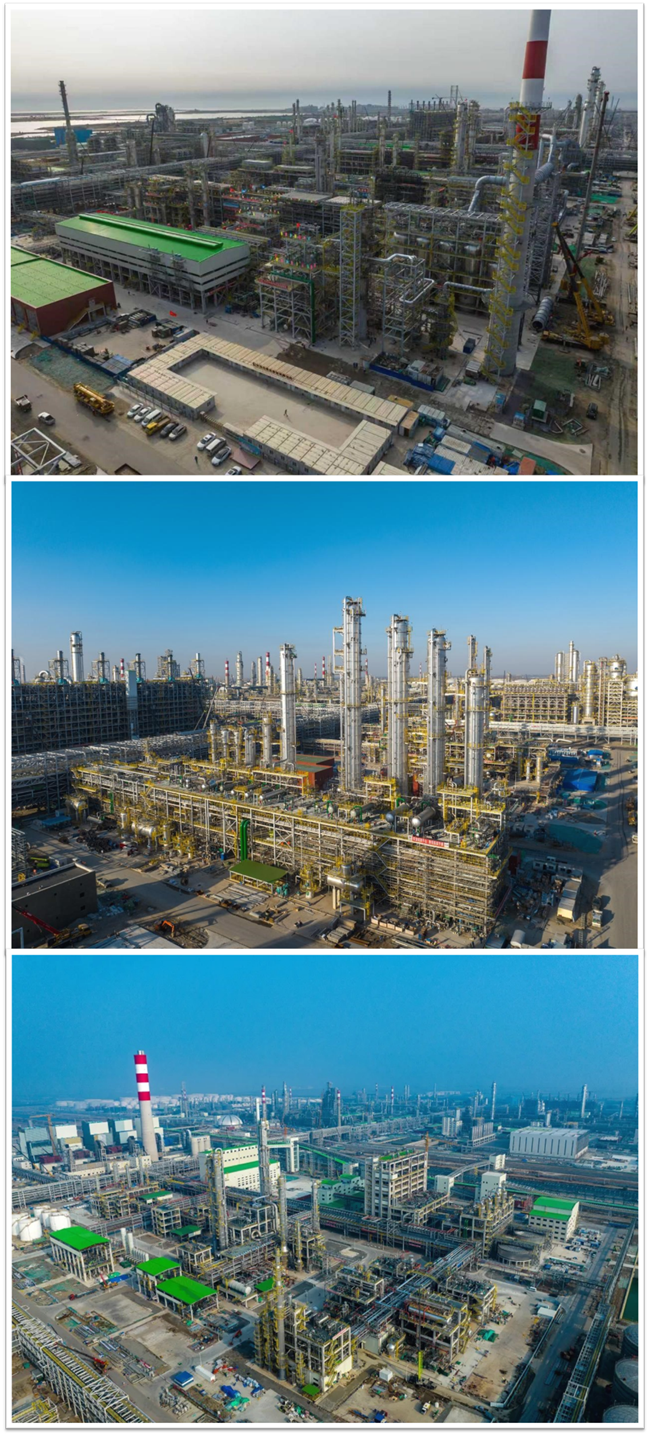
Core Viewpoint - The Huajin Aramco fine chemical and raw material engineering project has achieved mechanical completion of 32 production units, with plans to start operations in Q2 2026 and full production by the end of 2026, marking it as a significant integrated refining project in China [1][4]. Project Overview - The project includes a 5 million tons/year vacuum residue hydrogenation unit and a 200,000 tons/year butadiene extraction unit, with a total construction progress exceeding 88% [1]. - It is designed to produce a wide range of products, including gasoline, diesel, kerosene, styrene, ethylene glycol, PX, hydrogen peroxide, LPG, PE, PP, and ABS, among others [4]. Raw Material and Production Structure - The project primarily uses Saudi heavy and light crude oil with a ratio of 1.1:1, and it also sources additional raw materials such as coal and various chemicals to achieve approximately 15 million tons of product sales [5]. - The refining section employs multiple cracking units, aiming to reduce fuel oil output to about 30% of total crude processing, significantly lower than traditional refineries [5]. Market Impact - The project is expected to intensify competition in the Bohai Bay area, where several other integrated refining projects are located, potentially affecting the market dynamics for existing small and medium-sized refining enterprises [8][9]. - It is positioned as a key driver for revitalizing the Northeast industrial base, enhancing local resin product self-sufficiency, and creating approximately 12,000 direct jobs, with an indirect impact on 50,000 to 80,000 jobs [8]. Strategic Importance - The project represents a deep cooperation between China and Saudi Arabia, serving as a model for chemical technology exchange and contributing to the formation of a world-class integrated refining cluster in the Bohai region [12].

行业整体承压下部分化工企业逆势增长,善用期货衍生工具成其经营亮点
Qi Huo Ri Bao· 2025-10-13 23:48
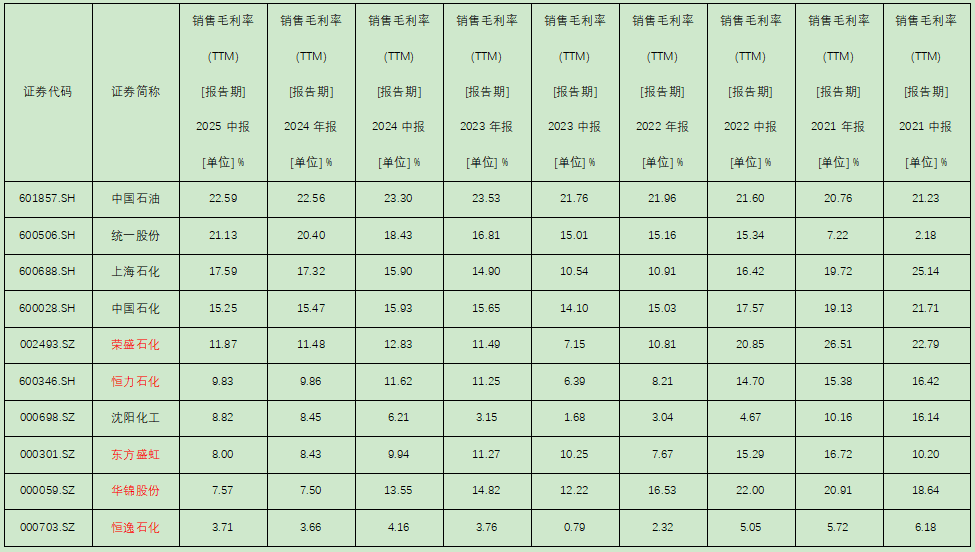
Core Viewpoint - The chemical industry is experiencing significant structural characteristics in the first half of 2025 due to complex domestic and international economic environments, energy price fluctuations, and differentiated end-user demand, with some leading companies achieving counter-cyclical growth through industry chain layout, technological advantages, and risk management capabilities [1][2]. Industry Overview - In the first half of 2025, the integrated refining and chemical sector saw total operating revenue decline by 8.80% year-on-year, with net profit attributable to shareholders dropping by 15.95% [2]. - Major companies such as Sinopec, PetroChina, Rongsheng Petrochemical, and Hengli Petrochemical reported varying degrees of revenue and profit declines [2]. - The chemical fiber sector exhibited an overall revenue decline of approximately 3% and a net profit drop of 16.47%, with significant disparities among companies [2]. Company Performance - Leading companies like Juhua Co. and Xin Fengming achieved net profit growth despite industry pressures, with Juhua benefiting from the "policy cycle dividend" in the fluorochemical sector [4]. - Xin Fengming utilized a strategy of "integrated industry chain + futures hedging" to navigate challenges in the polyester filament industry, achieving a revenue increase of 7.10% to approximately 3.35 billion yuan and a net profit growth of 17.28% to about 70.92 million yuan [5]. Risk Management Strategies - Increasingly, chemical companies are incorporating risk management into their core business strategies, with futures derivatives becoming a key tool for managing risks associated with raw material price fluctuations and exchange rate volatility [6][8]. - Companies like Hengli Petrochemical and Xin Fengming have effectively utilized futures trading to mitigate adverse impacts from price volatility, enhancing operational predictability [6][8]. Future Outlook - The chemical industry is at a critical turning point for "supply-demand rebalancing," with cautious optimism and signs of bottom recovery expected in the second half of 2025 [9]. - Positive factors include ongoing supply-side reforms, accelerated elimination of outdated capacity, stabilized energy prices, and the gradual emergence of demand resilience due to policies aimed at boosting consumption [9][10]. - Long-term, the industry is expected to focus on upgrading, with outdated facilities likely to exit the market, and companies will accelerate integrated layouts, digital transformation, and risk management capabilities [10].




东海证券晨会纪要-20250724
Donghai Securities· 2025-07-24 05:03
Group 1: Equipment Manufacturing Industry - The equipment manufacturing industry has shown robust growth in the first half of 2025, with industrial added value increasing by 10.2%, outpacing the overall industrial growth rate by 3.8 percentage points [5][6] - Key sectors such as railway, shipbuilding, aerospace, and other transportation equipment manufacturing saw a significant increase of 16.6% in industrial added value [5] - The production of advanced technologies like 3D printing equipment, industrial robots, and service robots has also experienced notable growth [5] Group 2: Energy and Non-Ferrous Metals Industry - The report anticipates a recovery in trade, particularly benefiting the petrochemical sector, which has been undervalued [11] - The domestic consumption recovery is expected to favor companies with cost advantages in the oil and gas sector, such as China National Petroleum and China National Offshore Oil [12] - Metal prices are projected to rebound, with aluminum prices expected to rise, benefiting companies rich in mineral resources like Tianshan Aluminum [12] Group 3: Market Overview - The A-share market showed mixed performance, with the Shanghai Composite Index closing at 3582.30, a slight increase of 0.01% [17][24] - The market experienced significant capital outflows, with net outflows exceeding 217 billion yuan, indicating increased selling pressure [17] - The healthcare and insurance sectors performed well, with the healthcare services sector rising by 1.62% [22]