生命健康制造

Search documents
2025年珠三角GDP达11.9万亿元 东岸领跑西岸转型分化明显
Nan Fang Ri Bao Wang Luo Ban· 2026-02-06 08:31
Core Insights - The Pearl River Delta (PRD) region's economy is projected to reach a total of 11.9 trillion yuan by 2025, accounting for over 80% of Guangdong's economy, with Guangzhou, Shenzhen, Foshan, and Dongguan solidifying their status as "trillion-yuan cities" [1] - Guangzhou and Shenzhen are expected to each surpass the 3 trillion yuan mark, contributing nearly 70% of the province's economic growth, thus acting as a "stabilizer" for Guangdong's economy [2][4] - The focus on "industrial upgrading" has become a consensus among local governments, with various cities emphasizing the importance of industry and enterprise in their development strategies [1][3] Economic Performance - By 2025, Guangzhou's foreign trade import and export volume is expected to reach 1.2 trillion yuan, a year-on-year increase of 10.4%, while its retail sales of consumer goods will reach 1.103238 trillion yuan, growing by 5.5% [3] - Shenzhen's industrial output value is projected to reach 5.44 trillion yuan, maintaining its position as the top city in China for four consecutive years, with foreign trade reaching a record high of 4.55 trillion yuan [3][6] - Dongguan's industrial output value is expected to grow by 4%, supported by advanced manufacturing and stable foreign trade, with total import and export volume reaching 1.57943 trillion yuan, a year-on-year increase of 13.8% [7][8] Industrial and Trade Dynamics - The industrial growth in Shenzhen is underpinned by a 19.2% increase in industrial technology transformation investment, with a steady growth of 5.4% in industrial added value [6] - Guangzhou's industrial recovery is marked by a positive growth rate in industrial added value, with strategic emerging industries contributing significantly to its GDP [7] - The four leading cities (Shenzhen, Huizhou, Guangzhou, and Dongguan) demonstrate that strong industrial performance and resilient foreign trade are critical for regional development [8][9] Regional Disparities - The economic performance of the eastern PRD cities contrasts with the western cities, which are facing challenges during their economic transformation [9][10] - Cities like Zhuhai, Jiangmen, and Zhongshan are exploring differentiated development paths, with Zhongshan showing strong industrial growth driven by new infrastructure [11][12] - Foshan, while maintaining a significant economic scale, is undergoing a transformation to enhance its advanced manufacturing sector, with a notable increase in the production of industrial robots [12][13]
深圳经济总量居首 梅州GDP增速第一
Nan Fang Du Shi Bao· 2026-02-06 06:00
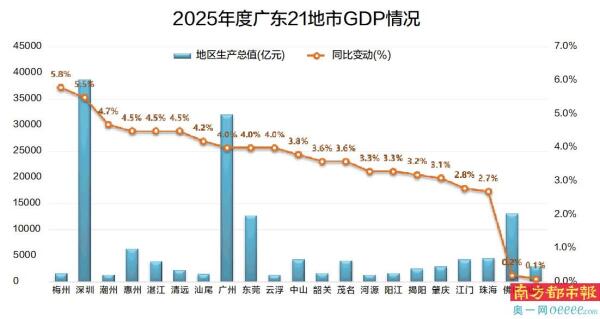
Economic Overview - As of February 5, 2025, all economic data for 21 cities in Guangdong has been released, with Shenzhen leading the province with a GDP of 3.87 trillion yuan [3] - The overall GDP growth rate for Guangdong is 3.9%, with Meizhou leading at 5.8%, followed by Shenzhen at 5.5% and Chaozhou at 4.7% [3] Industrial Growth - Zhanjiang leads the province in industrial added value growth at 10.7%, with Huizhou and Meizhou both at 8.6% [4] - Zhanjiang's industrial sector contributes over 40% to its economic growth, with significant increases in communication equipment and computer manufacturing [4] - Meizhou's industrial added value growth is 8.6%, with notable increases in non-ferrous metal smelting and electronic equipment manufacturing [5] Investment and Consumption - Industrial technological transformation investment in Yangjiang exceeds 60%, with several cities maintaining high investment levels in key and high-tech industries [7] - Guangzhou's retail sales of consumer goods show significant growth, particularly in furniture and communication equipment [8] - The consumption policies, such as trade-in programs, have positively impacted the consumer market across various cities [8] Foreign Trade - Shenzhen's total import and export volume reaches a record high of 4.55 trillion yuan, with exports at 2.74 trillion yuan [9] - Zhaoqing leads the province in export growth at 21.1%, with significant contributions from electromechanical products [10] - Guangzhou's foreign trade also shows strong performance, with a total volume of 1.2 trillion yuan and a 10.4% year-on-year growth [11] Agriculture - Agricultural production remains strong, with cities like Maoming and Zhanjiang exceeding 110 billion yuan in total agricultural output [13] - Zhuhai's agricultural output grows by 6.6%, leading the province, particularly in fisheries [13] - Yangjiang's agricultural output also shows positive growth, with a 6.4% increase [13]

同比增长5.1%!2025年上半年惠州GDP2910亿元
Nan Fang Du Shi Bao· 2025-07-23 08:56
Economic Overview - The GDP of Huizhou reached 291.006 billion yuan in the first half of 2025, with a year-on-year growth of 5.1% at constant prices [2] - The primary industry added value was 13.262 billion yuan, growing by 4.1%; the secondary industry added value was 153.687 billion yuan, growing by 7.7%; and the tertiary industry added value was 124.057 billion yuan, growing by 2.3% [2] Agricultural Sector - Agricultural production showed stable growth, with the total output value of agriculture, forestry, animal husbandry, and fishery at 23.595 billion yuan, a year-on-year increase of 4.4% [2] - Key agricultural products saw stable production, with vegetable and edible fungus output increasing by 4.0%, fruit output by 10.1%, and tea output by 7.3% [2] - Pork and poultry production declined, with pork output at 57,200 tons (down 5.5%) and poultry output at 41,800 tons (down 4.4%) [2] Industrial Sector - Industrial production experienced rapid growth, with the added value of large-scale industries increasing by 11.2% [3] - The electronics industry grew by 15.7%, while the petrochemical, energy, and new materials sectors grew by 5.4% [3] - Advanced manufacturing and high-tech manufacturing added value increased by 11.2% and 15.3%, respectively, accounting for 61.8% and 42.5% of the total industrial added value [3] Investment Trends - Fixed asset investment decreased by 17.9% in the first half of the year, with manufacturing down 9.3% and real estate development down 26.9% [3] - Investment in cultural, sports, and entertainment sectors surged by 87.8%, while information transmission and software services grew by 11% [3] Consumer Market - The total retail sales of consumer goods reached 103.865 billion yuan, growing by 5.5% [4] - Urban retail sales increased by 5.7%, while rural retail sales grew by 4.7% [4] - Online retail sales surged by 49.0%, indicating strong potential in e-commerce [4] Foreign Trade - The total import and export volume reached 197.988 billion yuan, with a year-on-year growth of 6.9% [4] - Exports totaled 111.109 billion yuan (up 6.8%), while imports reached 86.879 billion yuan (up 6.9%) [4] Fiscal and Financial Sector - The general public budget revenue was 25.571 billion yuan, a year-on-year increase of 3.1% [5] - The balance of financial institutions' deposits was 981.079 billion yuan, growing by 3.6% [5] - The consumer price index (CPI) decreased by 0.7%, indicating stable consumer prices [5] Income Trends - Per capita disposable income reached 26,731 yuan, growing by 4.8% [5] - Urban residents' per capita disposable income was 30,042 yuan (up 4.4%), while rural residents' was 17,503 yuan (up 6.2%) [5]