
石化能源新材料

Search documents
城市24小时 | 广东第五城 冲击下一个“双万城市”
Mei Ri Jing Ji Xin Wen· 2026-02-25 15:34
Group 1 - The core theme of the meeting in Huizhou is to promote the coordinated development of manufacturing and service industries, aiming to enhance investment quality and efficiency [1] - Huizhou is positioned as a key player in Guangdong's economic landscape, with a GDP exceeding 600 billion and a goal to reach a trillion GDP and a population of over 10 million [1][3] - The city is focusing on industrial upgrades and nurturing new growth drivers, particularly in petrochemical energy, new materials, and electronic information sectors [3] Group 2 - The Guangdong provincial government has high expectations for Huizhou, designating it as a new growth pole for high-quality development [3] - Huizhou's "14th Five-Year Plan" emphasizes the need for industrial cluster development and aims to establish a strong artificial intelligence and robotics industry [3][4] - A growth loop is forming where industry attracts population, leading to urban prosperity, which in turn supports further industrial development [4] Group 3 - Guangdong's service industry has maintained the highest value in the country for 41 consecutive years, with manufacturing accounting for about one-eighth of the national total [9] - The province's GDP is projected to reach 14.58 trillion by 2025, with manufacturing and service sectors playing crucial roles in this growth [9]

2025年珠三角GDP达11.9万亿元 东岸领跑西岸转型分化明显
Nan Fang Ri Bao Wang Luo Ban· 2026-02-06 08:31
Core Insights - The Pearl River Delta (PRD) region's economy is projected to reach a total of 11.9 trillion yuan by 2025, accounting for over 80% of Guangdong's economy, with Guangzhou, Shenzhen, Foshan, and Dongguan solidifying their status as "trillion-yuan cities" [1] - Guangzhou and Shenzhen are expected to each surpass the 3 trillion yuan mark, contributing nearly 70% of the province's economic growth, thus acting as a "stabilizer" for Guangdong's economy [2][4] - The focus on "industrial upgrading" has become a consensus among local governments, with various cities emphasizing the importance of industry and enterprise in their development strategies [1][3] Economic Performance - By 2025, Guangzhou's foreign trade import and export volume is expected to reach 1.2 trillion yuan, a year-on-year increase of 10.4%, while its retail sales of consumer goods will reach 1.103238 trillion yuan, growing by 5.5% [3] - Shenzhen's industrial output value is projected to reach 5.44 trillion yuan, maintaining its position as the top city in China for four consecutive years, with foreign trade reaching a record high of 4.55 trillion yuan [3][6] - Dongguan's industrial output value is expected to grow by 4%, supported by advanced manufacturing and stable foreign trade, with total import and export volume reaching 1.57943 trillion yuan, a year-on-year increase of 13.8% [7][8] Industrial and Trade Dynamics - The industrial growth in Shenzhen is underpinned by a 19.2% increase in industrial technology transformation investment, with a steady growth of 5.4% in industrial added value [6] - Guangzhou's industrial recovery is marked by a positive growth rate in industrial added value, with strategic emerging industries contributing significantly to its GDP [7] - The four leading cities (Shenzhen, Huizhou, Guangzhou, and Dongguan) demonstrate that strong industrial performance and resilient foreign trade are critical for regional development [8][9] Regional Disparities - The economic performance of the eastern PRD cities contrasts with the western cities, which are facing challenges during their economic transformation [9][10] - Cities like Zhuhai, Jiangmen, and Zhongshan are exploring differentiated development paths, with Zhongshan showing strong industrial growth driven by new infrastructure [11][12] - Foshan, while maintaining a significant economic scale, is undergoing a transformation to enhance its advanced manufacturing sector, with a notable increase in the production of industrial robots [12][13]
深圳经济总量居首 梅州GDP增速第一
Nan Fang Du Shi Bao· 2026-02-06 06:00
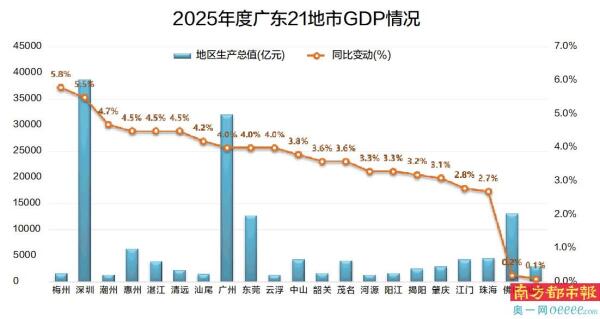
Economic Overview - As of February 5, 2025, all economic data for 21 cities in Guangdong has been released, with Shenzhen leading the province with a GDP of 3.87 trillion yuan [3] - The overall GDP growth rate for Guangdong is 3.9%, with Meizhou leading at 5.8%, followed by Shenzhen at 5.5% and Chaozhou at 4.7% [3] Industrial Growth - Zhanjiang leads the province in industrial added value growth at 10.7%, with Huizhou and Meizhou both at 8.6% [4] - Zhanjiang's industrial sector contributes over 40% to its economic growth, with significant increases in communication equipment and computer manufacturing [4] - Meizhou's industrial added value growth is 8.6%, with notable increases in non-ferrous metal smelting and electronic equipment manufacturing [5] Investment and Consumption - Industrial technological transformation investment in Yangjiang exceeds 60%, with several cities maintaining high investment levels in key and high-tech industries [7] - Guangzhou's retail sales of consumer goods show significant growth, particularly in furniture and communication equipment [8] - The consumption policies, such as trade-in programs, have positively impacted the consumer market across various cities [8] Foreign Trade - Shenzhen's total import and export volume reaches a record high of 4.55 trillion yuan, with exports at 2.74 trillion yuan [9] - Zhaoqing leads the province in export growth at 21.1%, with significant contributions from electromechanical products [10] - Guangzhou's foreign trade also shows strong performance, with a total volume of 1.2 trillion yuan and a 10.4% year-on-year growth [11] Agriculture - Agricultural production remains strong, with cities like Maoming and Zhanjiang exceeding 110 billion yuan in total agricultural output [13] - Zhuhai's agricultural output grows by 6.6%, leading the province, particularly in fisheries [13] - Yangjiang's agricultural output also shows positive growth, with a 6.4% increase [13]
举全市之力!惠州将这样打造人工智能和机器人产业
Nan Fang Du Shi Bao· 2026-02-04 08:17
Group 1 - The core focus of Huizhou's government work report is to strengthen the real economy and manufacturing sector, aiming to build a more competitive modern industrial system by 2026 [1][3] - Huizhou plans to establish a "2+1" modern industrial cluster, with significant investments in the petrochemical energy and new materials sector, targeting an industrial output value of 430 billion yuan [3] - The electronic information industry is set to expand, with a projected industrial output value reaching 700 billion yuan, focusing on areas such as ultra-high-definition displays and smart connected vehicles [3] Group 2 - A major initiative is the development of the artificial intelligence and robotics industry, with the establishment of dedicated institutions to coordinate resources and accelerate industrial transformation [3][4] - The city will implement the "Artificial Intelligence + Manufacturing" special action, promoting AI applications across various sectors including agriculture, healthcare, and urban management [4] - Huizhou aims to leverage the advantages of the Guangdong-Hong Kong-Macao Greater Bay Area to develop a green and efficient computing infrastructure cluster [4][5]

惠州市委书记、市人大常委会主任刘吉:凝心聚力打造广东高质量发展新增长极
Xin Lang Cai Jing· 2026-01-25 00:45
Core Viewpoint - Huizhou aims to become a new growth pole for high-quality development in Guangdong, focusing on economic responsibility and innovation to achieve breakthroughs in the "14th Five-Year Plan" and set a solid foundation for the "15th Five-Year Plan" [1][5]. Group 1: Implementation of Party Policies - Huizhou prioritizes the study and implementation of the spirit of the 20th Central Committee and Xi Jinping's important speeches as a major political task, with extensive training and outreach efforts reaching over 221 million people [2][4]. - The city has established a four-level publicity system and formed 289 teams with over 2,100 speakers to promote the learning and implementation of party policies [4]. Group 2: Economic Development Goals - Huizhou has completed its economic targets for the "14th Five-Year Plan" a year ahead of schedule, with an average growth rate of 6% over five years, aiming to become a city with a GDP of over 1 trillion yuan and a population of over 10 million [5][6]. - The city emphasizes the integration within the Guangdong-Hong Kong-Macao Greater Bay Area to enhance regional competitiveness and facilitate the flow of talent, technology, and finance [5]. Group 3: Industrial Strategy - Huizhou is committed to strengthening its manufacturing sector, particularly in petrochemical energy and electronic information, targeting an industrial output value of over 2 trillion yuan by the end of the "15th Five-Year Plan" [6]. - The city aims to establish itself as a global hub for the petrochemical industry, with a target of achieving a production value of 700 billion yuan in the petrochemical sector [6]. Group 4: Rural and Urban Development - The "Hundred-Thousand-Ten Thousand Project" has led to significant improvements in county economies, with several districts achieving GDPs exceeding 100 billion yuan [8][9]. - Huizhou is enhancing its urbanization efforts, improving the quality of life in towns and villages, and increasing the income of rural residents, with a projected growth of 5.9% in per capita disposable income [9]. Group 5: Future Initiatives - The city plans to continue its focus on integrated reforms and the development of seven industrial parks, aiming for a comprehensive enhancement of its economic and social systems [10]. - Huizhou will leverage high-quality party leadership to mobilize community and market forces for the successful implementation of its development strategies [10].
广东推进绿色制造,以高品质生态环境支撑高质量发展
2 1 Shi Ji Jing Ji Bao Dao· 2026-01-06 16:57
Group 1 - The core viewpoint of the article highlights Guangdong's achievements in ecological construction during the "14th Five-Year Plan" period, emphasizing the role of high-quality ecological environment in supporting high-quality economic development [1] - Guangdong occupies approximately 2% of the national land area while contributing about 10.5% to the national economic output, showcasing the importance of green development [1] - The city of Huizhou is used as an example of regional development, focusing on creating a favorable environment for the petrochemical energy new materials and electronic information industries [1] Group 2 - In green manufacturing, Guangdong supports the development of emerging industries, such as the new energy vehicle sector, which is projected to produce over 3.6 million units in 2024, accounting for one-quarter of the national output [2] - A new policy will be introduced in October 2025 to provide financial subsidies for the replacement of old non-operating heavy trucks, expected to eliminate 28,200 old vehicles and update 5,200 new energy trucks, stimulating consumption by approximately 3 billion yuan [2] - The ecological environment department in Foshan is assisting local ceramic manufacturers in achieving green development through technological and product innovation [2] Group 3 - Guangdong is actively developing green finance and has established a financial project library to support green development [3] - The province is working on establishing carbon footprint accounting standards and databases to facilitate enterprises' international green initiatives [3] - The establishment of the Guangdong-Hong Kong-Macao Ecological Environment Science Center aims to enhance technological support for the environmental protection service industry, which is leading nationally [3]
点赞!惠州提前一年完成“十四五”经济总量目标
Nan Fang Du Shi Bao· 2025-12-26 13:48
Core Insights - During the "14th Five-Year Plan" period, Huizhou has made significant progress in economic development, environmental protection, and improving the well-being of its citizens, positioning itself as a new growth pole for high-quality development in Guangdong [3]. Economic Performance - Huizhou's GDP has consistently crossed the thresholds of 500 billion and 600 billion yuan, with an average annual growth rate of 6.3% over the first four years, achieving its "14th Five-Year Plan" total target a year ahead of schedule [3]. - The total industrial output value in Huizhou exceeded 1.5 trillion yuan, and the city is projected to rank 30th among the "Top 100 Advanced Manufacturing Cities" in 2024 [3]. Industrial Development - Huizhou focuses on manufacturing, with significant growth in the petrochemical, energy, new materials, and electronic information sectors, enhancing its economic resilience [3]. - The city has established a strong talent pool, with over 1.8 million people and nearly 100,000 R&D personnel [3]. Infrastructure and Connectivity - Huizhou has developed a robust transportation network, ranking among the top three in the province for highway mileage and first for high-speed rail [4]. - The annual throughput capacity of Huizhou Port reached 180 million tons, and the airport is expected to handle 3.36 million passengers this year, marking a 17% increase [4]. Trade and Investment - The city has successfully established major foreign investment projects, including ExxonMobil's ethylene project and the Sino-Korean (Huizhou) Industrial Park, with an average annual growth rate of over 10% in foreign trade during the "14th Five-Year Plan" period [4]. Urban and Rural Development - The "Hundred Million Project" has significantly transformed Huizhou's urban and rural landscape, promoting high-quality development in the northern region and a thriving marine economy in the south [6]. - The city has invested nearly 130 billion yuan in the southern region, aiming to develop a modern marine ranch and enhance its coastal economic platform [6].
第一个20万亿大省,呼之欲出
首席商业评论· 2025-12-21 04:33
Group 1 - The core viewpoint of the article emphasizes Guangdong's ambition to double its GDP by 2035, aiming for a total economic output of over 25 trillion yuan, which would position it as a leading economic province comparable to California in the U.S. [5][7] - Guangdong's GDP was approximately 13 trillion yuan in 2022, and to achieve the doubling goal, it must maintain an average nominal growth rate of over 5% annually [7][9]. - The article highlights the importance of various cities within Guangdong, particularly Guangzhou, Shenzhen, and the emerging city of Huizhou, which is expected to become a significant economic player [11][13]. Group 2 - The article discusses the need for balanced regional development in Guangdong, particularly focusing on the less developed areas of the eastern and western regions, which currently contribute only about 20% of the province's GDP despite occupying over 70% of its land area [15][17]. - Initiatives such as targeted assistance and industrial transfer from the Pearl River Delta to these regions are being implemented to stimulate growth [17][18]. - The article mentions the "Hundred Counties, Thousand Towns, and Ten Thousand Villages" project aimed at enhancing rural economies and creating a robust economic framework across all levels [13][20]. Group 3 - The article outlines Guangdong's strategy to foster a new high-tech industry, focusing on sectors like renewable energy, aerospace, and advanced manufacturing, which align with national development goals [21][25]. - Guangdong is home to nine trillion-yuan industrial clusters and leads in several strategic emerging industries, positioning itself as a national leader in technology and innovation [25][26]. - The province's R&D expenditure is projected to reach approximately 509.96 billion yuan in 2024, with over 90% coming from enterprises, underscoring the role of private sector innovation in driving economic growth [26].

第一个20万亿大省,呼之欲出
虎嗅APP· 2025-12-14 13:13
Core Viewpoint - Guangdong Province aims to achieve a GDP of over 25 trillion yuan by 2035, effectively doubling its current economic output and reaching the level of a moderately developed country in terms of per capita GDP [6][9][11]. Group 1: Economic Growth Targets - The "14th Five-Year Plan" suggests that Guangdong's GDP should reach approximately 25 trillion yuan by 2035, with a nominal annual growth rate of over 5% [6][11]. - As of 2022, Guangdong's GDP was around 13 trillion yuan, and it surpassed 14 trillion yuan in the previous year, maintaining its position as the top province in China for 36 consecutive years [8][11]. - The target of 22 trillion yuan by 2035 would require a lower annual growth rate of about 3.5% [11]. Group 2: Economic Structure and Key Cities - The economic structure of Guangdong is heavily concentrated in the Pearl River Delta, with nine cities contributing over 80% of the province's GDP [19]. - Major cities like Guangzhou, Shenzhen, and the newly recognized Huizhou are expected to play pivotal roles in driving economic growth, with Huizhou's GDP already exceeding 600 billion yuan [20]. - The province plans to enhance the roles of secondary cities and urban clusters, including Zhuhai, Shantou, and Zhanjiang, to support overall economic development [22]. Group 3: Regional Development Disparities - The economic disparity between the Pearl River Delta and the less developed regions of East and West Guangdong is significant, with the latter contributing only about 20% of the province's GDP despite covering over 70% of its area [28][29]. - The "14th Five-Year Plan" emphasizes the need for coordinated development across the province, promoting industrial transfer and support for underdeveloped areas [30][31]. Group 4: High-Tech Industry Development - Guangdong aims to leverage national strategies to develop high-tech industries, focusing on sectors like new energy, aerospace, and advanced manufacturing [43][46]. - The province is home to nine trillion-yuan industrial clusters and has been recognized as the leading province in technological innovation for nine consecutive years [46][48]. - Guangdong's R&D expenditure is projected to reach approximately 509.96 billion yuan in 2024, with over 90% coming from enterprises, surpassing the total of 12 western provinces [48].
惠州设立首个科技成果转化引导基金 规模达2亿元
Nan Fang Ri Bao Wang Luo Ban· 2025-08-20 07:40
Core Viewpoint - The establishment of the Huizhou Technology Achievement Transformation Guidance Fund, with a scale of 200 million yuan, aims to accelerate the industrialization of major technological achievements in Huizhou, a manufacturing city with numerous technology-based enterprises [1] Group 1: Fund Overview - The fund is the first of its kind in Huizhou, focusing on transforming and industrializing significant technological achievements [1] - It is jointly funded by the Huizhou government, Yueke Chuangtou, Dongjiang Laboratory, Huizhou Guotou, and other entities, and will operate in a market-oriented manner [1] Group 2: Strategic Focus - The fund will align with Huizhou's "2+1" industrial system, which includes electronic information, petrochemical energy new materials, and life and health industries [1] - It aims to target large research platforms, universities, and research institutes to facilitate the transformation of technological achievements into practical applications [1] Group 3: Evaluation and Risk Management - The fund emphasizes overall effectiveness evaluation rather than solely focusing on the preservation and appreciation of state-owned capital [1] - It allows for a maximum risk tolerance of 50% for investment losses, provided that due diligence has been exercised [1] Group 4: Investment Ecosystem - Huizhou has adopted a "government guidance + market-oriented operation" model, gradually forming a chain of investment funds including angel funds, venture capital funds, and industrial funds [1] - The role of government funds in guiding investments is continuously strengthening, with ongoing efforts to establish additional funds for artificial intelligence and technology achievement transformation [1]