
电动汽车充电设施

Search documents
我国电动汽车充电设施达2069.8万个
Ren Min Wang· 2026-02-27 22:17
Core Insights - The total number of electric vehicle charging infrastructure (units) in China reached 20.698 million by the end of January this year, representing a year-on-year growth of 49.6% [1] - Public charging facilities accounted for 4.801 million units, with a year-on-year increase of 31.2%, while private charging facilities reached 15.897 million units, growing by 56.1% [1] Development Goals - The "Three-Year Doubling" action plan for electric vehicle charging facilities, issued by six departments including the National Development and Reform Commission and the National Energy Administration, aims to establish 28 million charging facilities by the end of 2027 [1] - The plan also targets to provide over 300 million kilowatts of public charging capacity to meet the charging needs of over 80 million electric vehicles, effectively doubling the charging service capacity [1] - As of December 2025, the number of electric vehicle charging facilities in China is expected to exceed 20.092 million, surpassing the 20 million mark [1]
全国新能源充电设施突破2000万个,大功率快充与乡村布局仍不足
Jing Ji Guan Cha Wang· 2026-01-24 06:20
Core Viewpoint - The National Energy Administration of China has reported significant growth in electric vehicle (EV) charging infrastructure, projecting a total of 20.092 million charging points by 2025, representing a year-on-year increase of 49.7% [2] Group 1: Charging Infrastructure Growth - By 2025, the number of private charging facilities is expected to reach 15.375 million, up 82% year-on-year, while public charging facilities will total 4.717 million, reflecting a 31.9% increase [2] - The growth in charging infrastructure has accelerated, with the time taken to increase from 1 million to 10 million charging points reduced from 13 years to just 18 months [2][3] - The average charging power of public charging stations has increased to 46.5 kW, with a 33% improvement in charging efficiency [2][3] Group 2: Coverage and Accessibility - Charging stations have been established in 98% of highway service areas, with 71,500 charging points built, and 19 provinces achieving full coverage of charging facilities in rural areas [3] - The current charging infrastructure is concentrated in economically developed regions, with the top 10 regions accounting for 65.7% of public charging facilities by 2025 [4] Group 3: Market Dynamics and Competition - The market share of the top five charging operators is projected to decline from 65.4% in 2024 to 61.1% in 2025, indicating increased competition [5] - The total number of battery swap stations is expected to reach 5,155 by 2025, marking a 16% increase from the previous year [5] Group 4: Future Projections - The "Three-Year Doubling" action plan aims to establish 28 million charging facilities by the end of 2027, catering to over 80 million electric vehicles [3][4] - Predictions indicate that by 2026, there will be an addition of 7.419 million private charging facilities and 1.448 million public charging facilities [5]


港股异动 | 挚达科技(02650)涨超10%续刷新高 未来两年国家明确提出大幅提高私人充电设施建设规模
智通财经网· 2026-01-16 04:06
Core Viewpoint - The electric vehicle charging infrastructure in China is experiencing significant growth, with a notable increase in both public and private charging facilities, which presents investment opportunities for companies like Zhida Technology. Group 1: Market Performance - Zhida Technology (02650) saw its stock price rise over 10%, reaching a new high of 313.4 HKD, with a trading volume of 20.06 million HKD [1]. Group 2: Industry Growth - As of November 2025, the total number of electric vehicle charging facilities in China is expected to reach 19.32 million, representing a year-on-year growth of 52.0% [1]. - Public charging facilities are projected to total 4.625 million, with a year-on-year increase of 36.0%, and the total rated power of public charging piles is expected to reach 210 million kW, averaging about 45.34 kW [1]. - Private charging facilities are anticipated to reach 14.697 million, showing a year-on-year growth of 57.8%, with a total installed capacity of 12.9 million kVA [1]. Group 3: Government Initiatives - The National Development and Reform Commission has launched a "Three-Year Doubling Action Plan" for electric vehicle charging facilities, aiming to build 28 million charging facilities by the end of 2027 to meet the charging needs of over 80 million electric vehicles [2]. - The plan emphasizes a significant increase in the construction scale of private charging facilities [2]. Group 4: Company Positioning - Zhida Technology is positioned as the world's largest provider of home charging solutions for electric vehicles, utilizing a "product + service + digital platform" model for deep market penetration [2]. - According to Frost & Sullivan, Zhida Technology holds approximately 9.0% of the global market share for home charging piles, with a 13.6% share in the Chinese market, ranking first in sales within China [2].
新闻发布︱新华社:总数突破1800万个!前三季度电动汽车充电基础设施发展呈现三大成效
国家能源局· 2025-11-01 03:03
Core Insights - The total number of electric vehicle charging facilities in China reached 18.063 million by the end of September 2025, marking a year-on-year growth of 54.5%, effectively supporting the charging needs of 40 million new energy vehicles [2] Group 1: Charging Service Capacity - The charging service capacity has significantly improved, with a total rated power of public charging facilities reaching approximately 200 million kilowatts, an increase of 59.2% since the beginning of the year, and an average power of about 44.4 kilowatts, up by 26.9% [2] - As of September 2025, 68,000 charging facilities have been built in highway service areas, contributing to the overall increase in charging infrastructure [2] Group 2: Technological and Business Innovations - Breakthroughs in new technologies and business models have been achieved, with over 37,000 high-power charging facilities (greater than 250 kW) established, enhancing charging speed significantly [3] - Intelligent charging technology has made progress, with 17 provinces conducting large-scale pilot applications for vehicle-grid interaction [3] Group 3: Policy Support and Market Dynamics - The National Development and Reform Commission and the National Energy Administration have issued a "Three-Year Doubling Action Plan" for electric vehicle charging facilities, aiming to double the charging service capacity by the end of 2027 [3] - Among the top 10 charging operators in the country, 8 are private enterprises, which manage 70.7% of the public charging stations [3] - The National Energy Administration has introduced policies to enhance safety management of charging facilities and promote the scientific planning of high-power charging infrastructure [3]

到2027年底,全国实现充电服务能力翻倍增长—— 电动车充电设施建设将提速
Jing Ji Ri Bao· 2025-10-23 01:24
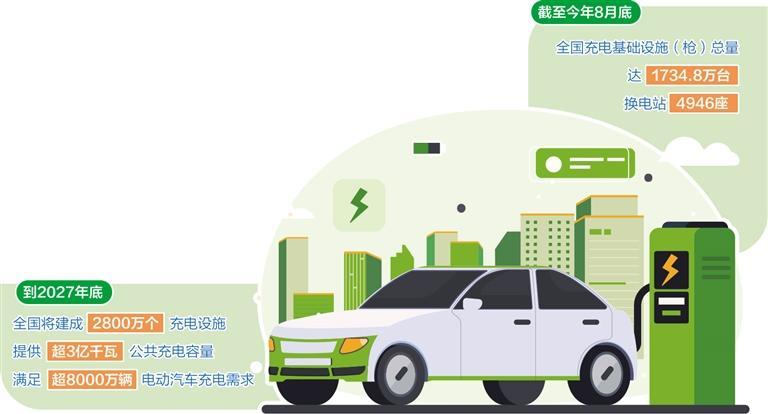
Core Insights - The "Three-Year Doubling Action Plan for Electric Vehicle Charging Infrastructure Service Capacity (2025-2027)" aims to establish 28 million charging facilities by the end of 2027, providing over 300 million kilowatts of public charging capacity to meet the charging needs of over 80 million electric vehicles, effectively doubling the service capacity [1][3]. Industry Developments - The charging infrastructure sector is transitioning from a focus on quantity to an emphasis on quality improvement, with the plan targeting five key areas: enhancing public charging facilities, optimizing residential charging conditions, promoting vehicle-grid interaction, improving power supply capacity, and elevating operational services [4]. - The rapid growth of electric vehicle ownership, with 36.89 million units as of mid-2023, highlights the significant market potential for charging infrastructure, which has already seen substantial progress with 17.348 million charging units and 4,946 battery swap stations established by August 2023 [3][4]. Company Innovations - Companies like BYD are innovating in the charging infrastructure space, having launched the world's first mass-produced megawatt fast-charging platform and integrated solar-storage-charging stations, with plans for full commercialization by 2026 [4]. - Huawei is focusing on enhancing service quality and operational efficiency in response to the growing demand for electric vehicle charging solutions, while companies like Beijing Saibao Distributed Energy Technology Co., Ltd. are introducing mobile charging solutions to meet diverse market needs [6]. Market Trends - The industry is expected to shift from price competition to service competition, emphasizing the need for improved service quality and ecosystem collaboration among stakeholders [5]. - The plan also aims to ensure equitable access to charging infrastructure by expanding coverage to rural areas, with a target of adding at least 14,000 direct current charging guns in regions lacking public charging stations [6].
到2027年底,全国实现充电服务能力翻倍增长——电动车充电设施建设将提速
Xin Lang Cai Jing· 2025-10-23 00:05
Core Insights - The National Development and Reform Commission and the National Energy Administration, along with five other departments, have jointly issued the "Three-Year Doubling Action Plan for Electric Vehicle Charging Infrastructure Service Capacity (2025-2027)", aiming to establish 28 million charging facilities by the end of 2027, providing over 300 million kilowatts of public charging capacity to meet the charging needs of over 80 million electric vehicles, thereby achieving a doubling of charging service capacity [1] Industry Overview - The issuance of this top-level design marks a new phase in the large-scale construction and innovative model of charging infrastructure in China, which is a critical support for the rapid development of new energy vehicles, indicating significant market growth potential [1] - As of June 2023, the number of new energy vehicles in China reached 36.89 million, accounting for 10.27% of the total number of vehicles [1] - By the end of August 2023, the total number of charging infrastructure units in China reached 17.348 million, with 4,946 battery swap stations, establishing the largest, most comprehensive charging service network globally [1] Company Insights - Companies in the charging infrastructure sector, such as Keda Intelligent Technology Co., are experiencing rapid growth, with expectations to exceed one million charging pile shipments this year [1]
电动车充电设施建设将提速
Jing Ji Ri Bao· 2025-10-22 22:21
Group 1 - The National Development and Reform Commission and the National Energy Administration, along with six other departments, have issued a three-year action plan to double the service capacity of electric vehicle charging facilities by 2027, aiming to establish 28 million charging facilities and provide over 300 million kilowatts of public charging capacity to meet the needs of over 80 million electric vehicles [2][3] - The charging infrastructure industry is transitioning from quantity-focused growth to quality enhancement, with the action plan emphasizing five key areas: improving public charging facilities, optimizing residential charging conditions, promoting vehicle-grid interaction, enhancing power supply capabilities, and improving operational services [3][4] - The industry is expected to shift from price competition to service competition, focusing on improving service quality and customer experience as electric vehicle adoption continues to rise [4] Group 2 - The action plan includes a commitment to expand charging networks into rural areas, with plans to add at least 14,000 direct current charging guns in townships that currently lack public charging stations, ensuring comprehensive coverage of charging facilities [5] - Companies like BYD are actively innovating in the charging infrastructure space, with plans to commercialize advanced charging solutions, including a megawatt fast-charging platform and integrated solar-storage-charging stations by 2026 [3][4] - The industry is witnessing a diversification of participants, with more local governments and enterprises engaging in the charging infrastructure supply chain, driving high-quality development [3][4]
到2027年底 全国实现充电服务能力翻倍增长——电动车充电设施建设将提速
Jing Ji Ri Bao· 2025-10-22 22:05
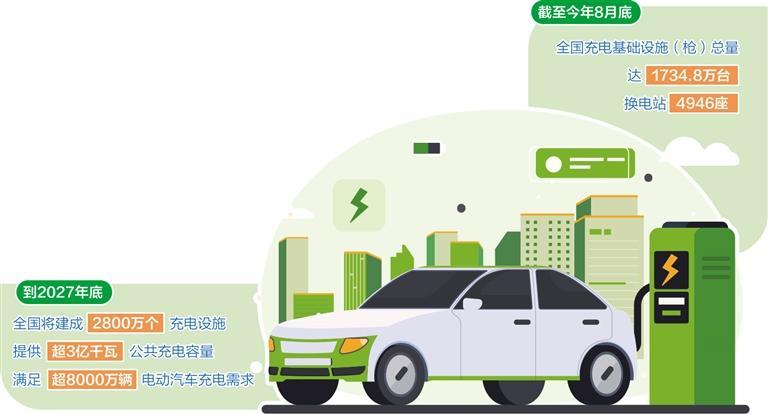
Group 1 - The core objective of the "Three-Year Doubling Action Plan" is to establish 28 million charging facilities by the end of 2027, providing over 300 million kilowatts of public charging capacity to meet the charging needs of over 80 million electric vehicles, marking a significant growth in charging service capacity [1][4] - The charging infrastructure industry is transitioning from a focus on quantity to quality improvement, with five key actions outlined in the plan aimed at enhancing public charging facilities, optimizing residential charging conditions, promoting vehicle-grid interaction, improving power supply capacity, and enhancing operational services [2][3] - The rapid growth of electric vehicle ownership, reaching 36.89 million units by mid-2023, has driven significant advancements in charging infrastructure, which now includes 17.348 million charging units and 4,946 battery swap stations, making it the largest and most comprehensive charging network globally [1][2] Group 2 - The industry is expected to shift from price competition to service competition, focusing on improving service quality and customer experience as electric vehicle adoption continues to rise [3] - Companies like BYD are innovating in the charging infrastructure space, launching the world's first mass-produced megawatt fast charging platform and integrated solar-storage-charging stations, aiming for commercial rollout by 2026 [2][3] - The plan emphasizes equitable and inclusive upgrades to the charging network, with a target to add at least 14,000 direct current charging guns in rural areas lacking public charging stations, ensuring comprehensive coverage and meeting peak demand during holidays [4]

新华社丨缓解“里程焦虑”!电动汽车充电设施将“三年倍增”
国家能源局· 2025-10-18 03:47
Core Viewpoint - The article discusses the "Three-Year Doubling Action Plan" for electric vehicle charging infrastructure in China, aiming to double the charging service capacity by the end of 2027, addressing the issue of "range anxiety" for electric vehicle users [2][3]. Summary by Sections Current State of Charging Infrastructure - As of September 2025, China has built the world's largest electric vehicle charging network with 18.063 million charging facilities, providing 2 charging stations for every 5 vehicles. Over 60,000 charging facilities have been established in highway service areas, facilitating cross-province travel [2]. Doubling the Number of Charging Facilities - The plan aims to increase the number of charging facilities to 28 million by the end of 2027, providing over 300 million kilowatts of public charging capacity to meet the needs of over 80 million electric vehicles. New residential areas are required to install charging facilities or prepare for future installations [3]. Enhancing Charging Facility Usability - The action plan emphasizes the construction of high-power charging facilities, with 1.6 million new direct current charging guns planned, including 100,000 high-power charging guns. The average power of public charging facilities is currently 45.5 kilowatts, which is insufficient for peak demand scenarios [4][5]. Comprehensive Coverage and Smart Energy Network - The charging infrastructure is transitioning from centralized to comprehensive coverage, enhancing convenience for electric vehicle users. The plan includes the expansion of vehicle-to-grid (V2G) technology, with over 5,000 new V2G facilities and a reverse power supply of over 20 million kilowatt-hours by 2027 [5]. Economic Impact - The implementation of the action plan is expected to stimulate over 200 billion yuan in investment in charging facility equipment manufacturing and construction, indicating significant market opportunities for the industry [5].

缓解“里程焦虑”!电动汽车充电设施将“三年倍增”
Xin Hua She· 2025-10-17 14:26
Core Insights - The National Development and Reform Commission and the National Energy Administration have launched a "Three-Year Doubling Action Plan" for electric vehicle charging facilities, aiming to double the charging service capacity by the end of 2027 [1][2] Group 1: Current State of Charging Infrastructure - As of September 2025, China has built the world's largest electric vehicle charging network with 18.063 million charging facilities, providing 2 charging stations for every 5 vehicles [1] - There are over 60,000 charging facilities in highway service areas, facilitating cross-province travel [1] Group 2: Expansion Goals - The plan aims to establish 28 million charging facilities nationwide by the end of 2027, providing over 300 million kilowatts of public charging capacity to meet the needs of over 80 million electric vehicles [2] - New residential areas are required to install charging facilities or prepare for future installations, ensuring easy access to charging [2] Group 3: Improvement of Charging Facilities - The plan emphasizes the addition of 1.6 million direct current charging guns in urban areas, including 100,000 high-power charging guns [3] - The average power of public charging facilities is currently 45.5 kilowatts, which is insufficient for high-demand scenarios during holidays and in urban hotspots [3] Group 4: Vehicle-to-Grid (V2G) Integration - The plan includes the expansion of vehicle-to-grid (V2G) applications, with a target of adding over 5,000 V2G facilities and achieving a reverse discharge capacity of over 20 million kilowatt-hours by the end of 2027 [4] - The implementation of this plan is expected to stimulate over 200 billion yuan in investment in charging facility equipment manufacturing and construction [4]