
电池金属

Search documents
终于反弹!现货黄金重回4800美元!企稳信号初现,杠杆抛售潮或近尾声
Xin Lang Cai Jing· 2026-02-03 01:21
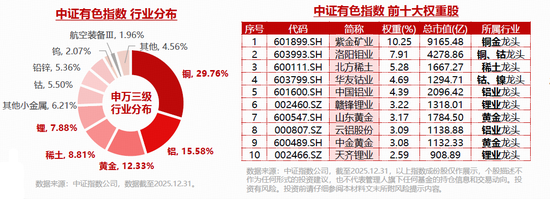
Group 1: Gold Market Insights - Gold prices rebounded to over $4800 per ounce, with a daily increase of more than 3% [1][7] - The forced selling wave caused by quantitative funds deleveraging and adjustments in leveraged ETFs has likely been mostly released [1][7] - Bank of America views gold as a crucial hedge against dollar depreciation, stating that "currency devaluation is the basic scenario" [1][7] - JPMorgan predicts that gold will remain a flexible and diverse hedging tool, with current investor demand exceeding previous expectations, potentially driving prices to $6300 per ounce by the end of 2026 [1][7] - New Lake Futures believes that long-term support for gold prices remains, with geopolitical risks and uncertainty in Trump’s policies being key focus areas [1][7] Group 2: Base Metals Outlook - Citic Securities maintains a long-term bullish outlook on the non-ferrous metals sector, citing strong price support from supply disruptions and high demand in certain areas [2][8] - The liquidity easing and rising trading activity, along with heightened risk aversion due to geopolitical conflicts, are expected to amplify price elasticity for metals [2][8] - Huatai Securities recommends a moderate allocation of 10%-20% in non-ferrous metals within investment portfolios to share in potential gains while diversifying risk [2][8] - The Huabao Non-Ferrous Metals ETF and its linked funds cover a wide range of industries, including precious metals, strategic metals, and industrial metals, providing a comprehensive approach to capturing sector performance [2][8]

中信证券:2025年有色金属行情领跑大盘 看好贵金属、工业金属等板块配置价值
智通财经网· 2026-02-02 01:21
Core Viewpoint - The report from CITIC Securities indicates that after a significant market surge in 2025, the momentum for the prices of non-ferrous metals and stocks remains strong, supported by supply disruptions, localized high demand, and inventory accumulation, with liquidity easing and geopolitical tensions likely amplifying price elasticity for metals [1] Group 1: Market Performance and Price Trends - In 2025, the CITIC non-ferrous metal sector index increased by 98.6%, outperforming the CSI 300 index by 77.4 percentage points [1] - The leading segments included tungsten (+144.8%), nickel, cobalt, tin, and antimony (+130.7%), and copper (+123.9%) [1] - Precious metals showed the most significant price increases, with average prices for gold and silver in 2025 rising over 70% year-on-year [1] Group 2: Supply and Demand Dynamics - Supply disruptions in the metal industry are expected to become more frequent and severe, with significant price increases for cobalt, tin, lithium, copper, and nickel due to these disturbances [2] - Structural demand resilience remains strong despite potential weaknesses in sectors like real estate and home appliances, with high demand expected in areas such as power grid investment, energy storage batteries, and AI servers [2] - Inventory accumulation driven by trade disputes is expected to amplify demand for copper, lithium, and rare earths, leading to price increases [2] Group 3: Trading Activity and Geopolitical Impact - The report anticipates that global liquidity will remain loose in 2026, with increased trading activity in precious metals likely leading to unexpected price surges for silver, copper, tin, and lithium carbonate [3] - Ongoing geopolitical conflicts are expected to elevate risk aversion, driving up prices for precious metals and extending to other non-ferrous metals like copper, rare earths, tungsten, and natural uranium [3] Group 4: Price Outlook for Major Metals in 2026 - Precious metals are expected to benefit from monetary attributes and sustained risk aversion, with gold projected to reach $6,000 per ounce and silver potentially rising to $120 per ounce due to extreme shortages and trading enthusiasm [4] - Supply constraints and resilient demand are expected to support strong price performance for copper and aluminum, with average prices projected at $12,000 per ton and 23,000 yuan per ton, respectively [4] - Battery metals like lithium are anticipated to rise to a price range of 120,000 to 200,000 yuan per ton, while cobalt prices are expected to be between 400,000 and 500,000 yuan per ton due to quota reductions [4] - Other metals such as rare earths, tungsten, tin, and natural uranium are expected to continue benefiting from supply-demand tightness, with price targets of 600,000 to 800,000 yuan per ton, 450,000 to 550,000 yuan per ton, 450,000 to 500,000 yuan per ton, and $100 per pound, respectively [4]

电池金属分析_锂_储能(ESS)热潮收紧市场,2026 年上半年价格将维持高位-Battery Metals Analyst_ Lithium_ ESS Boom Tightens Market and Will Keep Prices High In H1 2026
2025-11-24 01:46
Summary of Lithium Market Analysis Industry Overview - The analysis focuses on the lithium market, particularly driven by the demand for Energy Storage Systems (ESS) and the impact of supply constraints in China [2][3][12]. Key Insights - **Lithium Price Trends**: Lithium carbonate prices in China surged from approximately $9,200 per ton in mid-September to over $11,000 per ton recently. This price increase is attributed to a tightening market balance due to stronger-than-expected ESS demand and temporary supply cuts from lepidolite mines in China [2][3][12]. - **Price Forecasts**: - For H1 2026, prices are expected to remain firm at $11,000 per ton, before dropping to $9,500 per ton in H2 2026. This is an upward revision from a previous average forecast of $8,900 per ton for 2026 [2][6][19]. - By 2027, prices are projected to stabilize around $9,250 per ton, with a potential need for supply cuts to prevent unsustainable inventory levels [2][19]. Demand Dynamics - **ESS Demand Growth**: The demand forecast for ESS lithium consumption has been significantly upgraded to 589 GWh in 2025 and 736 GWh in 2026, up from previous estimates of 275 GWh and 413 GWh, respectively. This indicates a material increase in underlying demand [12][15]. - **Global Lithium Demand**: Total lithium demand is expected to rise by 140,000 tons in 2025 and 209,000 tons in 2026, reflecting a 9% and 8% increase, respectively [15][19]. Supply Considerations - **Supply Growth**: Supply growth is anticipated to accelerate to 27% year-over-year in 2026, driven by the resumption of CATL's lepidolite operations and increased spodumene production. This is a significant increase compared to the 12% growth expected in 2025 [6][19]. - **Inventory Days**: Inventory days of demand cover are projected to fall to 61 days in 2025, down from 89 days previously forecasted. This indicates a tighter market balance [6][19]. Market Outlook - **Long-term Market Balance**: The lithium market is expected to remain in a low-for-longer phase relative to the highs of 2022/23, with supply projected to exceed demand by 18% in 2028 unless producers limit expansions [19]. - **Future Price Trajectory**: Prices are expected to stabilize within the lower end of the orderly regime range, with forecasts of $9,500 per ton in 2028 and $10,500 per ton in 2029, as the market transitions towards levels that support project advancements [19]. Risks and Considerations - **Upside Risks**: Potential upside risks to the price forecast include delays in the restart of lepidolite mines in China or stronger-than-expected ESS growth, which could tighten inventory cover and push prices higher [20][19]. Conclusion - The lithium market is currently experiencing a tightening phase driven by robust ESS demand and supply constraints. While prices are expected to remain high in the near term, long-term forecasts suggest a need for supply adjustments to maintain market balance.