矿泉水

Search documents
官方通报矿泉水标签印人民币图样
Xin Lang Cai Jing· 2026-01-06 15:27
Core Viewpoint - The Guangxi Jinxiuyao Autonomous County Market Supervision Administration reported a potential violation regarding the use of RMB imagery on the labels of "Jiatianxia Mountain Song Spring" bottled water produced by Guangxi Xiuyao Shengshui Co., Ltd. [1] Group 1 - The local market supervision authority received complaints about the product labels allegedly using images related to the Renminbi [1] - The authority initiated an investigation and collected samples of the product labels for professional assessment [1] - The involved company has voluntarily suspended the production and sale of the product and is cooperating with the regulatory investigation [1] Group 2 - The market supervision authority will make a fair decision based on the findings of the investigation in accordance with laws and regulations [1]
格鲁吉亚的东方之约
Xin Lang Cai Jing· 2025-12-26 08:48
Core Insights - Georgia is China's first free trade partner in the Eurasian region, highlighting the strengthening economic ties between the two countries [1] - China has consistently been Georgia's largest export market and the third-largest trading partner, providing significant development opportunities for Georgia [1] - The participation of Georgia as a guest country at the 8th China International Import Expo (CIIE) showcases its commitment to expanding trade relations with China [1] Trade Opportunities - Georgian products such as wine, mineral water, honey, and dried fruits are rapidly entering the Chinese market, indicating a growing demand for these goods [1] - The CIIE serves as a platform for Georgia to present its unique products to a broader audience in China, enhancing its visibility and market access [1] - The increasing export of Georgian goods to China reflects the tangible benefits of the trade relationship, contributing to Georgia's economic growth [1]
2025美好生活|高质量发展与消费升级-2025年度美好生活新消费高峰论坛即将启幕
Sou Hu Cai Jing· 2025-11-17 10:23
Core Insights - The Chinese consumer market is undergoing a significant transformation, shifting from a focus on "cost-performance" to "emotional value" and "technological trust" as key competitive variables [2][6][7] - A high-quality development and consumption upgrade forum will be held on November 21, 2025, in Beijing, aimed at exploring paths for industry transformation and sustainable development [3][7] Market Structure - By 2025, the Chinese consumer market is expected to exhibit a "dumbbell" structure, characterized by rapid growth in consumption among Generation Z and a burgeoning silver economy focused on quality living, creating a trillion-level market [6] - This structural change is shifting consumer logic from "satisfying needs" to "creating demand," with consumers seeking products that embody more emotional and social values [6] Product Development - Companies are increasingly focusing on the emotional resonance and social value of their products, moving away from standardized goods [6] - Innovations such as "zero-additive herbal tea" and culturally enriched bottled water are examples of how brands are meeting urban consumers' demands for "natural health" and storytelling [6] Competitive Focus - The competition is shifting from market share to meticulous refinement across the entire R&D, production, and service chain [6] - Companies are embedding "craftsmanship" into the less visible aspects of the supply chain, enhancing product quality through advanced techniques like micron-level homogenization in dairy products and precise temperature control in chocolate production [6] Technological Integration - Technology is becoming a new engine for upgrading the consumer industry, with AI, IoT, and blockchain technologies deeply penetrating the supply chain [7] - The integration of technology with traditional practices is enhancing production efficiency and establishing "assured consumption" as a core competitive advantage [7] Future Outlook - The upcoming forum is anticipated to provide critical insights for the next decade of the consumer market, emphasizing that product value is not just a gift of nature but a commitment from companies to a better life [7]

内外双卷不确定下找到百亿品牌的持续结构增长逻辑?
Jing Ji Guan Cha Bao· 2025-11-14 02:23
Core Insights - The article discusses the challenges and strategies for companies transitioning from a billion-level revenue to a hundred-billion-level brand, emphasizing the need for a deep understanding of core advantages and strategic optimization in a competitive market [1][38]. Group 1: Current Challenges in Revenue Growth - Companies face significant challenges in revenue growth due to market saturation and intensified competition, with traditional linear growth models becoming ineffective [3]. - The loss of clear causal relationships complicates growth strategies, making it difficult for companies to predict and drive growth as they scale [3]. - Increased market uncertainty from macroeconomic changes, technological advancements, and competitor strategies further complicates long-term planning [3]. Group 2: Differences in Growth Logic - Companies at the billion-level focus on product line breakthroughs, optimizing existing products and expanding variations to meet diverse consumer needs [5][6]. - In contrast, hundred-billion-level brands shift focus to brand expansion, enhancing brand influence and market positioning through diversified product portfolios [6][7]. - Successful large enterprises recognize the limitations of relying on a single product line and adopt multi-faceted strategies for sustained revenue growth [6][7]. Group 3: Strategic Approaches for Growth - The transition from billion to hundred-billion revenue requires a shift from a map strategy, which relies on clear market positioning and plans, to a puzzle strategy that emphasizes flexibility and adaptability in a dynamic market [8][9]. - Companies must integrate various business units and market opportunities to create a complex growth network, allowing for rapid adaptation to market changes [9]. Group 4: Building a Hundred-Billion Brand - Companies should focus on core advantage development and reasonable structural extensions to diversify and expand their market presence [11]. - The growth process should transition from category expansion to business expansion, ultimately enhancing brand value and market leadership [13][14]. - Successful examples include Huawei, which leveraged its core technology in telecommunications to expand into smartphones and smart home products [12]. Group 5: Multi-Category and Multi-Business Strategies - Companies should start with a strong single product and then expand into related categories based on market validation [15][16]. - The example of Bosideng illustrates how a focus on a core product can lead to successful category expansion, achieving significant revenue growth [17]. Group 6: Multi-Brand Strategy - Companies can consider a multi-brand strategy when market maturity limits growth potential, leveraging established brand reputation to enter new markets [22]. - Anta's multi-brand strategy demonstrates how a company can cover various market segments, enhancing competitiveness and brand influence [24]. Group 7: Internal and Structural Growth - Companies must recognize external challenges and effectively integrate internal resources to achieve structural growth [36][37]. - The experiences of Haier, Midea, and Gree highlight the importance of understanding core brand genes—service, channel, and product—as pathways to growth [34][35]. Group 8: Future Growth Pathways - The article outlines a framework for companies to transition from billion to hundred-billion brands, emphasizing the importance of strategic planning and resource optimization [39][42]. - The future growth stages include transitioning to a thousand-billion platform and a ten-thousand-billion ecosystem, requiring a comprehensive understanding of market dynamics and consumer needs [41][44].
长白山矿泉水可持续发展:在保护中开发,留足生态水
2 1 Shi Ji Jing Ji Bao Dao· 2025-09-29 07:02
Core Insights - China faces four major challenges regarding water resources: excess water, scarcity, pollution, and turbidity, necessitating a focus on sustainable and high-quality water resource development [1] Group 1: Water Resource Challenges - The Ministry of Water Resources emphasizes the need for a systematic approach to water management to address issues like floods, droughts, water pollution, and soil erosion [1] - ESG considerations highlight the importance of water resource utilization and the risks associated with water scarcity [1] Group 2: Long White Mountain Water Resource Potential - Long White Mountain has significant water resource development potential, with at least 166 springs available for development, totaling a flow rate of 1.09 million cubic meters per day [2] - The annual flow from large water sources in Long White Mountain is nearly 400 million cubic meters, indicating substantial potential for water resource development [2] Group 3: Sustainable Development and Protection Measures - Seven key protective measures for mineral water resources have been proposed, including establishing protection zones, enhancing ecological protection, and limiting development to ensure ecological flow [2] - The need to balance water resource development with ecological sustainability is emphasized, considering the relationships between spring water, surface water, and groundwater [2][3] Group 4: Market Trends and Future Consumption - The trend in bottled water consumption indicates that China's consumption is significantly lower than that of the United States, suggesting a growth potential in the mineral water market [3] - The challenges of improving water quality from supply sources to household taps are highlighted, necessitating infrastructure upgrades [3]

2025农牧品牌之夜活动在成都举行 推介“高原粮仓·净土阿坝”
Si Chuan Ri Bao· 2025-08-29 03:39
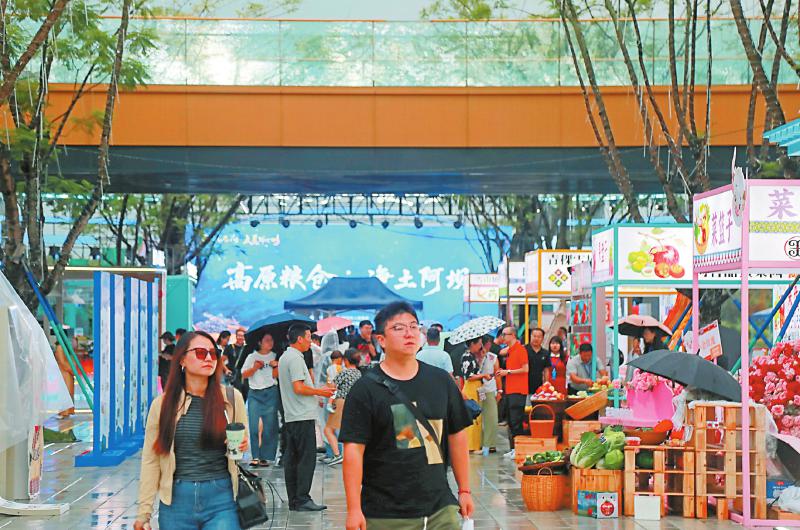
Group 1 - The event "Highland Granary · Pure Land Aba - 2025 Agricultural and Animal Husbandry Brand Night" was held in Chengdu to showcase the achievements of Aba Prefecture's agricultural development and promote its tourism and agricultural products [3] - The event featured three main sections: showcasing the agricultural origins of Aba, promoting unique agricultural brands, and releasing results of agricultural projects [3] - Five promotional segments were set up based on Aba's five major agricultural industries, including grain security, fruit supply, medicinal and health products, organic vegetables, and meat production [3] Group 2 - The event highlighted five representative achievements in market expansion and supply chain integration for Aba's agriculture, including the establishment of a summer breeding base in Ma'erkang City and the entry of local products into major supply chains [3] - A new IP image "Jingzai" was introduced at the event, attracting attention from guests and visitors [4]
泉阳泉召开业绩说明会 称天然矿泉水行业规模将持续增长
Zheng Quan Ri Bao· 2025-05-20 07:13
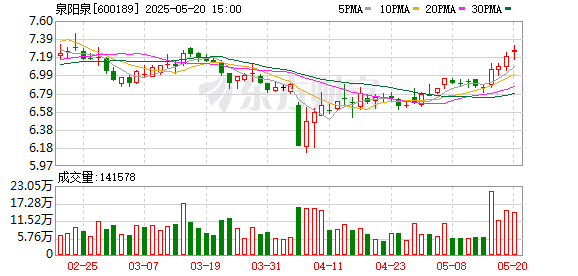
Core Viewpoint - The company,泉阳泉, reported a significant increase in revenue and a return to profitability in Q1 2025, driven by the growth of the consumer and health industries, strong competitive positioning, and ongoing reforms to enhance market competitiveness [2][5]. Company Performance - In Q1 2025,泉阳泉 achieved a revenue of 307 million yuan, representing a year-on-year increase of 31.74% [2]. - The net profit attributable to shareholders was 5.1093 million yuan, marking a turnaround from a loss to profitability [2]. Market Position and Industry Trends -泉阳泉 ranks among the top three in the national natural mineral water sector and is the only A-share listed company primarily focused on mineral water [2]. - The natural mineral water market in China is expected to continue growing, with a projected market size exceeding 21.3 billion yuan in 2024, reflecting a year-on-year growth of 17% [3]. Strategic Initiatives - The company has initiated several strategic projects, including increasing core water source capacity by 400,000 tons and expanding production capacity by 400,000 tons, with 200,000 tons expected to be operational by mid-2025 [4]. - A new production facility of over 16,000 square meters is under construction to enhance production capabilities [4]. Product Development and Market Strategy -泉阳泉 is transitioning from a focus on sales expansion to a new phase of continuous production increase and sales growth coordination [5]. - The company has successfully developed a new product line targeting maternal and infant consumers, expanding its product offerings [5]. Competitive Landscape - The mineral water industry is characterized by intense competition for water sources, with companies investing heavily in exploration and development to secure high-quality water sources [4]. - Despite its competitive advantages,泉阳泉 faces challenges such as brand recognition, scale effects, and a lack of national market presence, which may impact its ability to convert growth potential into market share and profitability [5].

高端快消品牌2024新品上市内容种草案
Sou Hu Cai Jing· 2025-05-09 01:44
Core Insights - The high-end natural mineral water brand OYLAN from Austria plans to enter the Chinese market in June 2024, focusing on sales in high-end supermarkets in Beijing and Shanghai [1][5] - The marketing strategy emphasizes exposure on the Xiaohongshu platform to build brand recognition among users [1][5] Marketing Strategy - OYLAN's marketing campaign targets Xiaohongshu, leveraging its user base characterized by high income and education levels, predominantly consisting of women from the post-90s and Gen Z demographics [1][2] - The KFS model (Key Factors for Success) will be employed, combining quality content with guaranteed traffic to enhance marketing efficiency through KOLs (Key Opinion Leaders), Feeds, and Search promotions [1][2][13] Competitive Landscape - The mineral water industry is experiencing rapid content growth, but the high-end segment remains relatively underdeveloped, presenting a blue ocean opportunity [1][2] - Major competitors include Evian, VOSS, FIJI, and Puna, which utilize lifestyle branding and celebrity endorsements to promote their products [1][2] Product Positioning - OYLAN is marketed as a "healing water" that embodies a balanced lifestyle aesthetic, emphasizing its rare and high-end image [2] - The brand aims to resonate with consumers through various lifestyle content strategies, including endorsements from celebrities and integration into high-end lifestyle scenarios [2] Campaign Phases - The marketing plan is divided into three phases: pre-launch to create buzz, launch to enhance exposure and brand recognition, and a long-term phase to penetrate interest groups and establish a high-end brand perception [2] - Key performance indicators (KPIs) such as CPC, KOL engagement rates, and total exposure will be used to measure the effectiveness of the marketing efforts [2]