
社会保险

Search documents
招聘会上的“社保课堂”
Xin Lang Cai Jing· 2026-02-26 20:44
Core Viewpoint - The large-scale offline job fair "Spring Breeze Action" was held in Zichuan District, Zibo City, Shandong Province, focusing on connecting job seekers with employment opportunities while promoting social insurance policies [1] Group 1: Event Overview - The job fair took place on February 25, featuring various companies and job openings [1] - The Zichuan District Social Insurance Service Center participated by moving its social insurance window to the job fair [1] Group 2: Policy Promotion - A "Social Insurance Classroom" was established at the job fair to educate job seekers about social insurance policies [1] - The initiative aims to guide companies in standardizing employment practices and help workers secure their rights and job stability [1]
申领“应急钱”不会扣“养老钱”
Xin Hua Wang· 2026-02-06 09:57
Core Viewpoint - The recent rumor that "receiving unemployment insurance will deduct from pension" is false and contradicts the original intent of social security policies, as clarified by the Ministry of Human Resources and Social Security [1][5]. Group 1: Social Security System - China has established a comprehensive social insurance system covering basic pension, medical, work injury, unemployment, and maternity insurance, with clear functions and responsibilities for each type [2]. - Unemployment insurance serves as an emergency fund to provide basic living support for unemployed individuals during their job transition period [2]. - The calculation of retirement pensions is based on factors such as contribution base, contribution rate, contribution years, and the average monthly salary of on-the-job employees, and is not affected by the receipt of unemployment insurance [3]. Group 2: Unemployment Insurance Regulations - The duration of unemployment insurance benefits is linked to the length of contributions: up to 12 months for 1-5 years of contributions, 18 months for 5-10 years, and 24 months for over 10 years [3]. - Individuals can continue to pay basic pension insurance while receiving unemployment benefits, and their eligibility for unemployment benefits will not be affected unless specific conditions are met [3]. Group 3: Public Awareness and Policy Communication - The spread of misinformation regarding social security policies can undermine public trust and hinder the effective implementation of welfare policies [5][7]. - There is a need for accurate policy interpretation and communication to bridge the gap between policies and the public, enhancing understanding and effectiveness [5][7]. - The Ministry of Human Resources and Social Security aims to improve service efficiency and accessibility in social security management, ensuring that policies benefit a wider population [6][7].
哈尔滨通报“1014人死后多领养老金”:责令家属30日内退回
Mei Ri Jing Ji Xin Wen· 2026-01-23 17:28
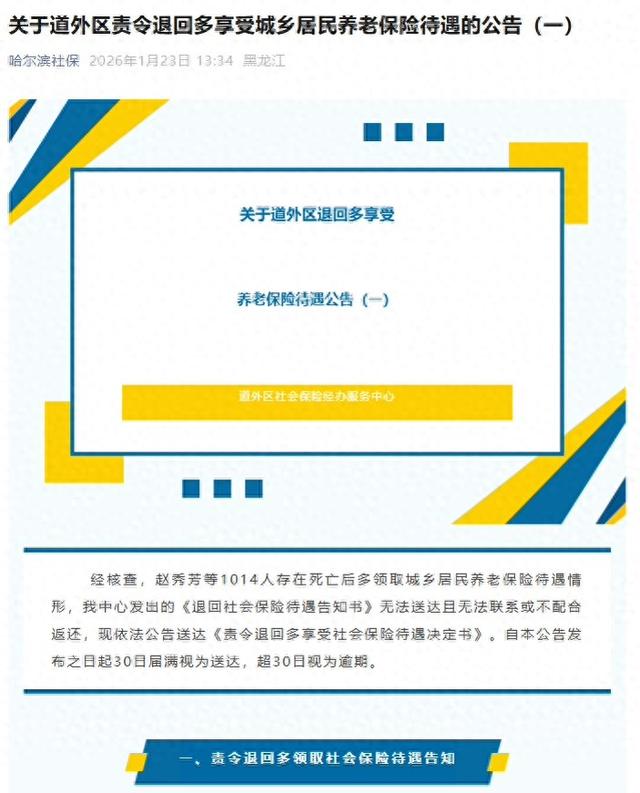
Group 1 - The announcement from "Harbin Social Security" indicates that 1,014 individuals, including Zhao Xiufang, have been found to have received urban and rural residents' pension benefits after their deaths [1] - The Social Security Center issued a notice for the return of these benefits, which could not be delivered to the individuals due to their refusal to cooperate or inability to contact them [1] - The announcement states that the individuals' families must return the excess benefits within 30 days of the announcement, or the Social Security Center will seek enforcement through the courts [1]
哈尔滨连发四公告!责令退回多享受的城乡居民养老保险待遇
Xin Lang Cai Jing· 2026-01-23 13:45
Core Viewpoint - The Harbin Social Insurance Center has announced that 1,014 individuals, including Zhao Xiu Fang, have been found to have received urban and rural resident pension benefits after their deaths, and they are being ordered to return these benefits [1][3][4]. Group 1: Announcement Details - The announcement states that the center's notice for returning the benefits could not be delivered, and the individuals involved could not be contacted or refused to cooperate in returning the funds [1][3][5]. - A legal notice for returning the excess benefits has been issued, and it will be considered delivered 30 days after the announcement, with any delays beyond this period being treated as overdue [1][3][5]. Group 2: Financial Details - The amounts overpaid range from tens to thousands of yuan, with the highest overpayment being 5,974.74 yuan for the period from August 2016 to August 2020 [6]. - Many individuals only received an extra month of benefits, with the lowest amount being 65 yuan [6]. Group 3: Legal Obligations - According to the Social Insurance Law and related regulations, family members are required to return the overpaid benefits within 30 days of the announcement by providing a death certificate and depositing the funds into a designated Agricultural Bank account [7]. - If the individuals do not apply for administrative review or file a lawsuit within the legal timeframe and fail to comply with the decision, the center will seek enforcement through the People's Court [7].

哈尔滨官方通报1014人死后多领养老金:责令退回
Xin Lang Cai Jing· 2026-01-23 09:38
Core Viewpoint - The Harbin Social Security Bureau has announced the requirement for 1,014 individuals to return overpaid urban and rural resident pension benefits due to their posthumous receipt of these payments [1] Group 1: Announcement Details - The announcement was made on January 23, detailing that the individuals, including Zhao Xiufang, received pension benefits after their deaths [1] - A notice for the return of these benefits was sent, but many recipients were uncooperative or unreachable, prompting the legal announcement for return [1] - The individuals are required to return the overpaid benefits within 30 days of the announcement, or face legal enforcement [1] Group 2: Legal Framework - The decision is based on the Social Insurance Law of the People's Republic of China and relevant regulations [1] - Families must provide death certificates and deposit the overpaid amounts into designated bank accounts to process the return [1] - Failure to comply with the decision may result in the Social Security Bureau seeking enforcement through the courts [1]
山东社保这五年,织就8000万人的安心与幸福
Xin Lang Cai Jing· 2026-01-21 16:27
Core Viewpoint - Shandong's social security system has made significant strides in reforming and enhancing public welfare, ensuring comprehensive coverage and improved service quality for its citizens [5][10][18]. Group 1: Social Security Coverage and Benefits - The social security network in Shandong covers 80 million people, translating government commitments into tangible benefits for households [5]. - By the end of 2025, the number of participants in basic pension insurance, unemployment insurance, and work injury insurance is projected to reach 80.18 million, 16.87 million, and 21.20 million respectively, marking increases of 5%, 15.1%, and 16.4% compared to the end of the 13th Five-Year Plan [10][14]. Group 2: Policy Implementation and Community Engagement - Shandong's social security initiatives include community outreach programs such as "Policy Night Markets" and "Happiness Markets" to educate citizens about social security benefits [8]. - The "Universal Coverage, Warmth for All" project aims to enhance public understanding of social security policies and encourage lawful participation in the system [8][9]. Group 3: Fund Management and Compliance - The management of social security funds has been strengthened through rigorous compliance measures and educational initiatives to prevent fraud [9][15]. - A comprehensive risk prevention system has been established to ensure the safety and proper allocation of social security funds [15]. Group 4: Digital Transformation and Innovation - Shandong is advancing its "Smart Human Resources" platform, which includes 28 specialized topics and aims to streamline 534 processes, enhancing service efficiency [16]. - The integration of blockchain technology in social security services is being explored to improve transparency and traceability in operations [17]. Group 5: Economic Support and Employment Stability - From 2021 to 2025, Shandong has allocated 11.71 billion yuan in wage subsidies to 138,300 enterprises, stabilizing 3.5 million jobs [9]. - The unemployment insurance standard has been raised to 90% of the local minimum wage, with monthly benefits reaching up to 2,160 yuan [14].

去年7月1日起,城阳基础养老金最低标准每人每月提高20元
Qi Lu Wan Bao· 2026-01-12 11:39
Core Viewpoint - The Qingdao City Chengyang District is set to enhance its social insurance coverage by 2025, with significant increases in the number of insured enterprises and employees across various insurance categories, aiming to improve the welfare of its residents [1][3]. Group 1: Social Insurance Coverage - By 2025, the number of registered enterprises in Chengyang District is expected to reach 49,100 [3]. - The insured employees for basic pension insurance, work injury insurance, and unemployment insurance are projected to be 635,000, 452,800, and 401,900 respectively, with total numbers and growth rates leading the city [1][3]. Group 2: Pension and Retirement Reforms - A total of 2.803 billion yuan will be allocated for basic pension benefits for employees, ensuring the basic living standards of retirees [4]. - The minimum standard for basic pension insurance for residents will increase from 238 yuan to 258 yuan per person per month starting July 1, 2025, reflecting a 20 yuan increase [4]. Group 3: Innovative Insurance Programs - Chengyang District is promoting pilot programs for "enterprise (talent) annuities" and "supplementary work injury insurance" to enhance social insurance system vitality [5]. - Currently, 13 enterprises with 1,661 employees are participating in the enterprise annuity program, while 283 enterprises with 15,930 employees are covered under the supplementary work injury insurance [5]. - Over 9,500 non-labor relationship workers have been included in work injury insurance coverage, extending protection from "labor relations" to "occupational groups" [5].
黟县保障水平“双提升”
Xin Lang Cai Jing· 2026-01-07 08:59
Core Insights - The article highlights the significant improvements in the rural and urban basic pension insurance system in Yixian County during the "14th Five-Year Plan" period, showcasing a unique local model for high-quality development in social security [1][2][3][4] Group 1: Pension Contribution and Coverage - The average contribution level for urban and rural residents' basic pension insurance in Yixian County has increased to 1,640.54 yuan, representing a substantial growth of 386.53% compared to the end of the "13th Five-Year Plan" [1] - The average pension level has risen to 264.45 yuan, marking a 117.91% increase from the end of the "13th Five-Year Plan" [1] Group 2: Policy Promotion and Public Awareness - A "policy promotion + full coverage" model has been implemented to enhance public awareness of pension policies, utilizing a four-level promotional network that includes county, township, village, and household levels [1] - Nearly 300 promotional activities have been conducted at the rural level, resulting in a 125.89% increase in the number of individuals opting for higher-tier contributions [1] Group 3: Data Sharing and Enrollment - The "data sharing + precise identification" model has been adopted to ensure comprehensive coverage, transitioning from a reactive to a proactive approach in policy outreach [2] - Over 80,000 pieces of information have been coordinated from relevant departments to identify and assist eligible individuals for enrollment [2] Group 4: Dynamic Management and Support Services - A "dynamic management + tracking service" model has been established to ensure that vulnerable groups receive the necessary support, with regular updates to lists of low-income individuals [3] - Approximately 70,000 yuan has been allocated for the payment of basic pension insurance fees on behalf of nearly 7,000 individuals from disadvantaged groups [4] Group 5: Grassroots Service Network - A "grid-based foundation + in-depth service" model has been created to enhance social security services at the grassroots level, ensuring full coverage of pension insurance services at the village level [4] - A training program has been implemented to develop a skilled workforce for policy promotion and service delivery, enhancing the effectiveness of social security services [4]
社保待遇领取 资格认证别忘了
Zheng Zhou Ri Bao· 2025-12-12 01:15
Core Viewpoint - The article emphasizes the importance of timely qualification certification for social security benefit recipients to ensure the uninterrupted disbursement of benefits [1] Group 1: Certification Requirements - Four categories of individuals are required to undergo qualification certification: monthly recipients of enterprise, government, and urban-rural basic pension benefits [1] - Monthly recipients of survivor living allowances for enterprise employees (including retirees) who support direct relatives must also certify [1] - Individuals receiving monthly disability allowances and living care fees due to work-related injuries are included in the certification requirement [1] - Monthly recipients of compensation for the dependents of deceased workers are also required to complete the certification process [1] Group 2: Certification Channels - Recipients can complete their social security qualification certification through various platforms, including the "Henan Social Security" WeChat official account, "Henan Social Security" APP, "Yushi Ban" APP, Alipay "Yushi Ban" mini-program, "Zhenghao Ban" APP, "Zhengzhou Human Resources and Social Security Card" WeChat official account, Henan Provincial Social Security Online Service Platform, and the National Social Insurance Public Service Platform [1]
陕西城乡居民基本养老保险全面实现“刷脸办”
Shan Xi Ri Bao· 2025-11-14 22:42
Core Points - The implementation of the "face recognition" method for urban and rural residents' basic pension insurance in Shaanxi has been fully launched, allowing participants to register quickly through the "Shaanxi Social Insurance" App without needing to fill out forms or visit service centers [1][2] - The new method enhances efficiency by enabling participants to update their information, transfer their insurance location, and apply for benefits through face recognition, significantly streamlining the process [1][2] Group 1 - The "face recognition" method integrates facial recognition technology with social insurance business systems, reducing the amount of documentation required from the public and optimizing the processing workflow [2] - This method improves operational efficiency and shortens processing times, making it easier for elderly individuals to manage their pension insurance without physical travel [1][2] - The system also enhances risk control by preventing fraudulent claims and duplicate benefit receipts, thereby protecting the integrity of the pension fund [2]