纸与林业产品

Search documents
恒科连跌三日后反弹0.56%,南向净买入近150亿
2 1 Shi Ji Jing Ji Bao Dao· 2026-02-27 10:29
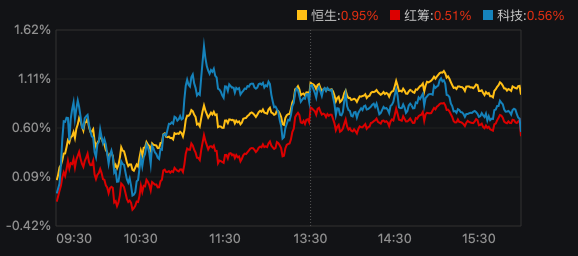
Market Overview - The Hong Kong stock market experienced a rebound on February 27, with the Hang Seng Index rising by 0.95% to close at 26,630.54 points, and the trading volume increased to 288.42 billion HKD from 259.28 billion HKD on the previous trading day [3] - The Hang Seng Tech Index also saw a slight increase of 0.56%, closing at 5,137.84 points, although it had previously declined for three consecutive trading days, with a cumulative drop of 10.27% over the past month [3][4] Sector Performance - The market displayed a "strong cyclical, differentiated technology, and weak consumer" characteristic, with coal (+4.37%), steel (+3.91%), and agricultural chemicals (+2.90%) leading the gains, driven by rising commodity prices and expectations of domestic growth policies [4] - Conversely, the airline sector (-3.00%), semiconductor materials and equipment (-2.81%), and paper and forestry products (-2.38%) faced declines, influenced by falling ticket prices post-Spring Festival and a significant drop in Nvidia's stock [4] Stock Highlights - Small-cap stocks performed exceptionally well, with notable gains from Changcheng Weiguang (+154.84%), Xingtai Chain Group (+63.52%), and Yuanli Holdings (+56.64%) [4][6] - On the other hand, Semai Holdings (-32.00%), Bairong Cloud-W (-18.78%), and Ying Yuzhou (-17.05%) experienced the largest declines, with Bairong Cloud-W possibly affected by adjustments in earnings expectations [4][6] Trading Volume Insights - The top three stocks by trading volume were Tencent Holdings (16.776 billion HKD), Alibaba-W (12.742 billion HKD), and Changfei Optical Fiber (9.101 billion HKD), with Changfei benefiting from its inclusion in the MSCI China Index [5][6] Corporate Developments - Baidu Group reported that AI business revenue accounted for 43% of its total, exceeding market expectations, while Alibaba announced the launch of the world's first "Qianwen" AI glasses, set for pre-order on March 2 [6] - BeiGene (6160.HK) achieved a net profit of 1.422 billion HKD for 2025, marking its first year of profitability [6] Market Sentiment and Future Outlook - The State Council issued opinions on improving the national unified electricity market system, raising profit improvement expectations for the electricity sector [7] - The MSCI China Index quarterly adjustment took effect, adding 33 A-share stocks focused on technology and semiconductors [7] - The Hong Kong Stock Exchange reported record high performance for 2025, with revenue of 29.161 billion HKD (up 30.3% year-on-year) and net profit of 17.754 billion HKD (up 36.0% year-on-year) [7] - The Hang Seng AH premium index fell to 118.81, indicating continued buying pressure from public funds in Hong Kong stocks [7] - Huashan Fund noted that the Hang Seng Tech Index has corrected 18% since its peak in October last year, with the risk-reward ratio gradually improving as the index remains sensitive to global liquidity and risk sentiment [7][8]


恒指温和收涨 周期股领涨科技分化
2 1 Shi Ji Jing Ji Bao Dao· 2026-02-25 12:09
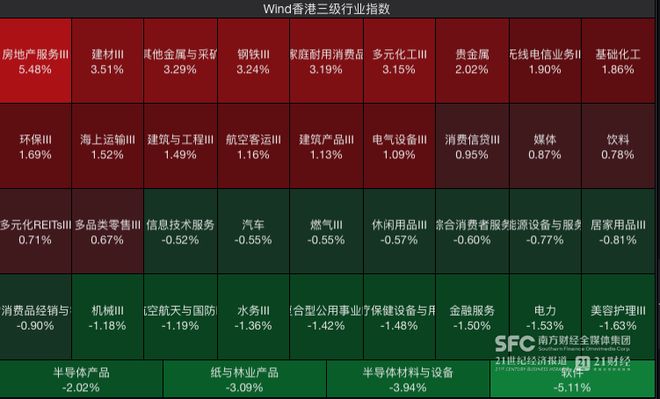
Market Overview - The Hong Kong stock market experienced a mixed performance with a structural characteristic of "strong cyclicals, weak technology" as policy support and rising commodity prices drove the market upward, while profit-taking affected the technology sector [1][2] - The Hang Seng Index rose by 0.66% to 26,765.72 points with a trading volume of 236.765 billion HKD, while the Hang Seng Tech Index slightly declined by 0.19% to 5,260.5 points with a trading volume of 51.908 billion HKD [1][2] Sector Performance - Cyclical sectors such as real estate services (+5.48%), building materials (+3.51%), and mining (+3.29%) led the gains, supported by favorable policies and rising commodity prices [2] - In contrast, technology sectors like software (-5.11%) and semiconductor materials and equipment (-3.94%) saw significant declines due to profit-taking from previously high-performing stocks [2] Individual Stocks - Notable gainers included Tianbao Energy (+69.49%) due to a projected profit increase of 84.5% year-on-year, and Semir Holdings (+60.53%) benefiting from active small-cap market sentiment [2] - Major decliners included Zhijing International Financial (-26.32%), Zhuoyue Holdings (-23.08%), and China National Pharmaceutical Group (-18.75%) [2] Trading Activity - The top three stocks by trading volume were Tencent Holdings (11.981 billion HKD), Alibaba-W (7.110 billion HKD), and HSBC Holdings (6.193 billion HKD) [2] Policy and Economic Developments - The Hong Kong budget proposed optimizing the listing system, including revising "same share, different rights" requirements and advancing T+1 settlement cycle consultations, aiming to enhance market efficiency [2] - New policies in Shanghai's real estate market, including shortening the social security period for non-local buyers and increasing public housing loan limits, stimulated the Hong Kong real estate sector [2] Future Outlook - Analysts suggest focusing on three sectors: precious metals and energy due to rising geopolitical risks, consumer sectors at relatively low valuations, and technology sectors expected to rebound as AI applications accelerate [3] - Concerns over potential VAT increases in service sectors may affect investor sentiment, but pre-meeting policy expectations could support the Hong Kong market [3] - The real estate sector showed overall gains during the Spring Festival, with a continued positive outlook for first-tier and select second-tier cities [3]




恒指温和收涨 周期股领涨科技分化丨港股复盘
2 1 Shi Ji Jing Ji Bao Dao· 2026-02-25 12:00
Core Viewpoint - The Hong Kong stock market experienced a mixed performance with a structural divergence, where cyclical sectors outperformed while technology stocks faced profit-taking pressures [1] Market Performance - The Hang Seng Index rose by 0.66% to 26,765.72 points with a trading volume of 236.765 billion HKD, while the Hang Seng Tech Index slightly declined by 0.19% to 5,260.5 points with a trading volume of 51.908 billion HKD [1] - Southbound capital recorded a net outflow of 3.569 billion HKD [1] Sector Performance - Cyclical sectors such as real estate services (+5.48%), building materials (+3.51%), and other metals and mining (+3.29%) led the gains, driven by favorable policies and rising commodity prices [1][2] - Technology sectors, including software (-5.11%) and semiconductor materials and equipment (-3.94%), showed significant declines due to profit-taking [1][2] Individual Stock Movements - Notable gainers included Tianbao Energy (+69.49%) due to a profit forecast increase of 84.5% year-on-year, and Semmy Holdings (+60.53%) benefiting from active small-cap market sentiment [2] - Major decliners included Zhijing International Finance (-26.32%), Chuangyue Holdings (-23.08%), and China National Pharmaceutical Group (-18.75%) [2] Major Transactions - The top three stocks by trading volume were Tencent Holdings (11.981 billion HKD), Alibaba-W (7.110 billion HKD), and HSBC Holdings (6.193 billion HKD) [3] - Conch Group plans to increase its stake in Conch Cement A-shares (7 to 14 billion HKD) and Conch Venture (10.61%), contributing to the rise in building materials stocks [3] Policy and Economic Factors - The Hong Kong budget proposed optimizing the listing system, including revising "same share different rights" requirements and advancing T+1 settlement cycle consultations [3] - New policies in Shanghai's real estate market aimed at stimulating demand, such as shortening social security requirements for non-local buyers and increasing public housing loan limits [3] Future Outlook - Analysts suggest focusing on three sectors: precious metals and energy due to rising geopolitical risks, consumer sectors at relatively low valuations, and technology sectors expected to rebound as AI applications accelerate [4]