半导体材料与设备

Search documents
恒科连跌三日后反弹0.56%,南向净买入近150亿
2 1 Shi Ji Jing Ji Bao Dao· 2026-02-27 10:29
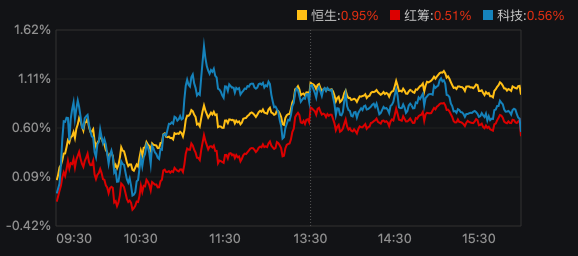
Market Overview - The Hong Kong stock market experienced a rebound on February 27, with the Hang Seng Index rising by 0.95% to close at 26,630.54 points, and the trading volume increased to 288.42 billion HKD from 259.28 billion HKD on the previous trading day [3] - The Hang Seng Tech Index also saw a slight increase of 0.56%, closing at 5,137.84 points, although it had previously declined for three consecutive trading days, with a cumulative drop of 10.27% over the past month [3][4] Sector Performance - The market displayed a "strong cyclical, differentiated technology, and weak consumer" characteristic, with coal (+4.37%), steel (+3.91%), and agricultural chemicals (+2.90%) leading the gains, driven by rising commodity prices and expectations of domestic growth policies [4] - Conversely, the airline sector (-3.00%), semiconductor materials and equipment (-2.81%), and paper and forestry products (-2.38%) faced declines, influenced by falling ticket prices post-Spring Festival and a significant drop in Nvidia's stock [4] Stock Highlights - Small-cap stocks performed exceptionally well, with notable gains from Changcheng Weiguang (+154.84%), Xingtai Chain Group (+63.52%), and Yuanli Holdings (+56.64%) [4][6] - On the other hand, Semai Holdings (-32.00%), Bairong Cloud-W (-18.78%), and Ying Yuzhou (-17.05%) experienced the largest declines, with Bairong Cloud-W possibly affected by adjustments in earnings expectations [4][6] Trading Volume Insights - The top three stocks by trading volume were Tencent Holdings (16.776 billion HKD), Alibaba-W (12.742 billion HKD), and Changfei Optical Fiber (9.101 billion HKD), with Changfei benefiting from its inclusion in the MSCI China Index [5][6] Corporate Developments - Baidu Group reported that AI business revenue accounted for 43% of its total, exceeding market expectations, while Alibaba announced the launch of the world's first "Qianwen" AI glasses, set for pre-order on March 2 [6] - BeiGene (6160.HK) achieved a net profit of 1.422 billion HKD for 2025, marking its first year of profitability [6] Market Sentiment and Future Outlook - The State Council issued opinions on improving the national unified electricity market system, raising profit improvement expectations for the electricity sector [7] - The MSCI China Index quarterly adjustment took effect, adding 33 A-share stocks focused on technology and semiconductors [7] - The Hong Kong Stock Exchange reported record high performance for 2025, with revenue of 29.161 billion HKD (up 30.3% year-on-year) and net profit of 17.754 billion HKD (up 36.0% year-on-year) [7] - The Hang Seng AH premium index fell to 118.81, indicating continued buying pressure from public funds in Hong Kong stocks [7] - Huashan Fund noted that the Hang Seng Tech Index has corrected 18% since its peak in October last year, with the risk-reward ratio gradually improving as the index remains sensitive to global liquidity and risk sentiment [7][8]



恒指温和收涨 周期股领涨科技分化
2 1 Shi Ji Jing Ji Bao Dao· 2026-02-25 12:09
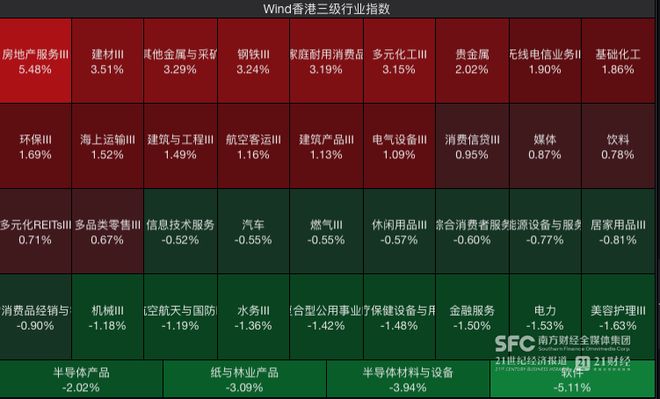
Market Overview - The Hong Kong stock market experienced a mixed performance with a structural characteristic of "strong cyclicals, weak technology" as policy support and rising commodity prices drove the market upward, while profit-taking affected the technology sector [1][2] - The Hang Seng Index rose by 0.66% to 26,765.72 points with a trading volume of 236.765 billion HKD, while the Hang Seng Tech Index slightly declined by 0.19% to 5,260.5 points with a trading volume of 51.908 billion HKD [1][2] Sector Performance - Cyclical sectors such as real estate services (+5.48%), building materials (+3.51%), and mining (+3.29%) led the gains, supported by favorable policies and rising commodity prices [2] - In contrast, technology sectors like software (-5.11%) and semiconductor materials and equipment (-3.94%) saw significant declines due to profit-taking from previously high-performing stocks [2] Individual Stocks - Notable gainers included Tianbao Energy (+69.49%) due to a projected profit increase of 84.5% year-on-year, and Semir Holdings (+60.53%) benefiting from active small-cap market sentiment [2] - Major decliners included Zhijing International Financial (-26.32%), Zhuoyue Holdings (-23.08%), and China National Pharmaceutical Group (-18.75%) [2] Trading Activity - The top three stocks by trading volume were Tencent Holdings (11.981 billion HKD), Alibaba-W (7.110 billion HKD), and HSBC Holdings (6.193 billion HKD) [2] Policy and Economic Developments - The Hong Kong budget proposed optimizing the listing system, including revising "same share, different rights" requirements and advancing T+1 settlement cycle consultations, aiming to enhance market efficiency [2] - New policies in Shanghai's real estate market, including shortening the social security period for non-local buyers and increasing public housing loan limits, stimulated the Hong Kong real estate sector [2] Future Outlook - Analysts suggest focusing on three sectors: precious metals and energy due to rising geopolitical risks, consumer sectors at relatively low valuations, and technology sectors expected to rebound as AI applications accelerate [3] - Concerns over potential VAT increases in service sectors may affect investor sentiment, but pre-meeting policy expectations could support the Hong Kong market [3] - The real estate sector showed overall gains during the Spring Festival, with a continued positive outlook for first-tier and select second-tier cities [3]




恒指温和收涨 周期股领涨科技分化丨港股复盘
2 1 Shi Ji Jing Ji Bao Dao· 2026-02-25 12:00
Core Viewpoint - The Hong Kong stock market experienced a mixed performance with a structural divergence, where cyclical sectors outperformed while technology stocks faced profit-taking pressures [1] Market Performance - The Hang Seng Index rose by 0.66% to 26,765.72 points with a trading volume of 236.765 billion HKD, while the Hang Seng Tech Index slightly declined by 0.19% to 5,260.5 points with a trading volume of 51.908 billion HKD [1] - Southbound capital recorded a net outflow of 3.569 billion HKD [1] Sector Performance - Cyclical sectors such as real estate services (+5.48%), building materials (+3.51%), and other metals and mining (+3.29%) led the gains, driven by favorable policies and rising commodity prices [1][2] - Technology sectors, including software (-5.11%) and semiconductor materials and equipment (-3.94%), showed significant declines due to profit-taking [1][2] Individual Stock Movements - Notable gainers included Tianbao Energy (+69.49%) due to a profit forecast increase of 84.5% year-on-year, and Semmy Holdings (+60.53%) benefiting from active small-cap market sentiment [2] - Major decliners included Zhijing International Finance (-26.32%), Chuangyue Holdings (-23.08%), and China National Pharmaceutical Group (-18.75%) [2] Major Transactions - The top three stocks by trading volume were Tencent Holdings (11.981 billion HKD), Alibaba-W (7.110 billion HKD), and HSBC Holdings (6.193 billion HKD) [3] - Conch Group plans to increase its stake in Conch Cement A-shares (7 to 14 billion HKD) and Conch Venture (10.61%), contributing to the rise in building materials stocks [3] Policy and Economic Factors - The Hong Kong budget proposed optimizing the listing system, including revising "same share different rights" requirements and advancing T+1 settlement cycle consultations [3] - New policies in Shanghai's real estate market aimed at stimulating demand, such as shortening social security requirements for non-local buyers and increasing public housing loan limits [3] Future Outlook - Analysts suggest focusing on three sectors: precious metals and energy due to rising geopolitical risks, consumer sectors at relatively low valuations, and technology sectors expected to rebound as AI applications accelerate [4]
英特格财报发布与战略进展引关注,机构评级调整影响股价
Jing Ji Guan Cha Wang· 2026-02-13 21:23
Core Insights - The article highlights key events related to Entegris (ENTG.US), a supplier of semiconductor materials and equipment, based on recent data and media reports [1] Group 1: Recent Events - Financial Report Release: The company typically releases quarterly financial reports about 1-2 months after the end of the fiscal quarter. Investors should pay attention to the upcoming financial report schedule, including the fourth quarter report for fiscal year 2025, covering performance until December 2025, and the first quarter report for fiscal year 2026. The most recent report was the third quarter report for fiscal year 2025, released on October 30, 2025 [2] - Dividend Payment Arrangement: Entegris has a record of paying quarterly dividends, with the most recent dividend being $0.10 per share, paid on August 20, 2025. The timing for the next dividend payment has not been disclosed and should be monitored through company announcements [2] - Strategic Initiatives Progress: Management mentioned strategic priorities during the third quarter fiscal year 2025 earnings call, such as accelerating the certification and production of new factories in Taiwan and Colorado, as well as deepening customer collaborations. These initiatives may impact long-term business but no specific timelines were provided [2] Group 2: Market Dynamics and Institutional Views - Market Volatility and Institutional Ratings: The company's stock has experienced significant volatility, with UBS raising its rating to "Buy" on January 15, 2026, and setting a target price of $145. Approximately 67% of brokers recommend a buy, but the rating adjustments are events that have already occurred, and their subsequent impact may continue to attract market attention [2]

开年险资调研忙 新质生产力受关注
Zhong Guo Zheng Quan Bao· 2026-02-06 03:50
Core Insights - Insurance capital management is increasingly focused on deep research of individual stocks and industries, with significant interest in A-share listed companies as indicated by over 300 companies being researched since the beginning of 2026 [1][2] Group 1: Research Trends - A total of 96 insurance companies and 32 insurance asset management companies have participated in the research of A-share listed companies since the beginning of 2026 [2] - Key players such as Taiping Pension, Changjiang Pension, and China Life Pension have conducted over 30 research sessions each within a month [2] - Regional banks and sectors like electronic components, semiconductor materials, and devices are receiving heightened attention from insurance capital [2] Group 2: Investment Strategies - Insurance capital views company research as a crucial part of investment strategy, often focusing on high-quality stocks with long-term growth potential [3] - The demand for high dividend stocks is driven by the need for stable cash flow in a low-interest-rate environment, with banks being a primary focus for insurance capital [4] - Insurance capital is increasingly adopting a dividend strategy, favoring high dividend stocks to stabilize returns amid pressure on fixed-income yields [4] Group 3: Focus on New Productive Forces - Insurance capital is aligning with long-term investments in new productive forces, particularly in technology innovation and emerging strategic industries [5] - There is a focus on investing in sectors with real technological barriers and clear business models that can deliver performance [5] Group 4: Investment Paths - For mature technology leaders, insurance capital is likely to invest directly for excess returns, while for emerging tech sectors, indirect investments through ETFs or industry funds are preferred to manage risks [6] - The insurance capital sector is particularly interested in AI-driven technology and high-end manufacturing, with a strategy to invest in companies with clear business models and strong competitive advantages [6]




开年险资调研忙 新质生产力受关注
Zhong Guo Zheng Quan Bao· 2026-02-05 22:23
Group 1 - The core viewpoint of the articles highlights the increasing interest of insurance capital in specific sectors and companies, particularly in regional banks and new productivity sectors, as indicated by their extensive research activities [1][2][3] - Since the beginning of 2026, over 300 A-share listed companies have been researched by insurance companies and asset management firms, with significant participation from 96 insurance companies and 32 asset management companies [2] - Key areas of focus for insurance capital include regional banks such as Shanghai Bank and Nanjing Bank, as well as sectors like electronic components, semiconductor materials, and devices [2][3] Group 2 - Insurance capital is increasingly favoring high-dividend stocks as a stable source of cash flow, particularly in a low-interest-rate environment, which drives the demand for equity assets [4] - The strategy of investing in high-dividend stocks is seen as a way to enhance returns and stabilize portfolios, with a focus on long-term holdings and dividend yields [4][5] - The shift towards high-dividend stocks is also a response to new accounting standards that increase profit statement volatility, making these investments more attractive [4] Group 3 - Insurance capital is aligning with the new productivity sector, which relies on technological innovation and strategic emerging industries, requiring long-term and stable capital support [5][6] - Investments are being directed towards technology leaders with clear business models and performance track records, while emerging tech sectors may be approached through industry-themed ETFs or funds to mitigate risks [6] - The focus on AI-driven technology and high-end manufacturing is expected to be central to future technological revolutions, with a commitment to direct investments in companies with strong competitive advantages [6]

开年险资调研忙新质生产力受关注
Zhong Guo Zheng Quan Bao· 2026-02-05 20:27
Group 1 - The core viewpoint is that insurance capital's investment framework is based on in-depth research of individual stocks and industries, with recent company surveys indicating areas of interest for insurance capital [1] - Since the beginning of 2026, over 300 A-share listed companies have been surveyed by insurance companies and asset management firms, with a notable focus on regional banks and new productivity sectors [1][2] - A total of 96 insurance companies and 32 insurance asset management companies have participated in these surveys, with significant activity from firms like Taiping Pension and China Life Pension [1] Group 2 - Regional banks such as Shanghai Bank and Nanjing Bank have been highlighted in the surveys, with specific attention on their interest margin changes, management strategies, asset quality, and dividend plans [2] - Companies related to new productivity, including Hai Tian Rui Sheng and Hikvision, have attracted attention from multiple insurance institutions [2] - The surveys serve as a key indicator of insurance capital's investment direction, with a focus on high-quality stocks for direct investment based on deep research [2] Group 3 - The ongoing low-interest-rate environment is pushing insurance capital to seek returns from equity assets, emphasizing the importance of stable cash flow and high-dividend assets [3] - Since 2025, insurance institutions have increasingly favored dividend strategies, particularly in high-dividend stocks like bank shares, which are seen as stabilizers in investment portfolios [3] - High-dividend stocks are considered a core focus for insurance capital's equity investment, with an emphasis on long-term holding and dividend yield [3] Group 4 - Insurance capital is characterized as long-term and patient capital, aligning well with the needs of new productivity sectors that rely on technological innovation and strategic emerging industries [4] - Investment strategies in technology sectors will focus on companies with real technological barriers and clear business models, with direct investments in established tech leaders and indirect investments in emerging sectors through ETFs or industry funds [4] - The AI-driven technology sector and high-end manufacturing are identified as key areas for future investment, with a flexible approach based on market conditions and company performance [4]
全球资本“迁徙”进行时
Jing Ji Wang· 2026-01-20 06:17
Group 1 - Global capital is shifting towards non-US assets, particularly in Asia, as the Federal Reserve enters a rate-cutting phase, reducing the attractiveness of dollar-denominated assets [1][3] - Asian technology stocks are becoming a focal point for global capital diversification, with significant investor confidence in the region as a growth engine, especially in the context of the AI supply chain [3][6] - Emerging markets, including Asia, are expected to outperform developed markets in 2026, driven by favorable capital market reforms and increased market risk appetite [2][3] Group 2 - Foreign investment in Chinese assets is transitioning from a cautious approach to a more proactive strategy, with an increasing interest in "long only" investment strategies [4][5] - The number of mainland private equity firms holding Hong Kong licenses has reached 133, indicating a growing trend of private equity firms seeking to connect with overseas capital [5] - Foreign institutions are particularly interested in China's technology sector, viewing undervalued Chinese tech stocks as attractive investment opportunities compared to their US counterparts [6][7]
全球资本“迁徙”进行时:对中国资产态度转为“计划布局”
Shang Hai Zheng Quan Bao· 2026-01-19 18:45
Group 1: Global Capital Migration - The global capital migration is underway, with Asian tech stocks significantly outperforming US tech stocks as of early 2026, indicating a shift in international capital allocation due to the Federal Reserve entering a rate-cutting phase and reduced attractiveness of dollar assets [1][2] - Emerging markets, particularly in Asia, are becoming the next focus for foreign investment as the trend of capital flowing predominantly to the US is beginning to reverse [2][3] Group 2: Performance of Emerging Markets - As of January 16, 2026, the Korean Composite Index rose by 14.87%, followed by the Nikkei Index at 7.14%, Shenzhen Component Index at 5.59%, and Hang Seng Index at 4.74%, while the Nasdaq Index only increased by 1.18% during the same period [2] - Emerging markets have shown superior performance compared to developed markets, driven by the Federal Reserve's rate cuts, favorable reforms in several emerging economies, and the concentration of AI supply chains in these markets [2] Group 3: Foreign Investment in China - Foreign institutions are increasingly shifting their strategies from "long-short" to "long only," indicating a growing interest in long-term investments in Chinese assets [4][5] - The number of mainland private equity fund managers holding a Hong Kong license has reached 133, with 63 managing over 5 billion yuan, reflecting a trend of private equity firms seeking better connections with overseas capital [6] Group 4: Chinese Stock Market and Technology Sector - The Chinese stock market is experiencing a strong performance, with valuations remaining attractive compared to other major global markets, and this trend is expected to continue [7] - Foreign investors are particularly interested in Chinese tech stocks, viewing them as undervalued compared to US tech giants, with a focus on sectors like semiconductors and electronic devices [8][9]
IPO这一年:受理放量、过会翻倍、撤单锐减、向“新”而行
Di Yi Cai Jing Zi Xun· 2025-12-30 12:13
Core Insights - The IPO market in A-shares is undergoing transformation in 2024, with a significant increase in IPO activities expected in 2025, characterized by a normalization of acceptance, review, and issuance processes [2] Group 1: IPO Acceptance and Trends - In 2025, a total of 251 IPO applications were accepted across the Shanghai, Shenzhen, and Beijing stock exchanges, which is 3.26 times the number in 2024 [3] - The number of companies that passed the review in 2025 reached 109, doubling the figure from the previous year [5] - The number of withdrawn applications significantly decreased, with only 95 companies terminating their reviews, a reduction of 77% compared to the previous year [7] Group 2: Monthly IPO Activity - June and December are peak months for IPO applications, with June accounting for 60% of the total applications for the year [3] - In June 2025, 150 IPO applications were accepted, while December saw an additional 46 applications [3] Group 3: Fundraising and Industry Distribution - The highest fundraising amount from accepted IPOs was 24.5 billion yuan by China Resources New Energy Holdings, followed by China Electric Power Construction Group with 9 billion yuan [4] - The manufacturing sector dominated the applications, particularly in chemicals, industrial machinery, electronic devices, semiconductors, and automotive components [4] Group 4: Review Success Rates - The approval rate for IPOs in 2025 was 93%, consistent with the previous year, with 62 companies successfully listing after passing the review [5] - Notably, the first unprofitable IPO on the ChiNext board was approved, indicating increased support for innovative companies [5] Group 5: Underwriters and Market Dynamics - The top three underwriters by the number of approved companies were Guotai Junan Securities, CITIC Securities, and CITIC Jianzhong, with 15, 12, and 11 approvals respectively [6] Group 6: IPO Queue Status - As of December 30, 2025, there were 297 companies still in the IPO queue, with the majority (173) planning to list on the Beijing Stock Exchange [8] - Guangdong province had the highest number of companies in the IPO queue, followed by Jiangsu and Zhejiang provinces [9]