
网络硬件

Search documents
黄金白银闪崩暴跌!科技股又跳水了
Xin Lang Cai Jing· 2026-02-12 23:23
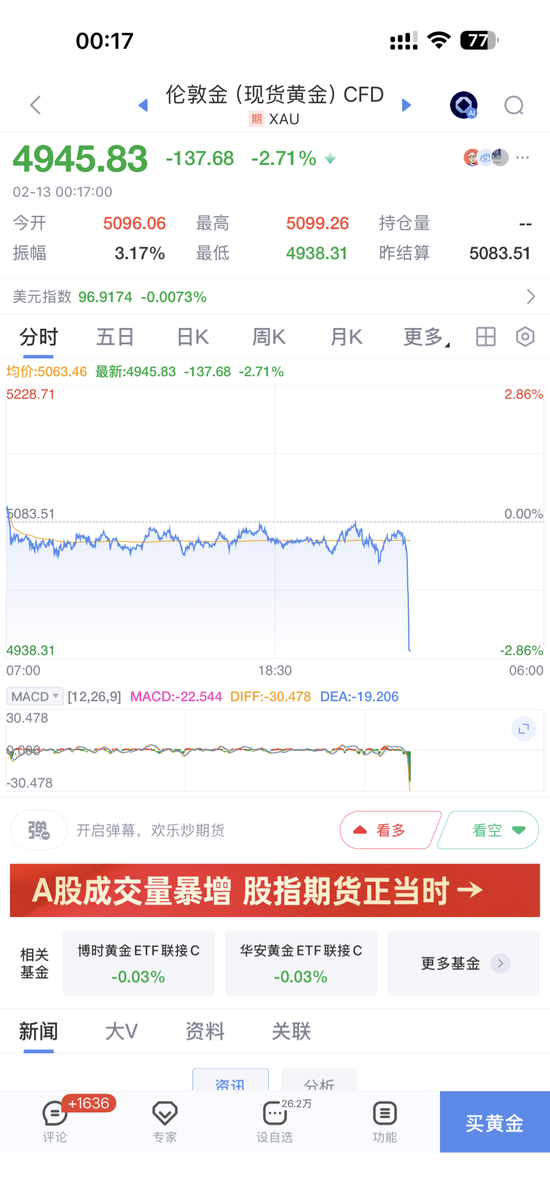
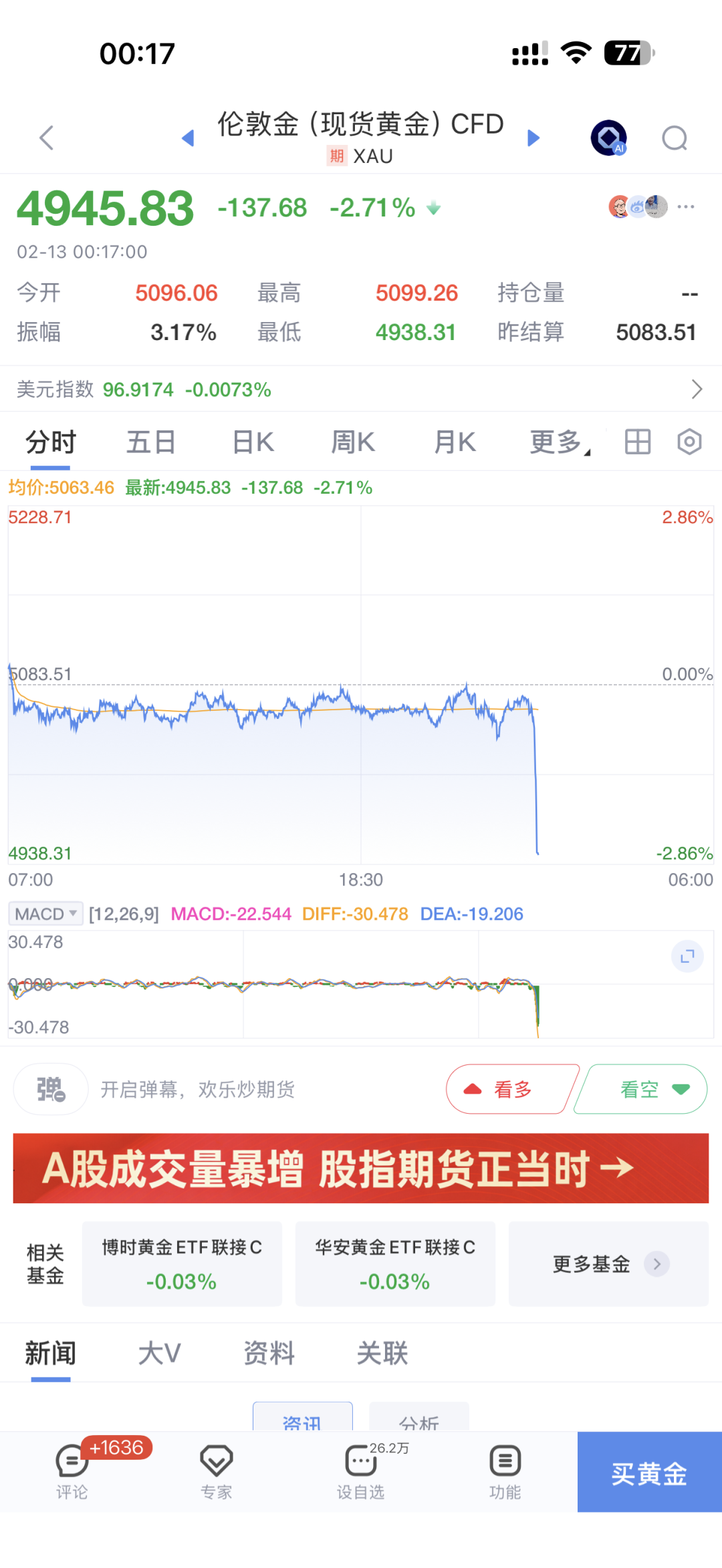
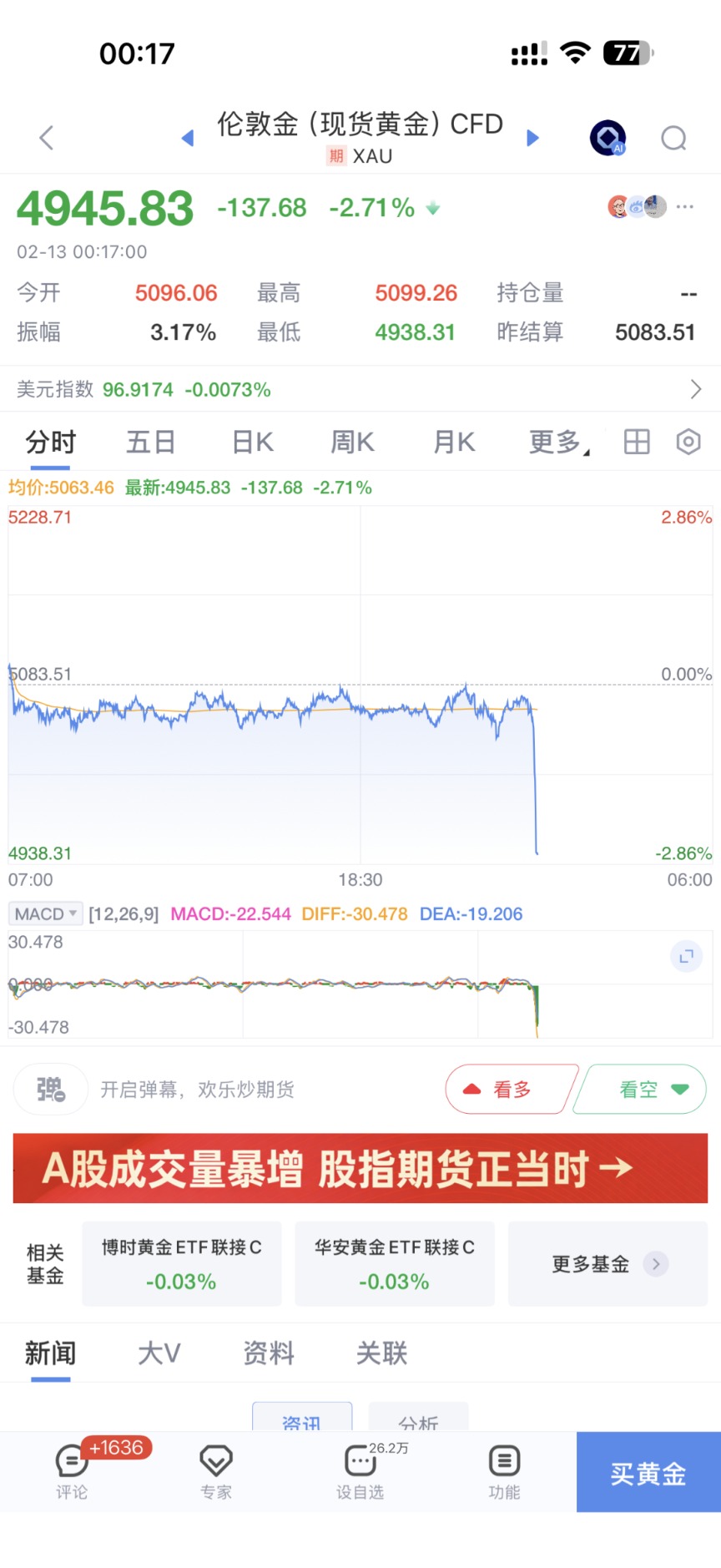
Market Overview - Precious metals experienced a sharp decline, with London gold and silver spot prices dropping by 2.71% and 7.06% respectively [1][17] - The U.S. stock market saw significant volatility, with the Dow Jones slightly down, the Nasdaq index dropping over 1%, and the S&P 500 index declining by 0.5% [7][21] Technology Sector - Major technology stocks faced pressure, with Netflix falling over 5%, and Amazon, Apple, and Meta each declining by more than 2% [12][26] - Cisco's stock plummeted over 11% due to disappointing earnings guidance for the current quarter [12][26] - AI advertising technology company Applovin's stock dropped nearly 19% after releasing fourth-quarter results that, while exceeding market expectations, did not alleviate concerns regarding AI-related impacts [12][26] Semiconductor and Storage Sector - The storage chip sector was a standout performer, with Seagate Technology rising approximately 10%, Western Digital increasing by about 8.65%, and SanDisk up by around 6% [12][28] - The strong performance in the NAND flash memory market is attributed to a robust recovery cycle driven by AI-related demand in data centers and enterprise servers, with revenue and profit forecasts from Japanese flash memory manufacturer Kioxia exceeding market expectations by 35% to 60% [12][28] Chinese Stocks - The Nasdaq Golden Dragon China Index fell by over 2.5%, indicating a notable adjustment in Chinese stocks [12][28]

深夜,黄金白银闪崩暴跌!科技股又跳水了,仅剩存储芯片暴涨
Zhong Guo Ji Jin Bao· 2026-02-12 22:43
Market Overview - A-shares trading volume has surged, indicating a favorable environment for stock index futures [2][3] - The U.S. stock market experienced volatility, with major indices like the Dow Jones and Nasdaq showing declines, particularly the Nasdaq which fell over 1% [4] Sector Performance - Walmart's stock rose nearly 4%, reaching a new high, reflecting strong performance in more cyclical market sectors [5] - The technology sector faced significant pressure, with major tech stocks like Netflix dropping over 5%, and Amazon, Apple, and Meta each declining by more than 2% [4][8] Notable Stock Movements - Cisco's stock plummeted over 11% due to disappointing earnings guidance for the current quarter [8] - Applovin's shares fell nearly 19% after releasing fourth-quarter results that, while exceeding market expectations, did not alleviate concerns regarding AI-related impacts [8] - Seagate Technology saw a significant increase of approximately 10%, driven by strong demand in the NAND flash memory market, which is benefiting from AI-driven data center needs [10] Investment Sentiment - UBS Wealth Management's Charlie Anderson noted a cautious optimism in the market, suggesting that despite a strong start to 2026, investors should prepare for potential volatility as the market seeks new catalysts [10] - The Nasdaq Golden Dragon China Index, which tracks Chinese stocks listed in the U.S., declined by over 2.5%, indicating a notable adjustment in Chinese concept stocks [10]
尾盘:美股继续下滑 思科领跌科技股
Xin Lang Cai Jing· 2026-02-12 19:57
Core Viewpoint - The U.S. stock market experienced a decline, primarily driven by concerns over the negative impacts of artificial intelligence on various industries, potentially disrupting business models and increasing unemployment rates [1][6]. Market Performance - The Dow Jones Industrial Average fell by 364.68 points, a decrease of 0.73%, closing at 49,756.72 points; the Nasdaq dropped by 351.67 points, down 1.52%, ending at 22,714.79 points; the S&P 500 index decreased by 66.44 points, a decline of 0.96%, closing at 6,875.03 points [3][8]. - Cisco Systems led the technology sector decline with a significant drop of 11.8% following disappointing quarterly guidance [3][8]. Sector-Specific Impacts - Financial stocks, including Morgan Stanley, faced pressure due to fears that AI could disrupt wealth management services [3][8]. - C.H. Robinson and other trucking and logistics companies saw stock prices plummet by 22% amid concerns that AI could optimize freight operations, negatively affecting specific revenue lines [3][8]. - The real estate sector was also affected, with companies like CBRE and SL Green Realty facing declines due to anticipated rising unemployment impacting demand for office space [3][8]. Software Sector Trends - The software sector, already troubled by disruptive concerns, saw further declines, with Salesforce shares dropping by 2% and a year-to-date decline exceeding 31%. Autodesk shares fell over 5%, with a year-to-date drop of 26% [3][8]. - The iShares Expanded Tech-Software Sector ETF (IGV) decreased by 3%, currently down approximately 32% from recent highs [4][9]. Investor Behavior - Increased selling pressure in silver, a popular trading commodity among retail investors, contributed to heightened risk-averse sentiment, with silver futures plummeting by 9% [4][9]. - Defensive sectors attracted investors, with Walmart and Coca-Cola shares rising by 3% and 2%, respectively, leading the S&P 500 sectors, both gaining over 1% [4][9]. Economic Indicators - Following a strong employment report, market enthusiasm waned, with economists questioning whether it would signal a trend in job growth, especially given revisions indicating zero job growth in the second half of 2025 [4][9]. - Traders are preparing for a key inflation report, with economists from Dow Jones expecting a 0.3% month-over-month increase in both the overall Consumer Price Index (CPI) and the core index (excluding food and energy) for January [4][9].


今夜,直线闪崩!
Zhong Guo Ji Jin Bao· 2026-02-12 16:32
Group 1: Precious Metals - Gold and silver prices in London experienced significant declines, with gold dropping by 2.71% and silver plummeting by 7.06% [1][3] Group 2: Technology Stocks - Major U.S. stock indices faced turbulence, with the Nasdaq index falling over 1%, while the Dow Jones and S&P 500 also saw slight declines [6] - Notable declines in technology stocks included Netflix down over 5%, Amazon and Apple each down over 2%, and Cisco plunging over 11% due to disappointing earnings guidance [6][7] - Applovin, an AI advertising technology company, saw its stock drop nearly 19% despite reporting key metrics above market expectations, indicating ongoing concerns about AI-related impacts [6][7] Group 3: Semiconductor Sector - The storage chip sector was a standout performer, with Seagate Technology rising approximately 10%, Western Digital up about 7%, and SanDisk increasing around 6% [8][9] - The NAND flash memory market is entering a strong recovery phase driven by AI-related demand in data centers and enterprise servers, with revenue and profit forecasts from Japanese manufacturer Kioxia exceeding analyst expectations by 35% to 60% [8] Group 4: Market Sentiment - UBS Wealth Management's Charlie Anderson noted a cautious optimism in the market, suggesting that while the stock market remains favorable, investors should prepare for potential volatility as they seek the next catalyst [10] - The Nasdaq Golden Dragon China Index, which tracks Chinese stocks listed in the U.S., fell over 2.5%, indicating a notable adjustment in Chinese equities [10]
曾经的“互联网泡沫之王”,如今重回巅峰!
Xin Lang Cai Jing· 2025-12-12 01:37
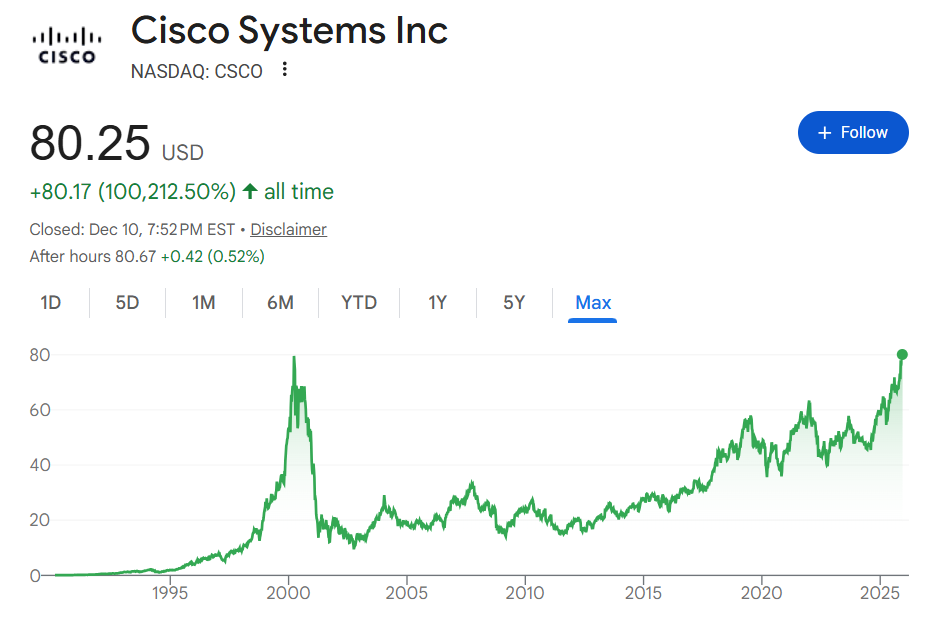
Core Viewpoint - Cisco Systems Inc has reached a historic high in stock price after a prolonged period of stagnation, largely attributed to the surge in spending in the artificial intelligence sector [1][18]. Group 1: Stock Performance and Market Context - Cisco's stock price rose by 0.9% to $80.25, marking a new high not seen in 25 years, with a total market capitalization of $317.1 billion [1][18]. - The stock's peak in March 2000 is viewed as the pinnacle of the internet bubble, and comparisons are being drawn between the current market dynamics and those of the late 1990s [1][21]. - The stock's recovery is seen as a reflection of investor confidence, despite concerns that it resembles a utility company rather than an innovative firm [11][27]. Group 2: Historical Context and Comparisons - Cisco was once the most valuable company globally during the internet boom, with a market cap exceeding $500 billion, but saw its value plummet by over 85% after the bubble burst [5][24]. - The company has since transformed and increased its stock price by over 800%, although its market cap remains more than 40% below its peak during the internet bubble [11][27]. - Comparisons are being made between Cisco and Nvidia, with some analysts suggesting that both companies are at the center of a potential AI bubble similar to the internet bubble era [3][21]. Group 3: AI Infrastructure and Future Outlook - Cisco's recent stock surge is primarily driven by strong revenue expectations, with the company poised to benefit from significant investments in AI infrastructure [12][29]. - The company anticipates sales of up to $61 billion for the fiscal year ending in July, exceeding Wall Street's expectations by approximately $1 billion [15][29]. - Former CEO John Chambers expressed optimism about AI's growth trajectory, predicting a significant increase in productivity by 2026 and dismissing concerns about an AI bubble [30][32]. Group 4: Strategic Insights and Industry Dynamics - Chambers highlighted the broad applications of AI across various sectors, including retail, automotive, and healthcare, emphasizing the rapid adoption by major companies [30][32]. - He warned that companies lacking a clear AI strategy may face severe challenges, while those with robust plans could thrive through strategic acquisitions and partnerships [32][33]. - The competitive landscape is expected to shift, with larger firms potentially facing setbacks, while mid-sized and smaller companies may encounter greater risks [32][33].
机构预测:中国生成式AI相关网络硬件支出将从2023年的65亿元增加到2028年的330亿元
Zheng Quan Shi Bao Wang· 2025-08-15 03:54
Core Insights - The rapid adoption of artificial intelligence (AI) across various sectors is enhancing efficiency and innovation in both business decision-making and personal digital assistance [1] - The demand for AI is significantly increasing the consumption of tokens in China, with a projected daily usage growth of nearly 10 times by the second half of 2024 [1] Group 1: AI Adoption and Impact - AI applications are being integrated into various industries to improve operational efficiency and user experience [1] - The total token consumption for public cloud large models in China is expected to reach 114.2 trillion tokens in 2024, excluding usage from overseas MaaS platforms [1] Group 2: Infrastructure Challenges - The surge in token usage is creating new demands on digital infrastructure, particularly in data centers, where communication energy consumption is rising [1] - The traditional upgrade logic of "compute first, then network" is becoming obsolete, necessitating a shift in network planning to accommodate high bandwidth, reliability, and low energy consumption [1] Group 3: Market Projections - The shipment volume of high-end Ethernet ports (≥200G) in China is projected to exceed 6 million in 2024, with a compound annual growth rate (CAGR) of 45.6%, reaching over 43 million by 2029 [1] - Spending on network hardware related to generative AI in China is forecasted to grow from 6.5 billion yuan in 2023 to 33 billion yuan by 2028, with a CAGR of 38.5% [1]