
自驾游

Search documents
江苏人春节开车出游最爱去哪
Xin Hua Ri Bao· 2026-02-24 21:20
Core Insights - The Jiangsu self-driving tourism market during the Spring Festival is characterized by high proportion, high traffic, and high growth, with self-driving accounting for nearly 80% of total travel volume in the province [1] - Daily exit flow on highways reached 3.42 to 3.59 million vehicles, a year-on-year increase of 4.5% and a 44% increase compared to regular days, setting a historical record for road network traffic during the Spring Festival [1] Group 1: Market Dynamics - The average daily flow at provincial boundary passages on national and provincial roads was 1.809 million vehicles, with highways accounting for 67% (1.211 million vehicles) [1] - The highest daily flow at the Su-Wan provincial boundary reached 806,000 vehicles, making it a core hub for cross-province self-driving [1] - Cross-province self-driving flow between Jiangsu, Zhejiang, and Shanghai ranks among the highest in the country, with Nanjing, Suzhou, and Wuxi as key departure cities [1] Group 2: Visitor Demographics - The top 10 sources of out-of-province self-driving visitors to Jiangsu are Anhui, Shanghai, Shandong, Zhejiang, Henan, Guangdong, Beijing, Hebei, Liaoning, and Shanxi [2] - The top 10 destinations for Jiangsu residents traveling out of the province include Zhejiang, Anhui, Shanghai, Jiangxi, Fujian, Guangdong, Shandong, Hunan, Henan, and Hubei [2] - The post-90s generation constitutes the majority of self-driving tourists at 42.5%, an increase of 5.8 percentage points year-on-year, showing a preference for niche destinations and customized routes [2] Group 3: Consumer Behavior - Orders for high-quality homestays increased by 12.6% year-on-year, with rural and hot spring homestays becoming popular [3] - Rural experience consumption (folk experiences, farmhouse meals) grew by 9.7%, indicating a closer integration of rural cultural tourism resources with self-driving travel [3] - The proportion of self-driving trips using new energy vehicles reached 32.1%, a significant increase of 12.1 percentage points from 2025, driven by improved charging infrastructure [3]
春节自驾更多人“一路向南”,“一老一小”为主力境外小众目的地受青睐
Xin Lang Cai Jing· 2026-02-24 03:54
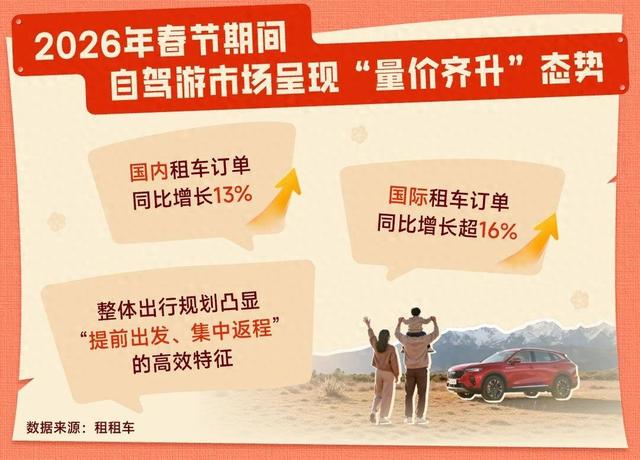
Group 1 - The core viewpoint of the report indicates a significant increase in both domestic and international self-driving travel during the 2026 Spring Festival, driven by factors such as the late holiday timing and convenient leave arrangements, with domestic car rental orders increasing by 13% and international orders by over 16% [1][5] Group 2 - The domestic self-driving market experienced a dual peak during the Spring Festival, characterized by the rigid demand for family reunions and the enthusiasm for southern vacations, with popular destinations being Hainan, Yunnan, and Guangdong, and overall order volume increasing by over 11% [3][5] - Classic self-driving routes remain popular, including the Hainan circular route and the scenic route from Kunming to Dali, with the average car rental period increasing by 7% and daily spending rising by 9%, reflecting a trend towards deeper and slower travel [3][5] Group 3 - The outbound self-driving travel market saw a significant growth in orders, with a 16% increase, and the peak travel period shifted to February 8-10, highlighting travelers' strategy of off-peak travel [5][6] - The rise of the "visiting relatives + tourism" model is a notable trend, with users completing both domestic and international self-driving trips increasing by 68% [5][6] Group 4 - Emerging destinations are gaining popularity, with South America showing the fastest growth, particularly Chile and Argentina, which saw increases of 218% and 246% respectively, while Oceania grew by over 30% [6][8] - Lesser-known cities are attracting more experienced self-driving enthusiasts, leading to a significant increase in bookings for these destinations, which require more planning and preparation [8] Group 5 - The source of outbound self-driving tourists is changing, with significant growth in demand from midwestern cities, such as Chongqing and Wuhan, which saw nearly 60% growth, indicating that self-driving travel is expanding beyond first-tier cities [8][10]

我国持续推动汽车后市场服务消费扩容提质
Xin Lang Cai Jing· 2026-02-10 04:37
Core Viewpoint - The Chinese Ministry of Transport is focusing on enhancing service consumption in the transportation sector, particularly through the promotion of self-driving tourism and the development of high-quality travel routes to stimulate economic growth and consumer spending [1][2]. Group 1: Self-Driving Tourism Development - Self-driving tourism has emerged as a new consumption hotspot, with many highways becoming popular tourist destinations, fulfilling public demand and boosting consumption [1]. - The Ministry plans to create a series of long-distance, cross-regional, high-quality self-driving tourism routes, improving road service capabilities and enhancing travel experiences [2]. Group 2: New Consumption Models - The Ministry is collaborating with other departments to develop innovative tourism products, such as "service area + tourism" and "bridge + tourism," which effectively stimulate related sectors like car rentals and camping services [2]. - There is a focus on supporting new consumption formats along travel routes, including self-driving camps, rental facilities, boutique accommodations, and themed dining [2]. Group 3: Growth of Rental and Night Tourism - The small and micro car rental market is expected to grow at an annual rate of approximately 15% during the 14th Five-Year Plan period, with efforts to enhance service networks and improve rental conditions [3]. - The Ministry is also working on measures to promote the night cruise economy and expand yacht consumption, with a target of 9,850 registered yachts by the end of 2025 [3]. Group 4: Expansion of Automotive Aftermarket Services - The automotive market in China has seen continuous growth, with a vehicle ownership of 366 million, leading to increased demand for aftermarket services like car modifications and rentals [4]. - The Ministry of Commerce is implementing measures to extend the automotive consumption chain, including pilot programs for automotive circulation and promoting automotive cultural events [5]. Group 5: Event Economy Development - The development of the event economy is a key focus, with efforts to enhance sports event services and innovate economic models to sustain growth in this sector [6].
第三届丝绸之路公路旅行大会在陕圆满落幕,“国家旅程”理念引发业界深度共鸣
Xin Lang Cai Jing· 2026-01-19 12:00
Core Insights - The "Third Silk Road Highway Travel Conference" was successfully held in Yang County, Shaanxi Province, focusing on the theme of "Silk Road Self-Driving, Habitat of the Red-crowned Crane, Integration of Transportation and Tourism" [1] - The event attracted over 170 participants from 16 provinces, including self-driving tourism associations, transportation service agencies, cultural tourism enterprises, and experts [1] Group 1: Industry Leadership and Collaboration - Liu Yiye, Deputy County Mayor of Yang County, and Wang Xinyu, Vice President and Secretary-General of the Shaanxi Tourism Association, issued an investment tourism invitation to self-driving tourism peers [2] - Song Lei, Secretary-General of the China Tourism Vehicle and Ship Association, emphasized the critical role of self-driving tourism in regional cultural and tourism resource integration and called for deeper collaboration and standardization [3] Group 2: Keynote Speeches and Innovations - Expert Ju Rongyun discussed the transformation of highway service areas into scenic and localized composite services, proposing a comprehensive service system for self-driving tourism [7] - Gui Bin, President of the Shaanxi Self-Driving and RV Camping Association, presented the "National Journey" concept, advocating for a shift from resource-driven to culture-driven self-driving tourism [10][12] Group 3: Consensus and Ecological Initiatives - Representatives from 16 provinces jointly released the "Qinling Ecological Civilization Tourism Declaration," promoting ecological priority, low-carbon travel, and responsible tourism practices [13] - The declaration aims to establish a shared ecological value recognition and demonstration standards within the self-driving tourism industry in the Qinling region [13] Group 4: Product Development and Strategic Collaborations - The "Silk Road International Self-Driving Core Segment" standardized product was launched, aiming to transition self-driving tourism from "single-point organization" to "systematic operation" [15] - A cooperation agreement was signed between the Yang County Cultural and Tourism Bureau and the North China Eight Provinces and Two Cities Self-Driving Tourism Association [18] - The conference also released a 2025 self-driving tourism recommendation list covering nine categories, including destinations and camping sites [19]

春节自驾游市场热度攀升 出境自驾需求有望超2025年国庆高峰丨封面有数
Xin Lang Cai Jing· 2026-01-09 08:22
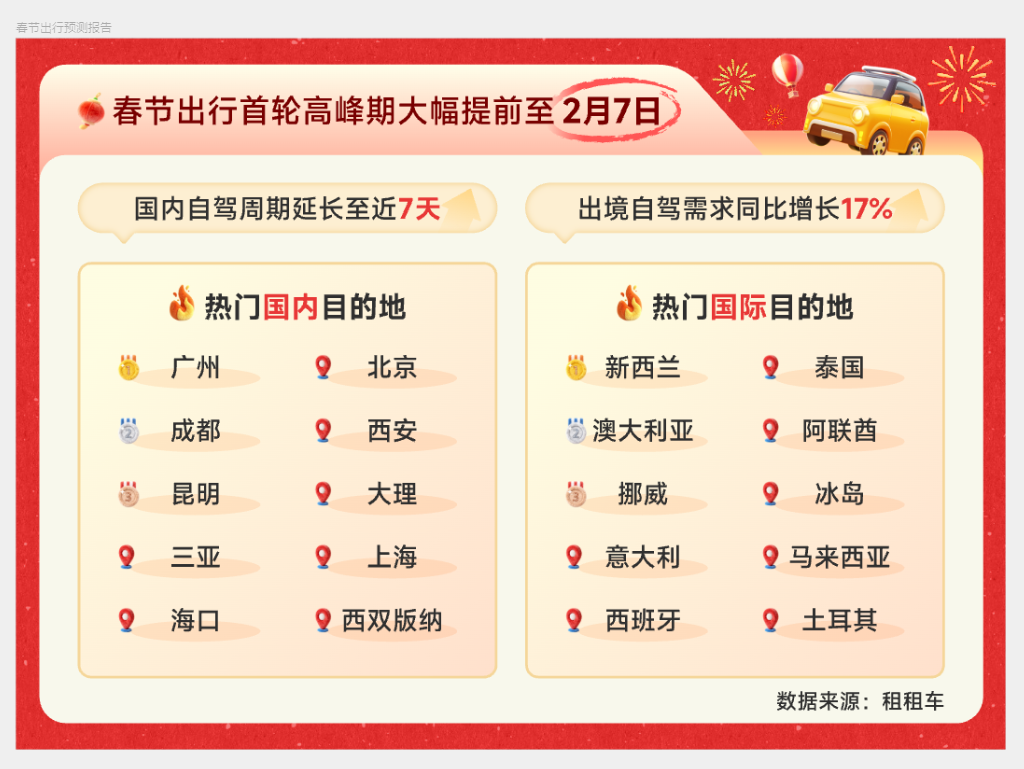
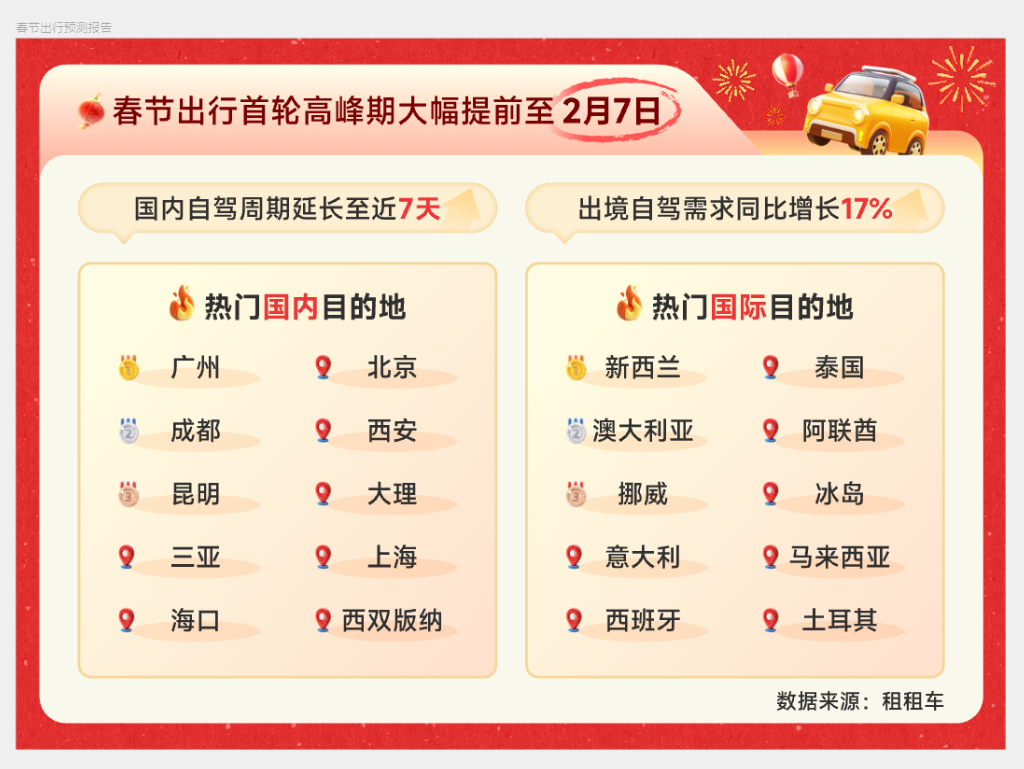
Core Insights - The demand for self-driving travel during the Spring Festival is expected to surpass the peak seen during the National Day holiday in 2025, with outbound self-driving bookings increasing by 17% compared to the same period last year [1] - The domestic self-driving travel market has shown resilience, with travel volumes consistently exceeding those of the same period in 2024, driven by a longer holiday period and accumulated travel demand [3] Group 1: Travel Trends - The Spring Festival travel peak is anticipated to start earlier, with a significant concentration of departures expected on February 7, followed by additional peaks on February 11 and 13, culminating in a concentrated travel period from February 14 to 15 [4] - This year, travelers are focusing on efficient use of their holiday, with a concentrated return on February 22, indicating a trend of "full enjoyment throughout the trip and concentrated return" [4] Group 2: Booking Characteristics - The overall self-driving travel during the Spring Festival is characterized by "delayed bookings" and "longer rental periods," with the booking peak expected to be about a week later than last year, and average trip lengths extending to nearly 7 days [5] - There is a clear distinction between "return home" and "tourism" flows, with popular return destinations including Chengdu, Fuzhou, and Wuhan, while tourism-focused travelers prefer combined travel methods of "plane/train + rental car" to cities like Guangzhou and Sanya [5] Group 3: Outbound Travel Demand - Popular outbound self-driving destinations during the Spring Festival include New Zealand, Australia, Norway, and Italy, with the southern hemisphere and northern European countries particularly favored by self-driving enthusiasts [6][7] - In Australia and New Zealand, self-driving demand has surged, with a month-on-month increase of approximately 30% since late 2025, leading to inventory shortages for popular vehicle models [6] - Norway has seen a 21% year-on-year increase in self-driving demand for the Spring Festival, with some popular vehicle models requiring bookings over two months in advance due to high demand [7]
春节自驾游热潮开启 广州成为国内最热自驾游目的地
Xin Lang Cai Jing· 2026-01-08 23:08
Group 1 - The core viewpoint of the article highlights the significant increase in self-driving travel bookings for the upcoming Spring Festival, with Guangzhou emerging as the top travel destination [2] - The domestic self-driving travel market has remained active since the National Day in 2025, with travel volumes consistently exceeding those of the same period in 2024 [2] - The extended Spring Festival holiday in 2026 is expected to create a "red opening" for the self-driving travel market due to accumulated travel intentions and long holidays [2] Group 2 - The characteristics of self-driving rentals this year include "delayed bookings and longer rental periods," with the average trip extending to nearly 7 days [4] - Popular return destinations include Chengdu, Fuzhou, Dongguan, and others, while tourist destinations are concentrated in Guangzhou, Chengdu, Kunming, and more [4] - The preference for combined travel methods, such as "plane/train + rental car," is increasing among travelers [4] Group 3 - The demand for outbound self-driving trips remains strong, with popular destinations including New Zealand, Australia, Norway, and others [5] - The self-driving demand in Norway has increased by 21% year-on-year, and Turkey has seen a more than 80% increase in bookings following the introduction of a visa-free policy [5] - The market reflects a dual trend of "ice and fire," with southern hemisphere destinations attracting families and northern Europe appealing to younger travelers [5] Group 4 - Guangdong's cultural and tourism advantages are highlighted, with its warm climate and well-developed road network making it a key destination for self-driving trips during the Spring Festival [6] - Guangzhou serves as a major transportation hub and tourist destination, linking self-driving routes within the province and surrounding areas [6] - The dual characteristics of "returning home + nearby travel" are evident in places like Dongguan, attracting many short-distance self-driving tourists during the festival [6] Group 5 - As the Spring Festival approaches, the self-driving travel market is expected to continue its upward trend, with multiple domestic and international routes anticipating a peak in bookings [7]
春节自驾游市场热度逐渐升温 出境自驾需求增长显著
Zheng Quan Shi Bao Wang· 2026-01-08 10:10
Group 1 - The core viewpoint of the articles highlights a significant increase in self-driving travel demand during the upcoming Spring Festival, with outbound self-driving bookings rising by 17% compared to the same period last year, and overall expectations to surpass the peak seen during the National Day holiday in 2025 [1] - The trend of "early departure" is noted as a prominent feature for self-driving travel this Spring Festival, influenced by the later timing of the holiday and an additional day off, leading to a "slow booking" and "long rental period" characteristic [1] - Popular return destinations for travelers include cities like Chengdu, Fuzhou, Dongguan, Jieyang, Guiyang, and Wuhan, while tourists seeking leisure prefer a combination of "flight/high-speed rail + rental car" to destinations such as Guangzhou, Chengdu, Kunming, Sanya, Haikou, Beijing, Xi'an, Dali, Shanghai, and Xishuangbanna [1] Group 2 - Popular outbound self-driving destinations during the Spring Festival include New Zealand, Australia, Norway, Italy, Spain, Thailand, UAE, Iceland, Malaysia, and Turkey, with a notable preference for summer destinations in the Southern Hemisphere and Northern European countries known for their auroras [2] - In Australia and New Zealand, self-driving demand has surged significantly, with a reported 30% month-on-month increase in self-driving demand for both countries as the travel season begins and more flight routes resume [2] - Norway and Iceland are also experiencing a new wave of tourist influx, with Norway seeing a 21% year-on-year increase in self-driving demand for the 2026 Spring Festival, leading to a shortage of popular vehicle models that require bookings over two months in advance [2]
春节自驾游市场热度攀升,出境需求增长显著,南半球与北欧成热门
Yang Zi Wan Bao Wang· 2026-01-08 08:18
Core Insights - The demand for self-driving trips during the Spring Festival is expected to surpass the peak seen during the National Day holiday in 2025, with outbound self-driving bookings increasing by 17% compared to the same period last year [1] - The domestic self-driving travel market has shown consistent activity, with travel numbers remaining above those of the same period in 2024, driven by a longer holiday period and accumulated travel demand [1] Group 1: Travel Trends - The peak travel period for self-driving trips is anticipated to start earlier, with a significant surge expected on February 7, followed by additional peaks on February 11 and 13, culminating in a concentrated travel period from February 14 to 15 [2] - Travelers are focusing on efficient use of their holiday time, with a concentrated return on February 22, indicating a trend towards "full enjoyment throughout the trip and concentrated return" [2] Group 2: Travel Duration and Patterns - The overall domestic self-driving travel is characterized by longer booking periods and extended rental durations, with average trip lengths increasing to nearly 7 days due to the later timing of the Spring Festival and an additional day off [3] - There is a clear distinction between "return home" and "tourism" travel flows, with popular return destinations including Chengdu, Fuzhou, and Dongguan, while tourism-focused travelers prefer combined travel methods such as "plane/train + rental car" [3] Group 3: Outbound Travel Popularity - Popular outbound self-driving destinations during the Spring Festival include New Zealand, Australia, Norway, Italy, Spain, Thailand, UAE, Iceland, Malaysia, and Turkey, with a notable increase in demand for destinations in the Southern Hemisphere and Northern Europe [5] - In Australia and New Zealand, self-driving demand has surged by approximately 30% since December 2025, driven by the peak travel season and increased flight availability [5] - Norway has seen a 21% year-on-year increase in self-driving demand for the Spring Festival, with some popular vehicle models requiring bookings over two months in advance due to high demand [5] Group 4: Market Dynamics - Following the announcement of visa-free travel to Turkey, self-driving bookings for the country surged by over 80% compared to the previous period, reflecting a growing interest among Chinese travelers [6] - The market is witnessing a dual trend of increased interest in both sunny Southern Hemisphere destinations and unique experiences in Northern Europe, indicating a diversification in travel preferences among Chinese self-driving tourists [6]
元旦假期首日:国内酒店预订热度增长超3倍,三亚入境游客大增5倍
Xin Lang Cai Jing· 2026-01-01 06:23
Core Insights - The domestic hotel booking popularity on January 1st has increased over three times compared to the same period last year [1] - Travelers visited 698 cities domestically and over 800 cities internationally, with more than 200 domestic cities seeing hotel stays [1] - January 1st marks the first holiday after Hainan's customs closure, with the tourism market in Hainan experiencing a doubling in activity [1] Hotel Booking Trends - The data from Qunar indicates that the number of flight tickets to Haikou on January 1st ranked among the top ten nationwide [1] - The popularity of self-driving tours around Hainan has surged, with Haikou and Sanya ranking as the top two destinations, showing significant year-on-year increases of 81% and 96% respectively [1] - Almost all cities and counties in Hainan welcomed more travelers compared to last year on January 1st [1] Popular Destinations - The most popular destinations for hotel stays in Hainan include Sanya, Haikou, Wanning, Lingshui, and Wenchang [1]
“十五五”中国小微客车短租市场规模年均料增15%左右
Zhong Guo Xin Wen Wang· 2025-12-23 12:16
Core Insights - The Chinese micro car rental market is projected to grow at an annual rate of approximately 15% during the 14th Five-Year Plan period [1][2] - The Ministry of Transport identifies key growth areas in transportation consumption, including yacht and cruise services, which are expected to see significant development [1] Group 1: Micro Car Rental Market - The total number of micro rental cars in China has reached 4 million, indicating rapid growth in this sector [2] - The Ministry of Transport plans to address current challenges in the micro car rental market by enhancing vehicle supply during peak times and optimizing rental services at transportation hubs [2] Group 2: Yacht and Cruise Services - The number of newly registered yachts in China has been growing at an annual rate of over 40% for the past three years, indicating a shift towards more accessible yacht consumption [1] - The Ministry of Transport, in collaboration with the Ministry of Culture and Tourism, is implementing measures to promote cruise transportation and tourism services [1] Group 3: Self-Driving Tourism - Self-driving tourism has emerged as a new trend, with many roads becoming popular tourist destinations, contributing to consumer demand and enhancing service quality [2] - The Ministry of Transport aims to improve the highway service system and develop a series of cross-regional, distinctive self-driving routes [2]