
高技术制造等

Search documents
工业利润扭转连续3年下降态势
第一财经· 2026-01-27 04:23
Core Viewpoint - The article highlights the positive growth in industrial profits in 2025, driven by proactive macroeconomic policies and the emergence of new growth drivers in the manufacturing sector, marking a turnaround from three consecutive years of decline [3][4]. Summary by Sections Overall Industrial Profit Growth - In 2025, the total profit of industrial enterprises above designated size reached 73,982 billion yuan, an increase of 0.6% compared to the previous year [3]. - December 2025 saw a monthly profit increase of 5.3%, reversing a 13.1% decline in November, indicating a significant recovery [3]. Profit Growth by Industry - Manufacturing profits grew by 5.0% in 2025, a substantial rebound of 8.9 percentage points from 2024 [4]. - The electricity, heat, gas, and water production and supply sector saw a profit increase of 9.4%, while the mining sector experienced a decline of 26.2% [4]. Profit Growth by Enterprise Type - In 2025, small and medium-sized enterprises, as well as foreign and Hong Kong, Macao, and Taiwan-invested enterprises, saw profit growth of 1.4% and 4.2%, respectively, reversing previous declines of 1.9% and 1.7% in 2024 [4]. - Profit declines for joint-stock enterprises and state-controlled enterprises narrowed by 3.5 and 0.7 percentage points, respectively, compared to the previous year [4]. Sector-Specific Insights - The equipment manufacturing sector's profits increased by 7.7%, contributing 2.8 percentage points to the overall profit growth of industrial enterprises, with its profit share rising to 39.8% [6]. - High-tech manufacturing profits surged by 13.3%, outperforming the overall industrial profit growth by 12.7 percentage points [6]. - The smart electronics sector saw a remarkable profit increase of 48.0%, with specific industries like smart drones and smart vehicle equipment experiencing profit growth of 102.0% and 88.8%, respectively [6]. Traditional Industries Performance - Traditional industries showed significant profit growth, with the biochemical pesticide and information chemical manufacturing sectors growing by 20.7% and 15.2%, respectively, exceeding the average profit growth in the chemical industry [7]. - In the chemical fiber and power sectors, profits from bio-based chemical fiber manufacturing and biomass power generation grew by 88.6% and 47.9%, respectively, significantly above their industry averages [7]. Future Outlook - The article emphasizes the need for continued technological and industrial innovation to support sustainable profit growth and address challenges posed by external environmental changes [7].


中经评论:16年规模第一,中国制造当更强
Jing Ji Ri Bao· 2026-01-23 00:09
Core Viewpoint - China's manufacturing sector is expected to maintain its position as the world's largest for 16 consecutive years, with a complete industrial system and a focus on high-end, intelligent, and green transformation [1][2][3] Group 1: Manufacturing Scale - China's manufacturing value added has been the highest globally since 2010, currently accounting for nearly 30% of global manufacturing, making it a key driver of global manufacturing growth [1] - Among 504 major industrial products worldwide, China leads in the production of most, including basic materials like steel and cement, as well as high-end equipment like industrial robots and electric vehicles [1] Group 2: Industrial System Completeness - China is the only country with a complete industrial classification covering all industrial categories, ensuring a stable and efficient production chain that can quickly respond to diverse global market demands [2] Group 3: High-end Manufacturing - High-end manufacturing is crucial for addressing weaknesses in core technologies and enhancing the quality and technical level of Chinese manufacturing, with significant growth expected in equipment and high-tech manufacturing sectors by 2025 [2] Group 4: Intelligent Manufacturing - Intelligent manufacturing, driven by AI, big data, and industrial internet technologies, allows China to compete on equal footing with developed countries, leveraging its advantages in new information technologies [3] Group 5: Green Manufacturing - Green manufacturing focuses on low-carbon technologies and circular economies, with projections indicating that by 2025, China's production of new energy vehicles will exceed 16 million units, maintaining its global leadership [3]
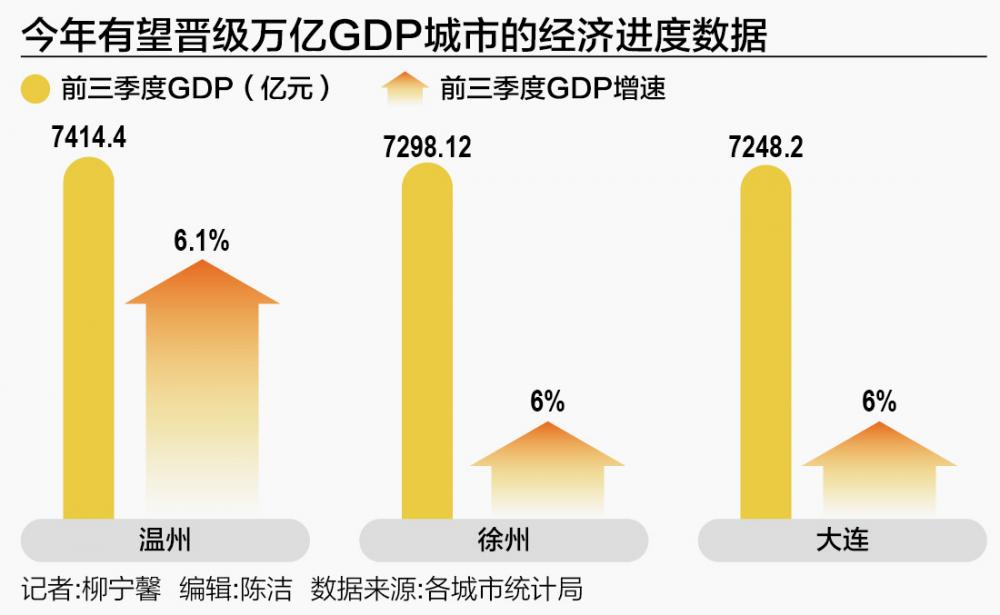
温州、徐州、大连冲刺万亿GDP城市 谁将晋级?
2 1 Shi Ji Jing Ji Bao Dao· 2025-12-13 00:55
Core Viewpoint - The competition for cities to join the "trillion GDP club" is intensifying, with Wenzhou, Xuzhou, and Dalian as key contenders, highlighting a shift in China's economic growth dynamics towards ordinary prefecture-level cities [1][19][20]. Group 1: Economic Growth and City Development - Wenzhou is expected to surpass a GDP of 1 trillion yuan this year, with Xuzhou and Dalian also aiming for this milestone [2][21]. - Currently, there are 27 cities in the trillion GDP club, with notable representation from various regions including the Yangtze River Delta and the Pearl River Delta [2][21]. - The expansion of the trillion GDP club is characterized by the rise of ordinary prefecture-level cities, indicating a change in the economic landscape of China [2][21][35]. Group 2: Wenzhou's Economic Strategy - Wenzhou's economic growth is supported by a robust manufacturing base and a strong private sector, with 156.4 million registered private enterprises as of November 2025 [6][26]. - The city aims to establish a dual trillion industry cluster by 2025, focusing on both traditional and emerging industries [7][26]. - Wenzhou's industrial transformation has shown significant results, with traditional and emerging industries experiencing growth rates of 11.4% and 12.4% respectively in the first ten months of the year [7][26]. Group 3: Dalian's Economic Challenges and Opportunities - Dalian aims to achieve a GDP of 1 trillion yuan by 2025, with a current GDP of 9516.9 billion yuan projected for 2024 [10][31]. - The city has a strong traditional industrial base, particularly in the petrochemical sector, but faces challenges in transitioning to high-tech manufacturing [11][32]. - Dalian's strategic location and existing industrial foundation provide significant growth potential, despite current limitations in innovation and industry structure [11][32]. Group 4: Xuzhou's Growth Potential - Xuzhou's GDP reached 7298.12 billion yuan in the first three quarters of the year, with a target to exceed 1 trillion yuan by 2025 [12][33]. - The city is positioned as a key player in addressing the economic imbalance between southern and northern Jiangsu province [14][33]. - Xuzhou's development strategy includes leveraging its geographical advantages to become a hub for regional connectivity [14][33]. Group 5: Future Trends in Urban Economic Development - The trend of ordinary prefecture-level cities joining the trillion GDP club is expected to continue, with cities like Shaoxing, Yangzhou, Yancheng, and Jiaxing as potential candidates [15][35]. - The focus on urbanization and collaboration with nearby major cities is crucial for these cities to achieve sustainable growth [36][37]. - Future urban development will prioritize not only GDP growth but also the quality of growth, emphasizing metrics such as per capita GDP and innovation resources [38][37].
最新经济数据公布!主要指标增长
Jing Ji Wang· 2025-08-15 08:49
Economic Overview - The national economy shows a steady and progressive development trend, with continuous growth in production and demand, stable employment and prices, and significant achievements in high-quality development [1] Industrial Performance - The industrial added value for July increased by 5.7% year-on-year and 0.38% month-on-month [2] - The equipment manufacturing sector saw an 8.4% year-on-year increase, while high-tech manufacturing grew by 9.3%, outperforming the overall industrial growth by 2.7 and 3.6 percentage points respectively [2] - Specific products such as 3D printing equipment, industrial robots, and new energy vehicles experienced production increases of 24.2%, 24.0%, and 17.1% year-on-year [3] Service Sector - The service production index rose by 5.8% year-on-year in July [4] - The business activity index for the service sector was at 50.0%, with a business activity expectation index of 56.6%, indicating positive sentiment in sectors like railway transport, air transport, and cultural entertainment [4] Consumer Market - The total retail sales of consumer goods reached 38,780 billion yuan in July, marking a 3.7% year-on-year increase, although it saw a slight month-on-month decline of 0.14% [5] - Sales of essential and some upgraded consumer goods showed strong growth, with categories like food, daily necessities, and sports goods retailing up by 8.6%, 8.2%, and 13.7% respectively [5] - Online retail sales for the first seven months totaled 86,835 billion yuan, growing by 9.2%, with physical goods online retailing at 70,790 billion yuan, a 6.3% increase [5] Investment Trends - Fixed asset investment (excluding rural households) for the first seven months was 288,229 billion yuan, reflecting a 1.6% year-on-year growth, with a 5.3% increase when excluding real estate development [7] - Infrastructure investment grew by 3.2%, while manufacturing investment rose by 6.2%, contrasting with a 12.0% decline in real estate development investment [8] Trade Performance - In July, the total value of goods imports and exports reached 39,102 billion yuan, a 6.7% year-on-year increase, with exports at 23,077 billion yuan (up 8.0%) and imports at 16,026 billion yuan (up 4.8%) [10] - For the first seven months, the total trade value was 256,969 billion yuan, with exports growing by 7.3% and imports declining by 1.6% [10] Employment and Prices - The urban surveyed unemployment rate averaged 5.2% from January to July, with July's rate also at 5.2%, showing a 0.2 percentage point increase from the previous month [12] - The Consumer Price Index (CPI) remained flat year-on-year in July, with a month-on-month increase of 0.4% [13] - Core CPI, excluding food and energy prices, rose by 0.8%, with the increase slightly widening by 0.1 percentage points from the previous month [14]