万亿GDP城市

Search documents
城市图谱|万亿城市俱乐部扩至29席 七成经济增速跑赢全国
Xin Jing Bao· 2026-02-04 11:10
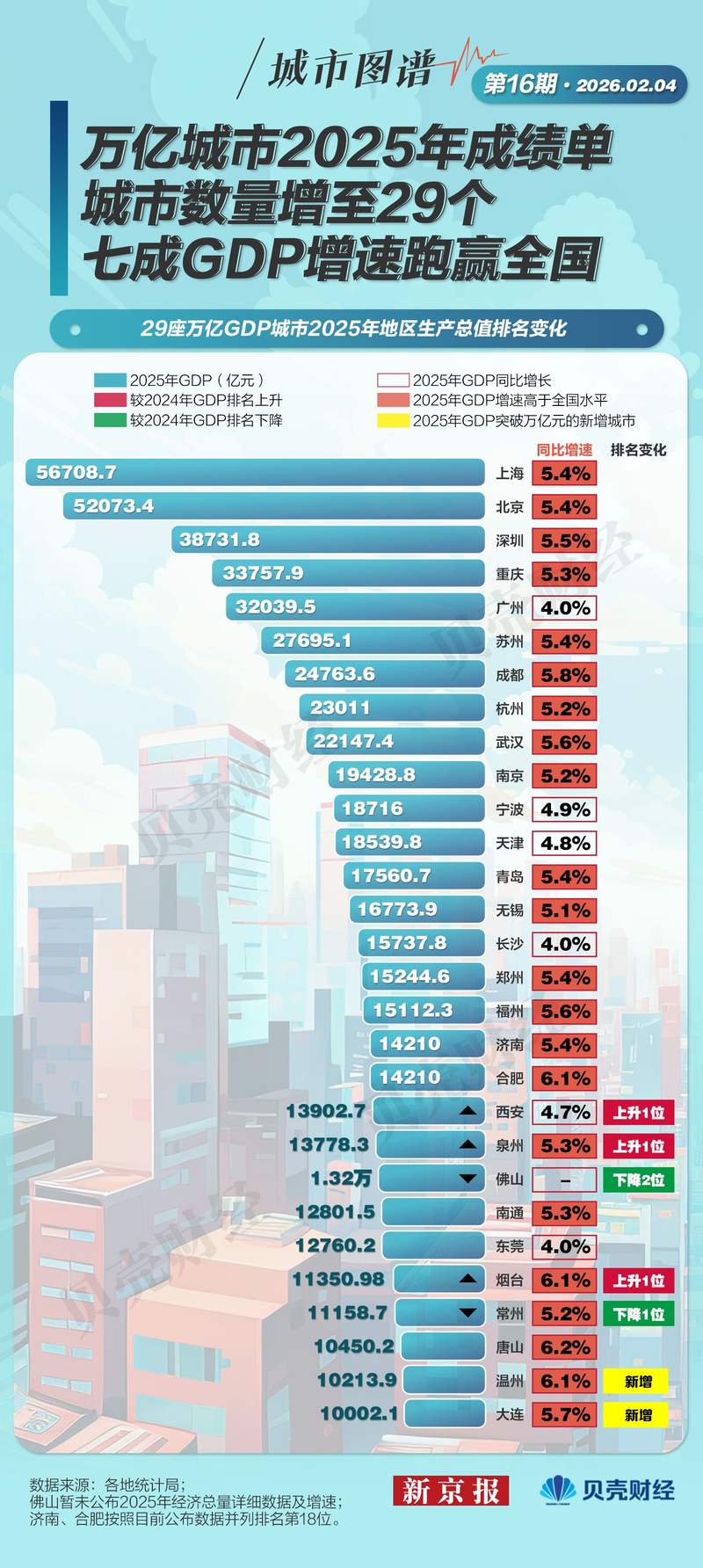
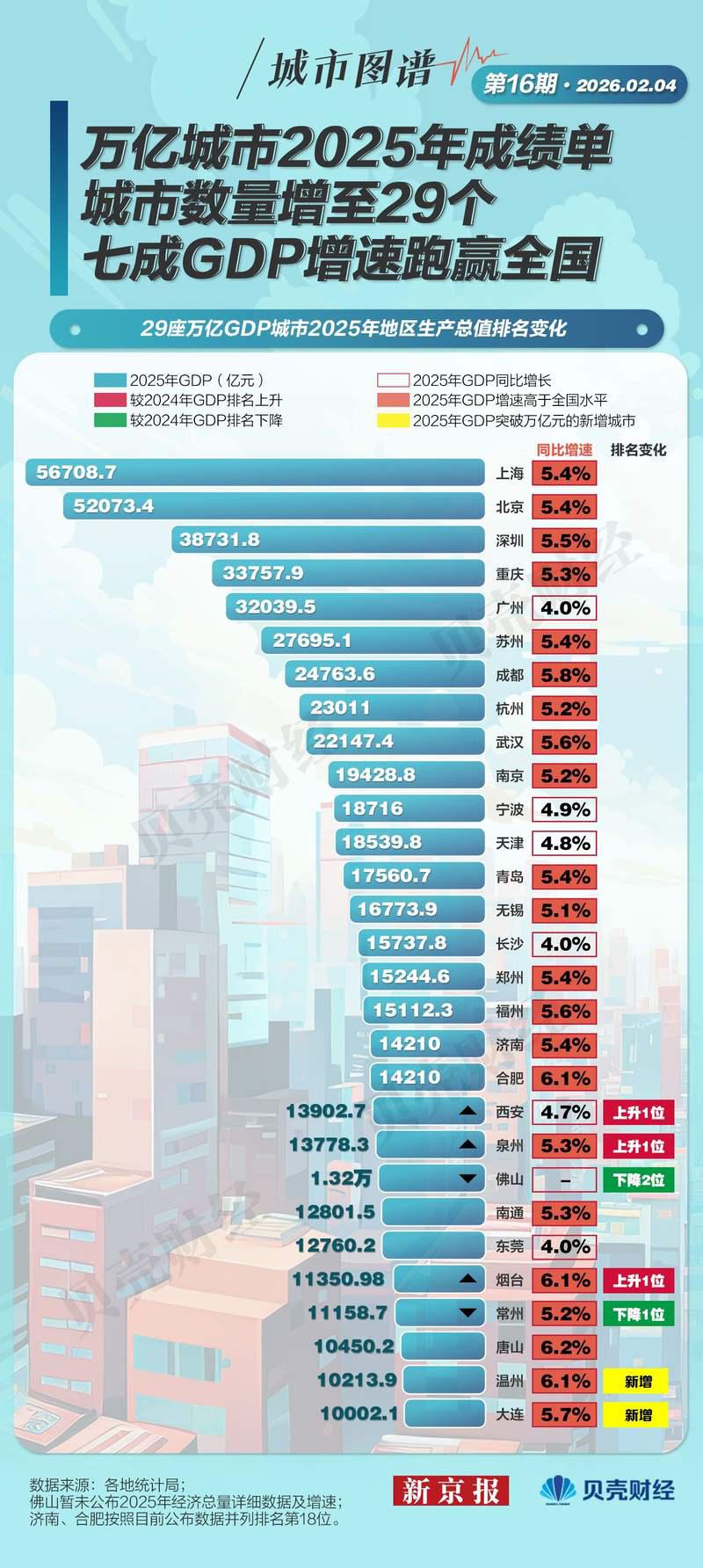
Core Insights - In 2025, Wenzhou and Dalian will join the ranks of trillion-yuan GDP cities, increasing the total number of such cities in China to 29, marking a significant elevation in urban economic capacity [1] - Among the 29 trillion-yuan cities, 22 cities reported GDP growth rates exceeding the national average of 5.0%, with Tangshan leading at a growth rate of 6.2% [1] - The competition among cities ranked below the top 20 is intensifying, with notable changes in rankings compared to 2024 [1] Economic Performance - Shanghai and Beijing have both surpassed 5 trillion yuan in GDP, maintaining their positions as the top two cities in the country [1] - Shenzhen's GDP reached 3.87 trillion yuan, positioning it as a potential candidate to become the next 4 trillion yuan city [1] - Cities such as Hefei, Yantai, and Wenzhou have shown impressive growth rates above 6.0%, indicating strong economic performance [1] Ranking Changes - Xi'an and Quanzhou have each moved up one position in the rankings, while Foshan has dropped two places [1] - Yantai has surpassed Changzhou to enter the top 25 cities, reflecting a rapid reshuffling of rankings among mid-tier cities [1] - The overall competition among cities ranked below the top 20 is becoming increasingly fierce, highlighting the dynamic nature of urban economic development [1]

万亿城市俱乐部扩至29席 七成经济增速跑赢全国
Xin Jing Bao· 2026-02-04 10:32
Group 1 - The core viewpoint of the article highlights the expansion of China's trillion GDP cities, with Wenzhou and Dalian successfully joining the ranks, bringing the total to 29 cities [1] - As of February 4, 2025, all 29 trillion GDP cities have reported their economic performance, with Shanghai and Beijing both surpassing 5 trillion yuan, maintaining their positions as the top two cities in the country [1] - Shenzhen's GDP reached 3.87 trillion yuan, positioning it as a potential candidate to become the next 4 trillion yuan city [1] Group 2 - Among the 28 cities that reported GDP growth rates, 22 cities exceeded the national average growth rate of 5.0%, with Hefei, Yantai, Tangshan, and Wenzhou showing growth rates above 6.0%, and Tangshan leading at 6.2% [1] - The competition among cities ranked 20th and below is intensifying, with Xi'an and Quanzhou each rising one position, while Foshan dropped two positions; Yantai surpassed Changzhou to enter the top 25 [1][3] - The rankings indicate a significant reshuffling among mid-tier cities, reflecting dynamic economic changes [1]
中国万亿城市,扩容至29座
3 6 Ke· 2026-02-04 02:46
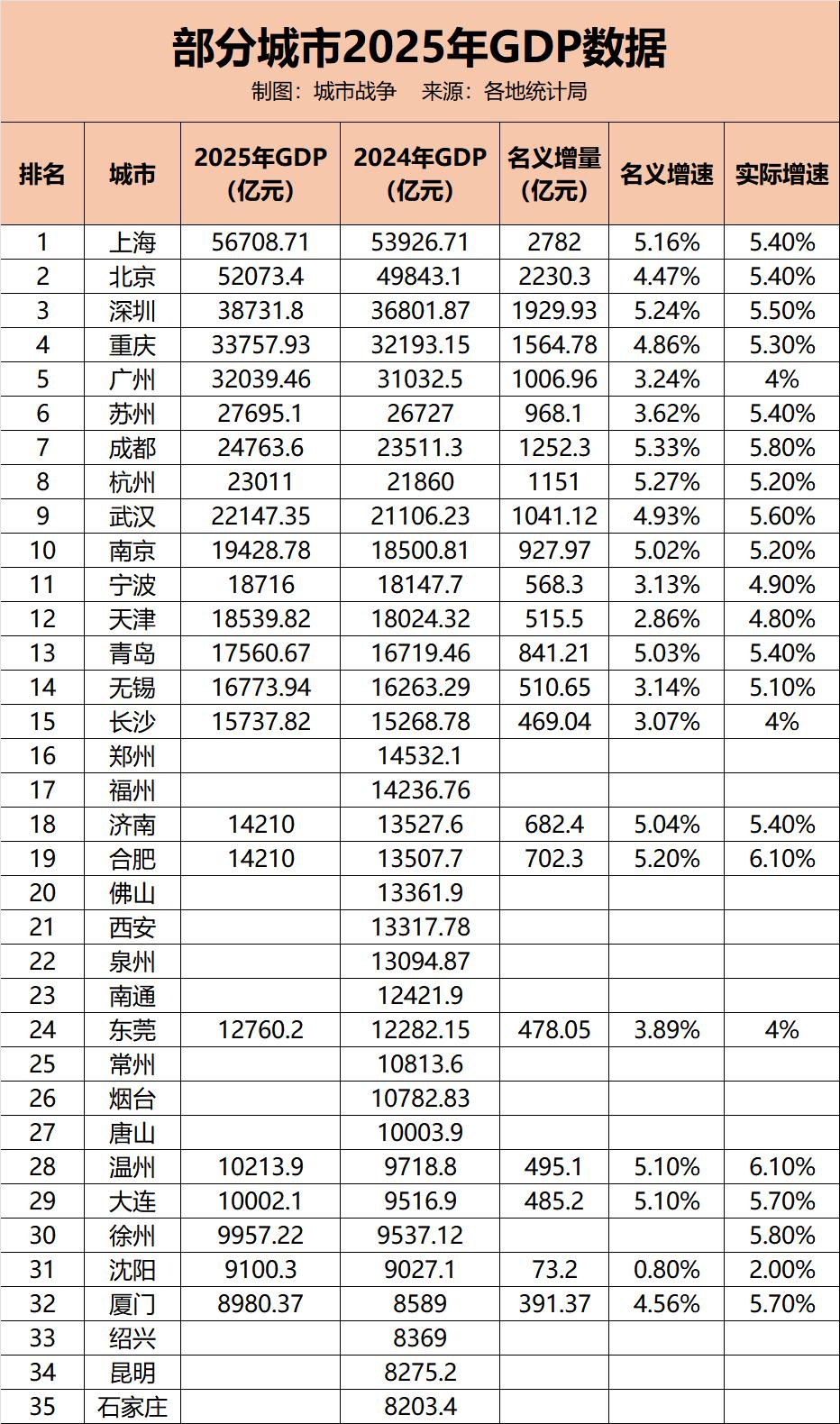
Group 1 - The core point of the article is that China now has 29 cities with a GDP exceeding 1 trillion yuan, marking a significant milestone for urban economic visibility on a national scale [1] - The new additions to the trillion-yuan GDP cities are Wenzhou and Dalian, with Wenzhou's GDP reaching 1,021.39 billion yuan in 2025, a growth of 6.1%, and Dalian's GDP reaching 1,000.21 billion yuan, a growth of 5.7% [1][5] - Xuzhou is close to becoming the next trillion-yuan city, with a GDP of 995.72 billion yuan in 2025, indicating a strong potential for future growth [5] Group 2 - The distribution of the 29 trillion-yuan cities shows that Jiangsu has the highest number with 5 cities, followed by Guangdong with 4 cities, and Shandong and Zhejiang each with 3 cities [8][9] - The article highlights the economic characteristics of these provinces, noting that Jiangsu's balanced regional development has led to all 13 of its prefecture-level cities being in the national top 100 [9] - The article also discusses the significance of Dalian as the first trillion-yuan city in Northeast China, which is expected to play a crucial role in revitalizing the region's economy [10] Group 3 - The article outlines the competitive landscape for future trillion-yuan cities, with Xuzhou, Shenyang, and Xiamen identified as potential candidates for the next round of growth [5][6] - It emphasizes the importance of regional centers and the differing strategies between coastal provinces, which tend to have multiple thriving cities, and inland provinces, which often focus on strengthening a single provincial capital [10][11] - The article concludes that there is no one-size-fits-all approach to regional development, and success depends on adapting strategies to local conditions [11]
徐州未能晋级万亿GDP之城
2 1 Shi Ji Jing Ji Bao Dao· 2026-02-02 05:48
Core Insights - Xuzhou's GDP reached 953.7 billion yuan in 2024, nearing the trillion yuan target, generating high expectations for 2025 [2] - The government report indicated a GDP growth target of approximately 5.8% for 2025, without specifying a clear GDP figure [2][4] - Xuzhou's mayor emphasized the importance of focusing on development rather than being fixated on the trillion yuan milestone [4] Economic Performance - In 2025, Xuzhou's GDP is projected to be 995.72 billion yuan, reflecting a 5.8% increase year-on-year, which is below the 6% target but exceeds the national average growth rate of 5.0% [4][5] - The primary industry added value was 79.25 billion yuan, growing by 3.0%; the secondary industry reached 365.63 billion yuan, with a growth of 3.5%; and the tertiary industry achieved 550.85 billion yuan, growing by 8.0% [5] - Industrial production saw a 6.8% increase in the added value of large-scale industries, with significant growth in chemical fiber manufacturing (10.5%), agricultural and sideline food processing (13.1%), and electrical machinery manufacturing (18.6%) [5] Investment Trends - Fixed asset investment in Xuzhou decreased by 11.9% year-on-year, which is significantly lower than the national average decline of 3.8% [5] - Investment in the primary industry fell by 27.4%, the secondary industry by 11.5%, and the tertiary industry by 11.9% [5] - Notable growth in specific sectors included textile (36.5%), automotive manufacturing (18.4%), and furniture manufacturing (9.5%) [5] Consumer and Income Data - Retail sales of consumer goods in 2025 are expected to grow by 5.5%, with significant increases in food (18.5%), clothing (15.5%), and communication equipment (11.5%) [6] - The per capita disposable income in Xuzhou is projected to be 42,230 yuan, reflecting a 4.9% increase year-on-year, with urban residents earning 48,978 yuan (4.3% growth) and rural residents earning 30,639 yuan (5.6% growth) [6]
徐州未能晋级万亿GDP之城
21世纪经济报道· 2026-02-02 05:35
Core Viewpoint - Xuzhou is approaching the trillion-yuan GDP milestone, with a reported GDP of 953.7 billion yuan in 2024, generating expectations for its 2025 target [1][3] Economic Performance - In 2025, Xuzhou's GDP reached 995.72 billion yuan, growing by 5.8% year-on-year, which is below the 6% target but exceeds the national average growth rate of 5.0% [6] - The primary industry added value was 79.25 billion yuan, growing by 3.0%; the secondary industry added value was 365.63 billion yuan, growing by 3.5%; and the tertiary industry added value was 550.85 billion yuan, growing by 8.0% [6] Industrial Growth - Xuzhou's industrial output value increased by 6.8% in 2025, with significant growth in chemical fiber manufacturing (10.5%), agricultural and sideline food processing (13.1%), and electrical machinery and equipment manufacturing (18.6%) [6] - High-tech manufacturing in Xuzhou grew by 9.0%, outpacing the overall industrial growth by 2.2 percentage points [6] Investment Trends - Fixed asset investment in Xuzhou fell by 11.9% year-on-year, which is significantly lower than the national average decline of 3.8% [7] - Investment in the primary industry decreased by 27.4%, the secondary industry by 11.5%, and the tertiary industry by 11.9% [7] Consumer Spending - Retail sales of consumer goods in Xuzhou grew by 5.5% year-on-year in 2025, with notable increases in food (18.5%), clothing (15.5%), and communication equipment (11.5%) [7] Income Levels - The per capita disposable income in Xuzhou reached 42,230 yuan in 2025, growing by 4.9% year-on-year, with urban residents earning 48,978 yuan (4.3% growth) and rural residents earning 30,639 yuan (5.6% growth) [7]
我国“万亿GDP”城市,扩至29个
财联社· 2026-01-30 14:15
Core Viewpoint - The article discusses the expansion of China's "trillion GDP" cities to 29 by 2025, highlighting the economic growth and potential investment opportunities in these urban areas [1]. Group 1: Trillion GDP Cities - By 2025, China is expected to have 29 cities with a GDP exceeding 1 trillion yuan, indicating significant economic development [1]. - The cities listed include major economic hubs such as Beijing (5.21 trillion yuan), Shanghai (5 trillion yuan), and Shenzhen (3.87 trillion yuan) [2][3]. - Other cities projected to reach or exceed the trillion yuan mark include Hangzhou (2.3 trillion yuan), Suzhou (2.77 trillion yuan), and Chengdu (2.48 trillion yuan) [2][3]. Group 2: Economic Data - The article provides specific GDP figures for various cities, with Tianjin at 5 trillion yuan and Chongqing at 3.38 trillion yuan [2][3]. - Cities like Jinan (1.4 trillion yuan) and Wuxi (1.68 trillion yuan) are also mentioned, with some cities like Tangshan expected to reach the trillion mark by 2024 [2][3]. - The data reflects a diverse range of economic performance across different regions, showcasing both established and emerging economic centers [2][3].

金观平:“万亿之城”扩大的不只是规模
Jing Ji Ri Bao· 2026-01-27 02:34
Core Insights - The expansion of "trillion GDP" cities in China reflects the optimization of regional development patterns and the elevation of urban capabilities, solidifying the foundation for high-quality economic growth [1] - The number of cities with a GDP exceeding 1 trillion has increased to 29, with Wenzhou and Dalian being the latest additions, showcasing the effectiveness of regional coordinated development [1] Group 1: Economic Milestones - Wenzhou achieved a GDP of 10,213.9 billion, becoming the third "trillion GDP" city in Zhejiang province after Hangzhou and Ningbo [1] - Dalian reached a GDP of 10,002.1 billion, marking it as the first "trillion GDP" city in Northeast China [1] - The growth of "trillion GDP" cities illustrates a shift from "point breakthroughs" to "broad expansions" in China's economic landscape [1] Group 2: Urban Competition Dynamics - The emergence of "trillion GDP" cities is reshaping urban competition, transitioning from simple economic scale comparisons to a comprehensive enhancement of core urban competitiveness [2] - Future urban competition will focus on diverse development dimensions, including technological innovation, high-end resource allocation, cultural soft power, and livability [2] - Major cities like Beijing and Shanghai aim for global influence, while others like Chengdu and Wuhan target GDPs of 30 trillion, indicating a competitive landscape [2] Group 3: Regional Collaboration - Urban competition is shifting from individual city races to regional collaboration, with city clusters becoming key spaces for development [3] - Successful cities will be those that can integrate regional resources and play critical roles within metropolitan areas [3] - The current phase of urban development in China emphasizes a transition from "quantitative growth" to "qualitative improvement," urging cities to become exemplars of high-quality development and regional coordination [3]
历史性突破!东北第一座万亿GDP城市,来了
3 6 Ke· 2026-01-26 02:58
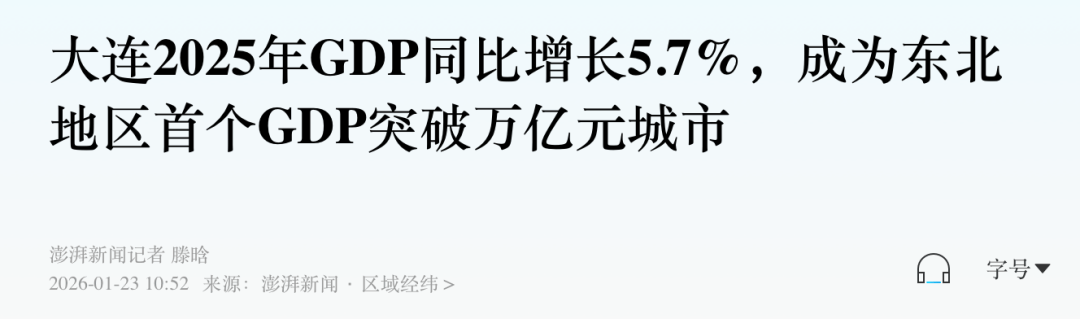
Core Viewpoint - Dalian has officially entered the "trillion GDP club," becoming the first city in Northeast China to achieve this milestone, with a projected GDP of 10,002.1 billion yuan by 2025, reflecting a year-on-year growth of 5.7% at constant prices [1]. Economic Performance - In 2024, Dalian's GDP reached 9,516.9 billion yuan, indicating it was on track to become a trillion-yuan city [1]. - Dalian's GDP growth rate for the first three quarters of the previous year was 6%, showcasing a robust growth momentum [1]. - The city's second industry is expected to contribute 3,532.5 billion yuan to the GDP in 2025, with a growth rate of 7.7%, the highest among the three industries [3]. Industrial Growth - The industrial sector's steady growth is a crucial support for Dalian's achievement of a trillion GDP [4]. - The petrochemical industry saw an 8.9% increase in value added, while the equipment manufacturing sector grew by 15.4%, with the railway and shipbuilding industry experiencing a remarkable 57.5% growth [4]. - High-tech manufacturing grew by 13.9%, with computer and office equipment manufacturing surging by 78.2% and pharmaceutical manufacturing increasing by 30.9% [5]. Structural Transformation - Dalian's economic structure still relies heavily on petrochemicals, equipment manufacturing, shipbuilding, and electronic information, indicating a need for further industrial upgrading [6]. - The city is actively transitioning towards "smart manufacturing," with initiatives to enhance advanced manufacturing and foster specialized enterprises [6]. - Notable advancements include the launch of the world's first ultra-large turntable bearing and the completion of a domestic 450,000 tons/year polypropylene mixing and granulating machine [6]. Investment Trends - Manufacturing investment in Dalian is projected to grow by 2.8% in 2025, while infrastructure investment is expected to decline by 11.9% [6]. - Investment in technological transformation of industrial enterprises is anticipated to rise by 14.5% [6]. Emerging Industries - Dalian is focusing on developing new industry clusters, including advanced manufacturing, new-generation automobiles, high-end bearings, and rail transit, with expected outputs of 1,000 billion yuan, 200 billion yuan, and 180 billion yuan respectively [6]. - The city aims to develop new information technology and clean energy industry clusters, targeting outputs of over 2,000 billion yuan and 610 billion yuan [8]. Regional Significance - Dalian's entry into the trillion GDP club marks a significant breakthrough for Northeast China, with Shenyang expected to follow suit soon [9]. - The historical context shows that major cities in Northeast China have seen a decline in their national rankings, emphasizing the need for sustainable competitiveness [12][15]. - The revitalization of Northeast China is increasingly reliant on the leading role of its major cities, particularly Dalian and Shenyang [25][30].

历史性突破!东北首座万亿城市来了
Sou Hu Cai Jing· 2026-01-23 08:25
Group 1 - Dalian has officially entered the "trillion GDP club," becoming the first city in Northeast China to achieve this milestone with a GDP of 10,002.1 billion yuan projected for 2025, reflecting a year-on-year growth of 5.7% at constant prices [1][3] - In 2024, Dalian's GDP reached 9,516.9 billion yuan, indicating its status as a near-trillion city, with a growth rate of 6% in the first three quarters of the previous year [3][4] - The industrial sector is a significant contributor to Dalian's economic growth, with the secondary industry expected to reach an added value of 3,532.5 billion yuan in 2025, growing at the highest rate of 7.7% among the three industries [4][5] Group 2 - The petrochemical industry remains Dalian's largest sector, accounting for over 40% of industrial output, with an increase of 8.9% year-on-year [5][8] - High-tech manufacturing is also on the rise, with a growth rate of 13.9%, particularly in computer and office equipment manufacturing, which surged by 78.2% [6][9] - Dalian is actively transitioning towards advanced manufacturing, with significant investments in technology upgrades, showing a 14.5% increase in industrial enterprise technology transformation investments [9][10] Group 3 - Dalian's retail sales of consumer goods are projected to reach 2,180.8 billion yuan in 2025, with a modest growth of 2.1%, indicating potential for improvement in consumer spending [10] - Following Dalian, Shenyang is expected to surpass 9,000 billion yuan in GDP by 2024, positioning it as the next city in Northeast China to join the trillion GDP club [11][29] - The overall economic revitalization of Northeast China will heavily rely on the performance of major cities like Dalian and Shenyang, which play a crucial role in the region's economic landscape [32]
温州、徐州、大连冲刺万亿GDP城市 谁将晋级?
2 1 Shi Ji Jing Ji Bao Dao· 2025-12-13 00:55
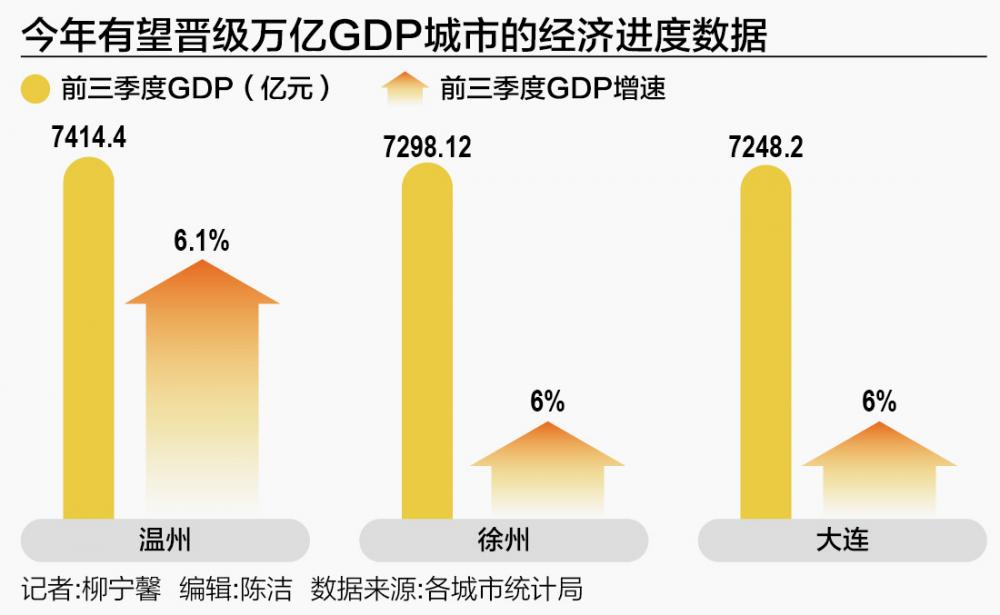
Core Viewpoint - The competition for cities to join the "trillion GDP club" is intensifying, with Wenzhou, Xuzhou, and Dalian as key contenders, highlighting a shift in China's economic growth dynamics towards ordinary prefecture-level cities [1][19][20]. Group 1: Economic Growth and City Development - Wenzhou is expected to surpass a GDP of 1 trillion yuan this year, with Xuzhou and Dalian also aiming for this milestone [2][21]. - Currently, there are 27 cities in the trillion GDP club, with notable representation from various regions including the Yangtze River Delta and the Pearl River Delta [2][21]. - The expansion of the trillion GDP club is characterized by the rise of ordinary prefecture-level cities, indicating a change in the economic landscape of China [2][21][35]. Group 2: Wenzhou's Economic Strategy - Wenzhou's economic growth is supported by a robust manufacturing base and a strong private sector, with 156.4 million registered private enterprises as of November 2025 [6][26]. - The city aims to establish a dual trillion industry cluster by 2025, focusing on both traditional and emerging industries [7][26]. - Wenzhou's industrial transformation has shown significant results, with traditional and emerging industries experiencing growth rates of 11.4% and 12.4% respectively in the first ten months of the year [7][26]. Group 3: Dalian's Economic Challenges and Opportunities - Dalian aims to achieve a GDP of 1 trillion yuan by 2025, with a current GDP of 9516.9 billion yuan projected for 2024 [10][31]. - The city has a strong traditional industrial base, particularly in the petrochemical sector, but faces challenges in transitioning to high-tech manufacturing [11][32]. - Dalian's strategic location and existing industrial foundation provide significant growth potential, despite current limitations in innovation and industry structure [11][32]. Group 4: Xuzhou's Growth Potential - Xuzhou's GDP reached 7298.12 billion yuan in the first three quarters of the year, with a target to exceed 1 trillion yuan by 2025 [12][33]. - The city is positioned as a key player in addressing the economic imbalance between southern and northern Jiangsu province [14][33]. - Xuzhou's development strategy includes leveraging its geographical advantages to become a hub for regional connectivity [14][33]. Group 5: Future Trends in Urban Economic Development - The trend of ordinary prefecture-level cities joining the trillion GDP club is expected to continue, with cities like Shaoxing, Yangzhou, Yancheng, and Jiaxing as potential candidates [15][35]. - The focus on urbanization and collaboration with nearby major cities is crucial for these cities to achieve sustainable growth [36][37]. - Future urban development will prioritize not only GDP growth but also the quality of growth, emphasizing metrics such as per capita GDP and innovation resources [38][37].