世界模型(World Model)

Search documents
AI叙事不断递进,阿里巴巴、中际旭创双双涨超2%!云计算ETF汇添富(159273)大涨超3%!机构:2026拥抱“AI+”投资主线!
Sou Hu Cai Jing· 2026-01-05 09:46
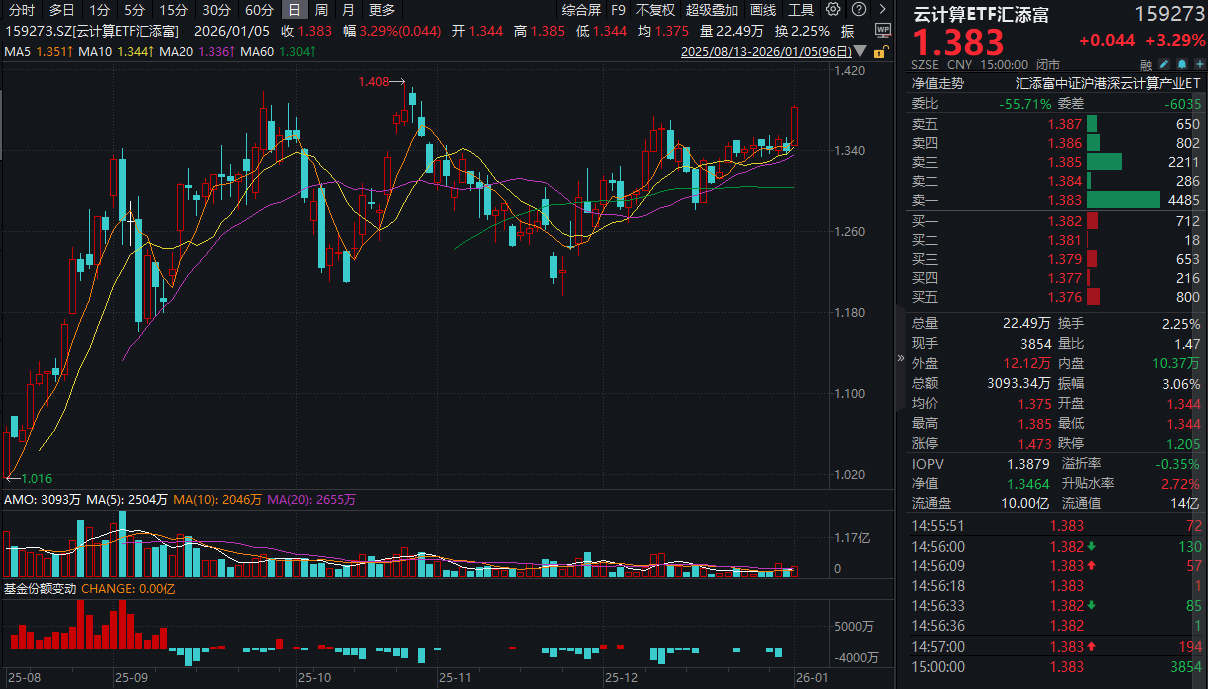
Group 1: Market Performance - The Shanghai Composite Index accelerated its rise by over 1%, returning to the 4000-point mark, with the computing power sector showing strong performance [1] - The cloud computing ETF Huatai-PineBridge (159273) saw a significant increase of over 3%, with a total trading volume exceeding 30 million yuan, representing a 33% increase compared to the previous period [1] Group 2: Stock Performance of Key Companies - Most of the weighted stocks in the cloud computing ETF Huatai-PineBridge closed in the green, with Kingsoft Office rising over 6%, and Alibaba-W, Zhongke Shuguang, and others increasing by over 2% [2] - The estimated weight and performance of key stocks include: - Zhongbiao Chuang (11.14% weight, +2.21% change) - Alibaba-W (9.52% weight, +2.55% change) - Kingsoft Office (3.97% weight, +6.49% change) [3] Group 3: Industry Trends and Projections - Guosen Securities reviewed the trends in AI model development, noting that the narrative around AI has evolved, with significant advancements expected in reasoning capabilities and application companies [4] - The capital expenditure (Capex) of major tech giants is projected to grow by over 50% year-on-year in 2025, with expectations of continued growth of over 30% in 2026 [5] - The demand for data center capacity is expected to increase significantly, with a projected shortfall in power supply due to the retirement of coal power and long construction cycles for supporting infrastructure [5] Group 4: Technological Developments - The evolution of model architecture continues, with a focus on addressing computational and memory consumption bottlenecks during training, as well as enhancing reasoning capabilities [5][7] - The emergence of AI agents is supported by improvements in model capabilities and efficiency, which are expected to drive significant growth in applications such as AI programming and content creation [8] Group 5: Investment Opportunities - The cloud computing ETF Huatai-PineBridge (159273) is positioned to capture the historical opportunities presented by AI-driven computing power, covering a wide range of sectors including hardware, cloud services, and data center operations [10]


人形机器人的2025:一半是迷雾森林,一半是星辰大海
Tai Mei Ti A P P· 2025-12-16 08:03
Core Viewpoint - The humanoid robot industry is experiencing significant investment and interest, with projections suggesting that humanoid robots could become as common as computers and smartphones in households within the next two decades. However, there are contrasting opinions regarding the feasibility and practicality of these robots, with some industry leaders expressing skepticism about their commercial viability and technological readiness [2][3][9]. Investment Trends - In the first nine months of 2025, global investments in humanoid robots reached approximately $7 billion, driven particularly by the Chinese market, marking a 250% increase compared to the same period last year [3]. - Major companies like UBTECH have reported significant order volumes, with UBTECH's cumulative order amount reaching 1.3 billion yuan [9]. Technological Challenges - The VLA (Vision-Language-Action) model, widely used in humanoid robot training, faces limitations due to the need for dynamic, three-dimensional data, which is scarce and complex to obtain [5][6]. - Critics argue that the reliance on language as an intermediary in the VLA model leads to information loss and inefficiencies, suggesting a shift towards a "World Model" that directly connects visual input to actions [8]. Market Dynamics - There is skepticism regarding the authenticity of reported large orders, with concerns that many are framework agreements or intention orders rather than binding contracts, which could lead to inflated market expectations [10][12]. - The industry is witnessing a surge in companies entering the humanoid robot space, with over 150 firms established, many of which are seeking capital to sustain operations amid unclear technological and commercial pathways [17]. Future Outlook - Despite current technological uncertainties, there is a strong belief in the potential of humanoid robots to integrate into everyday life, with predictions of significant advancements in the next few years [14][15]. - The investment return cycle for humanoid robots is expected to be short, with some analysts estimating a payback period as brief as 36 weeks, particularly in household service applications [15]. Industry Developments - Companies like Yuzhu Technology and Zhiyuan Robotics are preparing for capital market engagements, with Yuzhu Technology expected to submit an IPO application soon [16][17]. - The market for humanoid robots is showing signs of volatility, with some startups already ceasing operations, indicating potential challenges ahead for the industry [19].


资料汇总 | VLM-世界模型-端到端
自动驾驶之心· 2025-07-12 12:00
Core Insights - The article discusses the advancements and applications of visual language models (VLMs) and large language models (LLMs) in the field of autonomous driving and intelligent transportation systems [1][2]. Summary by Sections Overview of Visual Language Models - Visual language models are becoming increasingly important in the context of autonomous driving, enabling better understanding and interaction between visual data and language [4][10]. Recent Research and Developments - Several recent papers presented at conferences like CVPR and NeurIPS focus on improving the performance of VLMs through various techniques such as behavior alignment, efficient pre-training, and enhancing compositionality [5][7][10]. Applications in Autonomous Driving - The integration of LLMs and VLMs is expected to enhance various tasks in autonomous driving, including object detection, scene understanding, and planning [10][13]. World Models in Autonomous Driving - World models are being developed to improve the representation and prediction of driving scenarios, with innovations like DrivingGPT and DriveDreamer enhancing scene understanding and video generation capabilities [10][13]. Knowledge Distillation and Transfer Learning - Techniques such as knowledge distillation and transfer learning are being explored to optimize the performance of vision-language models in multi-task settings [8][9]. Community and Collaboration - A growing community of researchers and companies is focusing on the development of autonomous driving technologies, with numerous resources and collaborative platforms available for knowledge sharing and innovation [17][19].
资料汇总 | VLM-世界模型-端到端
自动驾驶之心· 2025-07-06 08:44
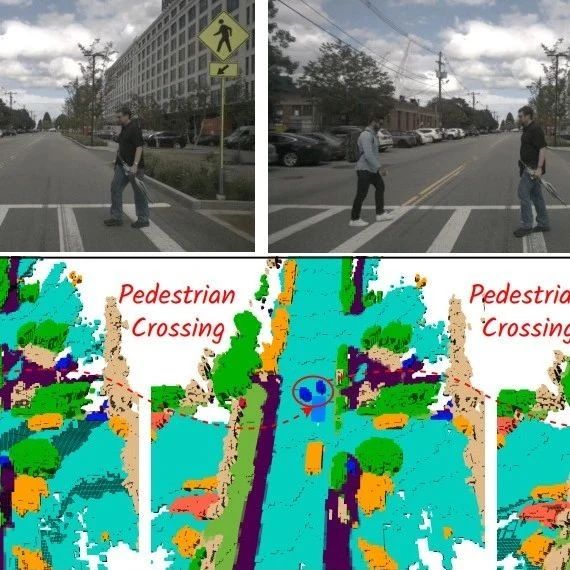
Core Insights - The article discusses the advancements and applications of visual language models (VLMs) and large language models (LLMs) in the field of autonomous driving and intelligent transportation systems [1][4][19]. Summary by Sections Overview of Visual Language Models - Visual language models are becoming increasingly important in the context of autonomous driving, enabling better understanding and interaction between visual data and language [4][10]. Recent Research and Developments - Several recent papers presented at conferences like CVPR and NeurIPS focus on enhancing the capabilities of VLMs and LLMs, including methods for improving object detection, scene understanding, and generative capabilities in driving scenarios [5][7][10][12]. Applications in Autonomous Driving - The integration of world models with VLMs is highlighted as a significant advancement, allowing for improved scene representation and predictive capabilities in autonomous driving systems [10][13][19]. Knowledge Distillation and Transfer Learning - Knowledge distillation techniques are being explored to enhance the performance of vision-language models, particularly in tasks related to detection and segmentation [8][9]. Future Directions - The article emphasizes the potential of foundation models in advancing autonomous vehicle technologies, suggesting a trend towards more scalable and efficient models that can handle complex driving environments [10][19].