东方红启兴三年持有A

Search documents
东方红资管陷信任危机:规模利润双降,三年持有期产品争议凸显 |基金观察
Sou Hu Cai Jing· 2026-01-19 09:33
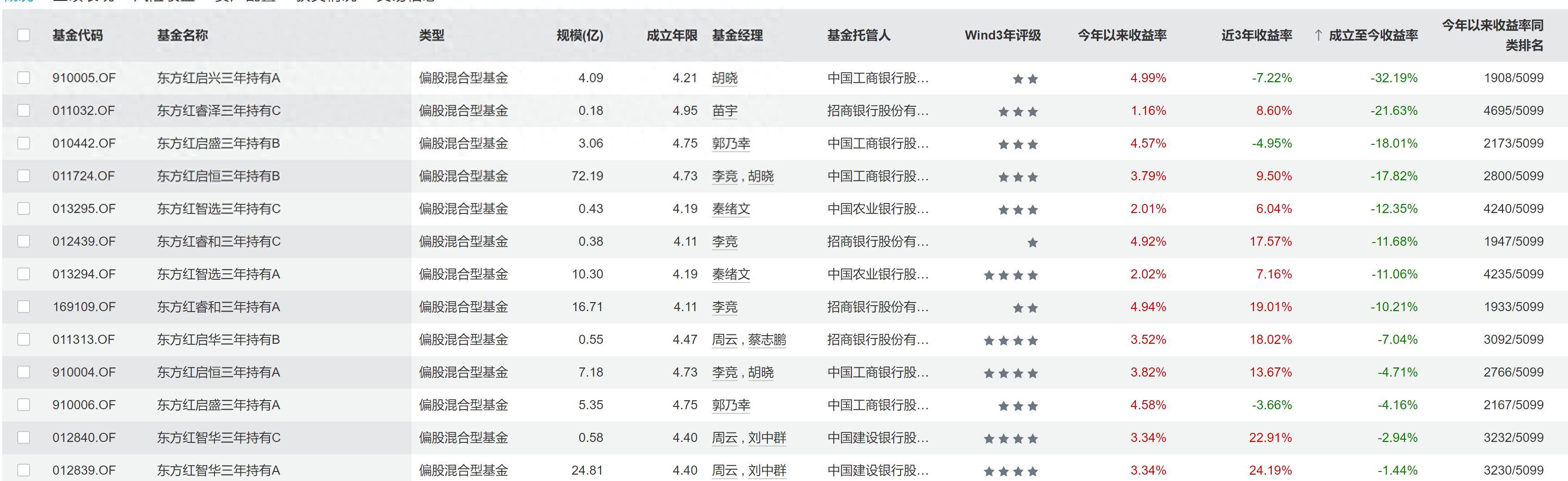
Core Viewpoint - Dongfanghong Asset Management Co., Ltd. is facing unprecedented development challenges, including a significant reduction in management scale, a sharp decline in net profit, loss of core research talent, and underperformance of three-year holding period products, which collectively threaten the trust foundation of this once-renowned asset management institution [1]. Group 1: Fund Performance - In the first half of 2025, Dongfanghong Asset Management experienced a brief surge in new fund issuance, with two products performing well: the Dongfanghong Core Value Mixed Fund raised 2 billion yuan and the Dongfanghong Yingfeng Stable Allocation FOF reached 6.573 billion yuan, setting a record for similar products in 2025 [2]. - Despite the excitement in new fund issuance, existing products are struggling, with 13 three-year holding period products failing to achieve positive returns as of the end of 2025. The Dongfanghong Qixing Three-Year Holding A product has accumulated losses of 32% [2][4]. - The disparity between the success of new funds and the poor performance of existing products reflects Dongfanghong's awkward position, where brand inertia attracts funds but insufficient core investment capabilities erode trust among existing clients [3]. Group 2: Financial Decline - Dongfanghong Asset Management's decline is characterized by structural issues rather than short-term cyclical fluctuations. The management scale has shrunk from a peak of approximately 270 billion yuan in 2021 to about 207.3 billion yuan by the end of 2025, a loss of nearly 60 billion yuan, resulting in a drop in industry ranking to around 40 [4]. - The company's profitability has also plummeted, with net profit falling from 1.438 billion yuan in 2021 to 333 million yuan in 2024, a decline of over 76%, marking the lowest level since 2016 [6]. Group 3: Talent and Investment Strategy - The decline of Dongfanghong Asset Management is closely linked to the continuous loss of core research talent. The company once boasted a strong investment research team but has faced a talent exodus, including key figures who have left to establish their own firms [11]. - The loss of talent has led to a transformation in investment style, with new fund managers frequently shifting their investment focus, diverging from the company's traditional deep value investment approach [13]. - The three-year holding period products, initially intended to promote long-term investment, have come under scrutiny due to their poor performance, particularly those launched at market peaks in 2021, which have resulted in significant losses for investors [8]. Group 4: Future Challenges - For the new head, Cheng Fei, the initial success in new fund issuance only temporarily alleviates pressure. The company faces multiple challenges, including improving the performance of underperforming products, addressing the concerns of trapped investors, rebuilding a research system independent of individual stars, and restoring its value investment philosophy to regain market trust [18].

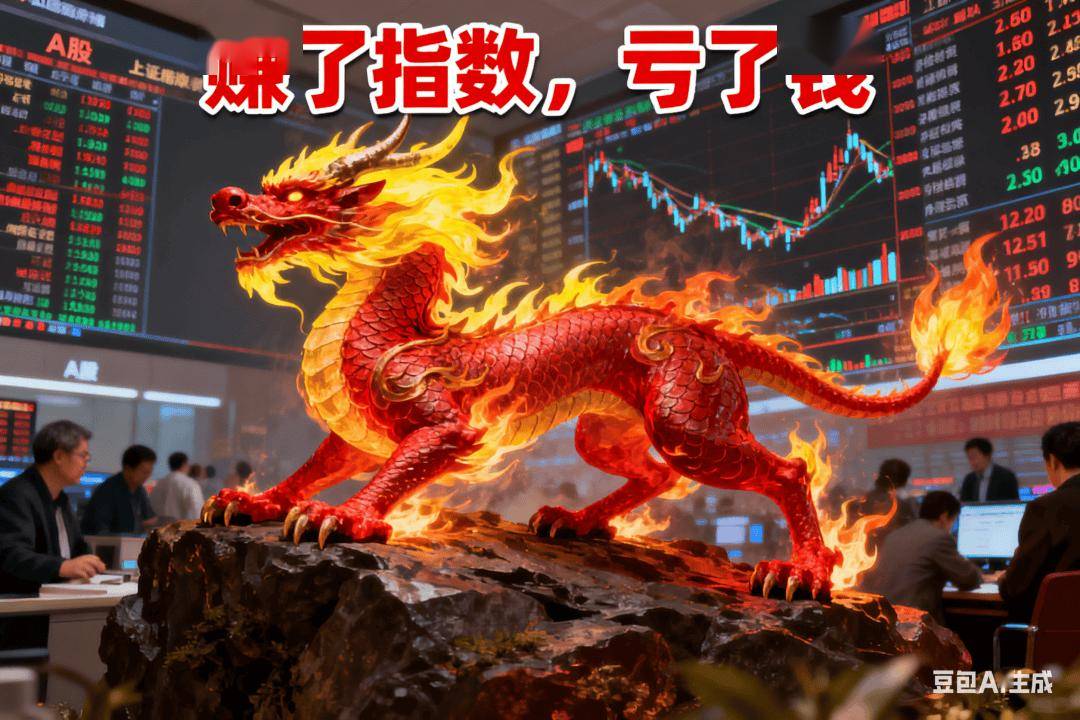
指数牛市狂奔,价值老将为何掉队?
Sou Hu Cai Jing· 2025-09-21 05:25
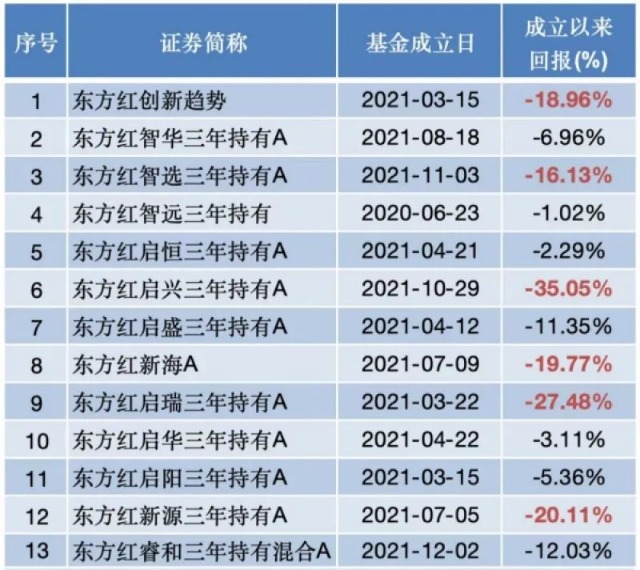
Core Viewpoint - The article discusses the paradox of value investors underperforming during a bull market, highlighting that many investors have lost money despite the overall market index rising significantly [3][7]. Group 1: Market Performance - As of September 18, 2025, the Shanghai Composite Index approached 3900 points, with a cumulative increase of over 15% from previous levels [3][7]. - Over 60% of individual investors experienced losses during this bull market, with an average loss of 28% [7]. - Notably, 13 funds under a prominent institution failed to achieve positive returns, with six funds showing returns below -15% since their inception [4]. Group 2: Fund Performance - Specific funds under the Dongfanghong brand showed particularly poor performance, with the Dongfanghong Qixing Three-Year Holding A fund returning -35.05% since its establishment [5][6]. - Other underperforming funds included Dongfanghong Qirui Three-Year Holding A at -27.48% and Dongfanghong Xinyuan Three-Year Holding A at -20.11% [5][6]. Group 3: Investor Behavior - The article identifies five traps that led to losses for value investors, including chasing speculative trends, neglecting long-term investment principles, and failing to maintain risk awareness [7][8][9]. - Investors often deviated from core value investment principles, leading to poor decision-making during the bull market [7][8]. Group 4: Market Dynamics - The bull market exhibited structural differentiation, with certain stocks and sectors, such as the liquor industry, experiencing declines despite the overall index rising [10]. - Psychological factors, such as greed and fear, significantly influenced investor behavior, leading to poor timing in buying and selling stocks [11][12]. Group 5: Evolving Investment Strategies - Value investors are encouraged to redefine their strategies in light of changing market conditions, focusing on high dividend yield stocks and emerging sectors like AI and biotechnology [13][14]. - The need for continuous adaptation in investment strategies is emphasized, as traditional approaches may no longer be effective in the current market landscape [14][15].
血亏35%!东方红“三年锁定期”反成投资者噩梦 谁该背锅?
Hua Xia Shi Bao· 2025-09-20 01:00
Core Viewpoint - The performance of the "three-year holding period" funds under Dongfanghong Asset Management has been disappointing, with all 13 funds established for over three years failing to achieve positive returns, raising concerns about the company's product strategy and market judgment [2][3]. Group 1: Fund Performance - As of September 18, 2025, 13 "three-year holding period" funds have not achieved positive returns, with six funds showing returns below -15% [2]. - The worst-performing fund, Dongfanghong Qixing Three-Year Holding A, has a return of -35.05% since its inception on October 29, 2021 [3]. - The majority of poorly performing funds were launched in 2021, coinciding with a peak in the A-share market, leading to systemic risks from the outset [3]. Group 2: Management and Strategy Issues - The overall poor performance of Dongfanghong's three-year products indicates systemic issues in product layout, research capabilities, and market judgment [3]. - The departure of key team members since 2016 has led to a loss of investment philosophy and continuity, contributing to declining product performance [9]. Group 3: Market and Investor Sentiment - The market is reassessing the design logic and issuance rationale of the "three-year holding period" products, which were intended to encourage long-term investment but have instead become a "passive constraint" for investors [6]. - The issuance of holding period products should be timed carefully, ideally during market lows, to align risks and rewards with investors [7][8]. Group 4: Company Financials - Dongfanghong's asset management scale has decreased from a peak of 2696.23 billion to 1662.99 billion, a reduction of 1033.24 billion or 38.32% [9]. - The company's revenue and net profit for 2024 were 14.35 billion and 3.33 billion, respectively, reflecting year-on-year declines of 30.41% and 32.04% [9]. Group 5: Leadership Changes - In May 2025, Dongfanghong appointed a new general manager, Cheng Fei, who has a background in fixed income and new business areas, raising hopes for a turnaround in the company's competitive position in equity investments [10].
金融圈重磅!千亿资管换帅
21世纪经济报道· 2025-03-26 15:06
Core Viewpoint - The article discusses the significant personnel change in the asset management sector, highlighting the upcoming transition of Cheng Fei from Guosen Securities to Dongzheng Asset Management, and the implications for both companies in terms of performance and strategy [2][3]. Group 1: Personnel Change - Cheng Fei, Vice President of Guosen Securities and Chairman of Guosen Asset Management, is set to join Dongzheng Asset Management, a well-established brokerage asset management firm [3][11]. - Cheng Fei has nearly 20 years of experience in asset management and has been a key driver of Guosen Asset Management's growth over the past four years [5][6]. Group 2: Performance of Guosen Asset Management - Under Cheng's leadership, Guosen Asset Management's net income from asset management fees increased from 203 million yuan in 2021 to 496 million yuan in 2023, with a year-on-year increase of 81.62% in the first three quarters of 2024 [5][6]. - The growth was attributed to innovative strategies, refined market management, and the use of capital market tools to provide financing services to real enterprises [6]. Group 3: Challenges Faced by Dongzheng Asset Management - Dongzheng Asset Management has faced significant challenges, with its non-monetary management scale declining by 261 million yuan in 2024, causing it to fall out of the top thirty in the industry [3][15]. - The firm has lost investor trust due to continuous losses, with several of its products reporting over 30% losses since inception [13][14]. - The market is closely watching how Dongzheng Asset Management will restructure its research and investment system to seek breakthroughs and establish a distinctive development goal [15].
千亿资管换帅,国信资管董事长成飞即将加盟东证资管
2 1 Shi Ji Jing Ji Bao Dao· 2025-03-26 13:46
Group 1 - The core point of the article is the significant personnel change in the asset management sector, with Cheng Fei, the chairman of GuoXin Asset Management, set to join Dongzheng Asset Management, which has been facing challenges in recent years [1][5] - Cheng Fei has been a key driver of GuoXin Asset Management's growth over the past four years, emphasizing the importance of a long-term focus and a dual approach of research and sales in asset management [1][2] - Under Cheng's leadership, GuoXin Asset Management's net income from asset management fees increased from 203 million yuan in 2021 to 496 million yuan in 2023, with a year-on-year growth of 81.62% in the first three quarters of 2024 [2][3] Group 2 - Dongzheng Asset Management, as the first broker asset management company, has seen a decline in its non-monetary management scale, dropping 26.1 billion yuan in 2024 and falling out of the top thirty in the industry [1][5] - The company is under pressure to restructure its research and investment system to seek breakthroughs and redefine its development goals amidst a backdrop of declining trust and continuous losses in its products [5] - The asset management industry is shifting towards innovation and diversification, with firms encouraged to find their unique development paths and leverage their strengths in absolute returns, fixed income, and product innovation [3][4]