中银科创夸腾系统

Search documents
中国银行多举措助力三大国际科技创新中心发展
Zhong Guo Jin Rong Xin Xi Wang· 2026-01-29 09:53
Core Insights - The Bank of China is enhancing its technology financial services by aligning with the characteristics of international technology innovation centers in Beijing, Shanghai, and the Guangdong-Hong Kong-Macao Greater Bay Area [1][2] Group 1: Beijing-Tianjin-Hebei Region - The Bank of China has a technology financial loan balance of nearly 650 billion yuan, serving approximately 15,000 technology enterprises [1] - A joint coordination mechanism has been established among the bank's branches in Beijing, Tianjin, and Hebei to support the collaborative development of industries [1] - The bank provides diversified financial services including equity, loans, bonds, insurance, and leasing under the "Bank of China Innovation" initiative [1] Group 2: Yangtze River Delta Region - In the Yangtze River Delta, the bank's technology financial loan balance is nearly 1.3 trillion yuan, with an annual growth rate exceeding 13%, serving over 50,000 technology enterprises [1] - The bank has launched the "Bank of China Innovation Computing Loan" in ten cities, creating a collaborative effect with government computing vouchers [2] - A differentiated service model has been developed, with specific offerings in Shanghai, Jiangsu, Zhejiang, and Anhui [2] Group 3: Guangdong-Hong Kong-Macao Greater Bay Area - The bank has partnered with the Guangdong Science and Technology Financial Group to launch the "Bank of China Guangdong Science and Technology Investment Loan" [2] - Utilizing its global layout, the bank facilitates technology enterprises' access to international capital markets [2] - Since 2025, 99 enterprises have successfully listed on the Hong Kong stock market, with the bank participating in 41 of these projects [2]

普惠金融再晋2000亿级 这次又是深圳分行
2 1 Shi Ji Jing Ji Bao Dao· 2025-10-15 12:30
Core Insights - The inclusive finance sector in Shenzhen is rapidly expanding, with several state-owned banks reporting significant growth in their inclusive loan balances, surpassing 200 billion yuan [1][2][3]. Group 1: Loan Growth and Achievements - By the end of September 2023, the China Bank Shenzhen branch announced that its inclusive finance loans exceeded 200 billion yuan, serving over 100,000 inclusive customers [1]. - In August 2023, the Industrial and Commercial Bank of China Shenzhen branch also reported its inclusive loan balance surpassed 200 billion yuan [2]. - The China Construction Bank Shenzhen branch was the first to exceed 200 billion yuan in inclusive loans back in 2020, and its current balance has reached over 350 billion yuan, making it the first branch in the country to achieve this milestone for small and micro enterprises [3][8]. Group 2: Market Demand and Challenges - Shenzhen has a vast market demand for inclusive finance, being home to a high density of small and micro enterprises, with 1,025 national-level "little giant" enterprises and 11,000 specialized small and medium enterprises projected by 2025 [5]. - The challenges of financing for small and micro enterprises persist due to a lack of collateral, guarantees, and information, leading to issues of "difficult and expensive financing" [5][12]. - The local government has established mechanisms to coordinate financing for small enterprises, including regular work meetings and initiatives like "thousand enterprises visiting ten thousand households" to facilitate communication [5]. Group 3: Regulatory Environment and Strategic Focus - The national emphasis on inclusive finance has led to regulatory requirements that banks prioritize inclusive loans, with performance assessment indicators for branches now including a weight of over 10% for inclusive finance [6]. - Banks are increasingly forming dedicated teams and departments to focus on inclusive finance, with the China Bank Shenzhen branch establishing a two-tier working group to ensure unified action across its branches [6]. Group 4: Technological Integration - Financial technology is being leveraged to enhance the efficiency of inclusive finance operations, with tools like AI and big data being used to streamline processes and reduce costs [10][11]. - The use of digital tools has significantly improved the efficiency of loan assessments and approvals, with some processes being reduced from a week to just one hour [10][11]. Group 5: Focus on Scene-based Financing - The "park loan" initiative has emerged as a key strategy for banks in Shenzhen, targeting small and micro enterprises located in industrial parks, which are abundant in the region [14][15]. - This model allows banks to assess risks and manage loans more effectively by collaborating with park management to access operational data from enterprises [15][16]. Group 6: Competitive Landscape - Large banks are increasingly penetrating the inclusive finance market, capturing a significant share of small and micro enterprise loans, while smaller banks face challenges in competing [17][18]. - Some smaller banks, like WeBank and Shenzhen Rural Commercial Bank, are adopting digital transformation strategies to enhance their competitive edge in the inclusive finance sector [17][18].

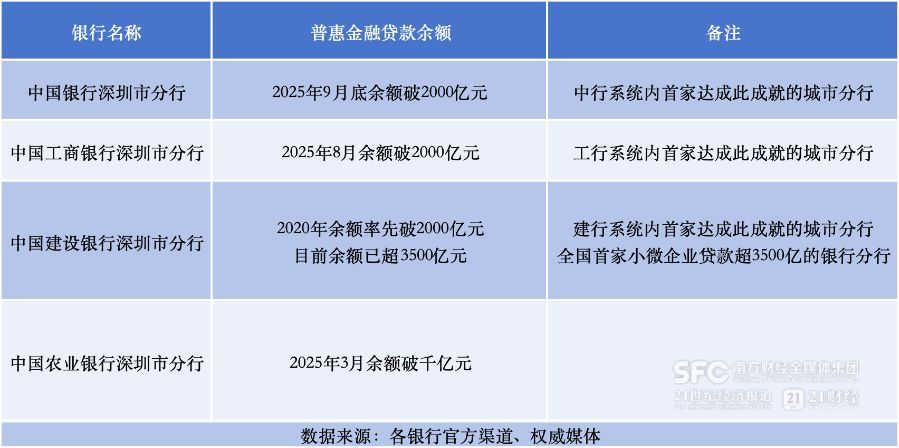
普惠金融再晋2000亿级,这次又是深圳分行
2 1 Shi Ji Jing Ji Bao Dao· 2025-10-14 09:53
Core Insights - The rapid growth of inclusive finance in Shenzhen is highlighted, with state-owned banks achieving significant milestones in loan disbursement, surpassing 200 billion yuan in inclusive loans [1][2][3] Group 1: Loan Growth and Achievements - By the end of September, the Bank of China Shenzhen branch announced that its inclusive finance loans exceeded 200 billion yuan, serving over 100,000 clients [2] - In August, the Industrial and Commercial Bank of China Shenzhen branch also reported its inclusive loan balance surpassed 200 billion yuan [3] - The China Construction Bank Shenzhen branch was the first to exceed 200 billion yuan in inclusive loans in 2020, and its current balance has reached 350 billion yuan [3][7] Group 2: Market Demand and Challenges - Shenzhen has a vast market demand for inclusive finance, being home to a high density of small and micro enterprises, with over 10,000 specialized small and medium enterprises expected by 2025 [5] - Small and micro enterprises face challenges such as lack of collateral and information, leading to difficulties in obtaining financing [5][11] - The local government has established mechanisms to facilitate financing for small enterprises, including regular work coordination and outreach activities [5] Group 3: Regulatory Environment and Strategic Focus - The regulatory environment has increasingly emphasized inclusive finance, with banks required to prioritize this area in their strategic planning [6] - The weight of inclusive finance in performance assessments for banks has increased, encouraging greater lending to small and micro enterprises [6] Group 4: Technological Integration - Financial technology is being leveraged to enhance the efficiency of inclusive finance operations, reducing service costs and improving productivity [9][10] - Tools such as AI and big data are being utilized for risk assessment and client profiling, streamlining the loan approval process [9][10] Group 5: Scene-based Financing - The concept of "scene-based financing" is being adopted, with initiatives like "Park Loans" aimed at providing tailored financial services to small enterprises located in industrial parks [14][15] - The number of industrial parks in Shenzhen is the highest in the country, facilitating better access to financing for small businesses [14] Group 6: Competitive Landscape - Large banks are increasingly dominating the inclusive finance sector, with their market share reaching 45.11% by mid-2025, while rural financial institutions hold 25.86% [18] - Smaller banks are facing challenges in competing with larger institutions but are adopting digital strategies to enhance their offerings [18][19]
债股协同、“H+A”深圳将给出科技产业金融“一体化”新解法
2 1 Shi Ji Jing Ji Bao Dao· 2025-06-10 13:49
Core Viewpoint - The release of the "Opinions on Deepening Reform and Innovation in Shenzhen's Comprehensive Reform Pilot" aims to enhance financial services for the real economy, particularly focusing on technology and industry integration in finance [2][5]. Financial Services and Innovations - Shenzhen has been recognized as a significant financial center, with the "Opinions" emphasizing the need to improve mechanisms that incentivize financial services for the real economy [2]. - The "Technology Industry Financial Integration Pilot" is designed to empower technological innovation and industrial development, facilitating financial resources to support research and entrepreneurship [2][5]. - New financial products such as "Tengfei Loan" and "Technology Startup Loan" have been introduced to support small and micro enterprises [2]. Credit and Financing Mechanisms - The "Yuanqu Loan," a no-collateral credit product, has been launched to assist small and micro enterprises by leveraging various data points from industrial parks [3]. - As of April 2024, the Shenzhen "Specialized, Refined, Unique, and Innovative" board has listed 301 companies, with 80.73% being small and medium enterprises [3]. - The total loan balance for technology enterprises in Shenzhen reached 1.23 trillion yuan, with a year-on-year growth of 7.23% as of March 2025 [4]. Knowledge and Intellectual Property Financing - Shenzhen leads the nation in knowledge property asset-backed securities (ABS) issuance, with a total of 99 issuances amounting to 21.906 billion yuan, accounting for over half of the national total [6]. - The "Opinions" highlight the need to optimize the connection between debt and equity financing for technology enterprises, addressing challenges such as asset collateralization and risk assessment [7]. Support for Listing and Investment - The "Opinions" allow companies listed on the Hong Kong Stock Exchange to also list on the Shenzhen Stock Exchange, promoting financial connectivity within the Greater Bay Area [8]. - There is a push for more long-term capital to support high-tech companies, especially those returning from overseas listings to the domestic market [9].
一线调研|托举AI,银行寻路
2 1 Shi Ji Jing Ji Bao Dao· 2025-06-09 07:04
Core Viewpoint - The rapid growth of the artificial intelligence (AI) industry in China has led to a significant increase in financing, with the scale expanding from 30.07 billion yuan in 2015 to 105.25 billion yuan in 2024, representing a 3.5 times growth, while traditional banks face challenges in lending to AI companies due to their unique characteristics [1][2][3] Group 1: Financing Challenges - AI companies face three main difficulties: lack of fixed asset collateral, difficulty in technology valuation, and challenges in risk control, leading banks to be hesitant in lending [1][2] - The high innovation and financial risk associated with AI companies, particularly during their early stages, complicate their financing as substantial R&D expenditures can negatively impact profitability [2][3] - The long investment cycles and high capital requirements of AI companies do not align with traditional bank funding preferences, which favor short-term, low-risk projects [2][3] Group 2: Bank Initiatives - To support the AI industry, banks are enhancing their organizational structures, innovating credit products, and upgrading risk management practices [3][4] - China Bank has launched a plan to provide no less than 1 trillion yuan in comprehensive financial support for the AI industry over the next five years, with a specific focus on Shenzhen [3][4] - Banks are establishing specialized branches and centers to better serve technology companies, with China Bank leading the way by setting up a dedicated department for innovation finance [4][5] Group 3: AI's Impact on Banking - AI technology is transforming banking operations, enhancing marketing services, automating repetitive tasks, and improving risk management through data processing capabilities [5][6] - Tools like "Zhongyin Qiye Yida" and "Zhongyin Kechuang Kua Teng" are being utilized by banks to streamline client assessments and credit evaluations, significantly improving efficiency [6][7] Group 4: Multi-layered Financial Support - The establishment of a multi-layered financing system is crucial for supporting technological innovation, as traditional indirect financing has limitations for high-tech enterprises [7][8] - Successful cases like UBTECH and Yujian Technology illustrate the importance of a multi-tiered capital market in supporting AI companies from initial funding to IPO [7][8] - Recommendations include increasing bank support for unprofitable tech companies and enhancing the linkage between debt and equity financing to create a sustainable ecosystem for high-tech enterprises [8]
助力深圳人工智能产业发展,中行打造“全周期”金融服务
Xin Hua Wang· 2025-05-14 11:31
Group 1 - The core viewpoint of the articles highlights the rapid development of China's artificial intelligence industry, which has significantly improved people's lives, supported by substantial financial backing from the Bank of China [1] - The Bank of China plans to provide no less than 1 trillion yuan in comprehensive financial support for various entities in the AI industry chain over the next five years [1][8] - The Bank of China has established a long-term support mechanism for the AI industry in Shenzhen, innovating a "full-cycle" service model and specialized products to enhance support for local AI enterprises [1][3] Group 2 - The "Science and Technology Innovation Loan" product has been upgraded to meet the full-cycle needs of enterprises, providing unsecured loans to high-tech companies, thus addressing the common financing difficulties faced by technology firms [2] - Shenzhen-based Jingtai Technology has benefited from the Bank of China's support, receiving a 30 million yuan unsecured loan in 2020, which facilitated its research and development efforts [2] - The Bank of China has optimized its organizational structure to enhance the efficiency of financial services for technology companies, including the establishment of a green channel for loan approvals [3] Group 3 - Shenzhen-based Yuejiang Technology has expanded its global presence, with over 50% of its revenue coming from overseas, supported by the Bank of China's extensive international network [4][6] - The Bank of China provides comprehensive financial services for Yuejiang Technology's overseas expansion, including international settlement and cross-border financial services during its Hong Kong listing [6] - The Bank of China's overseas institutions cover 64 countries and regions, enhancing its ability to support enterprises in their international operations [6] Group 4 - Longsi Sensor Technology, founded in 2020, has received support from the Bank of China in the form of unsecured loans, allowing it to focus on independent research and development [7][8] - The Bank of China has developed a technology enterprise evaluation model to support loan decisions based on various factors, improving the efficiency of customer acquisition and loan approval processes [8] - The Bank of China plans to provide a total of 100 billion yuan in comprehensive financial support for the AI industry in Shenzhen over the next five years, aiming to promote high-quality development in this sector [8]