
京东自提

Search documents
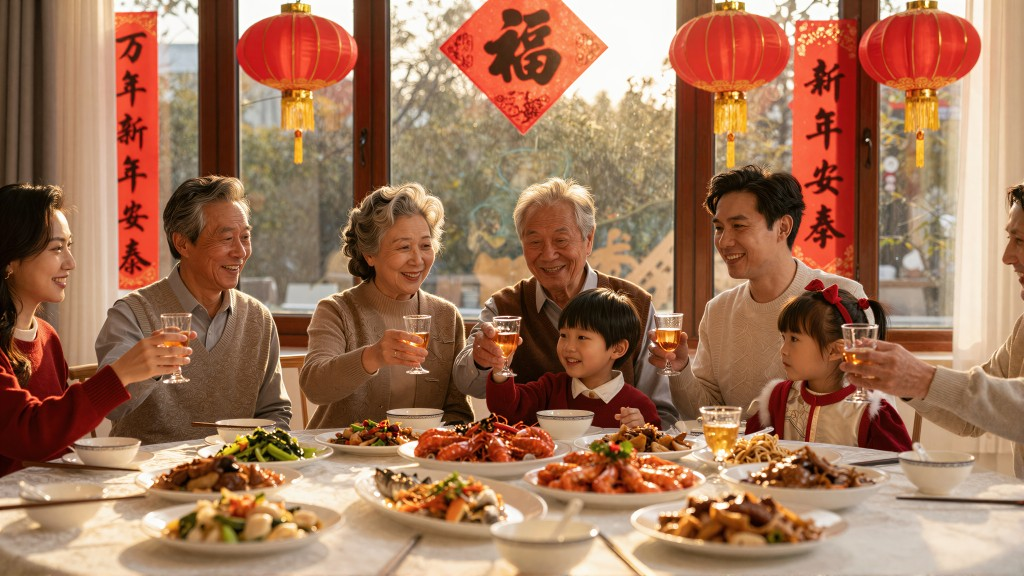
从囤货到提货:京东自提改写春节消费底层逻辑,即提即走成2026新年俗
Jin Rong Jie· 2026-02-14 03:24
Core Insights - The trend of consumer behavior during the Spring Festival is shifting from "advance stocking and planned purchasing" to "immediate pick-up and scenario-triggered consumption" [3][4] - JD's self-pickup service is transforming consumer behavior from a passive receiving model to an active integration into offline shopping experiences, becoming a key driver of this consumption habit evolution [3][4] Group 1: Changes in Consumer Behavior - This year's Spring Festival has seen a significant increase in instant consumption and scenario-based purchasing, with consumers prioritizing "buying accurately and picking up conveniently" over "buying early and stocking up" [4][6] - Consumers are now making purchases on-the-go, such as ordering gifts for relatives just before arriving at their homes, indicating a shift towards more efficient and less time-consuming shopping methods [4][6] Group 2: JD's Self-Pickup Value Proposition - JD's self-pickup service redefines the time logic of Spring Festival shopping, allowing consumers to complete purchases as part of their travel plans rather than as a separate task [6][8] - For merchants, self-pickup offers a low-cost fulfillment method with high customer conversion rates, leading to significant increases in sales and order volumes [6][8] Group 3: Market Impact and Promotions - The self-pickup service is not just a substitute for delivery but serves as a new entry point for foot traffic to physical stores, enhancing brand trust and customer engagement [8][9] - JD is launching promotional activities to attract consumers, such as discounted food items for self-pickup, further driving engagement and sales during the festive season [9]


2026吃饭新态度:不宅不懒,用京东自提,省配送费拿热乎饭
Sou Hu Wang· 2026-02-09 05:16
Core Insights - The article highlights the rise of JD self-pickup as a smarter, more cost-effective, and autonomous consumption method among urban white-collar workers and young people, redefining the value of a good meal [1][8] Consumer Perspective - JD self-pickup offers consumers a superior experience and higher cost-effectiveness, allowing them to enjoy meals at optimal temperatures and quality, which is difficult to achieve with traditional delivery methods [3][6] - The model provides consumers with greater control over their time, enabling them to order meals in advance and pick them up at their convenience, thus avoiding the uncertainties associated with food delivery [3][5] Merchant Perspective - For restaurant merchants, JD self-pickup represents a significant operational innovation, reducing delivery pressure and related costs while enhancing meal preparation efficiency and ingredient turnover [5][6] - The integration of self-pickup has led to a notable decrease in food waste, with merchants reporting increased profits per order due to savings on delivery costs [5][6] Market Trends - Data indicates that restaurants utilizing JD self-pickup have experienced substantial growth in order volume, reflecting an upgrade in consumer experience [6] - The future of dining consumption is shifting from mere convenience to a focus on quality experience, with JD self-pickup poised to meet the evolving demands for both efficiency and quality [8]
暴涨30倍,餐饮人在用“自提”闷声发财?
投中网· 2026-02-08 07:06
Core Viewpoint - The article discusses the emerging trend of "self-pickup" in the restaurant industry, highlighting its potential as a new growth opportunity that has been historically undervalued [4][7]. Group 1: Consumer Behavior - The "online ordering and self-pickup" model is becoming a habitual choice for young professionals, offering benefits such as cost savings, time efficiency, and better food quality [6][9]. - Consumers are increasingly opting for self-pickup not just to save on delivery fees but also to ensure food is served at the right temperature and to control pickup timing [9][10]. Group 2: Business Opportunities - Some restaurants have reported significant sales increases, with one community store achieving a tenfold sales growth in a single day and another restaurant doubling its monthly self-pickup orders to over 6,000 [6][10]. - Self-pickup is evolving from a supplementary option to a critical strategy for restaurants to address growth anxieties and enhance revenue [9][10]. Group 3: Market Dynamics - Despite the potential, the self-pickup feature is still underutilized, with many platforms focusing primarily on delivery and lacking dedicated resources for self-pickup [12][13]. - Some restaurants have not actively promoted self-pickup, leading to higher prices for self-pickup compared to delivery, which hinders consumer adoption [12][13]. Group 4: Case Studies - A store manager reported that after integrating self-pickup, daily sales surged from over 1,000 to 10,000 yuan, with online orders increasing from around 100 to 800 per month [17][19]. - Another restaurant saw self-pickup orders rise from 20 to over 200 daily, with a 40% increase in repeat purchases within 30 days [19][21]. Group 5: Strategic Insights - The shift towards self-pickup reflects a broader change in consumer expectations for experience, cost, and efficiency, allowing restaurants to create a new market outside of traditional delivery [23][24]. - Self-pickup not only increases order volume but also enhances customer trust and engagement by bringing consumers back into physical stores [27][28]. Group 6: Future Outlook - As self-pickup becomes a habit for more consumers, it may lead to a more interconnected local service network, allowing brands to deepen connections with their customer base [28][30]. - The article concludes that the essence of the restaurant business remains unchanged: quality products, good experiences, and genuine connections between people, with self-pickup enabling more efficient and focused operations [31].
暴涨30倍,餐饮人在用「自提」闷声发财?
36氪· 2026-02-07 13:34
Core Viewpoint - The article discusses the emerging trend of "self-pickup" in the restaurant industry, highlighting its potential as a new growth opportunity that has been underestimated until now [3][10]. Group 1: Consumer Behavior - The "online ordering and in-store pickup" model is becoming a habitual choice for office workers and young consumers, offering benefits such as cost savings, time efficiency, and better food quality [8][12]. - Many young consumers are not only motivated by saving delivery fees but also by the ability to control pickup times and ensure food quality [12][18]. Group 2: Business Opportunities - Some community stores have reported sales increases of up to 10 times, and certain specialty snacks have seen monthly self-pickup orders double, indicating a significant opportunity for businesses [9][40]. - Self-pickup is evolving from a supplementary option to a key strategy for businesses to address growth anxieties and enhance revenue [12][19]. Group 3: Challenges and Solutions - Despite the potential, self-pickup features are often underutilized, with many platforms focusing primarily on delivery and lacking dedicated resources for self-pickup [21][22]. - Some businesses have recognized the need for a new channel that optimizes costs and enhances brand visibility, leading to a shift towards self-pickup functionalities [16][17]. Group 4: Case Studies - A store manager reported that after integrating self-pickup, daily sales surged from over 1,000 yuan to 10,000 yuan, with online orders increasing from around 100 to 800 per month [31][40]. - Another restaurant saw self-pickup orders grow from 20 to over 200 daily, with a significant increase in customer repeat purchases [36][40]. Group 5: Future Implications - The self-pickup model is not just a new channel but a means to foster deeper connections between brands and customers, enhancing trust and loyalty [52][55]. - As self-pickup becomes a habit for more consumers, it could lead to a more integrated local service network, benefiting both platforms and businesses [55][56].

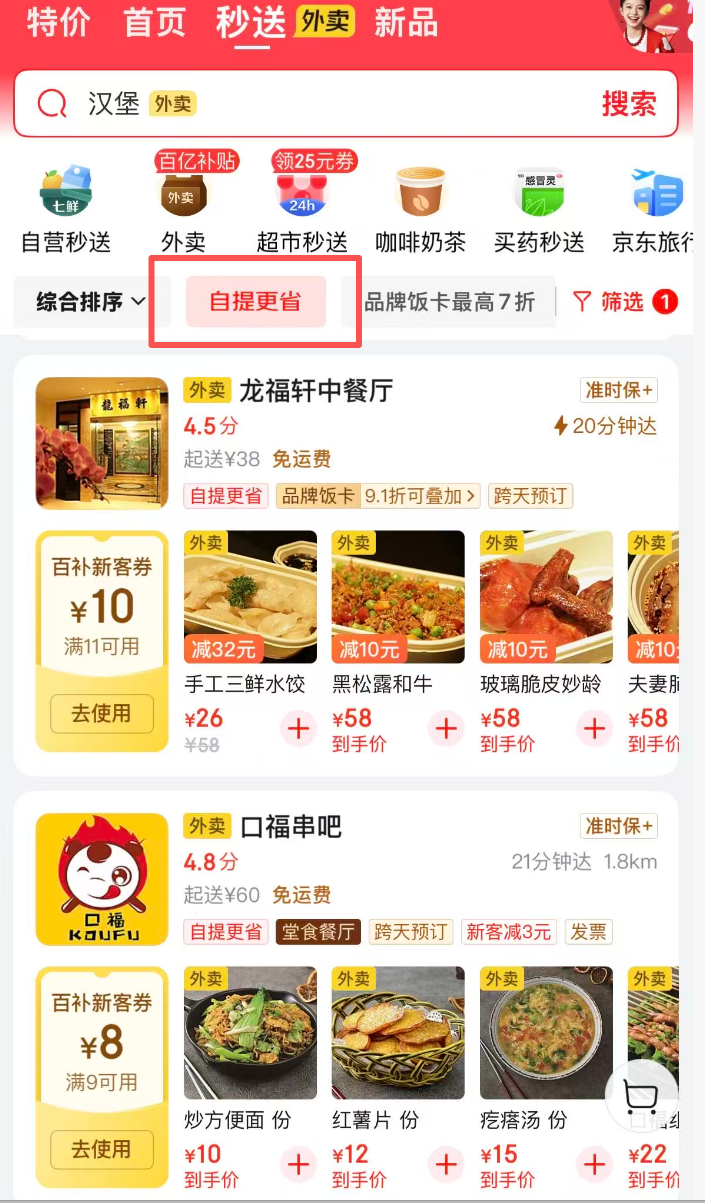
京东外卖·大牌请客1月18日正式开启,京东自提大牌美食低至1分钱
Zhong Jin Zai Xian· 2026-01-16 08:47
Core Insights - JD.com has launched the "JD Takeout · Big Brand Treat" campaign, offering significant discounts on popular food items to consumers nationwide [1] - The introduction of the self-pickup feature aligns with urban consumers' increasing demand for convenience in dining [3] Group 1: Campaign Details - The campaign includes offers such as 1 cent for a pizza from Zunbao and 1.68 yuan for a drink from Mixue Ice City, along with participation from various well-known food brands [1] - Consumers can access these deals through the JD app by navigating to the "Instant Delivery" section and searching for "Takeout Treat" [1] Group 2: Consumer Experience - The self-pickup feature allows users to order in advance and collect their meals at their convenience, enhancing the dining experience by eliminating wait times and ensuring food quality [3][5] - This service is redefining social interactions, as it creates opportunities for meaningful moments between family and friends, such as shared meals after busy workdays [5][7] Group 3: Market Impact - JD's self-pickup service is gaining popularity among urban professionals, providing them with flexibility and control over their meal times [5] - The combination of online convenience and offline experience is expected to stimulate consumer activity and contribute to the diverse development of the food service industry [7]

京东自提全国上线,打造到店自提本地餐饮消费新场景
Yang Zi Wan Bao Wang· 2025-12-17 05:26
Group 1 - JD.com launched a "self-pickup" feature nationwide on December 17, allowing users to place orders online and pick them up in-store [1] - The "self-pickup" feature is designed to enhance user experience by addressing the demand for efficiency, quality, and cost-effectiveness, aiming to fulfill the desire for a "faster, cheaper, and better" lifestyle [3] - On December 18, JD.com will introduce a promotional event called "Big Brands Treat," offering users the chance to purchase various food items at extremely low prices, with some items available for as little as 0.01 yuan [3] Group 2 - The self-pickup service is expected to be utilized frequently in workplace settings, catering to the needs of office workers [3] - The initiative is seen as a way to inject new momentum into the diverse development of the food and beverage industry [3]
