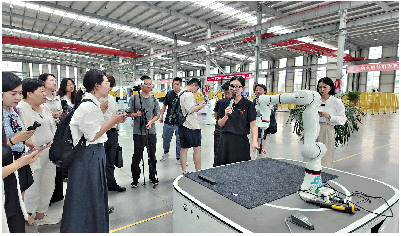
人形机器人行者泰山

Search documents
“满格”复工!济南民企“抢跑”春天里
Feng Huang Wang Cai Jing· 2026-02-25 00:15
这个春节,机器人无疑是热度最高的"主角",这股热潮在济南迅速转化为澎湃动能。山东优宝特智能机 器人有限公司的研发与生产节奏已全面拉满:算法实验区内,工程师们对四足机器人的运动控制参数进 行迭代优化;测试跑道上,型号为Y30的四足机器人正加紧练习新技能;装配工位上,人形机器人"行者泰 山"的组装热火朝天。交付在即,成品区内,一批人形、四足机器人整装待发,即将在智能导览、警务 安防、电力巡检、应急救援等场景中大显身手,从舞台焦点向生产主力加速转变。 新年伊始,贝壳视频在开工之际发布重磅消息,将正式更名为"贝壳文化科技集团"。这不仅是名称的变 更,更是核心战略的调整:在数字文明蓬勃发展的今天,文化与科技的深度融合正重塑产业形态。这次 更名,是公司对近年来在文化与科技融合领域实践成果的集中体现,也彰显了企业争做"文化新质生产 力领航者"的决心。与更名同步,品牌标识已完成焕新设计,业务体系围绕"文化科技融合"主线进行了 系统性重构与深化。 正月初八,春节假期后的首个工作日,当浓浓的年味还未散去,济南的民营企业早已开启"奔跑模式"。 从智能车间到研发一线,从传统制造到未来产业,机器的轰鸣奏响新春的序曲,忙碌的身影勾勒出奋 ...
济水之南新满目 大河万里入胸怀
Da Zhong Ri Bao· 2025-10-20 03:23
Core Insights - Jinan has experienced significant transformation and development over the past five years, particularly during the "14th Five-Year Plan" period, focusing on ecological protection and high-quality development in the Yellow River basin [1][2] - The establishment of the New and Old Kinetic Energy Conversion Pilot Zone has facilitated Jinan's growth in various industries, including new energy vehicles, aviation, and new materials, contributing to the city's economic strength [2][6] - Jinan's GDP is projected to reach 1.35 trillion yuan in 2024, marking a significant increase from previous years and positioning the city as a key center in the Yellow River basin [2][3] Economic Development - The New and Old Kinetic Energy Conversion Pilot Zone has developed three major industrial chains, contributing to the emergence of a trillion-yuan industry [2] - Jinan's industrial enterprises are expected to achieve over 1 trillion yuan in revenue for the first time in 2024, with significant growth in both deposits and loans [2] - The city has seen a 6.7% annual growth in industrial revenue and a 6.8% increase in profits from 2022 to 2024, outpacing national and provincial growth rates [6][7] Infrastructure and Transportation - Jinan has invested 3.7255 billion yuan in 235 key transportation projects during the "14th Five-Year Plan," significantly enhancing its transportation network [3][4] - The city is developing a comprehensive transportation hub, integrating rail, road, air, and water transport to improve connectivity and logistics [4] - The expansion of Jinan Airport is expected to accommodate 55 million passengers and 520,000 tons of cargo annually, further enhancing the city's logistical capabilities [3][4] Industrial Innovation - Jinan's high-tech manufacturing sector has seen an annual growth rate of 10.5% from 2022 to 2024, with high-tech industries accounting for 59.2% of the total industrial output [7][8] - The city has doubled its number of high-tech enterprises since 2020, with significant advancements in sectors such as artificial intelligence and biotechnology [8] - Jinan's software industry has also grown, with a 13.5% annual increase in revenue, ranking 7th nationally in software city evaluations [7][8] Quality of Life and Urban Development - Jinan has improved its urban environment, with a significant increase in green spaces and a reduction in air pollution, achieving a PM2.5 concentration of 36 micrograms per cubic meter in 2024 [11] - The city has invested in education and healthcare, with numerous new schools and healthcare facilities established, enhancing public services [10][11] - Jinan's population has grown by 270,000 from 2020 to 2024, with a focus on attracting talent and improving living conditions [11][12]
剑指黄河流域机器人高地,济南底气何在
Qi Lu Wan Bao· 2025-08-11 21:24
Core Insights - The robot industry in Jinan is rapidly evolving, with a focus on both industrial and daily life applications, showcasing the city's confidence in this sector [3][4] - Jinan's robot-related enterprises have reached 102, with a core industry scale of approximately 15 billion yuan, representing a significant portion of the province's economy [3][4] - The city is addressing challenges such as local supply chain gaps and the need for better matching of technology with market demand [5][6] Industry Overview - Jinan's robot industry includes various types of robots such as logistics, welding, and special-purpose robots, enhancing efficiency and safety in industrial applications [4] - The city benefits from its unique status as a national AI innovation application pilot zone, which supports the development of smarter robots [4][10] - The establishment of a complete industrial chain from core component production to system integration is underway [3][4] Challenges Faced - Local companies face difficulties in sourcing precision components, often relying on suppliers from other regions, which increases costs by approximately 20% [5][6] - There is a disconnect between technology providers and market needs, leading to missed opportunities for application in various sectors [6][9] Strategic Initiatives - Jinan is implementing a "three lists" strategy to connect demand and supply, successfully matching 56 scenarios across multiple industries [9][10] - The introduction of a cloud manufacturing platform aims to streamline the procurement process for local robot manufacturers, reducing costs and improving efficiency [7][8] Future Development - The city aims to create a robust ecosystem characterized by talent, technology, products, and application scenarios, positioning itself as a new hub for robot industry development in the Yellow River Basin [10][11] - The establishment of the "Shandong (Jinan) Embodied Intelligence Port" will support the entire lifecycle of robot enterprises, fostering innovation and collaboration [10][11] - The formation of the Jinan Robot Industry Alliance will enhance resource sharing and collaborative development among leading companies [11]



山东装备产业规模超3万亿,“产业链上的山东好品牌”首场记者见面会上——机器人共舞“智”造“新”时刻
Da Zhong Ri Bao· 2025-07-16 00:54
Core Insights - The event highlighted Shandong's ambition to become a hub for robot innovation and application, with the province's equipment industry expected to exceed 3 trillion yuan by 2024 [1][6] - Four key robot companies showcased their flagship products, emphasizing the integration of advanced technology in modern industrial applications [3][4] Industry Overview - The robot industry is positioned as a new engine for economic development, driven by advancements in artificial intelligence and related technologies [6] - Shandong has a robust industrial foundation with 41 industrial categories, supporting the growth of its robot industry [6] Company Highlights - The total sales of industrial and collaborative robots in Shandong are projected to surpass 8,000 units in 2024, ranking fourth in domestic robot shipments, with collaborative robots leading the market [3] - NuStar's precision planetary gear reducers have an annual output of over 700,000 units, making it the largest in China and second globally [4] Policy and Development Plans - The Shandong Provincial Industrial and Information Technology Department has launched an action plan aiming for the robot manufacturing industry to exceed 50 billion yuan by 2027 [6][10] - The plan emphasizes full-chain development, application across various scenarios, and comprehensive support for the industry [10][11] Investment and Collaboration - Companies like NuStar are investing significantly in expanding production capacity, with a recent investment of 670 million yuan to produce 1.5 million precision gear reducers [9] - Collaborative efforts among leading companies and local governments are crucial for enhancing the robot industry's ecosystem [6][10]
机器人产业展现出前所未有巨大生产力
Qi Lu Wan Bao· 2025-07-15 21:57
Group 1: Company Highlights - Luoshi Robot is a leading player in the industrial collaboration sector, focusing on industrial robots, flexible collaborative robots, and smart manufacturing solutions, with over 60 models and a projected sales volume of over 8,000 units in 2024, ranking fourth in domestic robot shipments and first in flexible collaborative robots [2][3] - Haier Robotics emphasizes the integration of AI in household robots, allowing them to learn and adapt to user behaviors, aiming for a market scale of one trillion yuan and a production target of one million units [4][5] - Youbot's humanoid robot "Walker Taishan" was developed in under two months, showcasing advanced capabilities in complex terrains, and is positioned among the top tier in the industry [6][7] - Niusidate Planetary Gearbox Company leads in precision planetary gearbox shipments, with over 700,000 units annually, and aims to foster 30 ecosystem enterprises in the robotics industry by 2035 [8] Group 2: Industry Trends - The robotics industry is experiencing significant technological advancements, with companies investing over 1 billion yuan in R&D over the past decade, achieving international leading levels in core technologies [3] - The integration of AI and embodied intelligence is a key trend, with companies developing various intelligent products to address the challenges of "unmanned factories" [3] - The household robotics market is expected to grow significantly, driven by the demand for smart home integration and industrial applications [5]