传统机械门把手

Search documents
门把手不再隐藏,让安全看得见
2 1 Shi Ji Jing Ji Bao Dao· 2026-02-09 22:50
Core Viewpoint - The introduction of the mandatory national standard for automotive door handles signifies a shift towards prioritizing safety over design aesthetics in the automotive industry, particularly addressing the issues associated with hidden and purely electronic door handles [1][2][4]. Group 1: New Standards Implementation - The new mandatory national standard, effective from January 1, 2027, requires all car doors to have mechanical release handles, ensuring accessibility even in power failure situations [1][2]. - The standard mandates that each car door must be equipped with a mechanical release handle that can withstand a force of at least 500 Newtons without failure [1][2]. - The phased implementation schedule allows new models to comply with most requirements by 2027 and all requirements by 2028, while existing models must comply by 2029 [3]. Group 2: Industry Impact and Consumer Safety - The standard reflects a significant regulatory response to safety concerns, as evidenced by rising complaints about hidden door handles, particularly in cold climates where they can freeze [2][4]. - Approximately 60% of the top 100 electric vehicle models in China currently feature hidden door handles, indicating a substantial number of vehicles will need modifications to comply with the new standards [2]. - The automotive industry is recognizing the importance of mechanical redundancy as a critical safety feature, emphasizing that design should not compromise user safety [3][4]. Group 3: Design Philosophy Shift - The automotive industry is urged to focus on safety rather than merely aesthetic or energy-efficient designs, as sacrificing safety for minor energy savings is deemed unacceptable [4][5]. - There is a call for a unified approach to automatic locking and unlocking mechanisms in vehicles to prevent issues such as accidental locking or failure to unlock after an accident [4].
工信部再发文,不再惯着「反人类设计」,新国标专治难用的门把手
3 6 Ke· 2025-12-18 02:23
Core Viewpoint - The Ministry of Industry and Information Technology (MIIT) has released a draft for "Safety Technical Requirements for Automotive Door Handles," which significantly impacts the design of hidden door handles, emphasizing safety and reliability over aesthetics [1][18]. Group 1: Regulatory Changes - The new regulations explicitly prohibit non-traditional handle designs, particularly electronic buttons, unless they are accompanied by permanent markings for user guidance [3][5]. - The regulations require that if the operation of a door handle is not intuitive, a clear instruction must be placed nearby, which could detract from the vehicle's luxury appeal [5][10]. Group 2: Safety Concerns - The MIIT has identified major safety issues with current designs, including insufficient strength, control logic vulnerabilities, and difficulties in identification and operation during emergencies [2][11]. - The new rules mandate that door handles must allow for mechanical release without tools in case of accidents or power failures, ensuring that passengers can exit safely [8][11]. Group 3: Industry Response - Companies like Great Wall Motors have decided to revert to traditional mechanical door handles due to the added weight and complexity of hidden mechanisms, which can compromise vehicle reliability [1][18]. - The industry is already shifting towards more conventional designs, as seen in new models from various manufacturers, indicating a trend away from complex electronic systems [22]. Group 4: Implementation Timeline - New models must comply with the regulations starting January 1, 2027, while existing models have until January 1, 2029, to meet the new standards [18][22].



全隐藏式门把手或被禁用,网友:终于等到这一天
Qi Lu Wan Bao· 2025-09-26 06:02
Core Viewpoint - The Ministry of Industry and Information Technology (MIIT) of China has released a draft for mandatory national standards on automotive door handles, aiming to enhance safety and address new technological demands in electric vehicles [2][3]. Group 1: New Standards and Requirements - The draft requires that both internal and external door handles must have a mechanical release function, allowing doors to be opened in case of an accident while locked [2]. - External door handles must provide a hand operation space of at least 60mm x 20mm x 25mm, equating to a minimum of 30 cubic centimeters [2]. Group 2: Impact on Automotive Industry - The new standards may lead to a ban on fully concealed door handles commonly found in electric vehicles, potentially resulting in a return to traditional mechanical door handles [3]. - In April, approximately 60% of the top 100 selling electric vehicle models in China featured concealed door handles, which are perceived as aesthetically pleasing but have raised safety concerns among consumers [4][6]. Group 3: Industry Response - Multiple automotive companies, including Geely and Leap Motor, have expressed their commitment to comply with the new regulations and are adapting their designs accordingly [6][8]. - Geely has been involved in the research and formulation of these standards and has developed various technical solutions to meet the new requirements [6].

全隐藏式门把手终于凉了,特斯拉们的“傲慢设计”都将被淘汰?
3 6 Ke· 2025-09-20 08:04
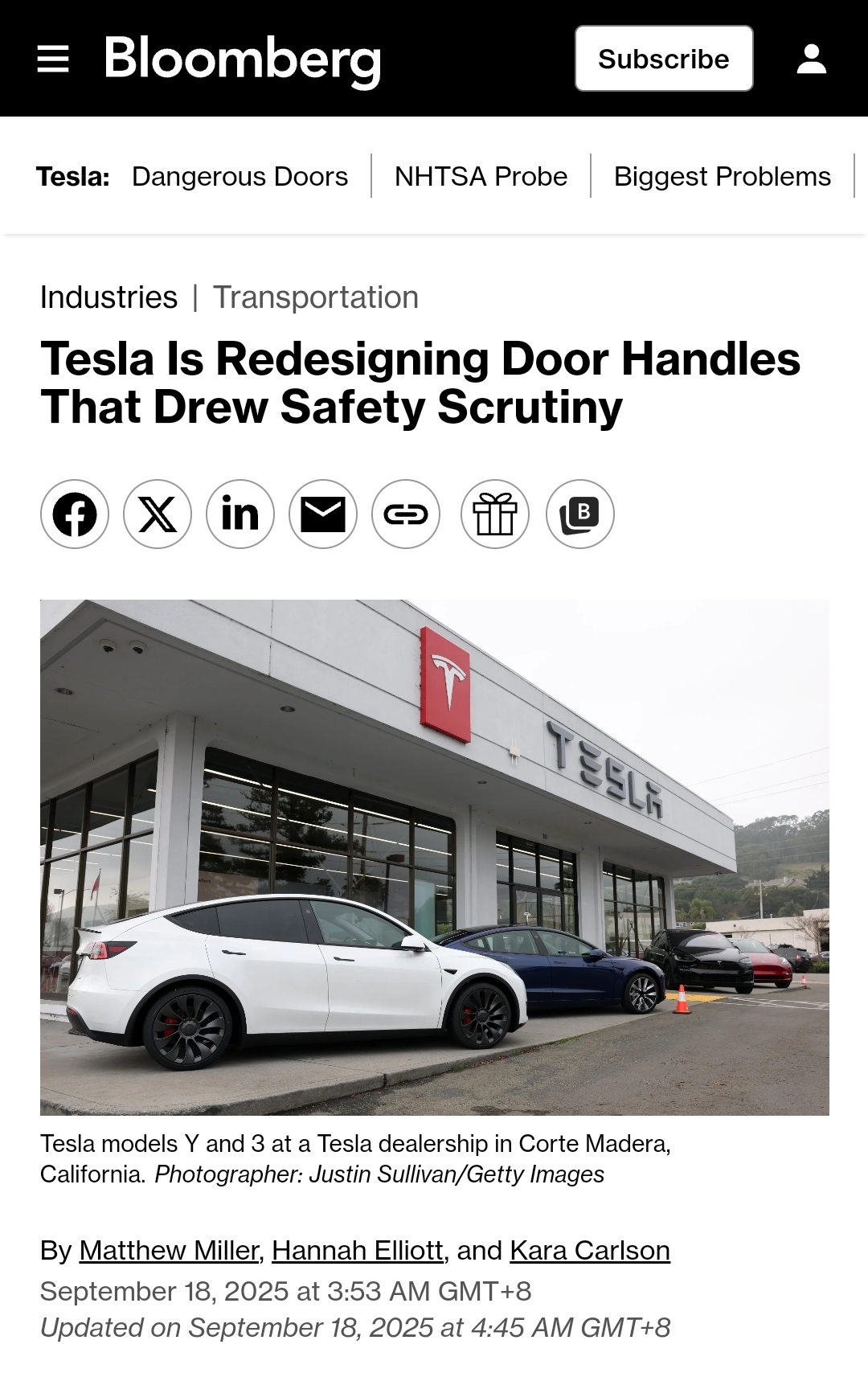
Core Points - Tesla is facing scrutiny due to issues with its electronic door handles, which have reportedly malfunctioned, leading to safety concerns for passengers, including children being trapped inside vehicles [1][5] - The U.S. authorities are investigating approximately 174,000 Tesla vehicles for potential risks associated with the electronic door handle failures, which could result in recalls if deemed unsafe [5] - The irony lies in Tesla's initial popularity for its hidden door handle design, which has now become a point of contention and potential regulatory change [5] Group 1: Design and Safety Concerns - The hidden door handle design, while aesthetically pleasing and aimed at reducing wind resistance, has raised significant safety concerns, particularly in cold weather where handles may freeze [6][12] - Reports indicate that incidents of accidents due to door handle failures have increased by 47% year-on-year, with hidden door handles accounting for 82% of these cases [13] - Testing shows that electronic door handles have a success rate of only 67% in side-impact collisions, compared to 98% for traditional mechanical handles, highlighting a significant safety gap [13][17] Group 2: Regulatory Changes and Market Trends - A draft national standard is expected to ban fully hidden door handles, allowing only semi-hidden and traditional designs, with a transition period until July 2027 [5][18] - The automotive industry may shift towards semi-hidden door handles as a compromise between aesthetics and safety, with several new models already adopting this design [20][23] - The market is likely to see a decline in fully hidden door handles, prompting manufacturers to reassess their design strategies to prioritize safety alongside modern aesthetics [20][26]