全铝换热器

Search documents
供需格局失衡,铝代铜成为产业必然?
Hua Er Jie Jian Wen· 2026-01-14 10:41
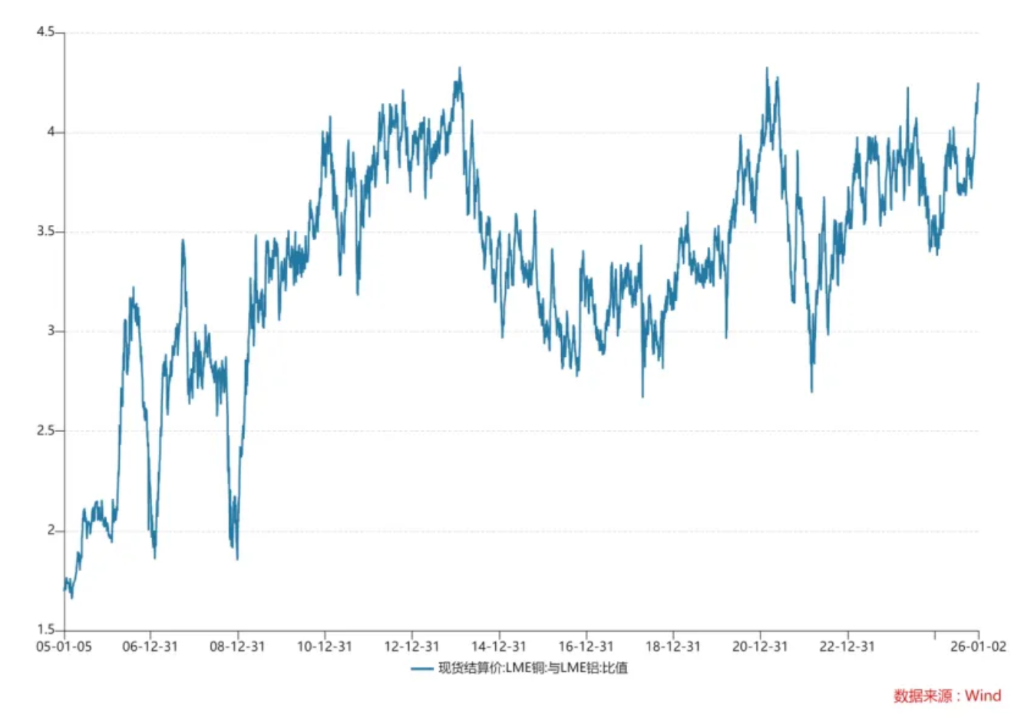
Core Viewpoint - The trend of "aluminum replacing copper" is becoming an inevitable choice in the industry due to rising copper prices and imbalances in market supply and demand, indicating a long-term technological revolution rather than a short-term speculation [1] Group 1: Price Dynamics - The current copper-aluminum price ratio is at a historical high, reaching 4.21 times, up from a low of 1.7 times in 2005, driven by differences in supply and demand dynamics for both metals [2] - The widening price ratio is pushing aluminum from a technical alternative to a real necessity [6] Group 2: Supply Constraints - Copper's supply lacks elasticity, primarily due to long development cycles of 7-10 years for new mines and low approval rates for environmental assessments [6][7] - In contrast, aluminum's supply constraints are mainly at the smelting stage, influenced by energy supply and water resource availability [8][10] Group 3: Technological Innovations - Systematic technological innovations in new materials, processes, and structures are making large-scale production of aluminum as a substitute for copper feasible [12] - Key technological breakthroughs expected by 2025-2026 include addressing issues like creep and electrochemical corrosion, enhancing aluminum's viability in various applications [13] Group 4: Industry Applications - In the power transmission sector, aluminum has already replaced copper in long-distance transmission lines, and its use in 5G base stations and data centers is increasing due to cost and weight considerations [15] - The air conditioning industry is moving towards standards that favor aluminum, with major companies like Daikin already using over 50% aluminum in their products by 2024 [15][16] Group 5: Market Dynamics - The aluminum sector is experiencing a restructuring phase, with companies that can secure stable, cheap, and green energy resources gaining competitive advantages [9] - China's electrolytic aluminum production capacity is capped at 45 million tons, with utilization rates nearing full capacity, indicating limited growth potential [19][21] Group 6: Financial Performance - Major players in the aluminum industry, such as China Aluminum and China Hongqiao, are positioned well in terms of production capacity and profitability, with China Aluminum holding a 17.5% domestic market share [22][23] - The financial metrics indicate that companies like China Hongqiao and Nanshan Aluminum are relatively undervalued compared to their peers, suggesting potential investment opportunities [25][26]

铝代铜僵
投中网· 2026-01-14 06:35
Core Viewpoint - The article discusses the rising trend of "aluminum replacing copper" in various industries due to the increasing copper prices and supply-demand imbalances, indicating a long-term technological shift rather than a short-term market speculation [6][7][8]. Group 1: Copper-Aluminum Price Ratio - The current copper-aluminum price ratio is at a historical high of 4.21 times, up from a low of 1.7 times in 2005, reflecting significant supply-demand differences and elasticities between the two metals [10][12]. - The widening price ratio is driving the shift from aluminum as a technical alternative to a real necessity in various applications [16]. Group 2: Supply-Demand Dynamics - Copper demand is increasing due to its role in the new energy era, while supply is constrained by long development cycles of 7-10 years and low environmental approval rates [17][18]. - In contrast, aluminum supply constraints are primarily at the smelting stage, with the industry undergoing a restructuring phase where companies with stable, low-cost, and green power resources will have competitive advantages [19][20]. - Both metals face supply elasticities, but the core constraints differ significantly, with aluminum becoming a feasible alternative in specific scenarios as technology advances [22]. Group 3: Technological Innovations - Systematic technological innovations in new materials, processes, and structures are making large-scale aluminum replacement of copper feasible [24]. - Key technological breakthroughs expected by 2025-2026 include solutions for creep, electrochemical corrosion, and improved conductivity, which will address traditional aluminum material pain points [25][26]. Group 4: Industry Applications - In the power transmission sector, aluminum has already replaced copper in long-distance transmission lines, and its use in 5G base stations and data centers is increasing due to weight and cost considerations [27]. - The air conditioning industry is moving towards aluminum, with major players like Daikin already using over 50% aluminum in their products by 2024 [28]. - The automotive sector is rapidly advancing in aluminum applications, with new aluminum alloy materials developed to solve corrosion issues and optimize creep performance, expected to be implemented by 2026 [30]. Group 5: Investment Logic - The current investment logic in the aluminum sector revolves around the "aluminum replacing copper" trend and the strategic value driven by resource nationalism [33]. - The electrolytic aluminum capacity utilization rate is nearing full capacity, with major companies like China Aluminum and China Hongqiao leading in production [34][36]. - Companies with aluminum ore and energy resources are expected to have more elastic performance in the face of price increases, with a focus on optimizing resource combinations [38]. Group 6: Financial Performance and Valuation - Financial performance metrics indicate that companies like China Hongqiao and Nanshan Aluminum International have lower P/E ratios, while ROE is high for companies like Nanshan Aluminum and Huafeng Aluminum [39][40]. - The overall aluminum sector is not undervalued, but individual stock differentiation is evident, with some companies like Nanshan International Aluminum and China Hongqiao appearing relatively undervalued [41][42].


美的、海尔、小米等联手推动→
第一财经· 2025-12-11 08:24
Core Viewpoint - The article discusses China's initiative to promote the use of aluminum instead of copper in air conditioning systems, driven by rising copper prices and the need for a secure supply chain in the multi-billion dollar industry [3][4]. Group 1: Industry Standards and Developments - China has released the group standard for "Aluminum Tube Fin Heat Exchanger Production Line for Room Air Conditioners" and is in the process of drafting additional standards related to aluminum heat exchangers [3][4]. - Major companies such as Gree, Midea, Haier, Xiaomi, and others are participating in the revision of national standards for air conditioning heat exchangers, with discussions scheduled for January 2026 [3][4]. - The China Household Electrical Appliances Research Institute has expanded its research group on aluminum applications in air conditioning to 19 members, including leading air conditioning manufacturers and related material companies [3][4]. Group 2: Technical Challenges and Solutions - The transition to aluminum heat exchangers faces three main challenges: high corrosion resistance technology, lack of standardized testing methods, and consumer biases against aluminum [4][5]. - The Ministry of Industry and Information Technology has outlined a plan to support the development of aluminum heat exchangers for air conditioning and refrigeration, emphasizing the need for high corrosion resistance technology [5]. - Companies are focusing on three technical directions for aluminum replacement: corrosion-resistant material design, surface treatment, and coating design, which require enhanced manufacturing and welding capabilities [5]. Group 3: Market and Consumer Perception - The demand for copper in household air conditioning is significant, with 10.7% of China's copper consumption (approximately 1.723 million tons) attributed to this sector, heavily reliant on imports [4]. - There is a need for government guidance and market cultivation to overcome consumer skepticism regarding aluminum's effectiveness compared to copper [4][5]. - A self-regulation agreement has been established among major air conditioning companies to promote the benefits of aluminum heat exchangers and enhance consumer trust in the technology [5].